All posts by Eric Hart

The Scenic World, 1886

The following article first appeared in the 1886 edition of The Cornhill Magazine.

The Scenic World

[F]ifty years ago, scenery decorations and properties were all of the rudest kind… Much of the extraordinary change that has taken place within twenty years is owing to the resources of science being applied to the stage. This is illustrated by the progress made in lighting… It is difficult to conceive the contrast to all this in Garrick’s day, when the stage was lit, not by footlights, but by four large chandeliers, which hung over the heads of the players. This was a rational system, for the faces were effectively lit up, and the scenery left dim and indistinct. But then these were the old foolish times when nobody cared for scenery, but for the play only and the actors.

Then any stuff would do for dresses—the coarsest was most effective—for there was but little light to see the texture. In Macready’s dress in ‘Virginius,’ now in Mr. Irving’s possession, the armour was of pasteboard covered with tinfoil, and the dagger of wood. There was a scarf of red serge, a linen tunic and sandals, &c. The whole could not have cost a couple of pounds. But a rich dress would have been wasted, and now the searching rays would display the poverty of material. Hence the introduction of rich and costly stuffs which makes the actress’s bill for dress now as high as that of a lady of fashion in the season. Hence those superb plushes and velvets of many tints, the brocades, the rare ornaments.

In the pantomimes we see whole bands of young ladies with their helmets, shields, and breastplates—no longer of pasteboard—made of a brilliantly polished silvery metal which reflects the bright rays of the limelight. This metal is costly enough, and these suits of armour cost a good deal. Stage jewellery now is a regular manufacture, and though many actresses wear real diamonds, it need not be said that the mimic stones are more effective. Sham furniture looks more like furniture on the stage than the finest that could be ordered from Maple’s. It would take too long to expound this, but in illustration it may be said that at the Théâtre Français there is a property clock for a boudoir elegantly painted and made of papier-maché, and which cost five or six hundred francs…

Nowadays there are regular costumiers, and when a play is brought out a contract is made with the person who makes and hires out the dresses at a fixed charge, and takes them back at the close of the season. They are then hired again to inferior theatres in town or country. This system is particularly adopted in the case of pantomimes, when some hundreds of dresses are required, which it would be quite too costly a business to buy outright for only a few weeks’ use. At the end of the season they are purchased, with the pantomime itself, scenery and properties, for some provincial theatre. They thus return again and again to the costumier’s store, and can be finally used for fancy balls, private theatricals, &c.

Smith, Elder, & Co., ed. “The Scenic World.” Cornhill Magazine 1886: 281-83. Google Books. Web. 23 Feb. 2016.
Everybody’s Propping for the Weekend

First up is my latest article in Stage Directions magazine. I talked with a number of props masters about creative ways to stretch your props budget. The result is “Creating Relationships to Create Props.

If you can find twenty minutes today, I definitely recommend this video. TechBuilder, a 17-year old from the Philippines, builds a life-size working BB-8 droid from materials he found at the hardware store. It’s all paper-mache, Styrofoam and wood cut by hand. If he needs a tool but can’t afford it, he makes one. He uses roll-on deodorant for ball bearings. The results are absolutely stunning.

Dave Lowe has this fantastically easy but incredibly effective technique for painting faux chipped paint rusted metal. Apocalyptic props, here I come!

Ugh, another actor dead from props. This time, it’s a Japanese actor who was stabbed with a samurai sword during rehearsal. So far, they have not said whether the sword was real or a prop, and whether they think it was an accident or murder, so I don’t really have much to say about the incident. Depending on what we find out, my advice would either be A) Don’t give actors real swords without a fight choreographer present, or B) Don’t hire murderers.

Finally, take a look at some of the props Alton Brown has used over at the Food Network. Somewhere, there’s a prop maker having the time of their life.

Sandpaper Grits

We all know about sandpaper grit. The lower the grit, the more coarse the sandpaper is, while the higher the grit, the less material it removes (and the smoother you can make your surface). You may have noticed that sometimes the grit has a “P” preceding the number. What does that mean?

It turns out sandpaper grit is measured in two different scales. As with most types of measurements, you have the US way and the European way. The US scale uses the bare numbers and is known as CAMI (Coated Abrasive Manufacturers Institute). The European scale is the “P” grade, and is known as FEPA (Federation of European Producers of Abrasives).

Both scales are based on the diameter of the average particle size in micrometer (µm), also know as a micron (one millimeter equals one thousand microns). Below is a chart comparing the two.

Average particle size CAMI FEPA
15.3 P1200
16 600
18.3 P1000
20 500
21.8 P800
23  400
25.75 P600
28.8 360
30.2 P500
35 P400
36 320
40.5 P360
44 280
46.2 P320
52.5 P280
53.5 240
58.5 P240
65 P220
66 220
78 180 P180
93 150
97 P150
116 120
127 P120
141 100
156 P100
192 80
197 P80
260 P60
268 60

You can see that the two different grit scales are fairly comparable at the coarser end of things.  In fact, 180 and P180 are exactly the same. But once they start getting finer than about 240, the two scales really start to diverge; 600 and P1200 are nearly identical.

Most sandpaper sold in the US uses CAMI, but you can find some brands with the “P” scale; Klingspor is one that comes to mind. The two scales can get tricky at the finer ends of things. If you read a tutorial that says to sand something at 800 grit, but you grab a sheet of P800 sandpaper, you’ll be using something far more coarse than what was intended.

But now you know.

Be My Prop Valentine

Whale, whale, whale, what do we have here? Stephen Kesler shares step-by-step photos of a life-sized humpback whale he carved out of foam. And you thought your prop was big? Even if you never have to sculpt something this large, it is still a great primer on sculpting foam in general.

Every time I watch Adam Savage organize his workshop, I think, “hey, that’s what I do.” And then I learn some new trick and realize my shop can be organized much better. In this video, he builds these mobile carts for glue and paint supplies. Now I need to build mobile carts for supplies.

Dj3r0m Cosplay Props has this awesome war hammer from the Skyrim video game.  From the process pictures, it looks like the whole thing was carved and assembled from MDF. Impressive. The paint job is pretty stunning, too.

Village Theatre put together this great infographic showing the amounts of consumables that go into a run of Crimes of the Heart.  Anyone who has done the show can attest to the large amount of shopping that needs to happen for that production. Of course, they missed the apples, sugar, bourbon and the paper that gets torn up.

Producing a Play in 1893

Last month, I shared some words and images about props from an 1893 magazine article titled “How a Play is Produced”. The article has a number of other great images showing the construction and rehearsal of a new play.

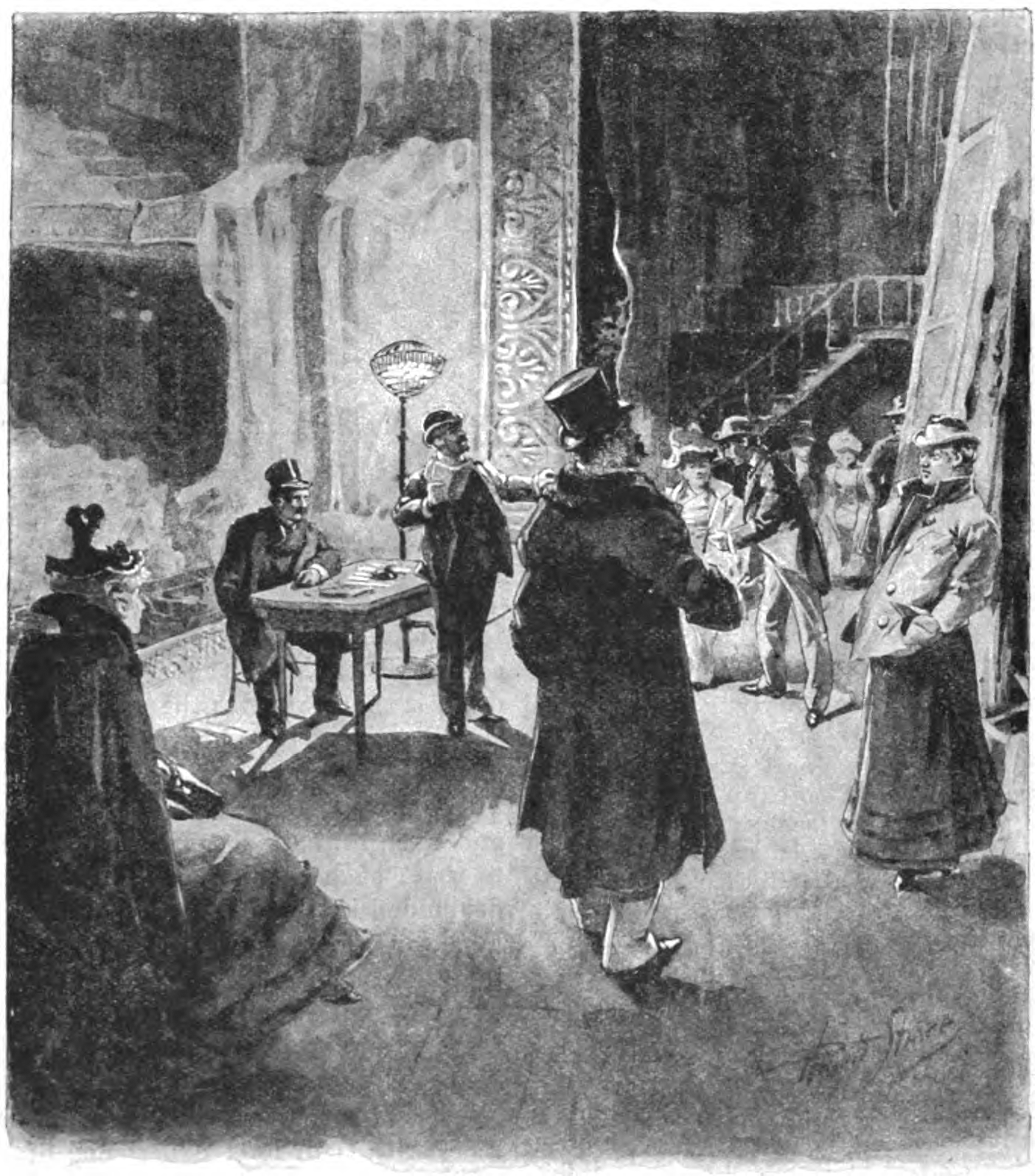
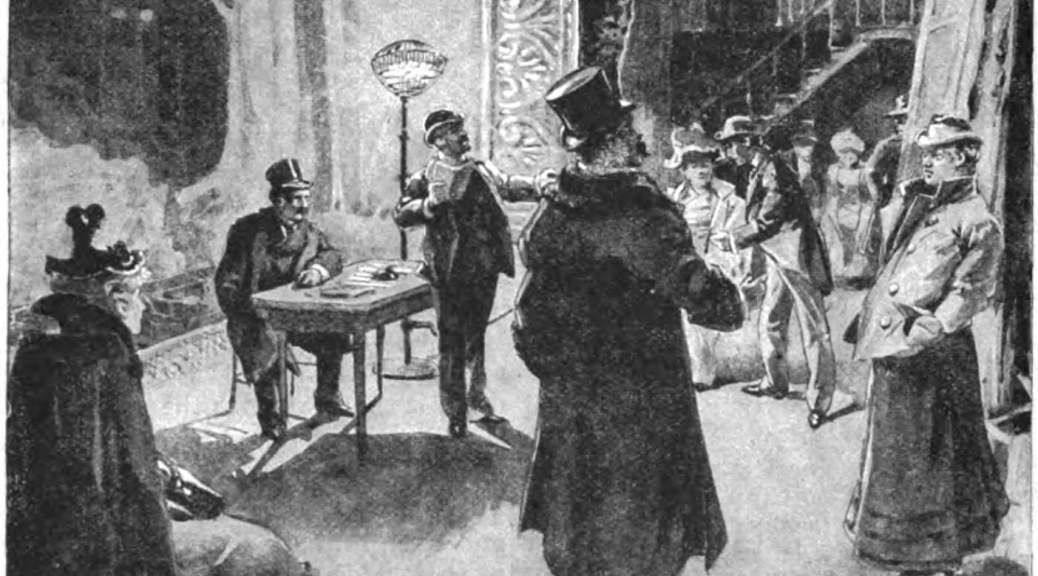
Stage Entrance
Stage Entrance
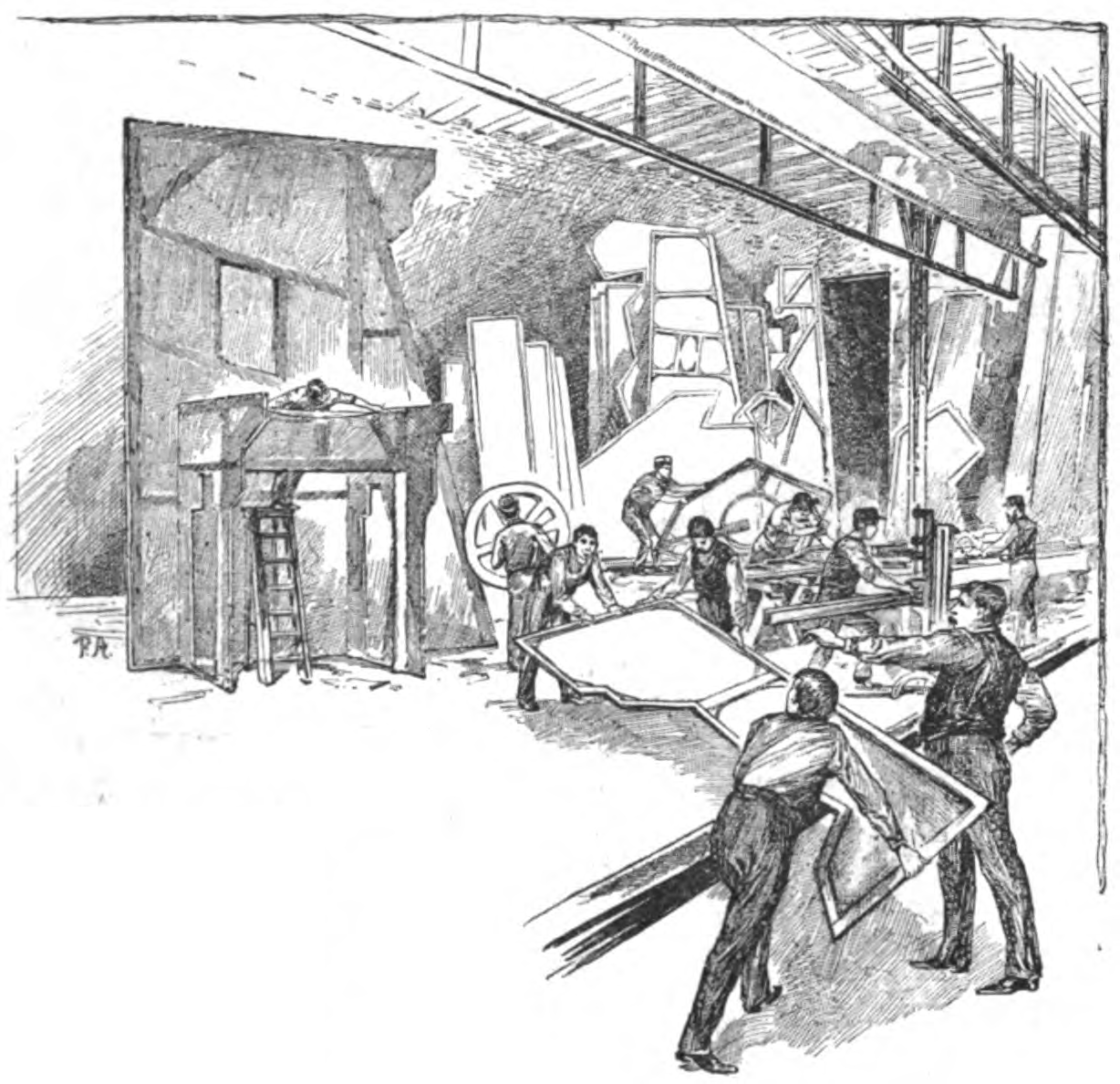
Constructing Scenes
Constructing Scenes
A Rehearsal
A Rehearsal
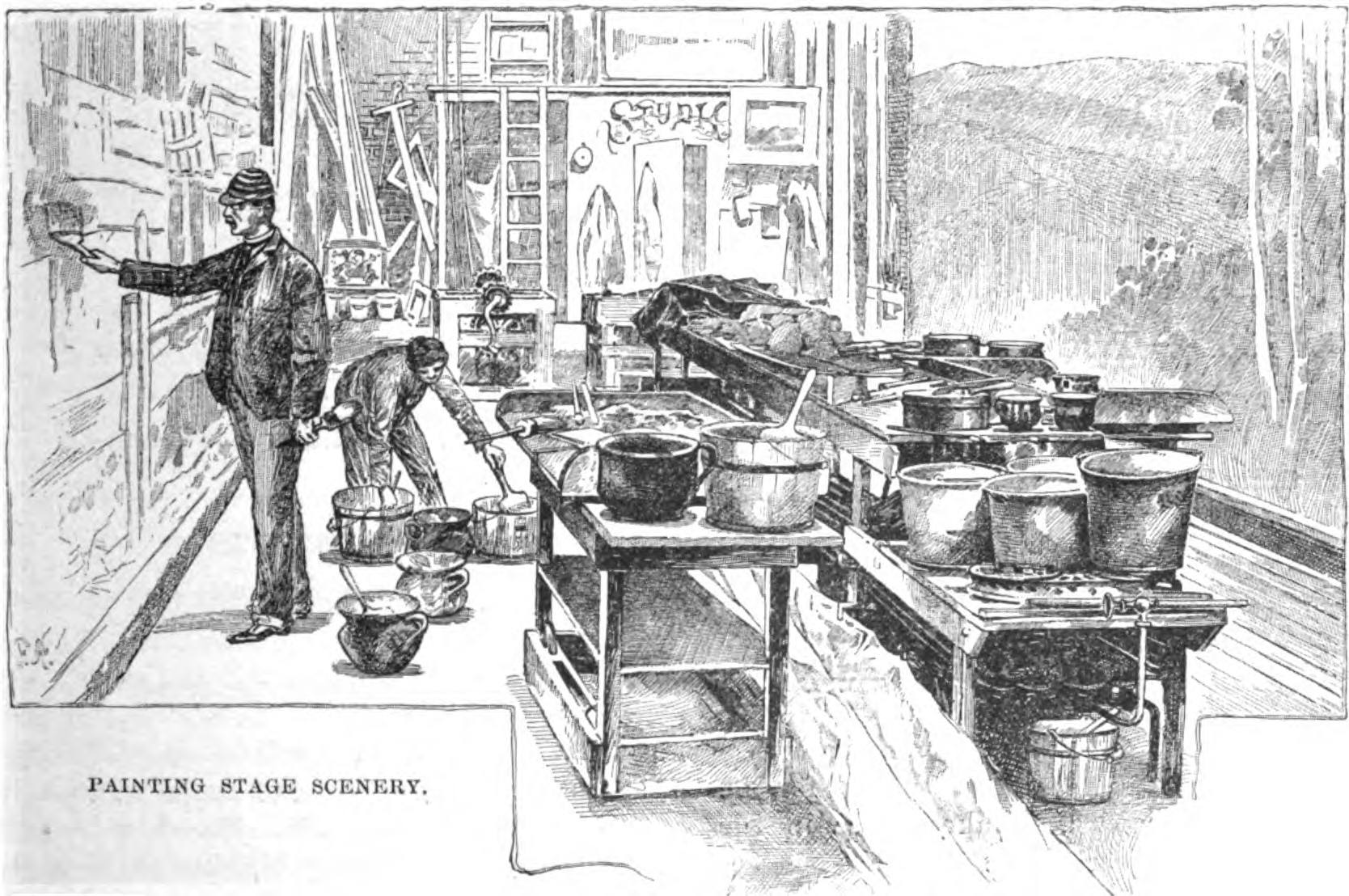
Painting Stage Scenery

The description of the scenic artist is enlightening:

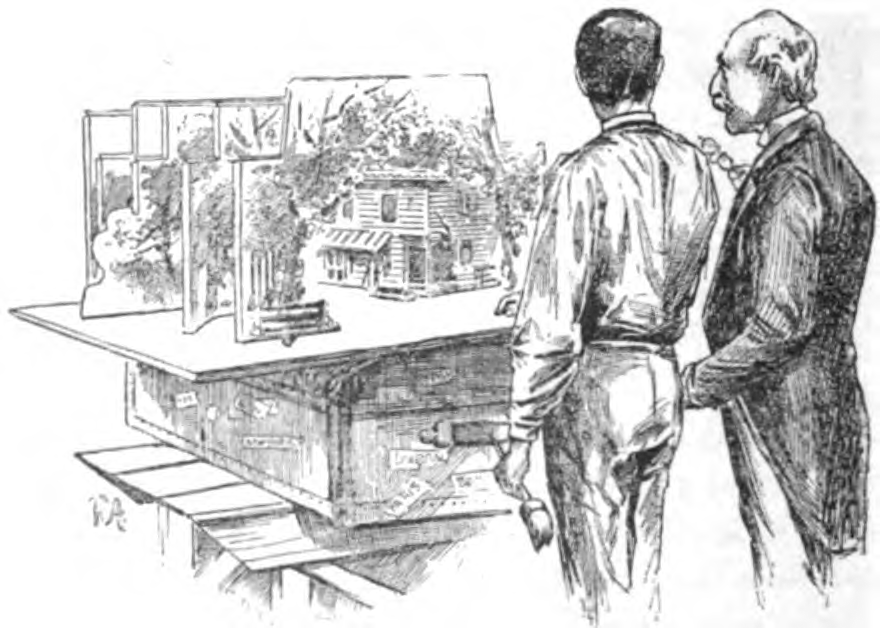
Each stock theatre has at least one scenic artist attached to it. It is the duty of the scenic artist to paint the scenery for each new production, or touch up old scenery for a revival. He has a large studio up in the “flies,” and it is there that the work is done. Directly the manager decides on the play he will produce he sends for the scenic artist, explains the scene of each act, and asks what there is “upstairs” that will do. Sometimes the manager will do the best he can with old scenery, and instruct the scene painter to alter and touch it up. At other times he will decide on having brand-new scenery for each act. In the latter case the scene painter receives the order to prepare models of each act, the style being left largely to the taste of the artist; and if the models are approved of they are given to the stage carpenter, who, with his ten or twenty assistants, reproduces them on the scale required. When this work is finished by the carpenters the painter steps in once more and sets to work on the decoration.

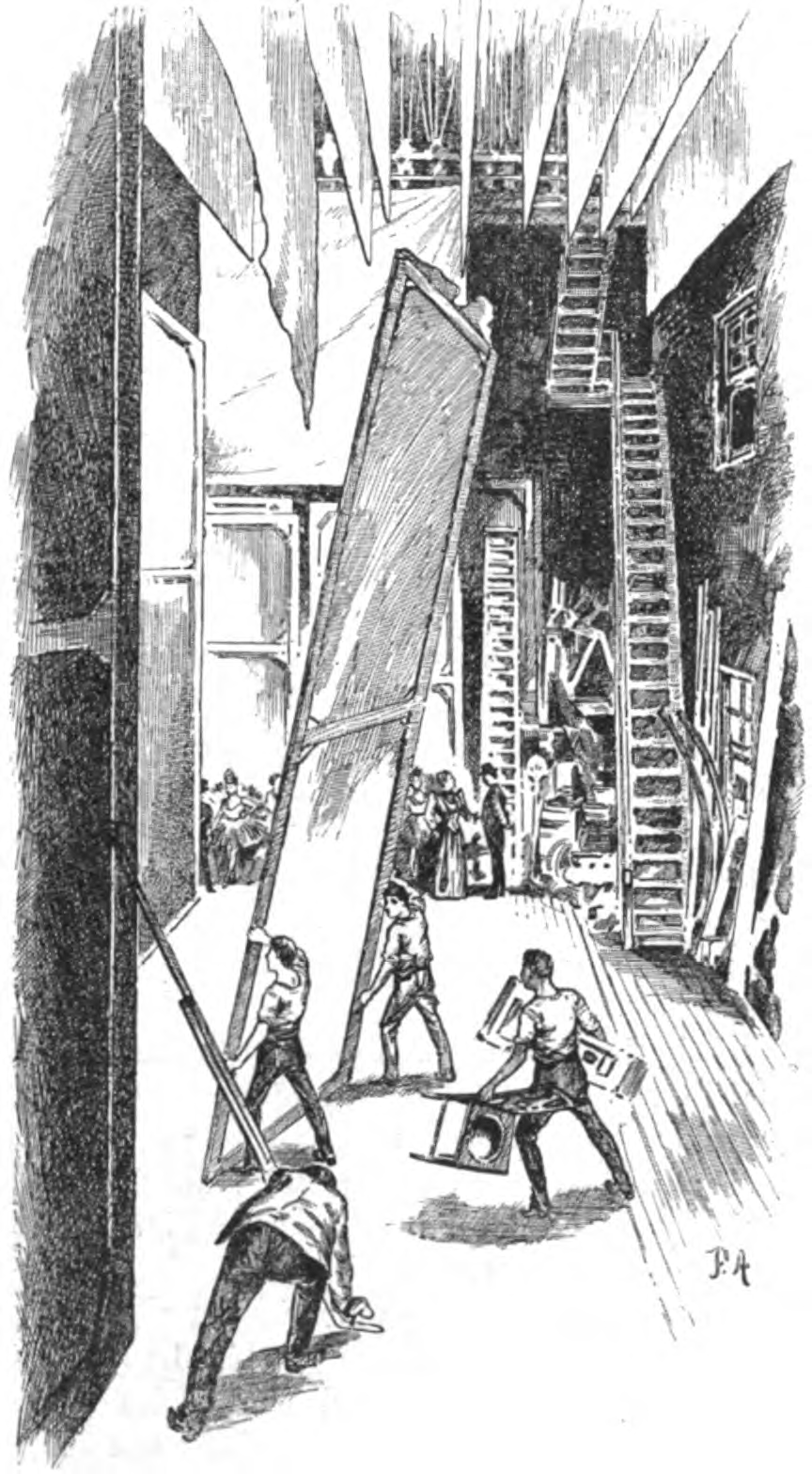
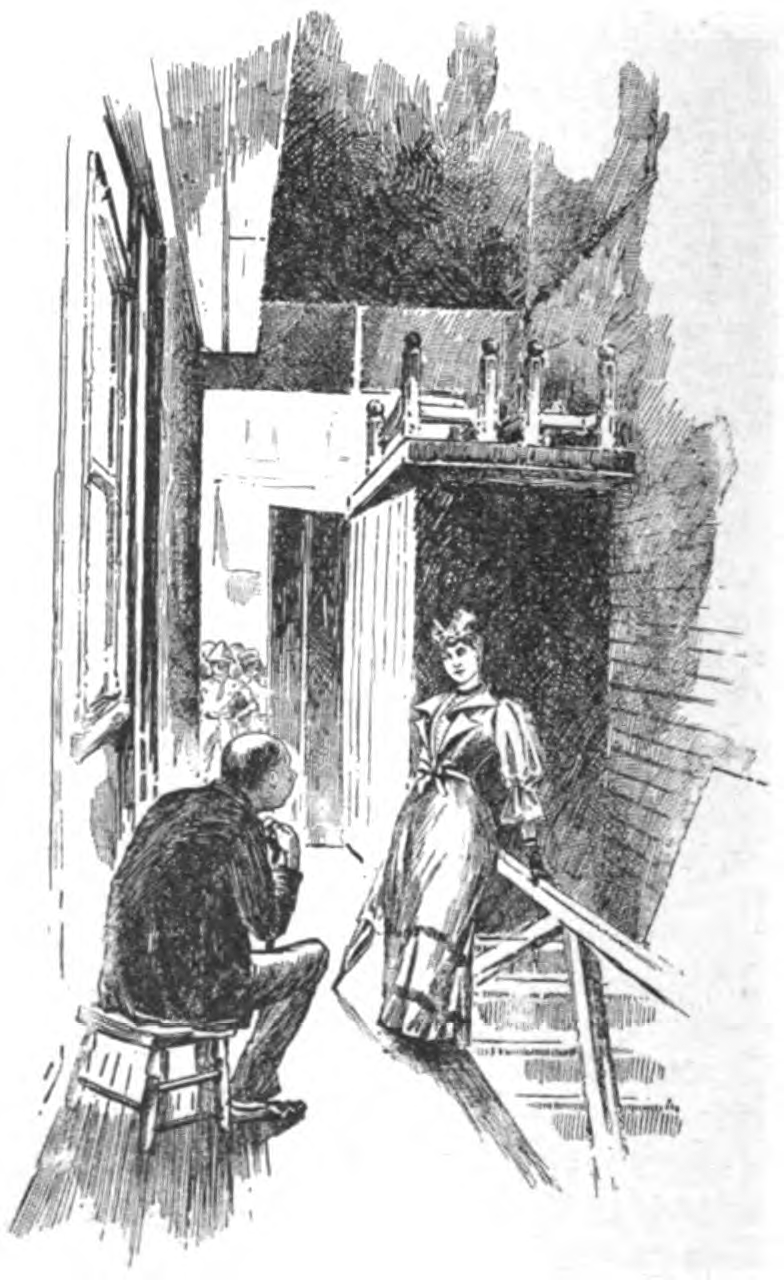
Setting a Scene
Setting a Scene
Model of a Scene
Model of a Scene
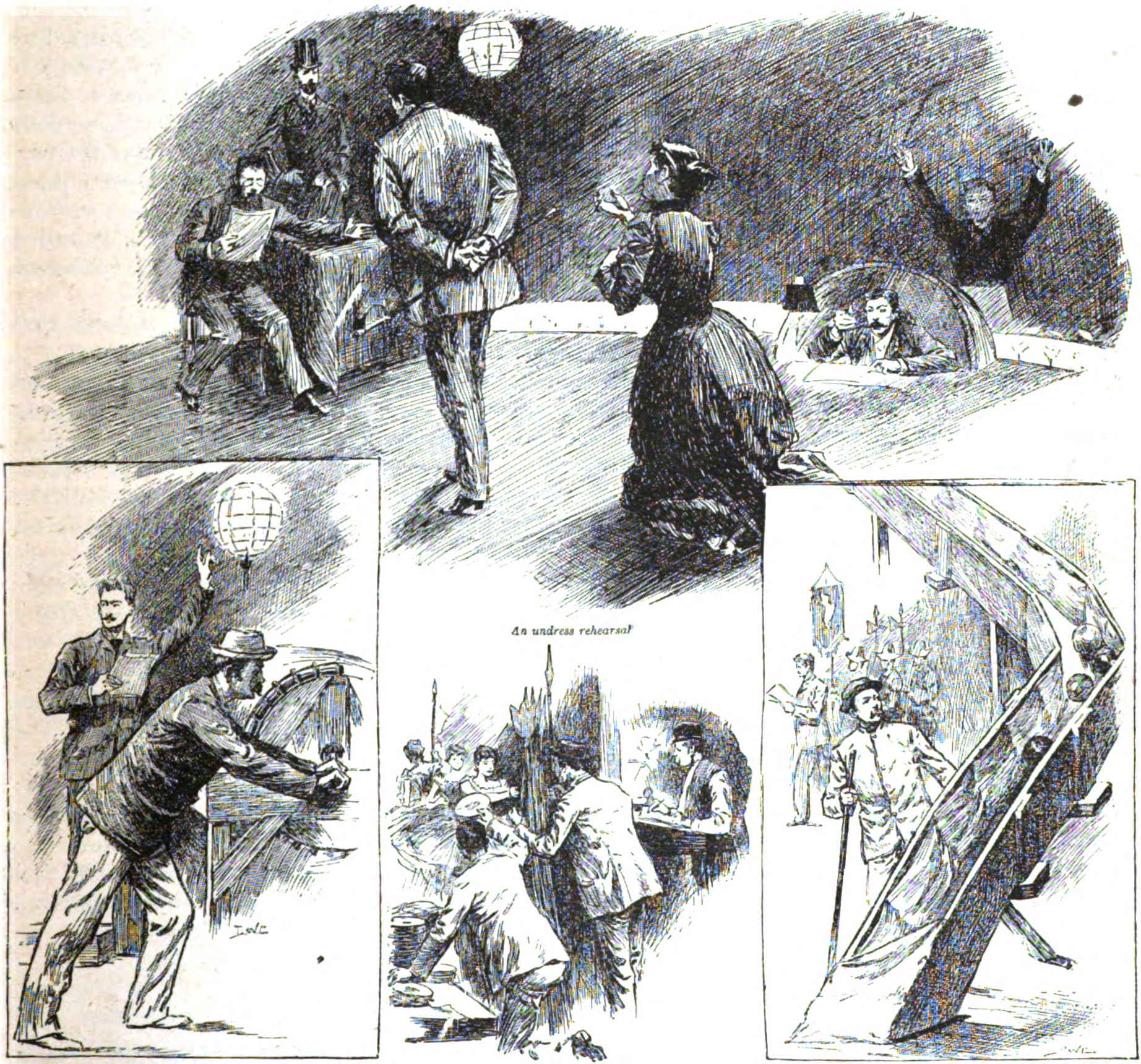
Scenes Behind the Scenes

The final image above shows a collage of scenes. On top is “an undress rehearsal”. Below is a wind machine, distributing the props, and a thunder apparatus.

Source: Hornblow, Arthur. “How a Play Is Produced.” Popular Monthly 1893: 614-22. Google Books. Web. 6 Jan. 2016.