Monday Link-a-tastrophe

By now you should know about This to That, a great tool for finding out what glue to use. Well, Beacon Adhesives, makers of such prop-friendly glues as Magna-Tac and Fabri-Tac, have their own Adhesive Selection Chart.

I know I just did a post on knots, but I had to show off this hot knot diagram. It’s from a site I just discovered called Low-tech Magazine, which “refuses to assume that every problem has a high-tech solution”. How very apropos for those of us in the world of ever-shrinking prop budgets.

Dug North has started compiling a great big list of Automaton plans in one single page. Some are even free!

Finally, here’s a neat little Repair Manifesto. You can view the image in a larger size as well.

3 Comments

Paper Props from Capeman

We just finished our summer season in Central Park with a theatricalized concert version of “Capeman”, the musical by Paul Simon. Though it got less-than-stellar reviews the first time around (and cost $11 million for 68 performances), this reincarnation was very well-received and quite enjoyable. It was also a lot of fun to work on, sort of like a chaser to the stomach-churning intensity of the two Shakespeare shows in repertory we did at the beginning of the summer (though having one of them transfer to Broadway is a nice feather in the cap). Plus, production meetings at the end of a long day of tech become a lot more fun when Paul Simon is giving you notes.

Anyway, the show had a few paper props I made; these are two of them, one of which made it in, the other which was cut. If you’re unfamiliar with the story, here’s a quick summary so you can follow along. “Capeman” is a fictionalized retelling of a real event. In 1959,  during a gang fight in Hell’s Kitchen (a New York City neighborhood), a 15-year old named Salvador Agron stabbed and killed two teenagers. He wore a cape, hence the nickname; the story exploded in the news media. He was convicted and placed on death row, but his sentence was lessened to life in prison. The musical follows his early life in Puerto Rico, the stabbing, his imprisonment, and his search for redemption and salvation while in prison.

Airplane ticket outside cover

Airplane ticket outside cover

The airline ticket is given to Agron’s mother while they lived in Mayagüez, Puerto Rico, by a New York preacher who wishes to marry her. As the show is based on a real event within the last century, I was able to dig up a lot of historical information and primary sources right on the internet. Several sites in particular came in handy. Airline History has a database showing which airlines were operational in different parts of the world throughout the history of aviation. They also have a lot of images of airline tickets. The front cover is an early 1950s ticket from Caribair, an airline that flew out of Mayagüez during the time period of the show. I liked the artwork of it, so I copied it “as is”. I resized it to the size of a typical airline ticket at that time, which I found by looking at several 1950s airline tickets on eBay that listed dimensions in their descriptions.

Airline Timetable Images was another great site I used. Though they cover timetables throughout history, rather than tickets, the artwork is still the same. This is where I found the back cover for my ticket shown above. I resized it and changed the colors to match the front cover. Airtimes is another great source for these kinds of images and information.

Inside pages of the airplane ticket

Inside pages of the airplane ticket

These are the inside pages. I made these from bits and pieces of ticket images I found from the previously mentioned sites, as well as eBay. It’s always a little harder to find images of the boring parts of ephemera, since most sites only scan and display the fun colorful parts. Also, the actual ticket part is taken by the airlines which tend to throw them away, as opposed to the traveler who is more likely to keep it as a souvenir. I’ve never even bought a real paper airplane ticket in all the times I’ve flown, so I couldn’t use my own memories as a reference.

I think what I came up with was close enough, particularly since they never display the inside of the ticket to the audience. I even remembered to check which airports existed in New York City at this time period; she couldn’t very well have a ticket in 1953 from Mayagüez to JFK!

Several vintage postcard options

Several vintage postcard options

I also made some postcards. I made three, but they were only going to use one. I thought these three were different enough to give them some choices. I really liked the red one on the right, as it reminded me of “West Side Story”, which was happening during this same time period and which dealt with some of the same issues and locations as the real Capeman saga. During rehearsal, they decided to change the postcard to a letter in an envelope.

Back of the postcard

Back of the postcard

I found an image of the back of a postcard from this time period as well. I printed the stamp image out separately and cut it out with those craft scissors that give you a wavy edge. Jay has several postal ink stamps in his tool bag, so we finished this off with a cancellation mark and a date stamp. It’s the little details like that which add so much more depth to a paper prop without adding too much effort.

Leave a comment

Which Classes Should I Take

It’s that time of year again; summer is winding down and school is about to start. If you’re one of many who are in college or graduate school, you may be wondering what classes you should take to help you be a better props person. Hopefully, I can help.

It should go without saying that if your theatre department offers a class in props, you should take it. If you go to a school that has multiple types of props classes, even better.

Other departments in your theatre program may have classes you can take as well. Mask-making, costume crafts, puppet building, scenic carpentry, etc. Even if you take a regular costume class, you will learn how to sew. You may also discover that you prefer working in costumes rather than in props. Part of going to college is to expose yourself to new experiences and career possibilities; you should keep an open mind and not rationalize your choices based on what you think you should be doing or what others expect of you.

Many props people I know who studied theatre in college focused on scenic design. They continue working in props as a way to pay the bills in between design gigs. Others, such as yours truly, find they actually prefer being a props person rather than a scenic designer. Scenic design classes are very helpful for a props person. First, the scenic designer is the main person a props master deals with on a show, so knowing how they work and how they arrive at their choices will help you deal with your designer better; it will give you a common vocabulary to speak with. Second, a designer comes up with a concept, and works out the details based on that concept and overall look. As a props person, you continue filling in the gaps of the design down to the tiniest details. Being able to think like a designer will help you take in the design as a whole and use it to decide what magnets to put on the refrigerator, or what color to stain the end table. If the designer wants a lamp, it is more efficient if the props master presents three options which fit the design of the play, rather than three completely random choices.

If your school offers a technical direction class, that is good for a props person as well; you can learn the project management skills which will help you as a props master and the ability to develop construction drawings from a designer’s drafting, which can assist you as a prop artisan.

The fine arts department is another place where you can find classes to take. Many arts departments are very particular about who takes their classes; in fact, if you are a junior or senior and not an art major or minor, they might not let you take any of their classes. But if you do manage to work your way in, classes in sculpting, mold-making, metal-work, mixed-media and found-object assemblage and the like will behoove you greatly.

In addition to practical arts classes, art history is an excellent class to broaden your prop knowledge. In fact, any sort of design history or theatre history classes will expand your knowledge base.

If you attend a liberal arts school, do not give up the opportunity that your general education classes may present. Rather than taking easy or basic courses in the other departments, look for the ones which are secret prop-classes in disguise. Classes in sociology, anthropology and history which focus on domestic life or the objects used by various cultures in the past or present. In my own undergraduate years, I fulfilled one of my humanities requirements with a class entitled, “Japanese Anthropology through Film,” which gave me a great crash course in contemporary Japanese life and pop culture, as well as some great reference books which will come in handy when I do a play set in Japan.

Remember: a props person is always learning, and every experience can enrich not just our vocation, but our lives as well. Have a good school year, and stay classy.

2 Comments

Prop or not?

Is a musical instrument a prop? Many prop masters like to say, “If you want it to look good, it’s a prop. If you want it to sound good, it’s the sound department.” We’re doing Capeman right now, which is a musical. The orchestra obviously brings their own instruments. Any instruments which are handled by the actors have been provided by us, the prop department. Is this the correct way to break down the responsibilities of the different departments? The answer is, “it depends.”

Companies which produce a lot of musicals or operas may have a separate department for dealing with the musicians’ “stuff”. Other houses may strictly state that props, and only props, deals with those matters. Finally, other places may not have a set protocol and simply decide it on a show-by-show basis.

Is a live animal a prop? A lot of theatres may automatically assign the procurement and wrangling of a live animal to the props department. Many prop departments may instead contend that “if it poops and eats, it’s casting.” in other words, the responsibility of a live animal falls to the same people in charge of live people. Of course, it may still fall to the props department, either because of tradition or practicalities’ sake. Again, there is no correct answer.

The lesson to take from these two examples is that the strict academic definition of a prop and the duties of a prop shop are not necessarily the same thing. Not everything which may be considered a prop is procured by the prop shop, and not everything done by a prop shop is a prop. Prop shops in the different disciplines of film, television and theatre have slightly different duties, and even prop shops in the same discipline may vary in their particular responsibilities.

2 Comments

36 Knots, Bends, and Splices

Who here likes knots? Who doesn’t like knots? When I was first starting out as a stagehand apprentice, I was told there were three knots I should memorize: the square knot, bowline, and clove hitch. These, I was taught, made up the bulk of all knots needed in theatre. Any other specialty knots came into play when you were doing specialty jobs. This has held fairly true throughout my career; other than the odd decorative knot or particular rigging challenge, I can usually solve my knotty problem with one of these three knots.

To that end, here are diagrams of thirty-six common knots, bends, and splices I pulled from an old book. These aren’t decorative or pretty knots; these are heavy-duty working-class knots, including the three I mentioned above. There is, of course, the larger question of what circumstances each of these knots should be used in; perhaps I will address that in a later post. Until then, why knot just enjoy the pictures?

Parts of a rope, overhand knot, figure eight knot, stevedore knot

Parts of a rope, overhand knot, figure eight knot, stevedore knot

Read More »

Leave a comment
  • About

    Eric Hart

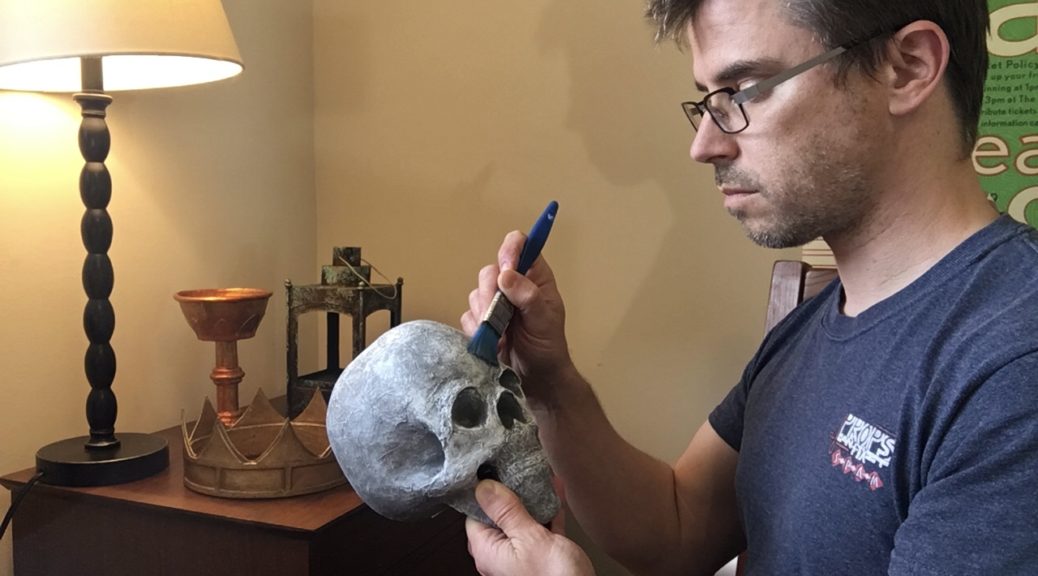
    I am Eric Hart, the assistant props master at the Public Theater in New York City, and a longtime prop maker.

    This site is a way to share my work and the things I've learned over the years. It's also a way to connect with other prop makers, props masters, and artisans, as well as a collection of all things of interest to props people from around the internet.

Switch to our mobile site