
Category Archives: Reprints

The Tangible Elements of Fantasy, 1909

The following comes from a 1909 edition of the San Francisco Call. Besides the description of the props, pay attention to an early description of spike marks.

The Tangible Elements of Fantasy

by Walter Anthony

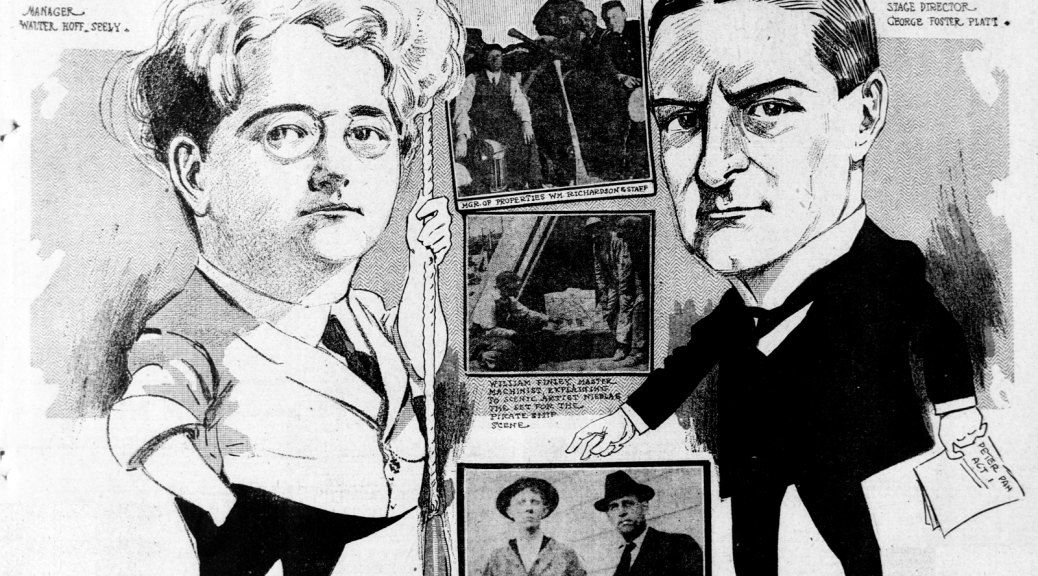
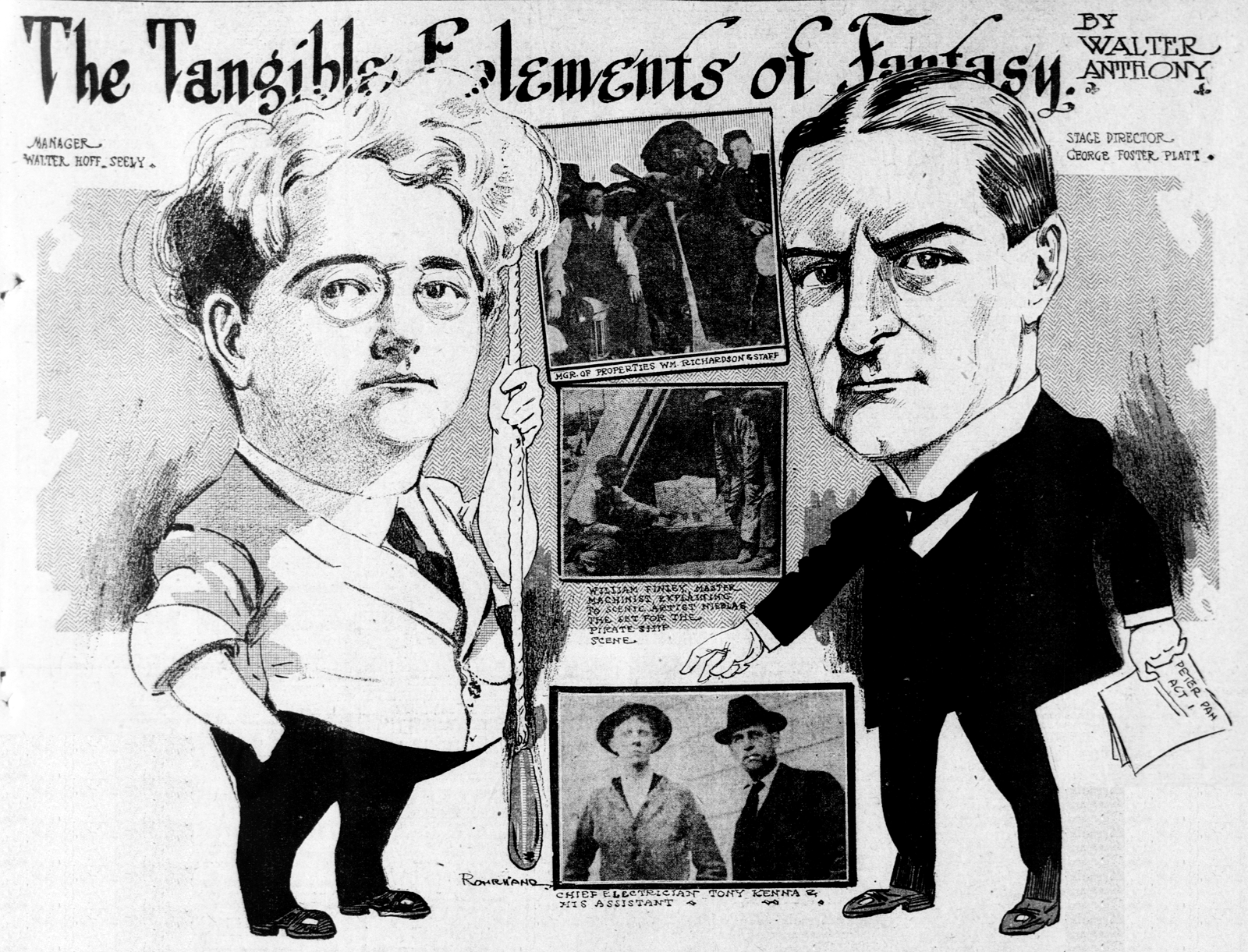
In the first place as you wander about the stage observing the traps which have been cut into the floor; the mysterious marks here and there which show the exact location of every individual piece of furniture and scenery; the accumulation of cannons and birds and dogs’ heads; the lion, the crocodile, which as tasted of Captain Hook’s hand and wants the rest of the pirate for dinner; the dog’s skin, that poor Harcourt has to perspire in; the maze of wires to swing the Darling children out of the window when Peter Pan teaches them the difficult art of flying—I say, when you take in the mass of mechanical detail which the production of “Peter Pan” requires, your admiration will grow for Barrie, the whimsical Scotchman, who conceived the whole thing; for Manager Walter Hoff Seely, who has not hesitated at putting $8,ooo into the production; and for George Foster Platt, the stage director, who is bringing all the ends of this fantasy together and is literally piecing together moonbeams and moth wings.

Then Stage Director Platt takes descriptions and roughly draws the scene, Ralph Nieblas, the scene painter, makes a model out of cardboard, with every measurement carefully indicated. When the model is done, it is an exact reproduction in miniature of what the scene is going to be like. Nieblas and William Finley, the head carpenter, get together and puzzle it out. Finley told me he had to be able to make anything from heaven in “Uncle Tom’s Cabin” to hell in “The Black Crook.”

Plans and specifications, drawn by Platt’s imagination from Barrie’s imaginary pictures, are made and the work of producing the scenery and the properties begins. Meanwhile, the propertyman is scouring the city for accessories, such as the bell which is used on the ships; for in the pirate boat scene there must be a real bell with a real clapper, to emit real vibrations. William Richardson, who is the propertyman, is now in a state bordering on nervous prostration, for the strange things he has had to collect include everything that a fantasy could demand. “I got the bell at a ship chandler’s,” he said, “and a bad cigar for Captain Hook to smoke at every performance, but I will not tell you where I got that. It wouldn’t be fair to the pirate. I had to get a hook for him to wear after the crocodile has eaten his hand, and the list of things that I have raced around town for would bewilder the most enthusiastic shopper in the world.”
Tangible Elements of Fantasy

Anthony, Walter. “The Tangible Elements of Fantasy.” The Call [San Francisco] 11 Apr. 1909: 25. Library of Congress. Web. 8 Sept. 2015.

The Saddest Man in Hollywood, 1940

The following article originally appeared in a 1940 issue of The New York Times.

More or Less According to Hoyle

by Thomas M. Pryor

The saddest man in Hollywood today is one Irving Sindler. The chances are you’ve never heard of him, for the gentleman so named is a property man by trade and, in motion pictures, these artists do not receive the same program recognition accorded them in the theatre. Though his name has never appeared in the screen credits, Mr. Sindler has become a Hollywood legend because he has managed to sneak his name into at least one scene of every film on which he has worked during the last fifteen years.

In “Wuthering Heights” there was a gravestone bearing the inscription, “I. Sindler, A Good Man.” In “Intermezzo” there was a Swedish bakery owned by “Sindler & Son,” and in “Raffles” a newspaper insert noted that “Lord Sindler had returned from a hunting expedition.” Sindler’s name decorated the front of a delicatessen store in “Dead End” and it appeared in Chinese across a banner in “Marco Polo”—or so we’ve been told. And preview scouts report seeing a sign labeled “Ma Sindler, Home Cooking” over a small cafe in “The Westerner,” which Samuel Goldwyn is holding for Fall release.

To his family and fellow-workers the Sindler trade-mark is as much sought for as is the ephemeral “Lubitsch touch.” But today Mr. Sindler is dejected, ashamed to face his family and friends because he failed to get his name into “The Long Voyage Home.” And it wasn’t that he didn’t try. He had a sign ready bearing the words, “Sindler & Son, Chemists,” but author Eugene O’Neill spoiled that by having most of the action take place on board a freighter. Sindler didn’t give up, however. He tacked the sign over the window of a Limehouse dive where Thomas Mitchell and John Wayne were scheduled to have a brawl, but Director John Ford spoiled that, too, by shooting away from the window.

And that is what has made Irving Sindler the saddest man in Hollywood.

Pryor, Thomas M. “More or Less According to Hoyle.” The New York Times 14 July 1940: 103.

Burning the Props, 1939

The following comes from a 1939 issue of The New Yorker. I don’t know if traveling plays still need to be destroyed after the show closes, but I do know you still see a lot of scenery and props end up in the trash at the end of a run.

Flashing Finish

by John McNulty, Eugene Kinkead, and Russell Maloney

It was all rather sad about “The Flashing Stream,” the play written by Charles Morgan, the London critic, which flopped here after being such a success in London. The cast went away in a huff, one of them declaring that presenting the play over here was like putting vintage claret before whiskey drinkers. We poured ourself a stiff slug of redeye at ten last Monday morning and went around to the Biltmore Theatre to watch a curious rite connected with the demise of an English play. When a British production is brought over here, God forbid, the scenery and props are admitted duty-free only on the understanding that at the conclusion of the run they must be either shipped out of the country or destroyed. Nine times out of ten the management elects to destroy them.

When we arrived at the Biltmore we found a jolly crew of vultures from the Williams Transfer Corporation on the stage of the Biltmore, dismantling the single set, an ancient fortress. They were under the supervision of Frank Williams, a partner in the company, a gray-haired veteran of the scenery-transport business. He told us that the general practice had been to chop up the scenery and props right onstage, but that in this instance the customs men had ordered a burning. This, he told us, would necessitate a trip up to the Colgate dumps, near the Bronx River. When they got their trucks loaded, a customs official appeared, checked the inventory, down to the last vase of artificial flowers, and assigned a guard who was with him to make the trip to the dump and see it all burned. We followed the trucks in a taxicab, brooding on the impermanence of everything.

The dump is a large, bare expanse with a pit that smolders eternally, yawning for English drama. The truckmen, half a dozen of them, made a pile of the scenery. “We’ll need gasoline,” somebody said. “This is all fireproofed.” One of the truckmen winked. “The hell we will,” he said, touching a match to the pile. It went up in flames at once. The truckmen, like destructive brownies, skipped about the flames and yelled. “Gone with the wind!” cried one, throwing into the flames a billboard picture of Margaret Rawlings, the star. Another man disemboweled a sofa and set fire to the insides. Then they all began hurling small objects into the flames—cushions, glassware, vases, occasional chairs, all the paraphernalia of English acting. Our last sight of the holocaust, as we drove off in our cab, was a man who, under the approving gaze of the customs guard, was prancing about with an armful of artificial tiger lilies, pitching them one by one into the flames.

Original appearance: McNulty, John, Eugene Kinkead, and Russell Maloney. “Flashing Finish.” New Yorker 29 Apr. 1939: 18-19. Print.

Macready Invents the Spike Mark, 1916

The following first appeared in a 1916 book titled “Recollections of a Scene Painter”,  written by an E.T. Harvey. In this section, Harvey talks about the famous English actor William Macready, who dominated the stage from 1818 to 1851. We hear what the carpenters in Philadelphia did after the Astor Place Riots, and we witness what may be the birth of the spike mark.

Macready was before my time, but he had made extensive tours in the United States, and many stories were still in vogue about him. Edwin Forrest, when in England, met with some severe criticism, which he and his friends attributed to Macready’s jealousy. This is generally believed to be without foundation, but it caused a bitter feeling here and when Macready played in New York, the Astor House riots occurred [in 1849], and seventeen people were killed. The same thing was threatened in Philadelphia, when he played in the Arch Street Theatre. The second night the mob was expected to reach the stage, and the old stage carpenter, Charley Long, told me many years afterward, that it was arranged to turn out the lights and open up the sectional stage, which would have thrown the mob in the cellar. The men stood all ready to do this. The crisis, however, was averted by the coolness and courage of Macready himself. But it was said the big chandelier in front of the theatre was filled with missiles thrown at him.

Many stories were in vogue to show his exactness of method. A message delivered to him on the stage had to be given on a certain spot, and when the actor playing the messenger had failed several times at rehearsal, Macready had a mark put upon the stage where he should drop on his knees to deliver it. At night, it was said, the actor went groping all over the stage to find the mark.

An interesting thing that I believe to be true was pointed out to me at the St. Charles Theatre, New Orleans. (The St. Charles was the historic theatre of New Orleans). Near the prompter’s stand were a lot of jagged holes in the brick wall; these were said to have been made by Macready, with a dagger in each hand, to get himself in the nervous tremor as “Macbeth,” after he has killed “King Duncan.”

Original Publication: Harvey, E. T. Recollections of a Scene Painter. Cincinnati: W.A. Sorin, 1916. 29. Google Books, 15 Feb. 2008. Web. 5 Sept. 2012.

Behind the Scenes part 5, 1890

The following comes from an 1890 news article in the San Francisco Morning Call. You can also check out the first part, the second part, the third part, and the fourth part:

A pair of wooden squares covered with sand-paper and rubbed together announces the coming of the engine in “Across the Continent.” A wish of wires did similar service for the locomotive in the “Main Line.” Cheerful, indeed, looked the fire on the hearth in the kitchen of Hazel Kirke’s home when she quitted it for the castle of Arthur Carringford. Gas jets and colored glass caused the illusion.

To be kicked downstairs should be severe punishment; it seems doubly so when done on the stage, for the crash, a machine with a lot of loose shingles working on a cog makes the commotion all the greater. Once in a while a gentleman is fired through a paper window, and in his descent apparently knocks into smithereens a skylight.

A demijohn wicker cover intact, holding broken glass, dropped as the actor takes flight, consummates the disaster to the ignominious character.

A steam pipe, or, when not convenient, slacked lime, will cause a semblance of dust or smoke in earthquakes or explosions.

A poorly equipped theater it is indeed that has not around a genius who can bark like a dog or crow after the manner of a cock…

Realistic properties are steadily encroaching on the art of the property-man. A cage of lions in “Theodora,” horses in “A Run of Luck,” “Jalma,” “Kerry Gow” and dozens of other plays; tanks of real water in which boat-races are carried on and heroines are half-drowned and dived after by brave heroes, etc., etc.

Probably the best piece of stage realism ever put on the stage was the cascade of real water, leaping from a height of fifty feet into the ravine below, seen in the recent production of “The Silver Falls” at the Boston Theater. Tons upon tons of water were utilized in this scene, and the great wonder of this exhibition of stage realism was what became of the water after it had dashed into the rocky ravine.

It was a simple matter. A huge tank was built under the stage, which, when filled to overflowing, was drained into the sewer.

All these realistic effects and such as were seen in “The Soudan” are but forerunners of an era that will leave nothing “faked” but the scenery.

Published in The Morning Call, San Francisco, December 25, 1890, pg 19. Originally written by Felix Barnley in 1887.