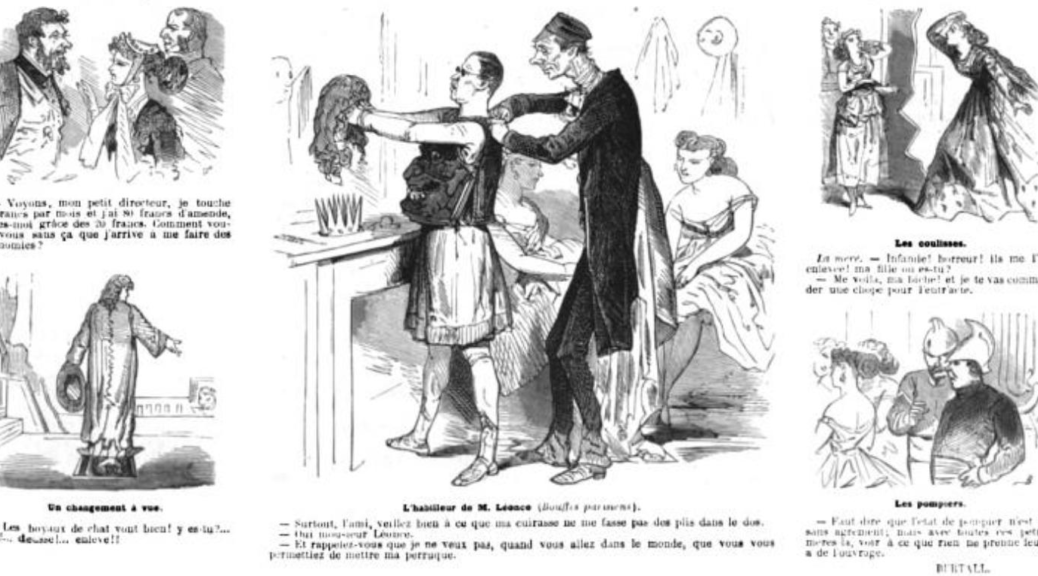
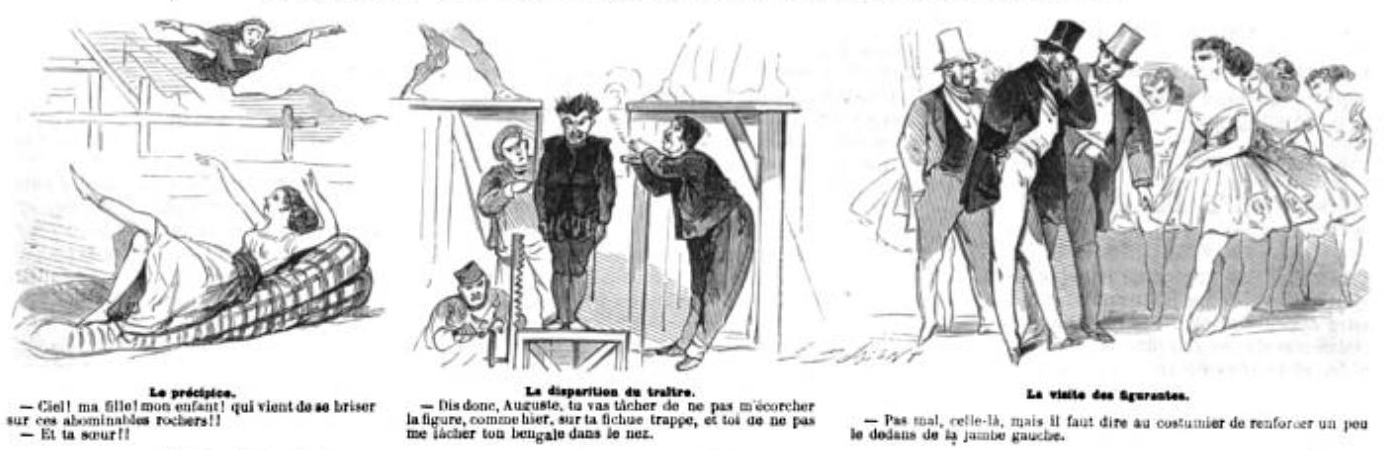
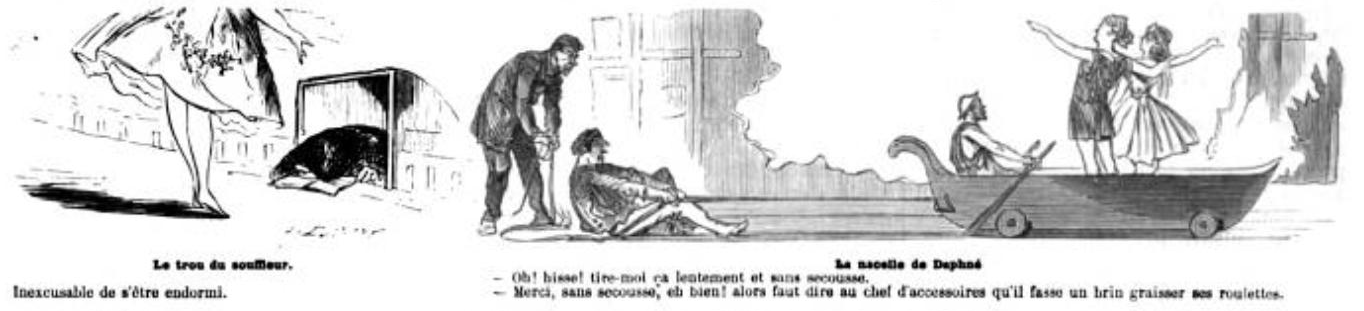
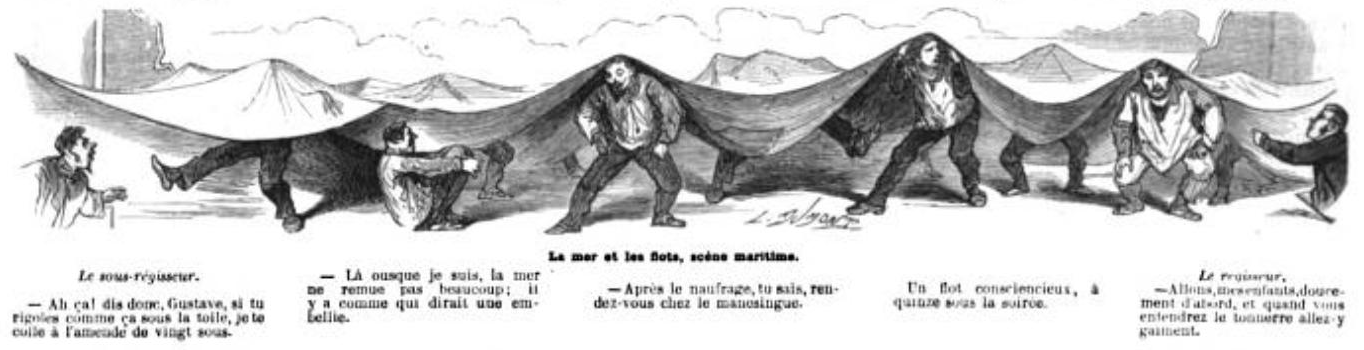
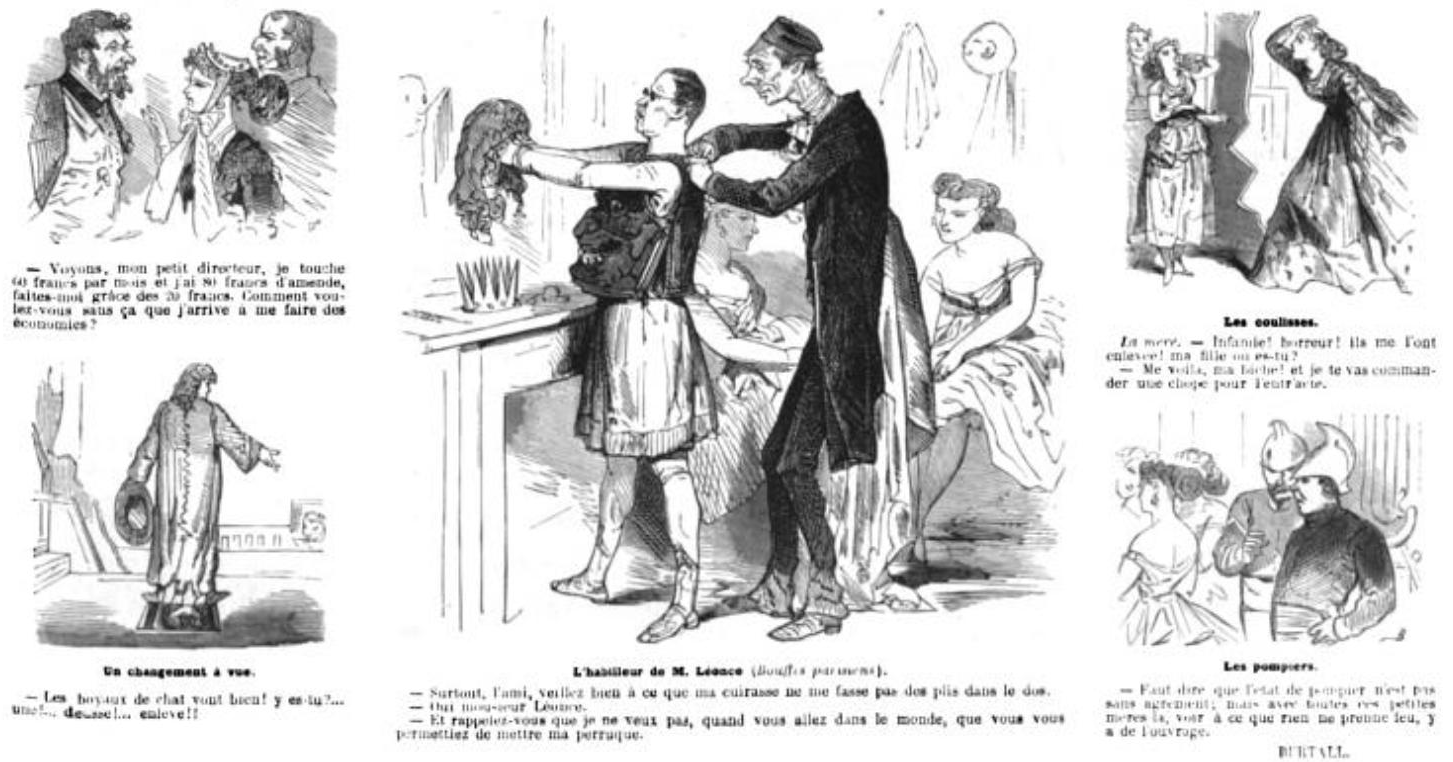
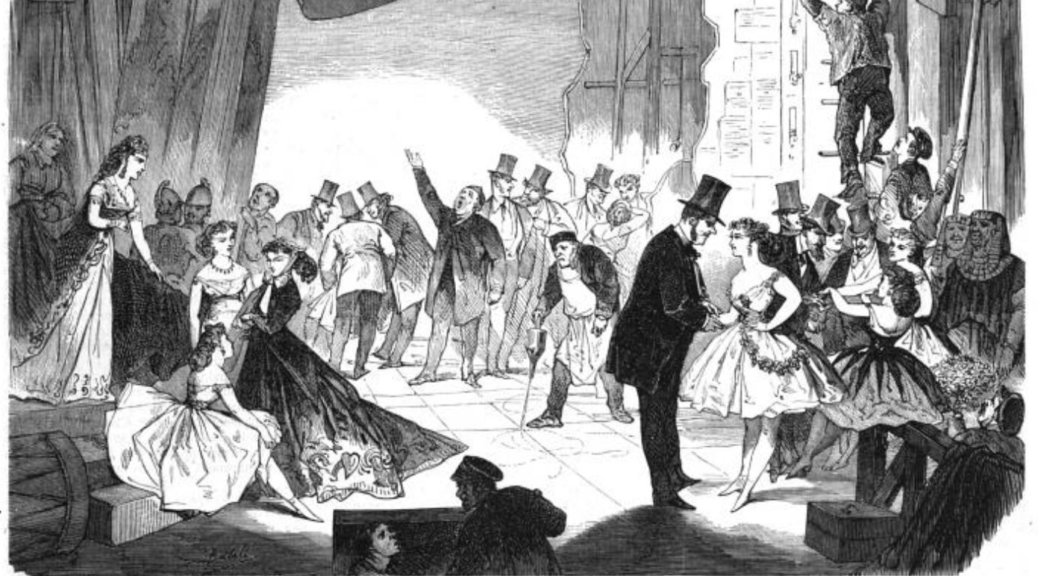
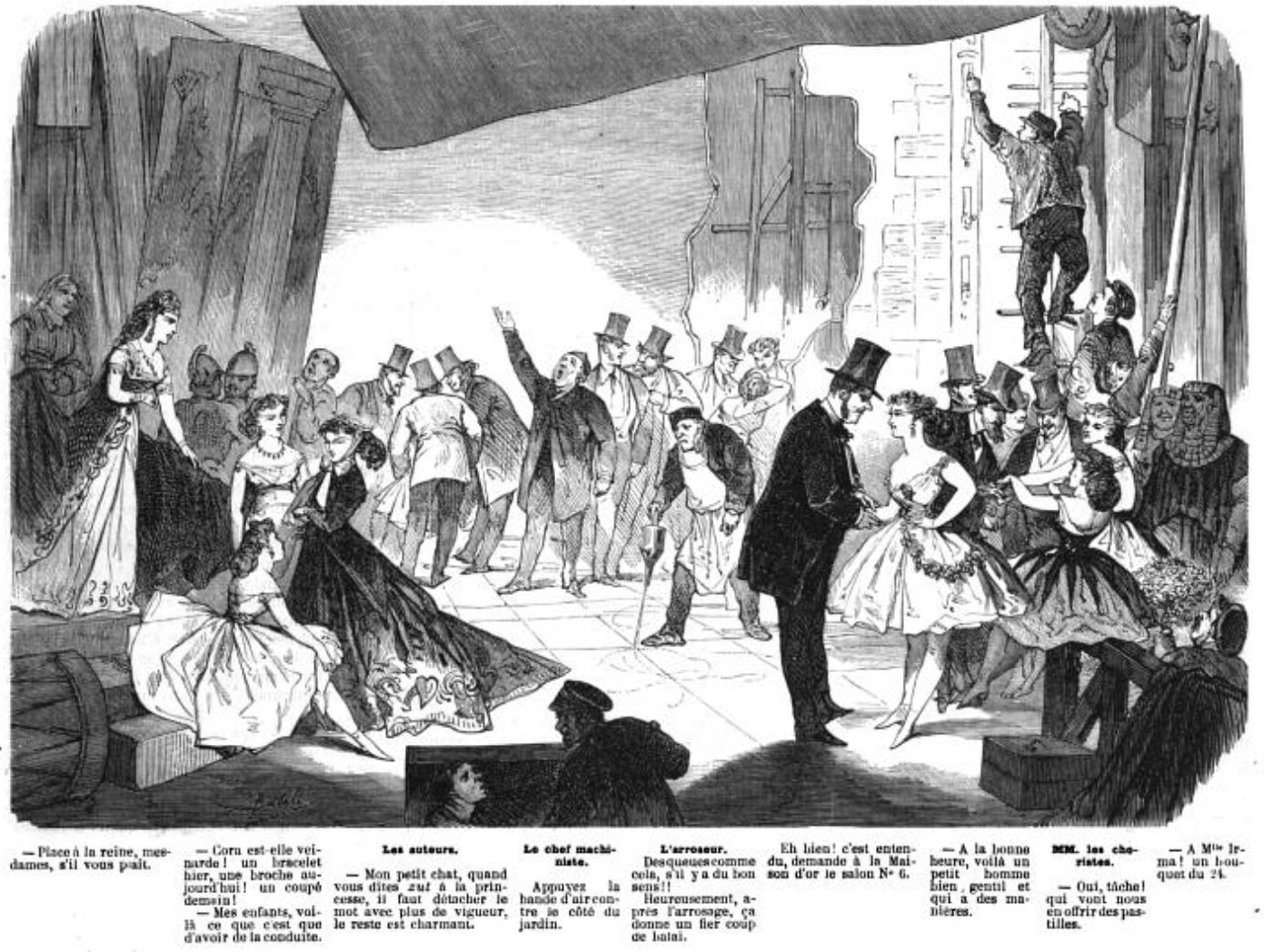
I came across the following wonderful illustrations of backstage theatre from 1866. It’s all in French. I thought I could try translating it on my own, but no luck, so here it is in its untranslated glory. If any of my readers know French and would love to take a crack at it, let me know!
The staff, big and small things, a scenic study by Bertall.
The Stage
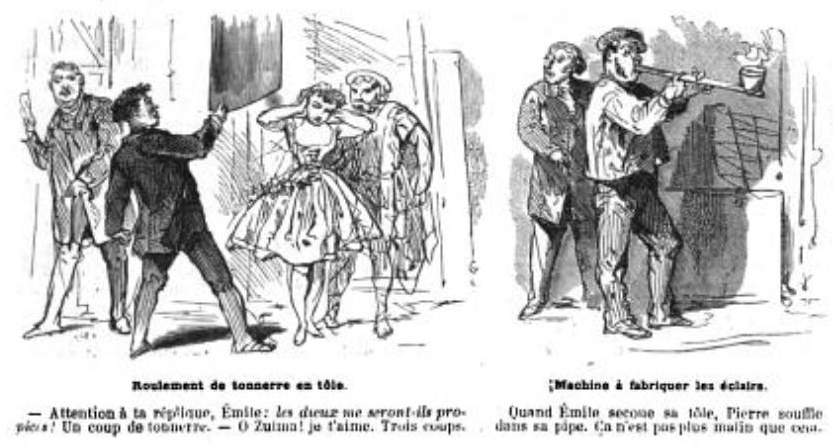
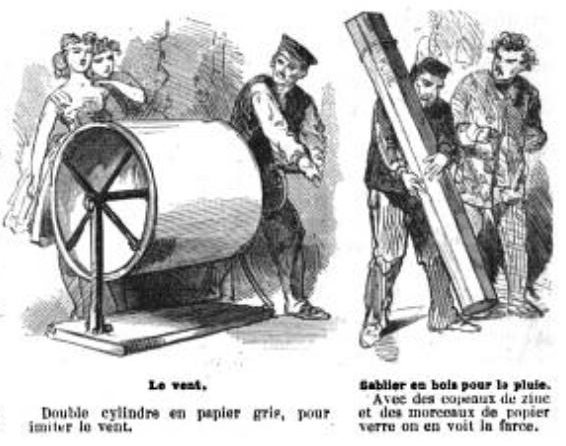
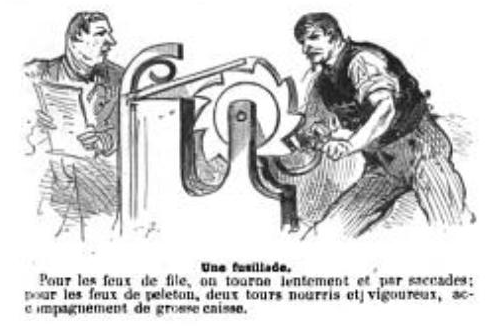
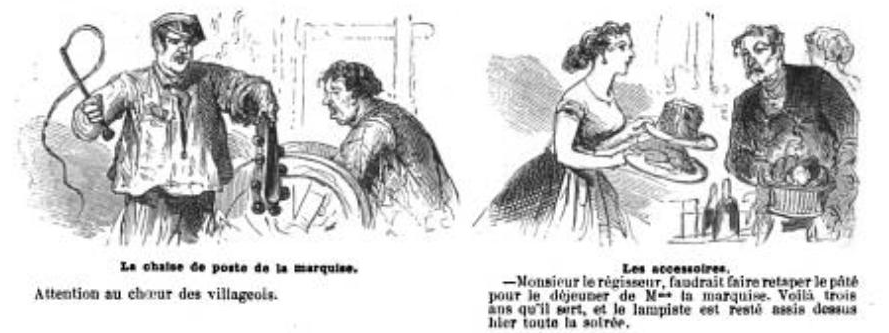
The next few illustrations show some manual sound effects and props.
Thunder and lightningWind and rainShootingSound and food
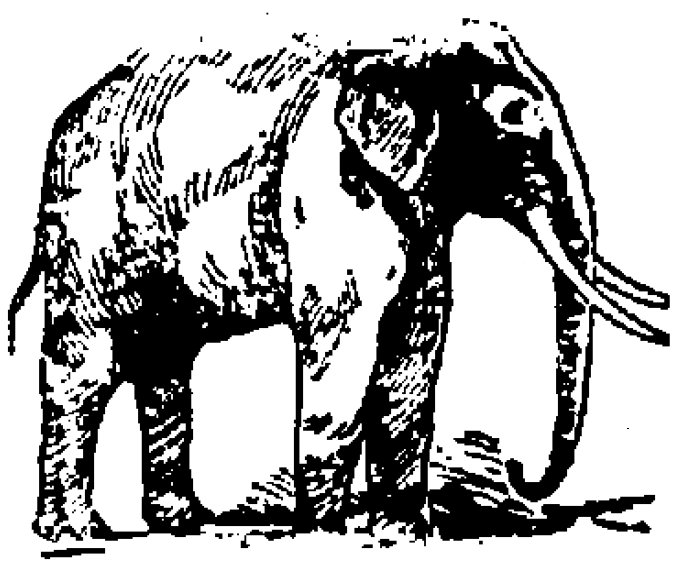
Last spring, I posted an article about the life-sized elephant prop in the 1891 musical, “Wang”. Here is another article about that elephant. I originally credited the construction of the beast to Edward Siedle; his obituary states he built it around 1900. This article credits the invention of the elephant to Woolson Morse, so perhaps Siedle’s elephant was built for the 1904 revival. Sorry the images are such low quality; perhaps someone out there can get better scans from the originals for me.
Not Barnum’s, But the Great Mechanical Wonder.
Few theatre-goers have any intelligent conception of the mechanism of some of the “animals” that are in the cast of a modern spectacular drama or comic opera. A long time ago when the heifer was part and parcel of “Evangeline,” it caused an infinite amount of merriment, but few ever stopped to think how it was done. Although its construction was simple enough, the effect was wonderfully amusing.
Framework of the Elephant
A representative of this paper met with Manager John W. McKinney at the Wieting opera house, and through his courtesy was enabled to critically examine the working model of the monster mechanical elephant in “Wang.” DeWolf Hopper’s delightful comic opera, which will be presented for the first time in this city on next Thursday evening at the Wieting opera house.
“The elephant,” said Mr. McKinney in explanation, “is a much more complicated creature than any other mechanical property ever used upon the stage, and while it amuses the play-goer, its mechanism is one of study, and the men who do the elephant act are not enjoying themselves as much as the people who are in front. With those men playing elephant is hard work, especially as the elephant is constructed on scientific principles, and in order to make it work properly several consultations were held with the editor of The Scientific American, as well as with several prominent bridge engineers and architects.
“The body of the Hopper elephant is built upon the cantilever principle and by the law of mechanics its weight, as well as the weight of its’ rider, is thrown downward and squarely distributed to the eight points of union as indicated in the above picture.
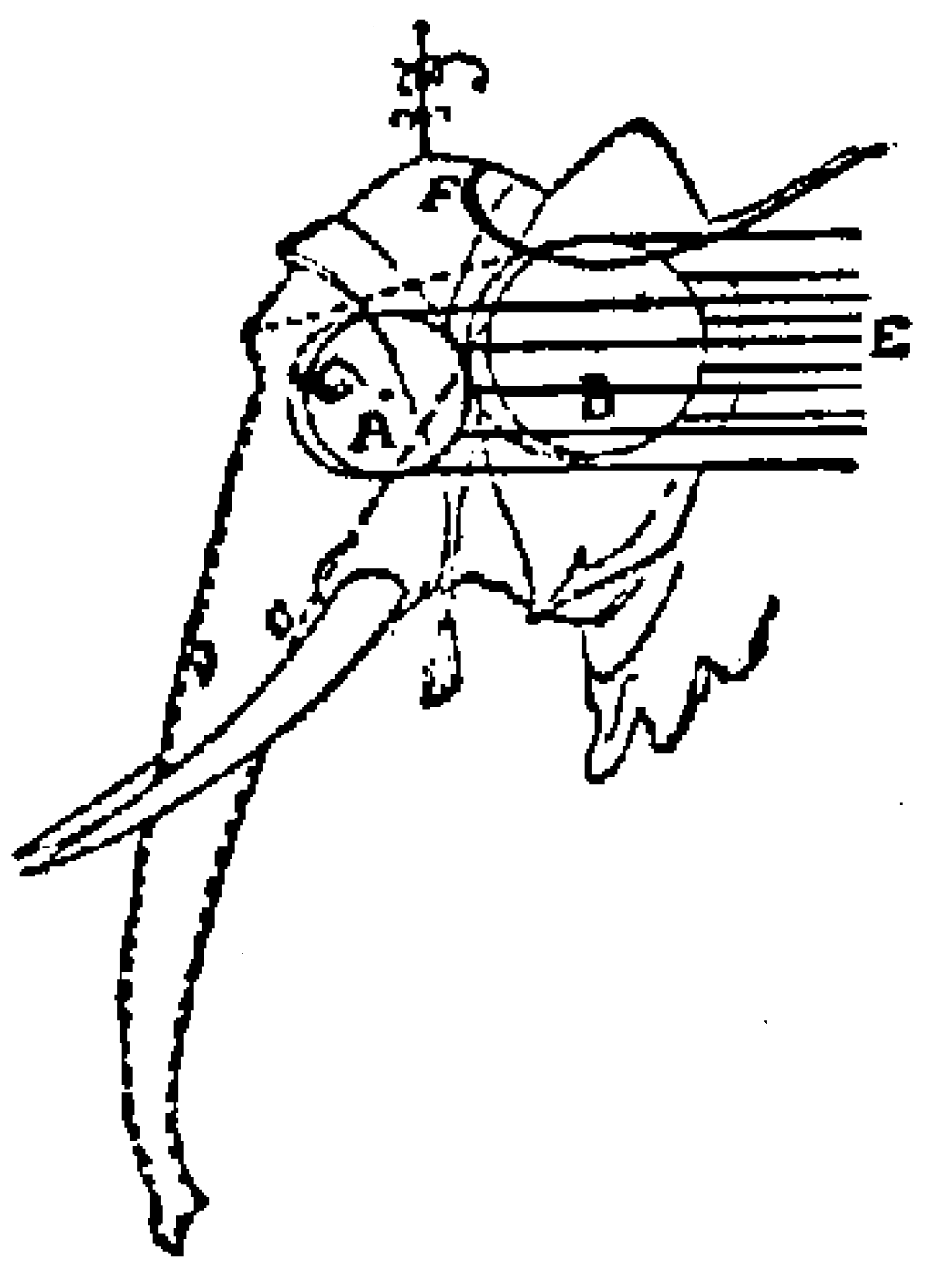
Diagram of the Elephant’s Head
A. Wheels for the eyes.
B. Wheels for the trunk.
C. Cord for drawing trunk inward.
D. Cord for drawing trunk outward.
E. Leather thongs for operating wheels.
F. Hook from which head is suspended.
The two men “who make the elephant” fore legs and hind legs, have something else to do besides stamp about the stage. They are joined together by a yoke which fastens the neck, shoulders and arms of each man, and this yoke serves as a communication between the two men. When the front legs want to make a movement this yoke prompts the hind legs as to their action. If the front legs want to advance that movement naturally draws the hind legs. By the mechanical construction of the “beast” the rider is enabled to shift his position on the back of the elephant at will. If this law were violated or not adhered to, the elephant’s equilibrium would be upset.
The Elephant’s Legs
The legs of the elephant are made of gutta percha and are worn precisely as trousers, and are held in position by heavy suspenders. The soles of the feet are made of heavy India rubber. The head rests upon a socket, which gives it an elephantine undulation. And in this head is a clockwork system of pulleys and wheels used by the man who plays the front legs. By this system he manipulates the trunk, tusks, eyes and ears. When the tender wants to curl the trunk inwards he inclines his head forward, grasps a tag at the end of a thong which is fastened to the trunk and by a movement of his head sets in motion a large wheel which turns so as to draw the thong tight, thus giving the desired result.
Woolson Morse, the young man who composed the music of “Wang,” is the inventor of this wonderful piece of stage mechanism, the excellence and fine adjustment of which is so apparent to the spectator who by the above description of the interior can tell “just how the wheels go round” when he witnesses “Wang.”
“Seeing the Elephant.” The Evening Herald [Syracuse] 9 Jan. 1893: 4. Fulton History. Web. 12 July 2016. <http://fultonhistory.com/Fulton.html>.
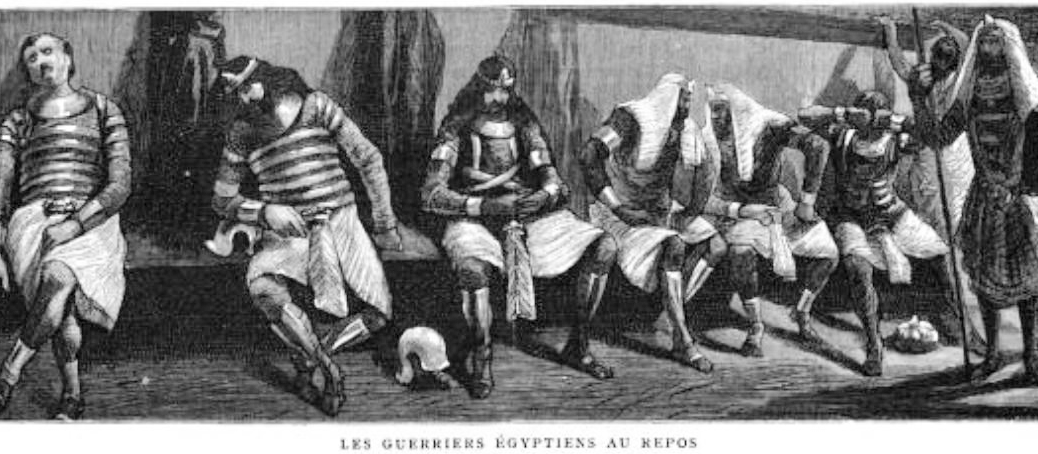
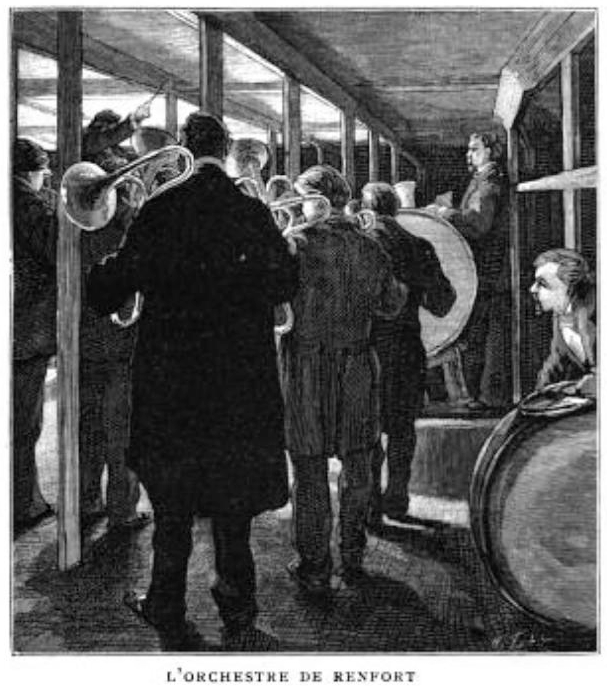
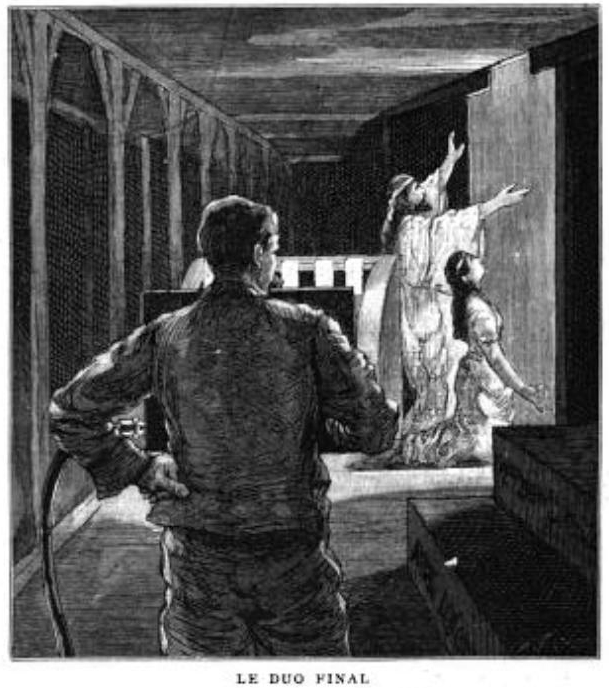
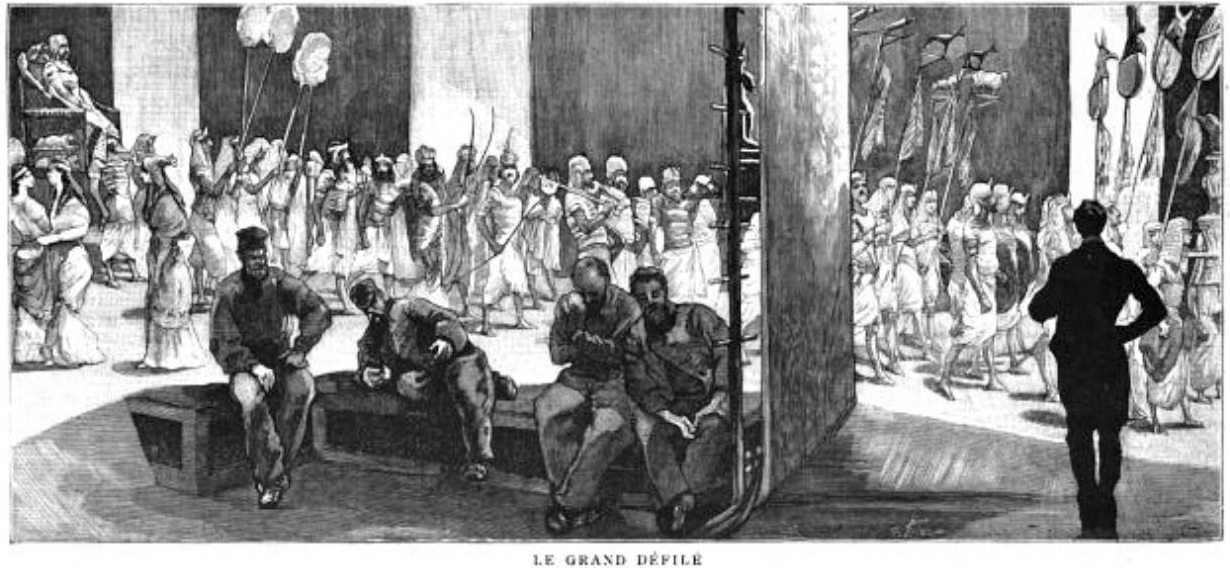
I came across these illustrations giving a backstage look at the opera Aïda. It is a French production from 1880. Even though it is over 135 years ago, some things still look the same.
The Egyptian Warriors at rest.Orchestra reinforcement.The final duet.The big parade.
The following is the third part of an article which appeared in an 1884 issue of the Bismarck Weekly Tribune. The first part and second part were posted previously:
“Stage banquets, suppers and meals of all kinds often put the ingenuity of the property man to a severe test. If the manager is economical the most elegant banquets are but hollow mockeries. The turkeys and chickens, which seem to spectators to be roasted to such a delicious degree of brownness, are only brown holland stuffed with sawdust. The wines are cold tea or water colored with burnt sugar. Sometimes they are drunk from pasteboard goblets and then they are purely imaginary. Do you remember Dickens’ description of how Mr. Crummles used to take long draughts of nothing out of the pasteboard goblets in banquet scenes?”
“Yet in these banquet scenes the people eat something?”
“Oh, yes. It is essential to the action that they shall eat. There is always a plate of bread and one of cold meat. They look at the elegant turkeys, chickens, etc, and eat the bread and meat. If the manager is liberal, however, a stage banquet is sometimes a meal at which no epicure would turn up his nose. This is always the case under Lester Wallack’s management. He gives his companies splendid suppers and real champagne. Poor Matilda Heron always did so, too, when she played Camille, and Albina de Mer, the wife of M. B. Curtis revived this good old custom in the same play when she starred it last season, presenting a bill of fare which included oysters, raw and fried, roast turkey, chicken salad and real wines.”
“The Property Manâ€, The Bismarck Weekly Tribune, Oct 31, 1884, pg 2. Reprinted from The Philadelphia Times.
Making and finding props for theatre, film, and hobbies