I’ve come across these great resources in the last couple of weeks:
Bolt Depot has these handy printable charts for identifying bolts and machine screws. You print out the PDF with page scaling turned “off”, and you can lay your bolt down on the different drawings until you find a match, and it will tell you what the diameter and thread count is. It has already helped me identify a metric bolt on a piece of furniture I needed to replace. Normally, I’ll check the bolt against my nuts to find a match, but I don’t have any metric hardware in the shop. Bolt Depot also has other handy information about nuts and bolts.
I found the following passage quite interesting. It is from an article written by Elisabeth Hunt in 1912, at the dawn of the New Stagecraft movement:
We are roused to full consciousness of what we have long dimly felt — that costly stage realism has o’erleapt itself and begun to create unreality. Practical properties are all very well; but when they are so ingenious and expensive as to attract attention to themselves, they are as disillusioning to an audience as if they were cheaply and absurdly impractical. Distraction is distraction, as fatal to dramatic illusion when it results from foolish extravagance as when it is mere poverty of resources.
For example: A genuine telephone switchboard on the stage becomes at once the most unreal thing in the world. Being where it does not belong, and where it must have been difficult to place, it makes a sensation—which it would not in life. To the audience it is a constant reminder that the stage where it is fixed is a stage, and not the room which it pretends to be.
As a matter of fact, a cheap, make-believe switchboard that could not be manipulated at all would not destroy the illusion more completely.
It continues:
As to the statement that realistic surroundings inspire the actor, somehow that does not ring true. And when extreme examples are urged, they sound positively puerile.
In one of the plays of last season, a certain stage represented a doctor’s office with the usual furniture, including a large desk and a stack of card index boxes. The public was privileged to know — press notices, probably — that the desk was completely filled, drawers, pigeonholes and all, with letters and papers such as a physician would accumulate, all addressed to the stage doctor or signed with his name; that the stationery spread before him had his name and address on letter heads and envelopes; and that, to crown this triumph of managerial art, the index boxes were full of cards, every one of which was completely made out.
The actor who played the part of the doctor was experienced and accomplished. It really seemed possible that he might have kept his impersonation, even if some of those cards had been left blank. In fact, any actor who has hard training back of him is apt to resent the idea that his concept of a part can be made to depend on preposterous realism which is invisible or meaningless to the audience. An imagination that is superior to footlights, open flies, and canvas walls is not likely to suffer from the consciousness that an unused drawer in a desk is empty. Moreover, if an actor’s hold on his part can be strengthened by mechanical means, it may as easily be weakened, in case some contraption is forgotten in setting the stage. What inspires the intelligent actor more than anything else that can be furnished him in the theater is a comfortable, commodious, well ventilated dressing room. Such humane accommodation could not, perhaps, be made to figure in a startling press notice; but it would quite conceivably encourage better art.
Nearly a hundred years later, and it’s sounding all too familiar.
On October 2, 2010, David Birrell was appearing in Stephen Sondheim’s Passion at the Donmar Warehouse in London. Â During a performance, one of the blank-firing guns used apparently had a problem, and Birell sustained an injury to his right eye. He may lose his sight in it. According to a spokeswoman for the theater, “It appears that during the duel scene in ‘Passion,’ David Birrell’s licensed replica stage gun misfired causing some debris to enter his eye.” Further sources claim it was actually an antique flintlock gun.
Accidents happen. Equipment malfunctions. Because blank-firing guns are so inherently dangerous, it is vital that even more attention is spent on following all the best practices of safety with them. I would go so far as to say that prop masters should not handle them: pyrotechnicians should handle the loading and handling of blank ammunition, experienced handlers should be in charge of selecting and maintaining the weapons, and skilled fight choreographs should block the scenes in which they are used. Of course, a prop master can also be a licensed pyrotechnician or be qualified to handle weapons (at the higher levels, many are); I am not saying being a prop master precludes one from using blank-firing guns, I am saying the title of “prop master” is not the sole prerequisite.
On April 15, 2010, Darrell D’Silva, an actor with the Royal Shakespeare Company was rehearsing a scene with a prop gun. He accidentally shot himself in the hand. It was during tech rehearsals for Antony and Cleopatra. He underwent surgery and returned to rehearsals with his arm in a sling. Apparently when it was handed to him, he thought it was unloaded. It took a big chunk off of his finger and blood spurted everywhere. Here is an incident where the accident came not from bad or malfunctioning equipment, but from bad communication. The actor was not told the gun was loaded, but more importantly, he disobeyed the cardinal rule of stage guns: treat every gun like it is a loaded weapon. An actor should never pull a trigger on a gun until the fight director commands him to.
November 15, 2008. Tucker Thayler, a 15 year old student at Desert Hills High School kills himself with a gun intended to be used as a sound effect for their production of Oklahoma. Apparently it was a real pistol with blanks. Apparently it was allowed as long as a parent was there to fire the gun. And I’m not sure how some schools still allow actual working firearms to be brought on campus. In most municipalities, you need a pyrotechnics license to fire blank ammunition for theatrical purposes; it is different than a standard gun license. After all, there are any number of firecracker and fireworks that average folk can use in their backyards legally in certain parts of the country, but once you want to fire them off inside a crowded theatre, the rules become much more stringent; the same is true of blank-firing guns.
Having a license means you have used blank ammunition before, the government trusts you to use blank ammunition in accordance with all safety standards and laws, and you are held liable for any accidents that may occur because of your negligence. If your area does not require licensing, you should still act as though it does and follow the same guidelines. Anyone handling or discharging blank ammunition should be familiar with it and know all the standard practices. Just because you can run out and buy it and “see what it does” does not mean that is in any way safe.
On March 31, 1993, Brandon Lee was filming a scene in The Crow. One of the thugs had a gun loaded with blanks to shoot at him. Because the blanks used were not correct and the gun was tampered with (stories are mixed), the gun had enough primer to push the cartridge out. Lee was hit in the abdomen and the bullet lodged in his spine. Several hours later, he died at the age of 28. A lot of the analysis of this tragedy points out that the thug should not have been aiming his gun directly at Lee. This goes back to the need for a qualified fight director; it’s not enough to know how to acquire and setup blank ammunition. Once also needs to know how to choreograph the scenes in a way to maximize safety.
On October 12, 1984, Jon-Eric Hexum was filming a scene in “Cover Up”, his first big role. He had a prop .44 Magnum loaded with blanks, and apparently was unaware that it could still expel paper wadding. Bored during a delayed scene, he began playing with his gun. It was loaded with 2 blanks and 3 empty cartridges. He held it to his head, quipped, “Let’s see if I’ve got one for me”, and pulled the trigger. The paper wadding hit hard enough to dislodge a quarter-size piece of his skull and push it into his brain. Six days later he was pronounced dead from the massive bleeding in his brain. This event is just screaming with its lack of safety protocols. Why was an actor left with a loaded pistol for such a long time when it was not needed? Why was he unaware that it was loaded, or that blank ammunition at point-blank range can be just as lethal? And whether it was loaded or not, he should not have pointed it at his head; he broke the cardinal rule where one treats every gun like it is a loaded weapon.
I, for one, find it absurd that one would want to put so many people in potential danger (by using blank-firing ammunition) for, essentially, a sound effect. I mean, do we drop stage weights from the grid to the stage where actors are because we like the sound it makes? Why is that ridiculous, but igniting gun powder is acceptable? Regardless of your beliefs, you will probably face the situation of dealing with blank-firing guns at some point in your career as a prop master. When one is faced with the situation of having to use them, all the appropriate safety precautions should be followed to the letter.
When a theatre regularly displays amputations, burning in acid, eviscerations, stabbings and all other manner of violent actions, a prop person may ask: how realistic were these effects, and how were they pulled off?
Perhaps one of the best kept secrets of the Grand Guignol was their fake blood. Many sources speak in fascination that it would congeal after a few minutes like real blood. Mel Gordon, a theatre Professor at U.C. Berkeley and Grand Guignol expert, says that the base is made of a heated mixture of equal parts carmine and glycerin (Callboard magazine, April, 1996). Carmine is a bright red pigment made by boiling dried insects; you can find paints which use that pigment, though finding it in its pure form is more difficult and necessitates looking for specialty online stores. You can still buy glycerin at drug stores and online. It is often added to stage blood to give it a bit of sheen under the lights. Further justification for this theory is found in a Time Magazine article entitled “The Theater: Murders in the Rue Chaptal” from March, 1947:
The theater has a secret recipe for blood; when the stuff cools it coagulates and makes scabs. Thrill-hungry customers in the small auditorium get a dividend when they overhear the hoarse backstage whisper: “Vite [tr: quickly], Edmond! Warm up the blood.”
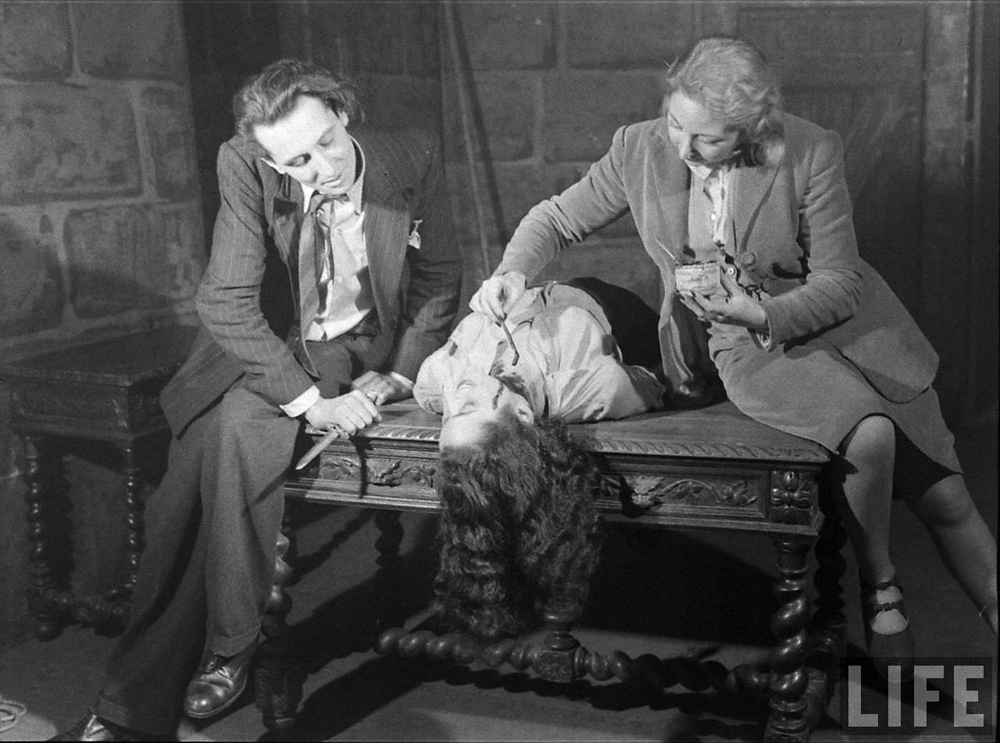
Eva Berkson applies blood to an actress' neck before a scene from "The Hussy". Photograph by Hans Wild, 1947
Nonon also made viscera from red rubber hose and sponges soaked in blood. Taxidermists supplied animal eyeballs, which he coated in aspic (a clear jelly made from meat stock) and stuffed with anchovies marinated in blood (Time, 1962). Sheep’s eyes were popular, but any animal would suffice because then the eyeball could bounce when dropped (Callboard, 1996). Edible eyeballs were made by a local confectioner’s shop (Pace, 1951). A tongue that was ripped out was made of rubber (Five Star Final, 1950) and (Pace, 1951). According to The Columbia encyclopedia of modern drama, Paul Ratineau, the stage manager, depended on the daily delivery of fresh animal parts by local butchers.
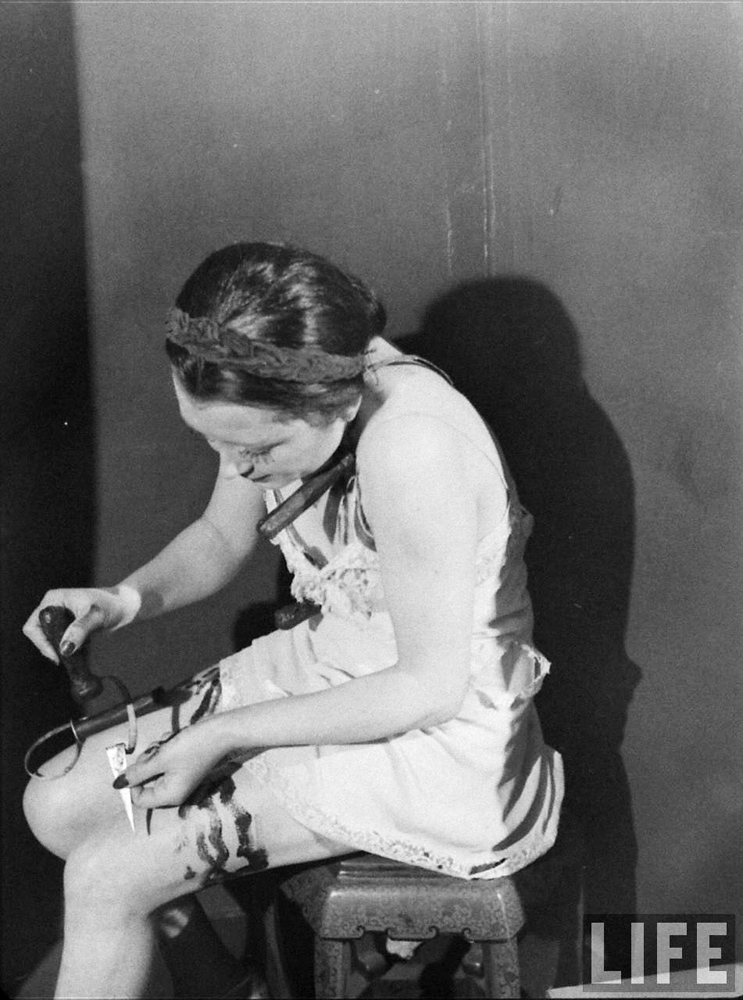
In order to deliver the goods, a variety of devices and trick props were required. These included rubber knives, concealed bladders, tubes and small, strategically located steam pipes (See Magazine, March, 1950), a dagger squirting “blood” from a vial hidden in an actor’s hand, quick flaming powders, a table with props hidden in upstage drawers (The New York Times Magazine, P.E. Schneider, March 1957). Daggers with retractable blades could also squirt blood from the handles; Mel Gordon explains that “a turkey baster, rubber ball, or an eye dropper could provide a good base for building a blood squirting knife” (Callboard, 1996).
In the photograph below, we see how some trick knives are like the classic “arrow-through-the-head” gag prop, where the two halves are separated by a metal clasp which fits around the actor’s limb.
Gordon also explains how the Guignol-eurs chopped off a man’s hand:
An actor cuts off his hand. Photograph by Hans Wild, 1947.
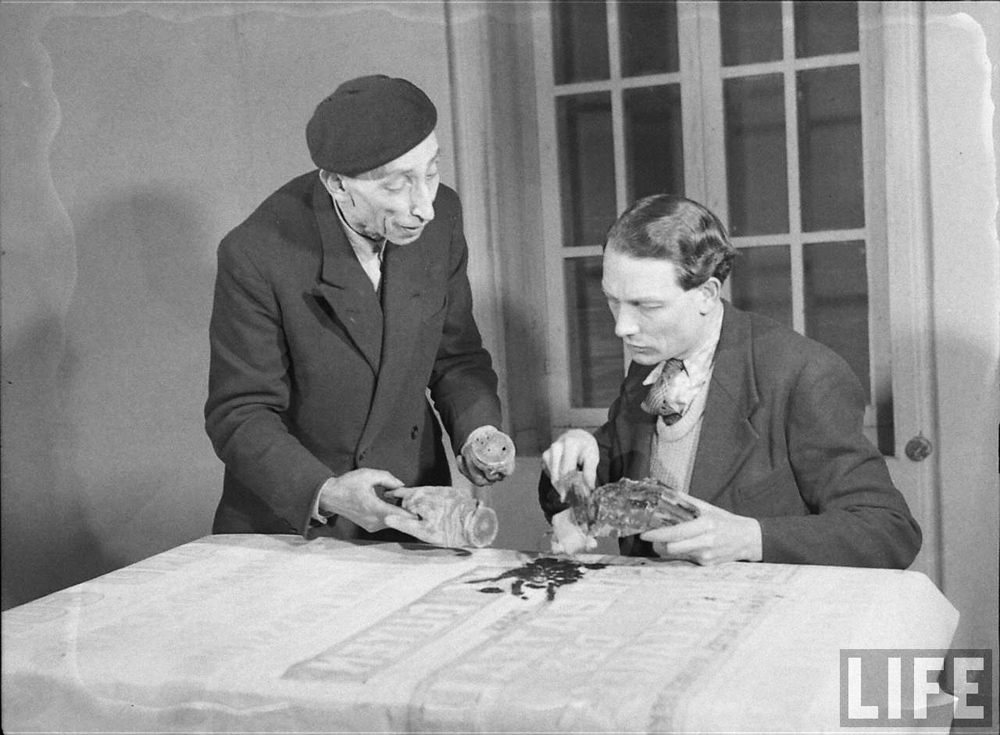
Cutting off a man’s hand is easier than it sounds. Stiffen a glove with glue water so it holds it’s shape and paint it like a real hand. The actor wearing the glove should still be able to move his fingers a bit. When the hand is chopped off the “chopper” removes the glove and the “chopee” moves his hand up into his cuff which is reinforced with a cardboard tube and fitted with a blood pack. The stiffened glove should hold it’s shape perfectly as the unwilling amputee writhes in pain (Callboard, 1996).
Edmond Beauvais, prop master, prepares a removable hand with the actor
Another eye-popping effect involves hiding a fake eye in the hollowed-out handle of a spoon. Conversely, an actress could wear a plaster or latex quarter mask which holds a fake (sheep’s) eye, lactose powder, and a blood capsule. If she wears her hair over that half of her face (“Veronica Lake” style), the effect would be quite flawless (Callboard, 1996). Mel Gordon describes a more complicated eye-gouging device:
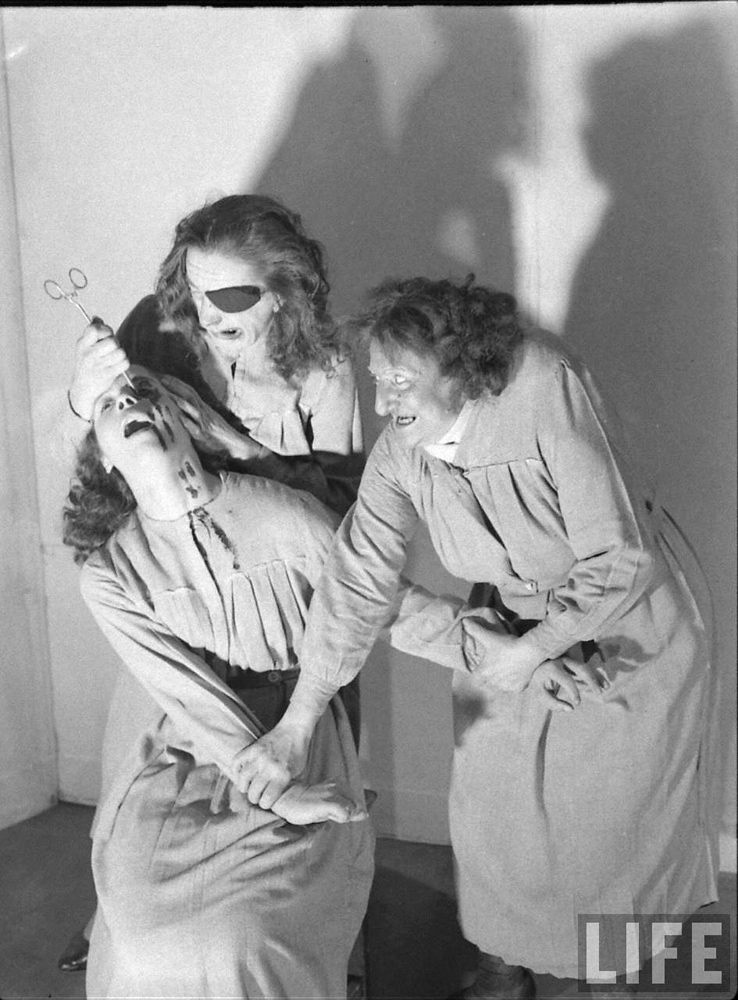
The retractable blade of the knife moves into the handle which squirts blood when pressed against the victim’s face. Affixed to the end of the handle is a piece of adhesive “skin” (latex or lamb skin) with a slit to allow the blade to move through it. As the handle is pressed against the victims eye the sticky “skin” is pressed to the eyelid leaving a gory empty eye socket. When the knife handle is pulled away the blade is released back into position. The actor with the knife squeezes a air pump in the handle and a rubber eyeball on the end of the knife inflates. The eye appears to be impaled on the tip of the knife. Many magic shops sell an inflatable ball and pump mechanism that could work as a base for this prop (Callboard, 1996).
Crime in a Madhouse. Photograph by Hans Wilder, 1947
Much of the development of the theatre’s effects are due to the above-mentioned Paul Ratineau. Many of the tricks were secret; some were even patented. Most were devilishly simple though. Their power and Ratineau’s cleverness did not come solely from the tricks though. He overcame a number of challenges. First, the stage itself was only twenty feet by twenty feet large, with the audience close enough to shake hands with the actors (“Theatre du Grand Guignol,” The Drama Review. Frantisek Deak, 1974). Second, the tricks needed to work consistently, in full view of the audience, and while the actors performed in character with other actors in the height of often-crazed emotions.
It should be no surprise then, that Ratineau also developed much of the Grand Guignol’s characteristic lighting. Besides setting the mood, the lighting could hide the imperfections in the prop trickery as well as guide the audience’s eyes to where it was desired. Similarly, the arrangement of the scenery and objects on stage combined with the blocking served to direct or misdirect the audience’s attention (O’Leary, 2005). Sound effects (also pioneered by Ratineau) were critical in bridging the gap between what an audience sees and what they imagine they are witnessing. Finally, dramatic tension and the power of marketing helped sell the bloodshed portrayed on stage by warming the audience up to a heightened level of expectation. The mystery of the special effects themselves added to the legend surrounding the Grand Guignol. In other words, the actual trick props, while clever, might seem crude and unrefined when studied under normal light and out of the context of the performances.
When money became tight, the theatre would prefer to stab women rather than men, because their smaller costumes were cheaper to clean. For head wounds, men were the victims because their short hair was easier to wash (Schneider, 1957). Schneider goes on to recount some of the more serious mishaps and accidents:
Naturally, all this gruesomeness is sheer illusion, but the sham is not always devoid of risk. Once, during an actress’ simulated hanging, the protective device broke and she almost did get hanged. Another recently was burned by the flame of a revolver. In “Orgy in the Lighthouse,†the heroine suffered even more; on one night, she almost caught fire; on another, her male partner began to live his part a bit too much and beat her up in earnest, so that she was forced to go off to the country to nurse a nervous breakdown.
See? Gore and horror aren’t always happy fun times.
Rebuilding the Boardwalk, pixel by pixel. A great article about recreating 1920’s Atlantic City for HBO’s Boardwalk Empire. With all the challenges you can imagine for such a task, one of the most difficult, according to the article, was finding the right chairs.
The Gizmologist’s Lair. W. E. Johns has such a plethora of articles and links on his site, I’ve barely scratched the surface and already have discovered so many great things. He has projects, reference for all sorts of technical and technological bits and more.