Ephemerotica


Accident Insurance Ticket uploaded by PaperScraps

Ephemera can be some of the hardest props to research and produce accurately, but thanks to the falling prices of bandwidth, storage, and digitization technologies, we see more and more scanned images of ephemera online everyday. It can be daunting to go through all the galleries and collections, and search engines are still less than ideal for finding the perfect image. Here are some sites I’ve discovered to help aid your search for the minor transient documents of everyday life. A lot of sites post a ton of links to other sites, but it can be frustrating as many places do not post images online, their images are unusable, or the navigation and search are just too complex and esoteric to use. Remember to search my blog in case you don’t see one of your favorite sites listed; I may have listed it in an earlier article.

The Ephemera Network has a lot of images uploaded by users. Because it is a community, there is also plenty of discussions and interaction concerning other places to track down ephemera. If you are a die-hard fan, you can even join in and share your interests or ask questions with other members.

The Ephemera Society of America has some nice links to online exhibitions displayed elsewhere on the web.

The Ephemera Catalog has a very large and very varied selection of ephemera for sale. The great thing about sites that sell ephemera is that they offer high-quality scans to entice buyers. The site also has a fantastic selection of ephemera links which should give you a few hours of entertainment.

Quadrille Ephemera shows a rotating selection of what they offer for sale. The shop specializes in more hand-written and personal ephemera, like invitations, checks and holiday cards.

Scott J. Winslow specializes in selling American historical memorabilia, mostly from the nineteenth century. The images on the site are pretty high-resolution.

Sheaff: ephemera has a lot of great images in a variety of interesting categories. Be sure to check out the “links” on this site; you’ll never leave the internet.

Beer Labels has nearly 5000 beer labels. The images on the website are watermarked, but they say they can email higher-resolution files without watermarks.

This huge collection of Wine Labels is organized by subject as well as brand.

The Central Pacific Railroad Photographic History Museum has documents, stocks and bonds, stamps, and other ephemera related to railroads.

The Ad*Access Project has over 7000 American and Canadian advertisements from 1911-1955.

A Nation of Shopkeepers is a collection of trade ephemera from 1654 to 1860. Check it out if you need business-related items from old-timey Britain.

Scrapbooks are great because they preserve many types of ephemera of lesser importance and pedigree that would normally be passed-on by collectors, but are nonetheless vital to adding detail to the world of the play. Heritage Scrapbooks has images from 21 scrapbooks of various ages. You can also check out Marion’s Scrapbook, from a young woman during her college years of 1913-1917.

If you’re interested in medical and surgical imagery, you can browse several thousand images at the History of Medicine.

I like this collection of holy cards left in books in the Ireland Library collection.

Arms, crests and monograms began to be used on stationary in England in the 1840s. They replaced the wax seal in many cases, which is oh-so-popular as a theatrical prop device. For the prop-maker obsessed with utmost historical accuracy, you can browse crests organized by topic to add to the stationary in your show.

Like stamps? Who doesn’t like stamps? Though images of stamps aren’t terribly difficult to search for, you can save time with this comprehensive index of stamps from around the world. Browse by country or topic and narrow your search by year.

Dying Speeches & Bloody Murders is an interesting collection; in 18th and 19th century Britain, broadsides were sold at public executions with an account of the crime or description of the criminal. They’re like an old-timey (and more gruesome) version of a program at a sporting event.

The Brooklyn Public Library has an interesting collection of ephemera related to the history of Brooklyn.

Likewise, the Kentuckiana digital library has paper stuffs related to old Kentucky.

Similarly, the Roscommon Historical Research site has ephemera from County Roscommon in Ireland. They do not have many examples online, and the pictures are too small to print directly, but they have such a great range of items that are often overlooked at other sites.

If you are interested in learning more about ephemera rather than merely looking at it, the articles at the Ephemera Society of America delve into the histories of all sorts of fascinating categories and subcategories of printed paper materials.

As always, one of my favorite sources for ephemera is Flickr. Do you have any favorite sites or sources? Leave me a comment and let me know!
When Irish props are smiling

The Abbey Theatre in Dublin, Ireland, first premiered The Plough and the Stars back in 1926. They’ve been producing it fairly regularly since then, and some of the props have been along for the ride. “Ploughing history into every production” by Sara Keating in the Irish Times is a great article about the pedigree of some of these props.

The ghosts of long-dead actors sit in chairs that are still recycled between productions, while the shadow of other plays hover above an original Victorian pram that has been used at the Abbey since its very first years. Such objects accrue stories in the same way that cities or buildings or people do. They are a palimpsest of many different lives and different uses.

They carry legends that are usually lost as actors and artists pass on: nobody thinks to write them down.

In the article, Ms. Keating interviews archivist Mairéad Delaney, prop master Stephen Molloy and prop maker Eimear Murphy. They explore the histories of some of these objects, such as Uncle Peter’s Sword, the Tricolor, Mollser’s Coffin, Bessie Burgess’ Shawl, and Mrs. Gogan’s Pram. The aforementioned pram had indeed been used in every production since 1926, and is over a hundred years old by this point.

The Abbey also possesses the original prompt script for the play, filled with notes and scribblings of everyone including Seán O’Casey, the author. All of these objects are remarkable in their own right, but even more so because they survived the Abbey Theatre burning down in 1951 and being completely rebuilt.

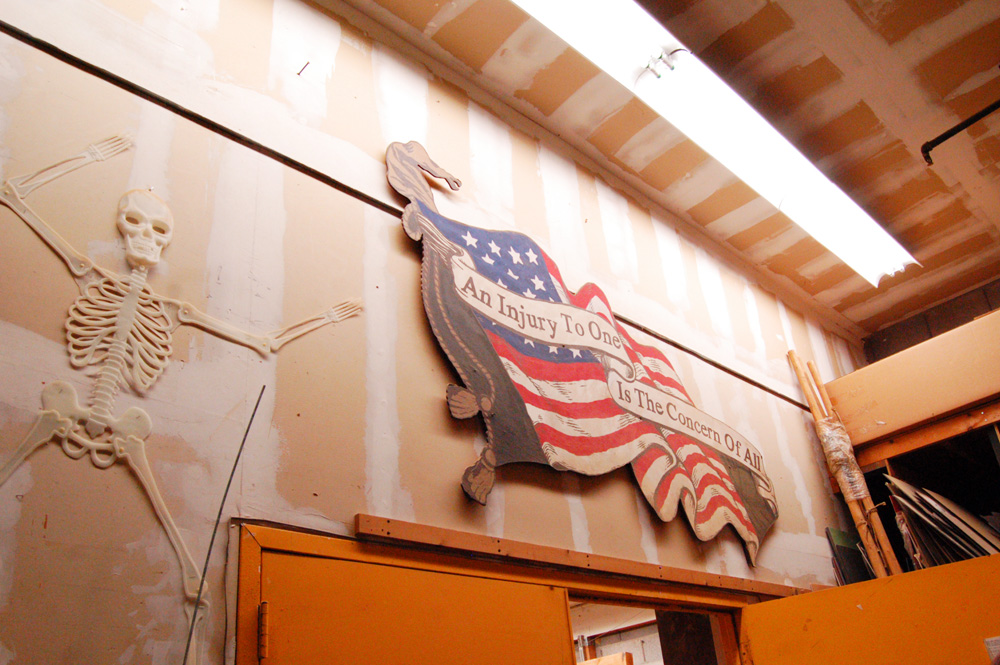
Berkeley Repertory Theatre prop shop

During the 2010 S*P*A*M Conference, we visited the Berkeley Rep prop shop. Even if you’re not familiar with the Berkeley Rep, you’ve probably heard of some of the shows that came from there: American Idiot and In the Next Room (or The Vibrator Play) are two of the more recent shows which have come to New York City. Ashley Dawn, the prop master at Berkeley Rep and one of the hosts of the Conference, graciously gave us a tour of their prop shop.

BRT prop shop
BRT prop shop

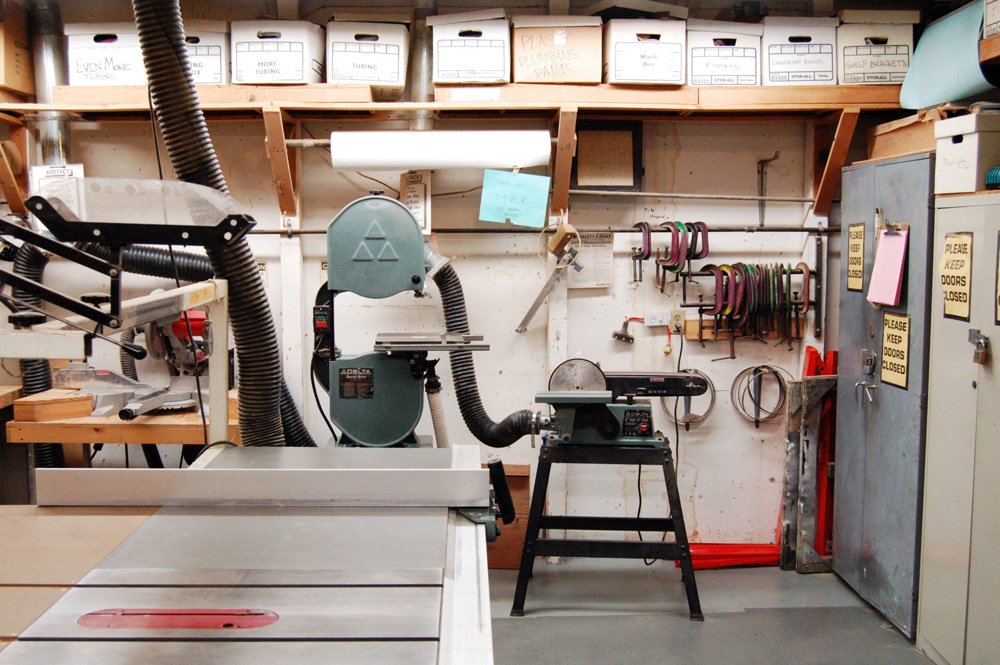
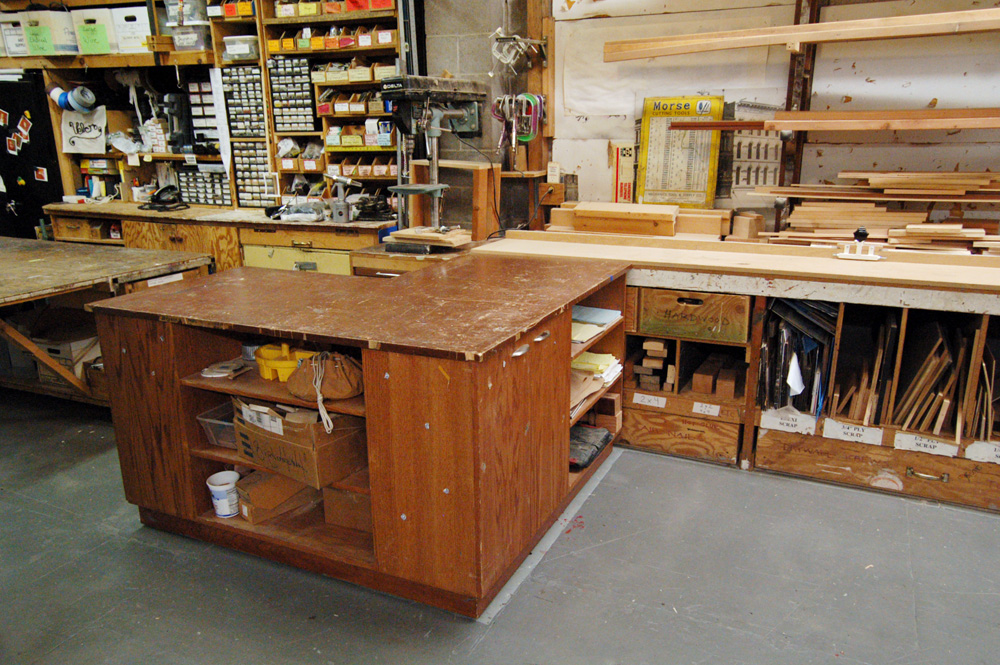
The prop shop is located within the same building as the theatre. Notice all the dust collection hoses. Also, the shop is very clean, and every nook and cranny has some form of boxes, bins, drawers or shelves for storage. Though hectic at first glance, it was actually very clean and well-organized, and once you knew your way around, it seemed it would be easy to quickly locate whatever you needed.

BRT prop shop
BRT prop shop

Berkeley Rep is fairly similar to the Public Theatre in terms of the size and number of shows produced in a season. In fact, many shows we do are co-productions. It was inspiring to see how they’ve organized their limited space to handle the demands of their shows, particularly because our own shop is larger. It would appear one can always squeeze more use out of a space, no matter how small.

Sign over the BRT prop shop

They have a separate area for welding and working with metal, which is also shared by the scene shop when they are at the theatre loading in a show. During the rest of the time, the scenery is built and painted at a much larger building a few miles away. In the near future, they are getting a new facility where scenery, props and costumes are all housed together; the prop shop I just showed you will soon be no more.

Choosing the right disposable glove

First, I wish to offer a caveat; I don’t write much about safety, because it’s a highly complex area, especially once you start talking about safety around chemicals. I’m not an expert, and if you are in a workplace situation, there are actual regulations, standards and laws that need to be followed. The last thing I want is someone’s sum total of knowledge about safety coming from “Eric Hart’s Props Blog.” Still, the home hobbyist may not know where to look for information, and the prop shop employee may not know what questions to ask their employer, or what their employer is responsible for providing. Thus, what follows is not a guide for choosing the right disposable glove; rather, it is a guide to what questions to ask and what information to look up to learn which disposable gloves are best for each situation. All the safety data in the world is useless if we don’t know what information we are trying to find, or even that we need to find certain kinds of information. Often, we don’t know what we don’t know.

Dozens of companies make disposable gloves, offering hundreds of combinations of materials, thicknesses and liners. You need to find the permeation data for the specific gloves you are using. This will tell you how long it takes for specific chemicals to work their way through the glove and onto your skin.

No single glove will protect you against every chemical. There were approximately 50,000,000 chemicals registered by the CAS on September 7, 2009, with more being added at the rate of twenty-five per minute. Luckily in theatre, we only use a small percentage of those chemicals. If you work at a theatre or shop in the USA that employs ten or more people (that’s counting the whole theatre, not just the prop shop), then it is subject to OSHA regulations, and your employer is required to inform you of any toxic chemicals you may be using.

As a general rule of thumb, you should be wary of rules of thumb when it comes to safety. But a good rule of thumb to follow in safety is “don’t get stuff on you, and don’t breathe anything that isn’t air.” Choosing the right glove falls under the “don’t get stuff on you” part of the rule. Gloves are necessary because many chemicals can be absorbed through the skin. Chemicals commonly used in prop shops that can be absorbed through the skin include solvents and epoxies. Solvents don’t just include pure solvents like acetone, xylol and mineral spirits, but also any product that includes solvents: spray paints, cleaners, adhesives, etc.

Another good rule of thumb is that latex gloves don’t stop any chemicals. They can keep your hands dry, and they’re great for keeping blood and other bodily fluids from getting on your hands. They’re also useful for the reverse: keeping your own sweat and oils from getting onto your work surface. But as far as working with any sort of industrial or household chemicals, they may as well be invisible.

Notice how I mentioned household chemicals above. Just because you can buy something in a grocery or drug store doesn’t make it safe to work with without proper protection. For example, many cleaners like Windex, 409 and Simple Green use a chemical called 2-Butoxyethanol. The toxic exposure level of 2-Butoxyethanol is less than that of acetone and hexane, placing it in the category of “highly toxic” chemicals. When you start looking at permeation charts for popular glove brands, you see a trend; latex gives you no protection, while neoprene and vinyl will offer only several minutes before exposure begins. If you are using anything other than nitrile, you are exposing yourself to a highly toxic chemical.

If you are using a glove and the substance is splashing or spilling onto your bare arm, it defeats the purpose. Make sure you are wearing sleeves that offer similar chemical protection, or use longer gloves.

Many chemicals we use for prop making are toxic through skin absorption. An example is any of the two-part epoxies we use: sticks of epoxy putty, five-minute epoxy glue, epoxy coatings for fiberglass and carbon fiber, epoxy resin for casting. Epoxy is a sensitizer, which means our bodies do not react to it on the first exposure. Rather, it is on the second or subsequent exposures where we develop what is essentially an allergic reaction. It can even be after decades of using a product before one reacts to it. But reaction can be severe. Here is a chilling but not uncommon description of a reaction:

Open, oozing, and itching insanity hives virtually all over my body and my eyes literally were swollen shut for a week on two separate occasions. Recovery, each time, took better than a month.

Once developed, it is not reversible, and occupational physicians may advise you to not only never use epoxy again, but none of the “two-part” chemicals in that category. No more Smooth-On products, Great Stuff, A-B foam, etc. If you make your living as a props artisan, you pretty much have to do all your molding and casting out of plaster.

It is important to note that permeation data charts tell how long it takes for a chemical to permeate through a glove. This implies that no glove will offer permanent protection; they are called “disposable” for a reason. In fact, the most a glove gets tested is for 6 hours. If you use a pair of gloves all day, don’t set them aside for the next day. In fact, you should throw the gloves away. Trying to stretch the use of a pair of gloves to save money may seem thrifty, but it is actually counter-intuitive. The same is true of any safety measures and products you use. If you use or reuse them improperly, you get the worst of both worlds; you are spending money but not keeping yourself safe. If you feel you are spending to much money on safety equipment to make props, the best solution is to stop making props. You don’t go scuba diving without an air tank. We often get in situations where the easiest solution seems to be to continue on and finish a prop; it’s late and you’ve run out of gloves, and all the hardware stores are closed, and all you need to do is get one more coat of epoxy on so it can cure by the morning and they can use the prop in rehearsal. When you get to those situations, remember this: Your goal in life is not to finish that single prop. Your goal in life is to build props for the rest of your life. Taking shortcuts now will affect your health later on. No prop in the existence of humankind has ever been more important than your health.

A good shop foreman will be consistent in his or her purchasing of disposable gloves, so you don’t have to hunt down the permeation data every time he or she buys a new brand.

In conclusion, don’t get stuff on yourself. You should know what is present in any material or substance you are working with. If it includes chemicals that can be absorbed through your skin, you need to find out what glove will offer protection from that chemical, and how long it will offer that protection. Remember that gloves from different companies may differ in their permeation data, even if all the stats on the box seem the same.

More interviews with props people

Today I wish to present you with a number of interviews with prop masters and makers in theatre, television in film. It’s good to get perspective on the job from other people. For most of the interviews, I’ve pulled out some select quotes which especially struck me. Enjoy!

An interview with Sarah Bird, prop master on On the Levee. Sarah is a New York City-based prop master, and this is a nice little video about the work she did at Lincoln Center Theatre.

An Interview with Ken Hawryliw, prop master on Battlestar Galactica, which is notable for being the BEST TV SHOW EVER:

What he taught me is the attitude that someone has spent a huge amount of money, sometimes hundreds of thousands maybe millions of dollars, to design an object that you can now buy for a few dollars. Why not take that object and use it; build it into a prop because the design is great already. You’re incorporating it into something that has to function and the ergonomics are already built into it, so it makes a lot of sense to do things that way. It’s very economical.

Prop Talk with BURN NOTICE’s Charlie Guanci, Jr.:

Usually it’s reading/breaking down scripts and jumping right into the next day of work, but I do try to find out what are the latest interesting pieces and what I can bring to the table so if I’m asked or I can provide a solution to something from doing my own research through the Internet or talking to people or seeing something on YouTube. You hear about things, I get feedback from other people saying, “Hey, have you seen this, have you heard about this?” I book-log that and it’s like, “Let’s try to do that.”

Interview with Graham Coutts, propmaster on Friday the 13th.

You never have free rein, everything involves collaboration and approval, however, I think the Designer has a high degree of confidence in my ability.

MPPC Exclusive: Rick Gamez – Jack of All Trades, Master of Most. Prop maker on films like The Rocketeer, Men in Black, Independence Day, et al.

It’s getting smaller and harder to make a living at this due to so much emphasis on computer generated imagery. What once was to provide a ton of weapons for an army now is just a handful who are copied and pasted onto a battlefield. There will still be a call for Hero props but the mass amounts are gone. Shows keep looking for cheaper ways of making shots happen. They tend to look mostly where they can get the best tax break and shoot there. The trickle down of budgets affect every department and so it does with mine as well. The days of the skilled worker is changing to the skilled computer artist.

Making and finding props for theatre, film, and hobbies