Thoughts on Green Props

I hate the word “green”. I believe the “green” movement has largely been co-opted by marketers and advertisers in an attempt to sell the same stuff in a new feel-good form. “Green” bottled water and “greener” disposable packaging still has a negative effect on the environment and community.

That being said, I whole-heartily subscribe to what “green” should mean. We can’t pretend that things disappear when you put them in the garbage, and you have to understand that everything comes from somewhere else; how it is made (or mined, or harvested, etc.) has a real impact on people’s lives.

Every bit of lumber we use means less trees somewhere else. In some cases, they come from a place where trees are replanted to replace the ones taken, and a whole group of people are able to make a living for their families. In other cases, entire ecosystems are destroyed as forests are removed, and the native people who live there are pushed aside and left with nothing to sustain them. This is true of all materials. Being green is not some feel-good philosophy to make animals smile. Choosing greener products is a declaration that the materials you buy for making props are less important than razing a village and giving cancer to children.

As props people, we are already predisposed to being green. We collect and reuse things from the past that were destined for the dumpster. We keep our budgets down by trolling thrift stores, eBay, and Craigslist. We let others borrow, rent and buy the items we’ve accumulated. We are largely pack-rats; the only reason we get rid of things is because we physically run out of room to store it in our already overstuffed storage areas.

Being green is also safer. If a product releases toxic chemicals when being used, chances are it also damages the environment in its creation. A shop which chooses less-toxic alternatives in its materials and supplies, which provides proper safety equipment and ventilation, and which is aware of the affects of what it uses (by studying and maintaining its MSDS collection) is already greener than a shop which doesn’t.

For more practical tips and additional information about green theater, you can explore the following links. None of them have to do with props specifically, but combining the information on scenery, costumes, and offices will give you a good start.

Behind the Scenes at the Theatre, 1861

Originally published in Dwight’s Journal of Music, 1861.

Now let us step into the “property room.” This is under the charge of an individual known as the “property man” of the theatre, and “theatrical properties” are the various articles other than dresses used in the representation of plays; consequently the property room of a large theatre is quite a museum, and really a very curious sight to one who visits it for the first time.

Here are embroidered purses of gold (filled with broken china and tin), fat pocket books of (newspapers) bank notes by rich old uncles in farces, kings’ golden sceptres, fairies tinselled wands, goblets of gold, flagons of silver, tin cups for peasants’ revels, and papier mache chickens and roast beef for dinner scenes, caskets of jewels, gorgeous Dutch metal candelabras, signet rings for monarchs, and staffs for beggars and witches, Othello’s handkerchief, the witches’ cauldron, Romeo’s vial of poison, Shylock’s scales and knife, Falstaff’s jug of sack, Friar Laurence’s rosary, Prospero’s wand, clubs for mobs, shillelaghs for Irishmen, writing aparatus for lovers to write hurried letters, kings to sign death warrants, and spendthrift’s heirs to draw bills, the “letters” used in different standard plays, all alphabetically arranged and properly superscribed ready for use, so that they serve whenever the play is performed, wills and deeds with broad seals and black marks made to look well “from the front,” crown jewels, jugs of ale without the ale, and a thousand other things used in mimicking life and representing romance.

We must not, however, forget the armory part of the property man’s charge, not the least curious part of his collection. Hero the visitor finds stands of muskets enough for a company, glittering spears for a Roman legion, gleaming battle axes for barbarians, curved scimitars for Moslems, and straight blades for true cavaliers, Spanish rapiers, Highland claymores, Toledo blades, and English broadswords. The fasces of tho Roman lictors and pole-axes of the Queen’s guard stand side by side, the executioner’s big axe and block repose grimly in a corner, while on the walls are daggers of all sorts and sizes, from the delicate one which the maiden draws as a protection against dishonor, to the broad blade bared by the murderer or ‘front wood robber,’ who steps softly over the stage when the lights are turned down, to thuds of the big fiddle; pistols, tomahawks, and other murderous implements in glittering profusion.

Whenever it happens that any of these properties are needed, the prompter makes a requisition on the “property man” the morning before the play in which they are used is performed, and the latter sees that they are ready in the evening, either in the dressing-room of the actor, if they are to be carried upon the stage, or upon the stage in their proper scene and position. The property man is generally an expert in imitating real articles with papier-mâché, paint, gold leaf, tinsel and Dutch metal; he manufactures the dragons, demons’  heads, and furnishes the blood, thunder and lightning, stormy waves, and sun and moon for the establishment.

From Dwight’s Journal of Music, Volumes 19-20, by John Sullivan Dwight, 1861, pp. 228-229

Fun Prop Quotes

Today, let me regale you with several quotes I’ve collected from mid-twentieth century books on props.

“One of the key jobs on any film set is that of the property master, and his range of activity is perhaps the largest of all. If it ‘moves, it’s mine,’ the prop man can say, on most occasions.”
People who Make Movies, by Theodore Taylor, 1967 (pg 76).

“In the property-maker’s room lives the wizard of the studio. He is always experimenting with new compositions with which to get the multitudinous effects that he is called on to supply. Latex, rubber solution, glues, Rhodoid, cellophane, resinous plastics, Perspex, and ingenuity – these are his materials. He is an inventor, a chemist, a bit of an artist, and an engineer.”
Designing for Films, by Edward Carrick, 1950 (pg. 106).

“The three basic types of properties are stage props, such as furniture, news desks, and lecterns; set dressings, such as pictures, draperies, and lamps, and hand props, which are items such as dishes, telephones, and typewriters actually handled by the talent.”
Television Production Handbook, 5th ed., by Herbert Zettl, 1992 (pg. 440).

“The most important part of any storage area is its retrieval efficiency. If you must search for hours to find the props to decorate your office set, even the most extensive prop collection is worth very little. Clearly label all storage areas, and then put the props and scenery back every time in the designated areas.”
Television Production Handbook, 4th ed., by Herbert Zettl, 1984 (pg. 28).

“As soon as the actors are free of books, important hand props (those handled a good deal by the actors) should be brought to rehearsal – or rehearsal substitutes provided – so actors can practise the use of them and save time at dress rehearsals.”
Directing for the Theatre, by Wieder David Sievers, 1965 (pg. 246).

Confusions in the Definition of a Prop

The definition of a prop is a sometimes nebulous thing. We all know that a book or an apple is a prop. But what about a purse or a built- in bookcase? And why is props in charge of manual sound effects and bushes? The confusion stems from the fact that what a prop is and what a prop shop does can be different things. To confound this, one prop shop may have slightly different duties than another; also, the duties of a prop shop in theatre are different then that of a props crew in film. As one final confusion, an individual production may see a slight modification in the duties of the prop shop based on the specific challenges in relation to the workloads of the various shops. A scene shop may build a certain prop because their shop is better equipped for its manner of construction. It is still a prop in the academic sense. After the show, it goes into the prop shop’s storage, and if used again, it is a props person that pulls it from the stock. Likewise, in a future production, the prop shop may be better equipped and can build a similar prop on their own. It is not the scene shops duty just because they built one in the past.

Keep these three confusions in mind when talking about the definition of a prop. Though usually the same, the academic definition of a prop and the practical obligations of a prop shop are sometimes at odds.

Make a Switchblade

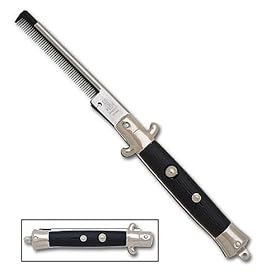
Here’s an old prop chestnut which we’ve used during our current production of Bloody Bloody Andrew Jackson. Let’s say your play requires a switchblade or two. Real switchblade knives are fairly illegal; even if you can find a place that sells them, you often need a special license to purchase it. However, you can buy switchblade combs at many novelty stores.

Switchblade Comb
Switchblade Comb

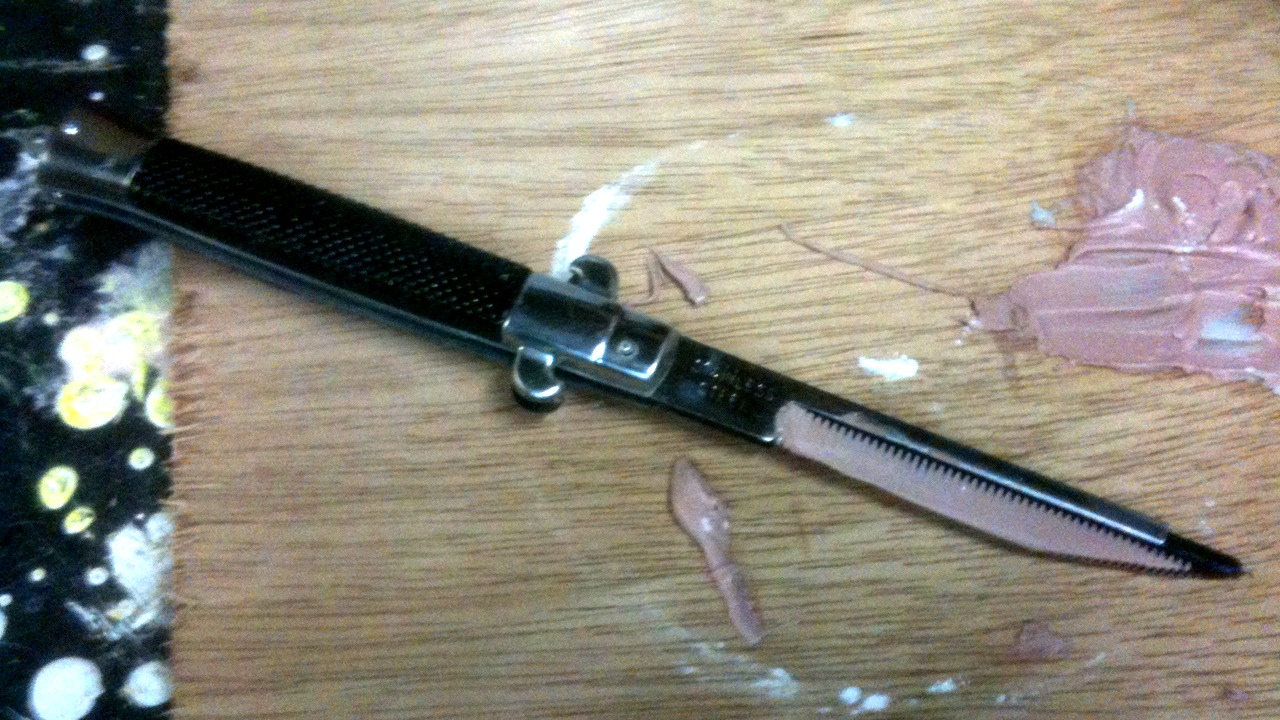
You can fill the gaps in the comb part with Bondo (or whatever your preferred brand of auto body filler is). Sculpt it into the shape of a blade, but be careful not to get much thicker than the comb; if you add too much thickness, the blade will no longer pop out.

Fill the gaps of the comb with Bondo

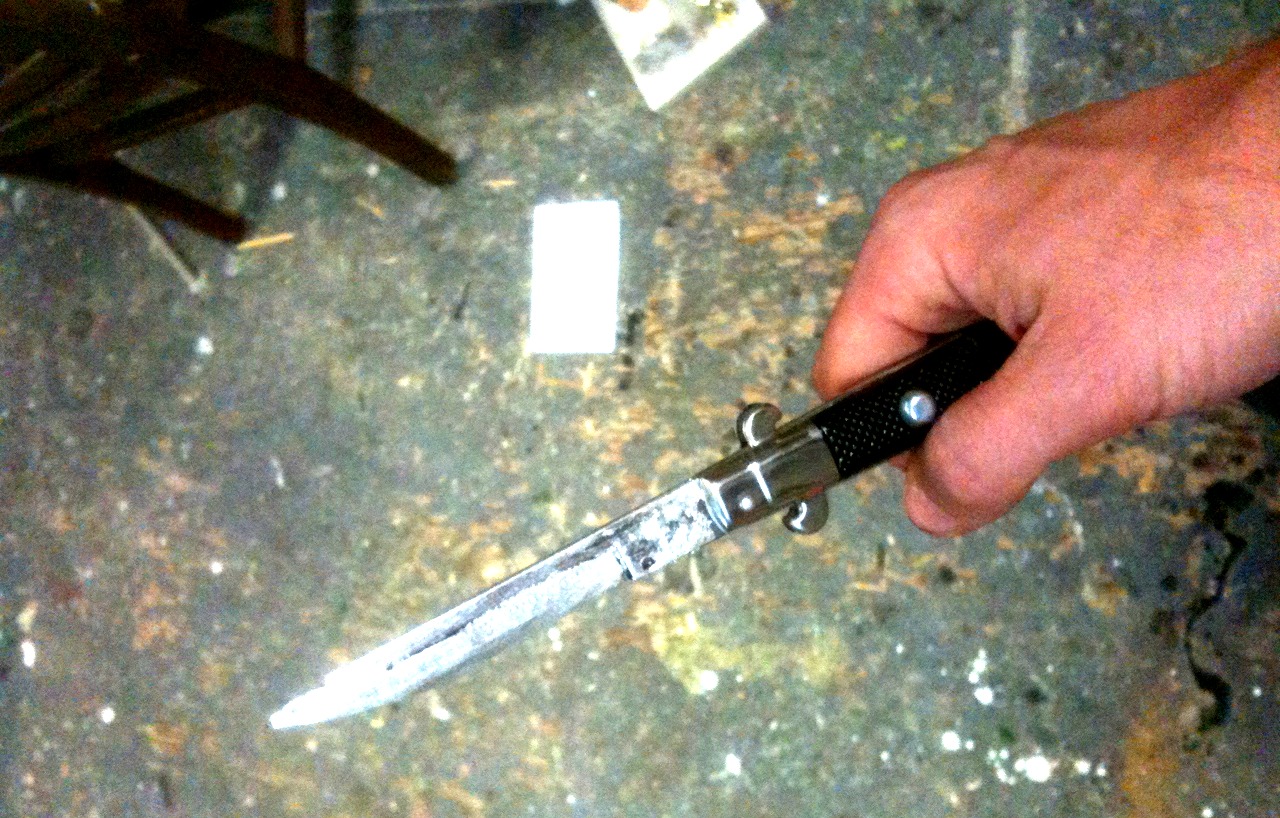
Finish it off with silver-leaf. Again, silver-leaf will add no thickness to the blade (which some paints might), and it will give it the ability to glint and gleam from the stage. It will also be less likely to rub off during frequent usage.

Switchblade comb, or knife
Switchblade comb, or knife?

Making and finding props for theatre, film, and hobbies