Paper-tearing jig

Our upcoming show requires a large amount of torn pieces of paper. They also live in a working sink throughout the production. As with any paper prop handled roughly by an actor (and especially one that might get wet during the show), we treat it almost like a consumable, with a large amount of back-ups at the ready.

Natalie came up with a quick jig to ease this operation. It’s a small piece of quarter-inch MDF with each edge giving a different “deckled” pattern.

So get out there and tear it up this Friday!

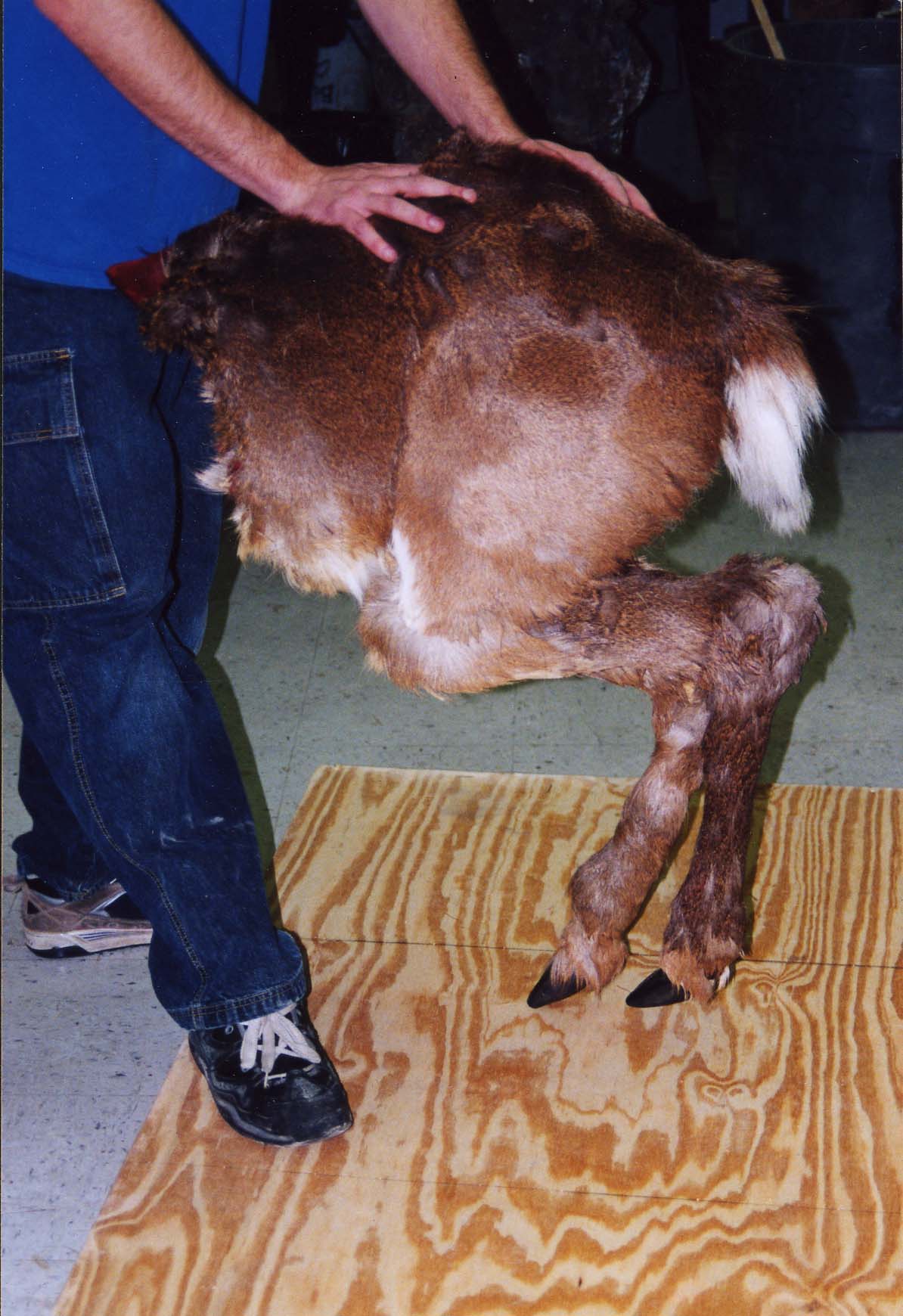
Deer Butt

Last Monday, my wife and I saw A Lie of the Mind by the New Group up at Theatre Row.

Deer Butt
Deer Butt

We went because Natalie had her deer butt in the show. She didn’t make it for this production though; she made it at Ohio University over seven years ago. Matt Hodges, the prop master for the current production, found it in his search for a deer butt; it just so happened he was in our shop around when Tom Fiocchi, the prop master at Ohio University, told Natalie that someone had bought her butt. Thus, I was able to score some tickets, and Natalie was able to see a prop from her past.

Remember kids; build a prop well, and it can live for years to come!

The Property Department of an opera house in 1851

This article first appeared in The Critic, a London literary journal, in 1851.

A Peep into the Interior of an Opera House

The Property Department

The word “property” implies that vast variety of articles which, after the scene is placed and the actors are dressed, are still required to complete the picture. It is easier to name some of these things than further to define their general character. Among them are stage furniture – tables, chairs, sofas, ottomans, curtains, draperies, musical instruments (other than those used by the orchestral performers), flowers, vases, garlands, helments, swords, spears and shields, thrones and canopies, animals, jewel caskets, crowns, coronets, and sceptres, guns, halberds, wings and wands for fairies, altars, cabinets, goblets, banquetting boards, tombs, sledges, carriages, garden seats, chandeliers, banners, trophies, croziers, flags, mitres, candlesticks, beds, clocks, looking-glasses, lanterns, emblems, masks, palm branches for angels, and torches for devils. With such a specimen of the varieties, each of which is “a property,” some idea may be formed of the ingenuity, readiness, and industry which send up all these things when wanted, and a thousand others, from the bowels of the theatre itself. For nearly everything is manufactured on the spot. Descending through some labyrinthine passages, and below the level of the put, the explorer finds a series of apartments where day does not seem to come, but where eternal gas more than supplies its place, and where – under the superintendence of the most talented of property masters, Mr. Bradwell – a body of workers male and female, are engaged in making and ornamenting these articles, renovating old ones, and transforming them from one fashion to another, or skillfully carving, and gilding, and painting new and fresh ones. The scene, as may be imagined, is extraordinary, from the miscellaneous character of the manufacture. For while some of the objects are substantial and real, others are but imitations. A chair or a sofa, for example, is solid and steady – which is well, for Signor Lablache may chance to sit upon it – whereas the spear of the angel, or the pickaxe of the peasant, which is to be wielded by some young lady in the wings or a jacket, as the case may be, is of some light wood, with silver paper counterfeiting steel, or a little dark paint affecting to look like iron. There is, of course, a separation in the labour, but to the unaccustomed eye there is a series of visions of gold, shavings, bright colour, carpenters’ benches, diamond stars, tenpenny nails, goblets of rosy wine, and unmistakeable gluepots. But it requires a more intimate inspection of the work, and a comprehension of its heterogeneous character, to do justice to the extraordinary ability of the property master. When a new opera or ballet is to be produced, he makes out, very early in its history, a list of everything which can possibly be wanted upon the stage, and he is responsible for the scenes lacking nothing when the curtain rises.

Originally printed in The Critic, London Literary Journal. Volume 10, Published by J. Crockford, 1851 (pg. 183)

Mechanical Elephants

I have elephants on the mind today; I’m not sure why.

This elephant is from a French show in 2006 called “Visit From The Sultan Of The Indies On His Time-Travelling Elephant”. It was designed by François Delarozière, made mostly of wood and needed 22 handlers to operate its hydraulics and motors. But wait, there’s more.

Continue reading Mechanical Elephants

Why the term “prop master”?

Why do we use the term “property master”? In our modern world of “directors”, “managers”, and “heads”, why use the word “master”? Where does it come from?

The term “property master” is in reference to the old European guild systems. In a guild, a person would apprentice to a master for several years, learning the trade. He (or she) would then become a journeyman, traveling from one master to the next, practicing their craft in exchange for housing and a daily wage. Finally, one would apply to the guild for membership, often having to complete a masterpiece showing competence in your given trade. Only a master could run their own shop. Thus, a props master denotes one who is proficient in the craft of props, and is qualified to run a props shop.

Did props people actually belong to a guild in the Middle Ages? Probably not; as seen in my previous post, guilds supplied the props for Medieval pageants. Thus, the bread was supplied by the master bakers, and the ships provided by master shipwrights. A “property-master” would be redundant. It would appear that the term did not exist while guilds were predominant in Europe.

The term “property” was used in a theatrical sense since at least 1425 A.D. We have evidence of what these properties are from the late Middle Ages on through the Elizabethan Period. We know that the companies accumulated and stored props, that they commissioned special props from the guilds, and that the actors themselves would supply a lot of the more personal props. However, we don’t know the term for the person who would head the organization of all these props. Perhaps there was none, and the duties were split between the owners, managers, and artists of the company.

We first hear about a general “property-man” in 1749. W.R. Chetwood’s A General History of the Stage describes a property-man as “the person that receives a bill from the prompter for what is necessary in every play; as purses, wine, suppers, poison [etc.]”. The earliest occurrence of the term “property-master” I could dig up is in England in 1831. This sentence appears in “The Royal Lady’s Magazine”:

The other parts were filled as usual, Curioni being the Idreno, and Lablache the Assur. Curioni makes a woful [sic] mistake in dressing himself like a Cherokee Indian: somebody should instruct him, that there is more than one India, and that he errs in thinking he is king of that which is in the west. Talking of costume, cannot the property-master find something more resembling a crown than the bottomless tin-pot which is at present stuck on Arsace’s head.

The Royal Lady’s Magazine. July, 1831 (pg. 56)

It would appear than that the head property-man began to be called a property master well after the guilds had begun their decline. This terminology is also confusing because a props shop does not operate as a guild in the legal sense. Some occupations, such as electricians or contractors, are required to be licensed, which is similar to the requirement that a crafts-person belong to a guild in order to participate or run a shop. A property master does not need a license nor any specific schooling or degrees to operate.

Unofficially of course, a props career still operates like a guild in many ways. I began as an “apprentice in props”, followed by a property carpenter journeyman position at the Santa Fe Opera. The Actors Theatre of Louisville where I once worked also hires journeyman. (Check out “The Wanderers“, an interesting look at the modern revival of journeymen artisans in Europe.) The idea, if not the name, of journeyman can be seen in the career paths of many theatre artisans as they travel from theater to theater taking a variety of seasonal and over-hire positions to build their resumes and portfolios.

You don’t hear a lot about formal apprenticeships anymore, where a beginner spends five to seven years cleaning the shop of a master in exchange for knowledge and housing. Many theaters have apprentice programs (sometimes called “internships”) which last for a season or a year, some of which are quite good. There are of course, many other theaters which hire apprentices and interns and use them merely as cheap labor, imparting no guidance or knowledge whatsoever. We all like the satisfaction of solving a problem on our own, but the value of being taught the basics in the beginning cannot be underestimated. It is highly inefficient for so many people to be reinventing the wheel every year in theatre, especially when there so many more worthy prop challenges.

But I digress. What I’ve described here is the most reasonable sounding theory I’ve heard on why the head of a props department is called a “property-master”. If you’ve ever heard your own theories, or heard additional evidence either for or against this one, let me know!

http://www.guardian.co.uk/money/2006/jul/15/careers.work5

Making and finding props for theatre, film, and hobbies