
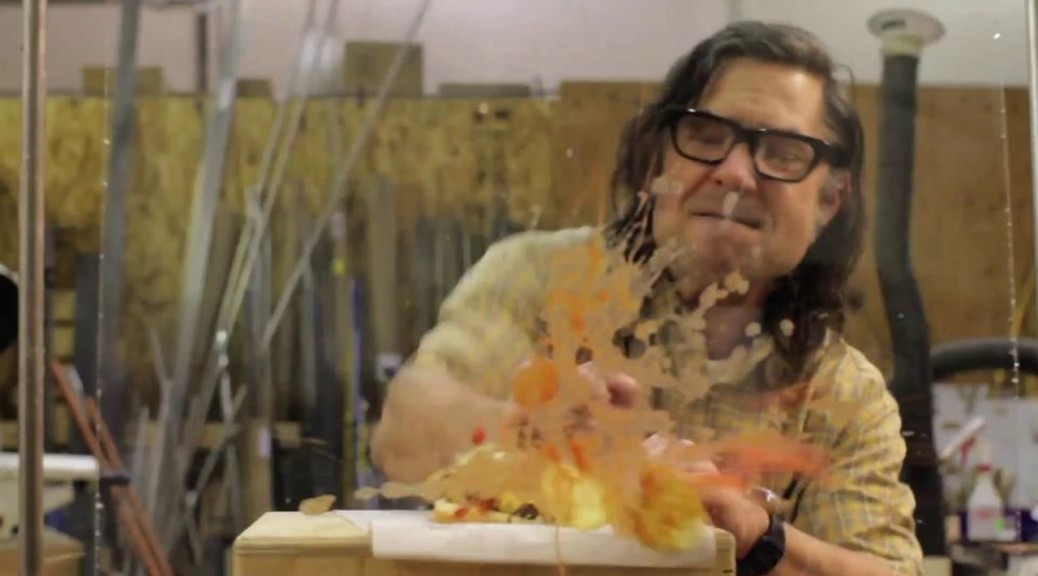
ParaNorman is a film from 2012 made by the same folks as Coraline. Like Coraline, the film is composed almost entirely of stop-motion animation, using color 3D printers to make many of the replacement parts for the character faces. Still, it also used a ton of hand-building, particularly for the props, set dressing, and vividly-detailed landscapes. Check out this all-too-brief featurette on the hands that made the world of ParaNorman. So many model houses. So many tiny props.
Friday Rehearsal Notes
I have an article out in this month’s Stage Directions magazine, hot off the presses. For “Cabinet of Wonders“, I spoke with Marc André Roy, the lighting project manager on Kurios, the new show from Cirque du Soleil. Kurios has a lot of props with wireless lighting and motion effects, and we looked at how Cirque makes that happen. I also talked with James Smith at RC4 Wireless, where all the wireless dimmers that Cirque uses are made. You may remember my blog post on my trip to RC4 Wireless earlier this summer.
These photographs of the inventories of British Soldiers are endlessly fascinating and useful. Thom Atkinson has taken all the gear and paraphernalia that a British soldier was issued at various times in history over the past 1000 years, and laid it all out on the floor. If you wanted to know what an archer was carrying at the Battle of Agincourt in 1415 (say, if you’re doing Henry V), this is where you should go.
The Examiner has a great interview and profile of Beth Hathaway, a master of building creatures for film. Hathaway has been a fabrication specialist at Stan Winston Studios and KNB EFX for decades, working on projects such as Edward Scissorhands, Jurassic Park, Terminator 2, Star Trek: The Next Generation and The Walking Dead.
Finally, check out this LA Times story on Nick Metropolis, the famed LA store filled with junk and jumble of all varieties.

Bill Doran Builds a Sniper Rifle from Mass Effect
Bill Doran of Punished Props has a new video up showing the build of a sniper rifle from the Mass Effect video game. He has a great process down, showing how to layer up materials to get all the different shapes, and approaching each layer with various tools to get the most precise result possible with the least amount of effort. Enjoy!
1903 Lectures on the Property Man’s Job
I recently came upon the 1903-1904 academic catalog for the American Academy of Dramatic Arts. At that time, it was a two-year program for young men aged sixteen to seventeen. The school still exists, granting two-year associates degrees to aspiring actors.
All students at the time were given introductory lectures in the various technical departments on stage. The lecture on props has a bullet-point list of all the topic covered, which I have reprinted below. It is fascinating to see the list of what a props person was responsible for and what skills they were required to have from over 110 years ago, and compare it to today.
The lectures were given by a Mr. Wilfred Buckland, with assistance by Mr. Edgar J. M. Hart (no relation) and Miss Louise Musson. The topics of the lectures are as follows:
The Property Man’s Work in Preparing a Production:
- The property plot
- cabinet work
- paper work
- upholstery, furniture, bric-Ã -brac, carpets, rugs, hangings
- stage props
- side props
- hand props
- written letters
- inserts in newspapers
The Property Man’s Work at Performance:
- Helpers and clearers
- system
- the property room
- laying the floor cloth
- setting the stage
- marking
- dressing a scene
- hanging curtains
- hanging side props
- effects
- apparatuses
- flash pans
- rain box
- thunder box
- thunder crash
- glass crash
- carriage roll
- knocks
- snow box
- salt
- fuller’s earth
- blowers
- leaves, stumps, and grass mats
- animals
- the rosin box
- eatables
Striking Properties:
- Clearing
- handling furniture
- care of props
You can read the whole 1903 Annual Catalog of the American Academy of Dramatic Arts here.
First Links of August
Happy August, everyone. While the “regulars” still have some summer left, those of us in theatre are already gearing up to work on all the new shows for the fall season, not to mention those of us in the academic world getting ready for the new school year. But there’s still time to read about props stuff on the internet, so enjoy the following:
Priceonomics has a short history of fake money in the movies. It delves into some of the more high-profile cases of fake movie money making it into the real world, and the resultant crack-downs by the Secret Service. It goes into detail of some of the rules of using money on film and how the top prop houses modify their fake money to follow those rules.
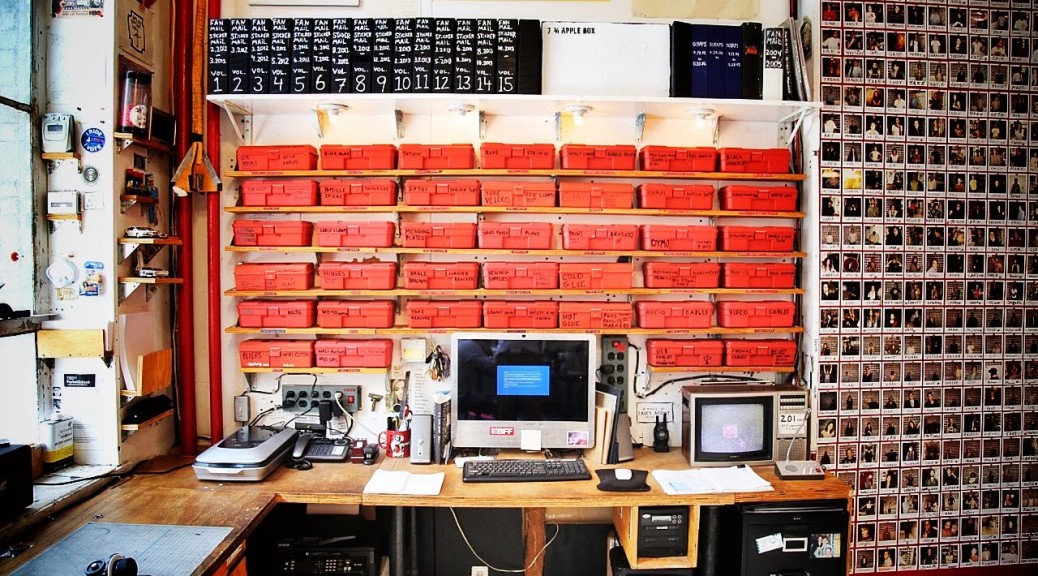
Casey Neistat has a new video series on his studio, and his first video shows his red box system of organization. Â He’s an independent film maker, but his system solves the same problems that prop shops have: how to save a little bit of everything, but be able to find it quickly.
Adam Savage has spent over four years painstakingly recreating the Mecha-Glove from the Hellboy film. Tested has a video where they talk with Adam about all the various processes and challenges of building this complex piece.
Finally, Credits has a great piece on building The Guardians of the Galaxy. Though it only briefly touches on the props for the film, it does delve into a lot of the physical and design work that went on in a number of the departments. Plus, it looks like a really exciting film.