The Ten Best Props (of 1921)

The following article, written by Lisle Bell, first appeared in Theatre Magazine in May of 1922. It’s interesting that theatre-goers from almost a hundred years ago recognized that props were forgotten during awards ceremonies. It’s also cool that one of the ten best props of 1921 was the bar in “Anna Christie”, a prop that I tackled earlier this year.

As the dramatic year draws to a close, the critical pastime of handing out the laurel begins. The producers are sitting in their box offices, counting out the money, and the actors are beginning to look forward to the relaxations of the Atlantic or of Great Neck, but meantime the critical judges, both professional and amateur, are busy thumbing over their accumulated programmes. Those who have blue ribbons to pin, prepare to pin them now.

These exercises usually take the form of “ten best” and “ten best that.” Combing over the productions of the season, the experts select the plays and players who have, in their estimation, contributed most to the advancement of their art. Their choices, alphabetically arranged or else tabulated in the order of merit, are duly published to a waiting world, and mere theatregoers spend many a pleasant evening quarreling with their decisions or improving upon them.

The Drama League makes an authentic choice of those who have rendered the greatest service to the cause, and those thus honored are invited to a banquet, where they occupy such positions of distinction, and are in fact so conspicuous, that one wonders whether they really have a chance to enjoy the food. Perhaps, however, the actors who attend those functions do not have to satisfy an appetite, and so merely go through the motions of eating with evident relish, much as they might do while taking part in a stage meal.

There is something truly fascinating about stage food, and the manner of its histrionic disappearance. Who will ever forget that patient loaf of bread that Margaret Wycherly kept eternally cutting in “Jane Clegg”? And does anyone recall a more intense scene of drama than that opening of the last act of “The Grand Duke”—with no one on the stage but Lionel Atwill and his breakfast? Here was drama reduced to highest nutriment—the conflict between an epicure and his spices which was as packed with thrills as a conflict between a dope fiend and his vices. Atwill gave as much thought and deliberation to the dressing of his salad as Ziegfeld gives to the undressing of his chorus.

The more we think about the importance of this property breakfast, the more we are struck with the fact that the whole domain of stage props has been neglected in the annual awards of the drama experts. Burns Mantle edits a volume of the best plays of the year; the magazine critics issue their ukases of ten best “unfeatured male players,” and “unfeatured female players;” even the reviewers at Podunk and one-night stands get out lists of the best things that have come to the “opry house,”—and all this time the props have languished, unwept and unsung.

Here goes, then, for the ten best props of the season of 1921-22: Continue reading The Ten Best Props (of 1921)
Creature Features

I caught a few episodes of Jim Henson’s Creature Shop a while back when my wife was in the hospital. It was very entertaining and informative, and probably the closest a reality show has come to portraying what prop builders actually do (though the show deals with creature building). I recently found that the SyFy website has some companion Creature Feature videos to go with the show.

In the videos, the expert mentors on the show, Peter Brooke, John Criswell and Julie Zobel, take you through the process of building a creature. They start with design and sculpting, go through the animatronics, show you different finishing techniques, and end with how puppeteers bring it to life. It’s not an explicit “how-to” guide, since they gloss through everything quickly and don’t go into details. But if you have some experience, it is great to see how the masters do it, since you can get a lot of inspiration of new things to try on your own.

Friday Night Links

Happy Friday, everyone. It’s that time of year when summer seems to be winding down; summer theatres are getting down to their last few shows, schools are getting ready to start up, and busy props people are panicking that they haven’t taken a vacation yet. If you’re stuck inside on a computer, I hope these links will keep you busy for awhile:

The Credits has a great interview with Conor O’Sullivan, prosthetic supervisor for films and shows such as Saving Private Ryan, The Dark Knight, Game of Thrones, X-Men: First Class, and the upcoming Hercules. While the art and craft of prosthetic effects often gets all the press, this article delves into something just as important: the logistics and planning to get it all done. Putting a fake tattoo on an actor is far different than getting matching tattoos on 150 extras every morning in less than five hours.

Fon Davis shows you how to make your own vacuum forming machine in this video. While others have shown how to build cheap or free machines like this, Fon goes a step further and assembles a machine entirely out of found parts, modified with only a drill and some duct tape.

I needed to make some small translucent crystals for a project I’m working on, and the Arms, Armor and Awesome blog has a fantastic tutorial on how to cast gems out of clear resin (h/t to Propnomicon for the link).

The NYC Prop Summit just got a webpage. The Summit itself is typically held each year around August (this year it is August 22nd), where props people from in and around the New York City area get together to network, celebrate, and learn new things. They also have a Facebook group where members go for help or advice.

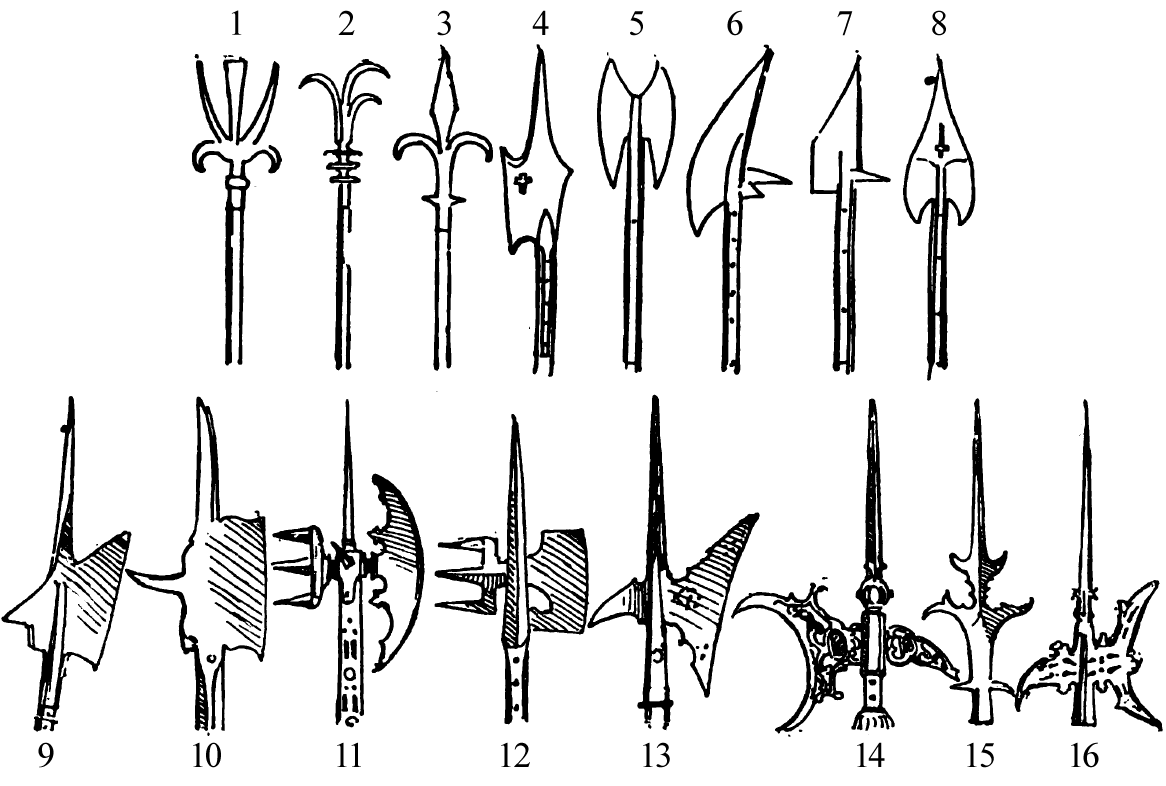
Halbards of the Christian Middle Ages

“The halbard may be derived from the German Halbe-Barthe; half battle-axe; or from Helm, casque, and Barthe, battle-axe; or from Alte Barthe, old battle-axe: in Germany and Scandinavia it dates from the earliest centuries of the present era, though it was not known in France until the Swiss introduced it in 1420.”

The Halbard
The Halbard

1, 2, and 3. Three kinds of halbards, somewhat like the ranseurs, eleventh century.

4. Swiss halbard, fourteenth century.

5, 6, 7, and 8. Four German halbards of the fourteenth century.

9. Swiss halbard, beginning of the fifteenth century.

10. Swiss halbard, end of the fifteenth century.

11. Swiss halbard with three-pronged hammer, end of the fifteenth century.

12. German halbard with three-pronged hammer, beginning of the sixteenth century.

13. Swiss halbard, middle of the sixteenth century.

14. German halbard, sixteenth century, engraved and gilt, a very handsome weapon.

15. German halbard, sixteenth century.

16. Venetian halbard, end of the sixteenth century.

The illustrations and descriptions have been taken from An Illustrated History of Arms and Armour: From the Earliest Period to the Present Time, by Auguste Demmin, and translated by Charles Christopher Black. Published in 1894 by George Bell.

Though halberd is the preferred modern spelling, this article uses halbard, an accepted variant.

Casting a Rubber Hammer

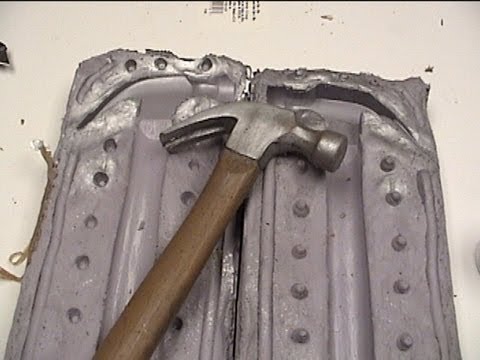
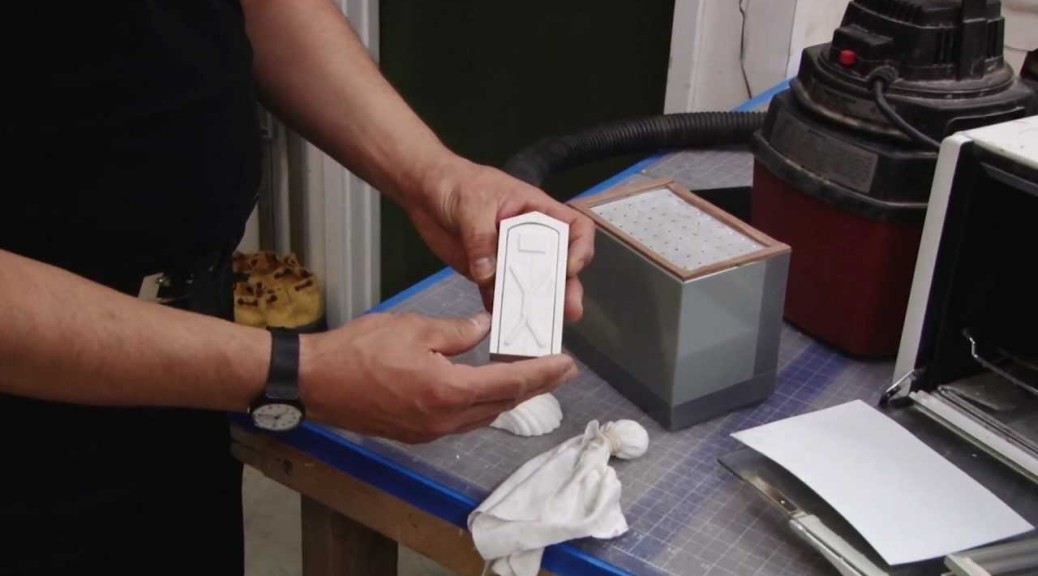
I recently came across the Brick in the Yard Mold Supply YouTube Channel, which has well over a hundred videos on molding, casting and finishing techniques. I started off by watching this one on casting a rubber hammer. Brick in the Yard has been selling molding, casting and special effects supplies out of their shop in Texas since the mid-nineties, and their collection of videos give an in-depth look on how to use a lot of them. So check it out:

Making and finding props for theatre, film, and hobbies