
All posts by Eric Hart

Hand Fire-Arms through History

Hand fire-arms
Hand fire-arms
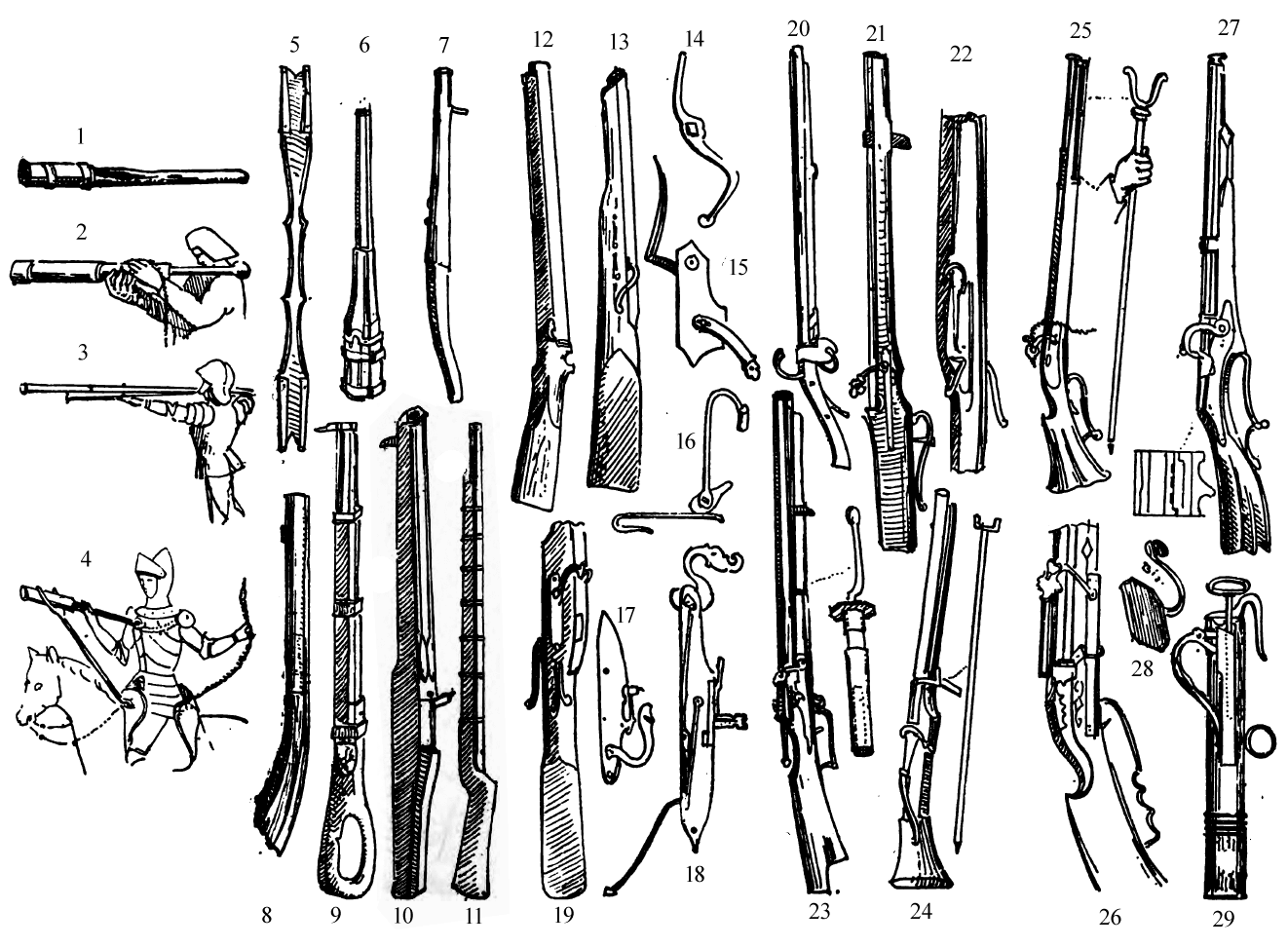
  1. Hand cannon for foot soldier in cast iron, belonging to the first half of the fourteenth century. The touch-hole (German, Zünderloch) is on the upper part of the cannon.
  2. Hand cannon for foot soldier, from a MS. of the end of the fourteenth century. The touch-hole is on the top of the cannon.
  3. Hand cannon for foot soldier, from a manuscript of the year 1472, in the library of Hauslaub at Vienna.
  4. Hand cannon for a knight, called a petronel, from a manuscript in the ancient library of Burgundy. The articulated plate armour is characteristic of the latter half of the fifteenth century, though the bassinet has a movable vizor. These hand cannons were in use at the same time as the serpentine arquebuse, and even as the flint and steel arquebuses and muskets, ie till the beginning of the sixteenth century, as may be seen from the drawings, by Glockenthon, of the arms of the Emperor Maximilian I. (1505).
  5. German hand cannon, fixed on wooden boards or stands, belonging to the beginning of the sixteenth century. The touch-hole is still on the upper part of the cannon. From the drawings of Glockenthon, done in 1505.
  6. German hand cannon in fluted iron, of the beginning of the sixteenth century, or end of the fifteenth century. It is only 9 1/2 inches in length, 2 inches in diameter, and is fixed on to a piece of oak about 5 feet in length. In the Germanic Museum, where it is wrongly ascribed to the fourteenth century.
  7. Hand cannon in wrought iron, called a petronel, to be used by a knight. It is of the end of the fifteenth century.
  8. Hand cannon with stock of the end of the fourteenth century. The touch-hole is on the top of the cannon.
  9. Angular hand cannon on stock; to be used in defending ramparts. It is a little over 6 feet in length, and the touch-hole is on the top of the cannon. This piece was used in the defence of Morat against Charles le Téméraire (1479).
  10. Eight-sided hand cannon with stock. The touch-hole, which is on the top of the cannon, has a cover moving on a pivot. This cannon is 54 inches in length, and the balls or bullets about 1 1/2 inch in diameter. It belongs to the first part of the fifteenth century.
  11. Persian matchlock cannon, copied from the Schah-Namen, in the Library of Munich.
  12. Hand cannon on stock, end of the fourteenth, or beginning of the fifteenth century. In this piece the touch-hold is on the right side.
  13. Hand cannon with serpentine, a match-holder, without trigger or spring, invented about the year 1424.
  14. Serpentine or guncock for match, without trigger or spring.
  15. Serpentine without trigger, but with spring.
  16. Serpentine with spring, but without trigger.
  17. Serpentine lock, without trigger or spring.
  18. Hackbuss lock with spring and trigger.
  19. Hackbuss (in German, Hakenbüchse) or hand cannon, with butt end and serpentine lock. It belongs to the second half of the fifteenth century. The match is no longer loose, but fixed to the serpentine, which springs back by means of the trigger. This sort of cannon is generally about 40 inches in length, and it is usually provided with a hook, so that when it is placed on a wall it cannot slip back. The hackbuss without a hook is, as a rule, better made, and was subsequently called arquebuse with matchlock. It had also front and back sights (in German, Visir und Kern).
  20. Chinese arquebuse.
  21. Swiss arquebuse of the second half of the fifteenth century.
  22. Double arquebuse (in German, Doppelhaken). This weapon had two serpentines, or dogheads, falling from opposite points, and was generally used in defending ramparts; the barrel was usually from 5 to 6 1/2 feet in length.
  23. Hackbuss, loaded from the breech by means of a revolving chamber, a weapon belonging to the beginning of the sixteenth century.
  24. Hackbuss and gun fork (German, Gabel), from the drawings of Glockenthon; it may also be seen in the engraving of the “Triumph of the Emperor Maximilian I.” From this we see that the hackbuss, or match arquebuse, was used for a long time together with the wheel-lock arquebuse.
  25. Serpentine hackbuss with match, also called musket. It is also furnished with a fork, called a fourquine in French.
  26. Hackbuss or musket, with link.
  27. Serpentine hackbuss with link, also called arquebuse, loaded from the breech by means of a revolving chamber. It dates from the year 1537, and bears the initials W. H. by the side of a fleur-de-lys.
  28. Eye protector, belonging to a musket in the Arsenal of Geneva.
  29. Hand cannon with rasp, early part of the sixteenth century. It is entirely of iron, and is called Münchsbüchse (monk’s arquebuse). For a very long time it was wrongly thought to be the first fire-arm ever made, and to have belonged to a monk named Berthold Schwartz (1290-1320), who was also said to have invented gunpowder. This little weapon is about 11 1/2 inches in length, and the barrel 5 inches in diameter. It preceded the wheel-lock, and appears to have suggested the idea of it. A rasp scatters sparks from the sulphurous pyrites by friction.

The illustrations and descriptions have been taken from An Illustrated History of Arms and Armour: From the Earliest Period to the Present Time, by Auguste Demmin, and translated by Charles Christopher Black. Published in 1894 by George Bell.
Pistols, 1500-1856

Here is a small collection of typical or notable pistols spanning from the sixteenth century to the middle of the nineteenth century.

Pistols, 1500-1856
Pistols, 1500-1856
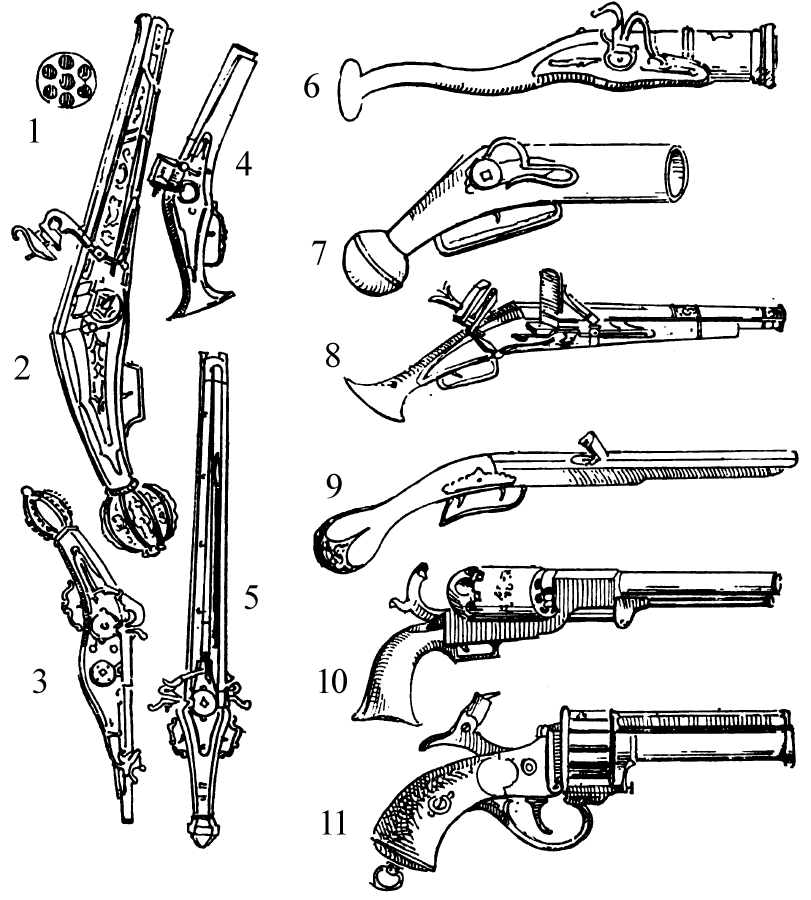
  1. Barrel for number 4.
  2. Wheel-lock pistol of the sixteenth century. This was the sort of pistol used by the German cavalry, and also by the Ritter, or knights.
  3. Wheel-lock pistol with double barrel, beginning of the seventeenth century.
  4. Wheel-lock pistol, firing seven shots.
  5. Double wheel-lock, end of the sixteenth century. Arsenal of Zurich.
  6. Wheel-lock and mortar pistol, called in German Katzenkopf, of the seventeenth century.
  7. Wheel-lock and mortar pistol of the seventeenth century. It is entirely of iron.
  8. Flint-lock pistol, end of the seventeenth century.
  9. Pistol with flint-lock, of the beginning of the eighteenth century.
  10. Colt’s revolver, invented by Samuel Colt, of the United States, in 1835.
  11. Mat revolver, invented a short time back by M. Le Mat.

The illustrations and descriptions have been taken from An Illustrated History of Arms and Armour: From the Earliest Period to the Present Time, by Auguste Demmin, and translated by Charles Christopher Black. Published in 1894 by George Bell.
It’s Your Weekly Dose of Props Links

Here is a pretty cool step-by-step guide to a Dragonbone dagger replica made by Folkenstal. Folkenstal uses some interesting techniques of laying up different thicknesses of plastic to create a rough block, and then sanding and cutting it to the final shape. Great photographs.

Furoshiki is the Japanese art of wrapping objects with cloth. The Japanese Minister of Ecology is encouraging the country to use furoshiki to carry the products they purchase, rather than paper or plastic bags. They’ve even made a handy chart showing how to wrap various-shaped objects. I can imagine this coming in handy for all sorts of prop purposes.

Here is a fun video brought to you by Syfy Channel’s Heroes of Cosplay on aging and distressing your props.

Finally, Tested brings us this sixteen-minute tour through Harrison Krix’s garage, better know as the Volpin Props prop shop. We get to see his small but well-equipped shop, check out some of his favorite tools, and get a sample of some of the many cool props he has built over the years.

Magically-Appearing Flags

This past summer, our production of The Grand Duchess of Gerolstein at the Santa Fe Opera had a lot of tricks. Like… a lot of them. One trick I worked on was a set of magically-appearing flags. The set had seven flag poles along one wall, and during one big moment of pomp and circumstance, the design team wanted flags to suddenly appear on them. The idea is kind of like those “bang” flags that pop out of guns in the cartoons.

Flag tubes
Flag tubes

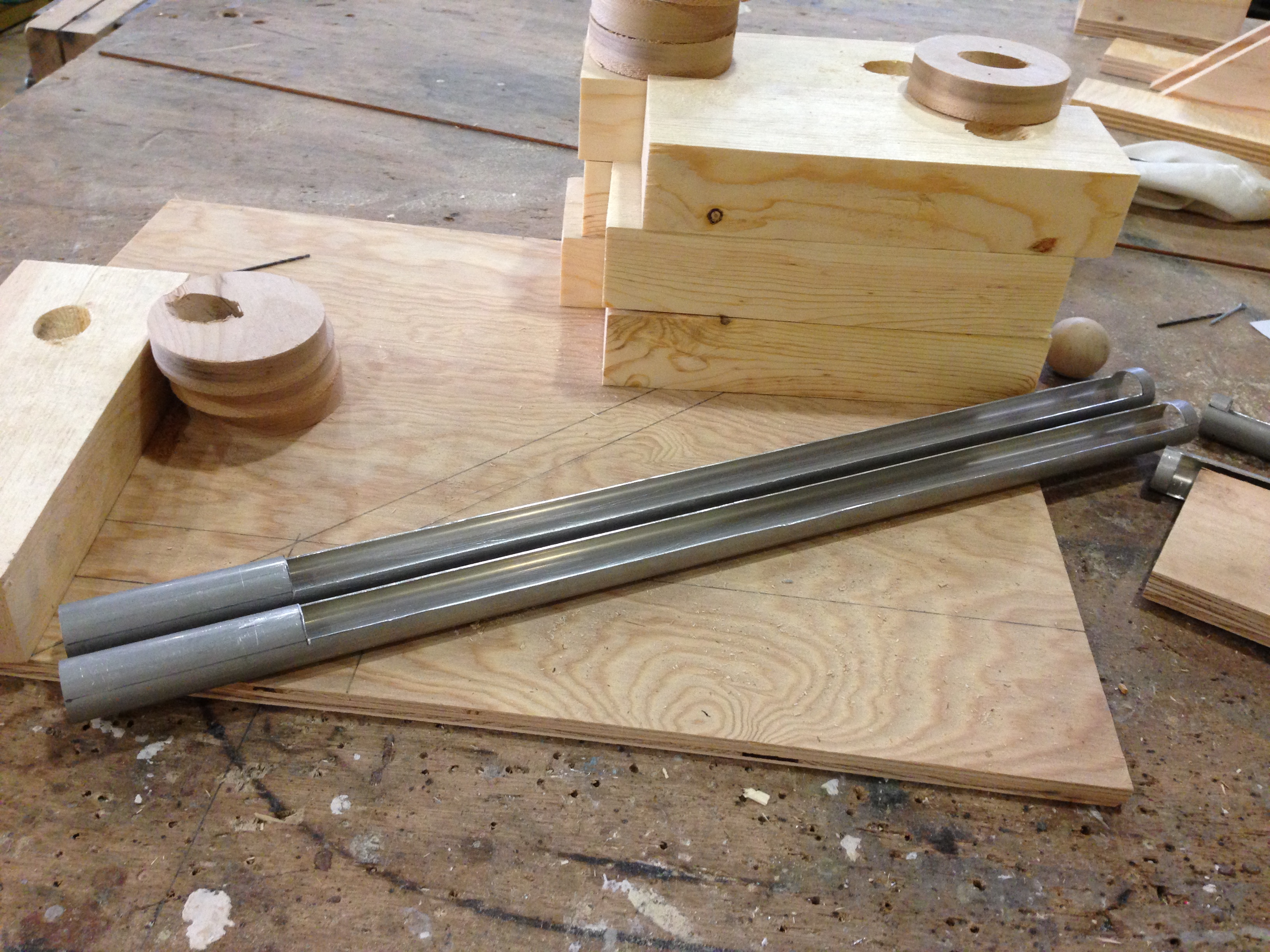
The basic mechanism behind the trick is that each flagpole has a second pole which sleeves inside. The two poles have slightly less than half of their surface notched out, as you can see in the photo above. The outer pole is fixed in place on the set, while the inner pole can spin around inside. So you can spin the inner pole to a position where the whole flag pole looks like a solid rod, and the flag is trapped inside. Then when you spin the inner pole around so the notches line up, the flag is free to drop down.

You can watch it all in action in the video below. The video also shows how I rigged the tubes so they could be activated by pulling a string off-stage, since there was no room on set to activate them directly.


It’s Fire Prevention Week

This week (October 6-October 12, 2013) is Fire Prevention Week. It is a good time to remind ourselves to check that we are following all the proper fire prevention procedures, whether we work in theatre, an independent shop, or at home.

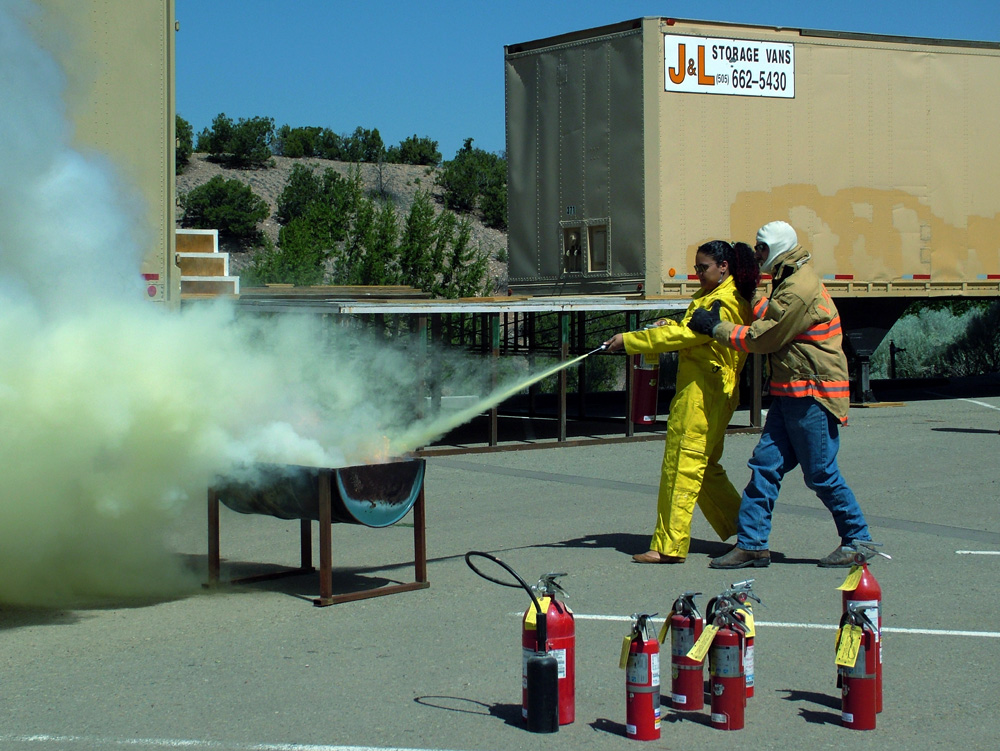
Using a Fire Extinguisher

Fires happen. We should not pretend that they are a thing of the past, or that our laws and technology protect us. Every year, Patrick Hudson of OffstageJobs.com reminds us how many fires (that we hear of) happen in the entertainment industry; in 2012, there were at least 14. His posts do a good job of reminding us what the proper procedures are. And in case you think they can’t happen to you, he reminds us that the Iroquois Theatre thought the same (go read those articles now; I’ll wait). Despite its boast of being “fireproof” in a city with one of the strictest fire codes in the world, it caught fire in 1903 and killed 602 people. This was not the result of some grand failure, but rather a whole lot of little things that could have been avoided: exit doors were unmarked or blocked, lighting fixtures were in the path of the fire curtain, the scenery was not adequately flame-proofed, etc. Most of these were violations of existing fire code, rather than the lack of knowledge of how to prevent fires.

So while props people are typically not in charge of maintaining many of these things, as a member of the production team, we can still monitor them. If management or producers are pushing for unsafe practices (like covering the exit signs, or disabling the fire curtain), we can stand with the rest of the technicians so they do not need to fight the battle alone. We can keep our props out of stairwells and maintain clear egress paths through our storage areas. If we have prop fire extinguishers, keep them labelled well and far away from real fire extinguishers. Leave flammables in the flammables cabinet. If you are not aware of all the regulations and procedures to follow, Fire Prevention Week is a good time to brush up.

And if you work in your rental home or apartment (and even if you don’t), get renter’s insurance. My wife and I lived through a fire that destroyed our whole apartment building. It’s traumatizing enough without having to worry about all your stuff and where you’re going to live. You may not think you have enough stuff to make it worthwhile, but the value of all your little odds and ends adds up quick. Renter’s insurance is much more than just replacing your stuff; ours also sent movers to salvage and clean what they could while housing us in a temporary apartment. I only had to miss one day of work, which was important because I was freelancing at the time, and paid hourly. Anyone in the building without insurance had to scramble to find a place to sleep that same day, as well as take time off work to haul all their belongings out before they were damaged further or looted.

So take this week to double-check that you are doing all you can to prevent fires and are prepared to deal with one should it occur, both at work and at home. You’ll be glad you did.