
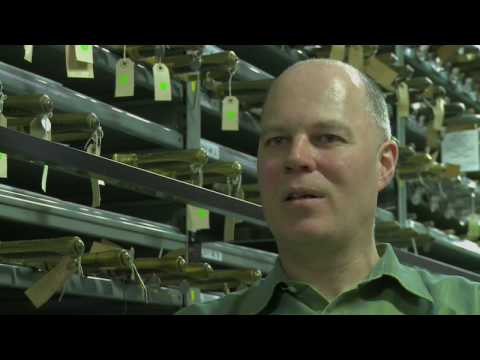
Peter Lyon is a swordsmith for Weta Workshop in New Zealand. He has made swords for both The Lord of the Rings and The Chronicles of Narnia. Check out this video where he visits the Royal Armouries in Britain to check out the real swords that his fantasy creations are based off of.
All posts by Eric Hart
End-of-the-week Links
Well, I am off this weekend to Bucknell University, where I will be signing copies of my book during Homecoming Weekend. If you are in Central Pennsylvania, feel free to stop on by. I’ll try to post pictures and updates on my Twitter. I also have some stories I’ve found around the Internet this week:
Props master extraordinaire Jim Guy is profiled in yet another news article. He talks about how he got started, his favorite parts of the job, and how new people can begin a career in props.
LiveScience takes a look at the technology behind horror-movie monsters. Though it seems a lot of films just use CGI for everything, many effects are still practical. In fact, advances in technology have made it easier to use all sorts of prosthetic, animatronic and makeup effects for movies.
While we’re on monsters (it is nearly Halloween, after all), I enjoyed this article on a Philippine monster-making company. Their creatures are actually based on the characters from Philippine folklore, but done in a more-Western style.
The Credits talks with the makeup maestro for the new Carrie film. They discuss in detail how they did the infamous “pouring of blood” scene; it’s a little trickier than you might expect, but it led to a much more consistent result on-screen.
Finally, Non-Toxic Kids lays out ten reasons we need stronger laws about toxic chemicals. Though aimed at parents, the reasons are just as relevant to props people. While we may feel adequately informed about the dangers of industrial chemicals and supplies, we also use plenty of household cleaners and chemicals that you may not realize are also toxic.
Costumes and Scenery for Amateurs, 1915 (part 2)
The following comes from a 1915 book called “Costumes and Scenery for Amateurs”. I published the first portion of the chapter on props way back in 2009. Here, without further delay, is the conclusion.
Stimulate initiative and invention wherever possible. A round collar box is only a collar box until you use it for an earthen bowl. A white cardboard shoe box is cut down a little, covered with black tissue paper, has a little yellow pane inserted in each side, and a curtain ring for a handle. Behold a lantern for a Yankee minute-man, or Paul Revere, or anyone else who wants to use it.
Remarkable stage furniture can be made from wooden boxes of all sizes. A packing case makes a dais. Several boxes nailed together and stained brown will make a peasant’s cupboard.
Three boxes nailed together like this |¯| will make a hearth. If it is to be a mediæval or fairy tale hearth, cover it with cheap gray cambric, bulked to look like stone, and marked with splotches of white and brown chalk. Be sure you turn the unglazed side of the cambric outward. Use chalk because paint will not show up well on cambric. A brick fireplace for a modern scene can be made in the same way, covering the boxes with brick chimney paper than can be bought at Dennison’s Tissue Paper Co., Boston, Chicago, or New York. One of their catalogues will prove invaluable to directors living in the country. A narrow box on rockers, stained brown, becomes a Puritan or eighteenth century cradle. Gilded and hooded it is the cradle of a royal Princess. Couch seats can be made from boxes, only be sure that they are secure.
Originally published in “Costumes and Scenery for Amateurs”, by Constance D’Arcy Mackay, 1915 (pp 95-96)
Button-Tufted Settee
Triad Stage’s production of Wait Until Dark was set in a hip and modern New York City apartment circa 1963. The kind of furniture it required was not easily found in your typical antique store, nor was it cheap to come by. One key piece we needed was a sleek upholstered settee; with the stage in a thrust configuration, it needed to be low-profile as well. A settee like this easily cost as much as my entire props budget, so I had to build it from scratch.
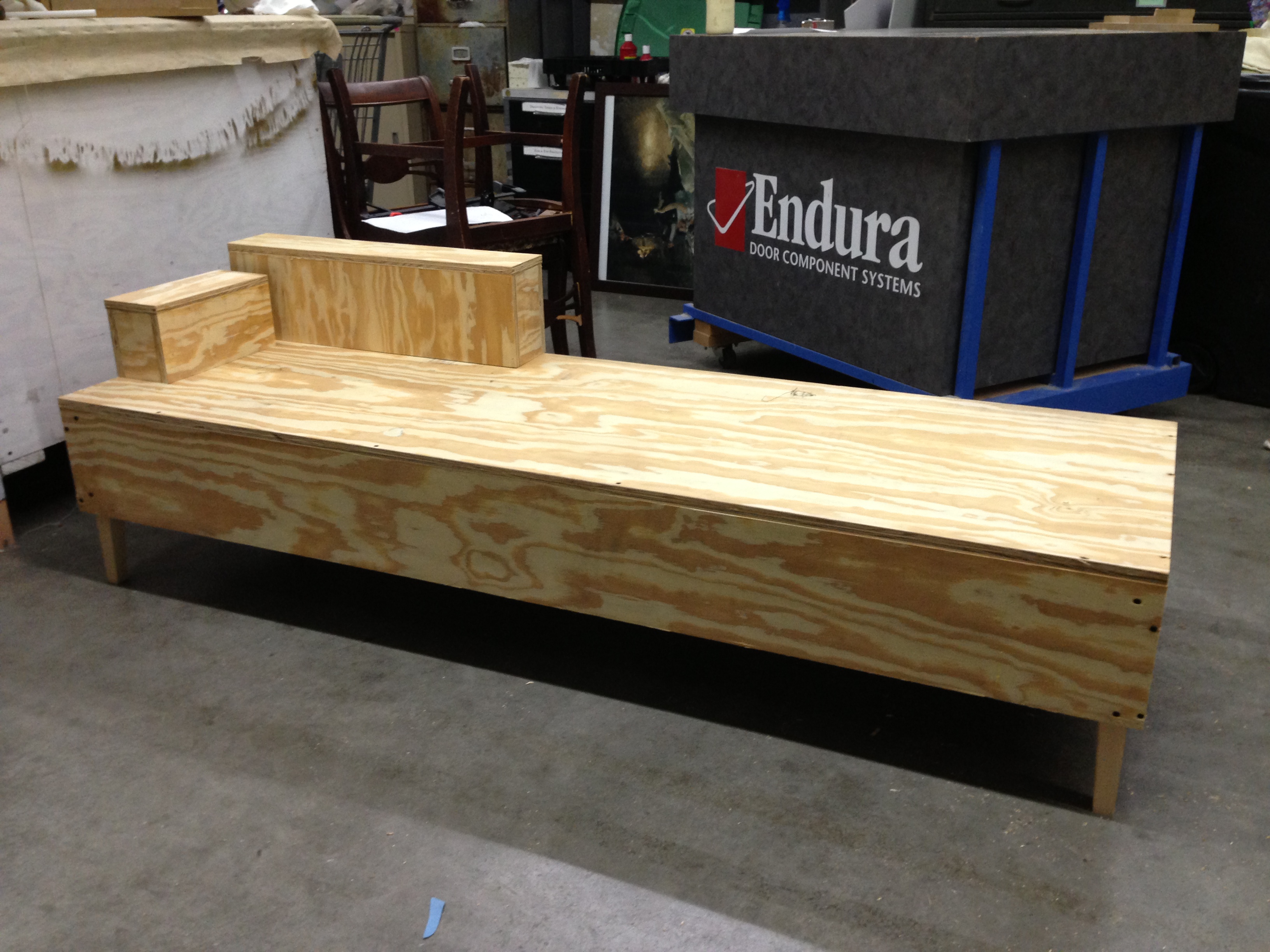
I started off by building the basic shape out of plywood, with wooden tapered legs. A lot of the challenge here was thinking forward to how I would upholster and attach all the parts. It’s easy to work yourself into a corner if you don’t plan ahead; you may end up covering a bolt with a piece of fabric, but you cannot attach the bolt until the fabric is on. It can be quite the brain-twister.
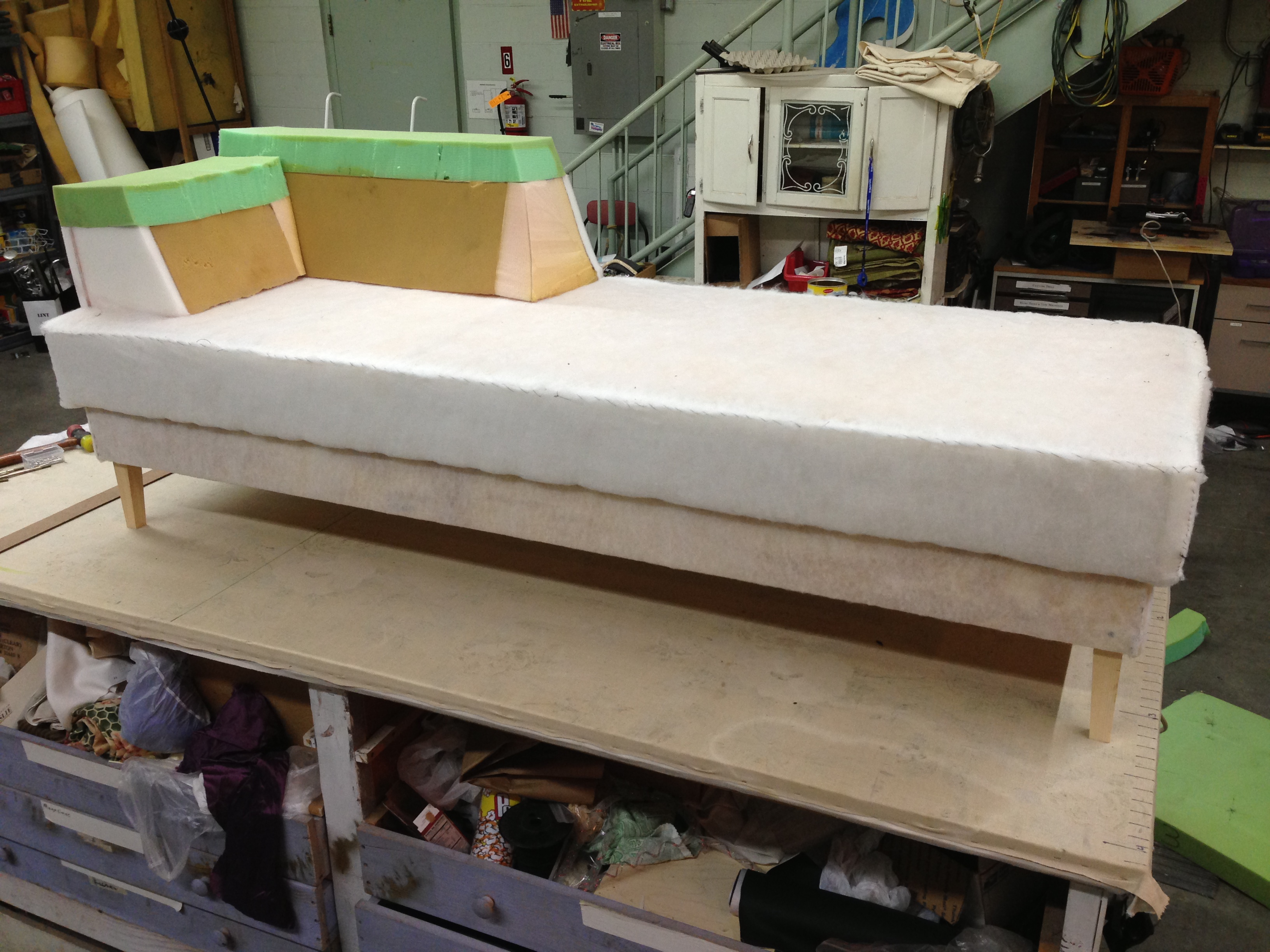
I then began covering the plywood with upholstery foam, followed by batting. The cushioning was a lot more stiff than what you may typically find in a settee, since actors tend to sink into soft cushioning, making it harder to stand up quickly. I find myself reinforcing and stiffening a lot of upholstered furniture for this reason, so I just built this settee to be somewhat stiff from the get-go.
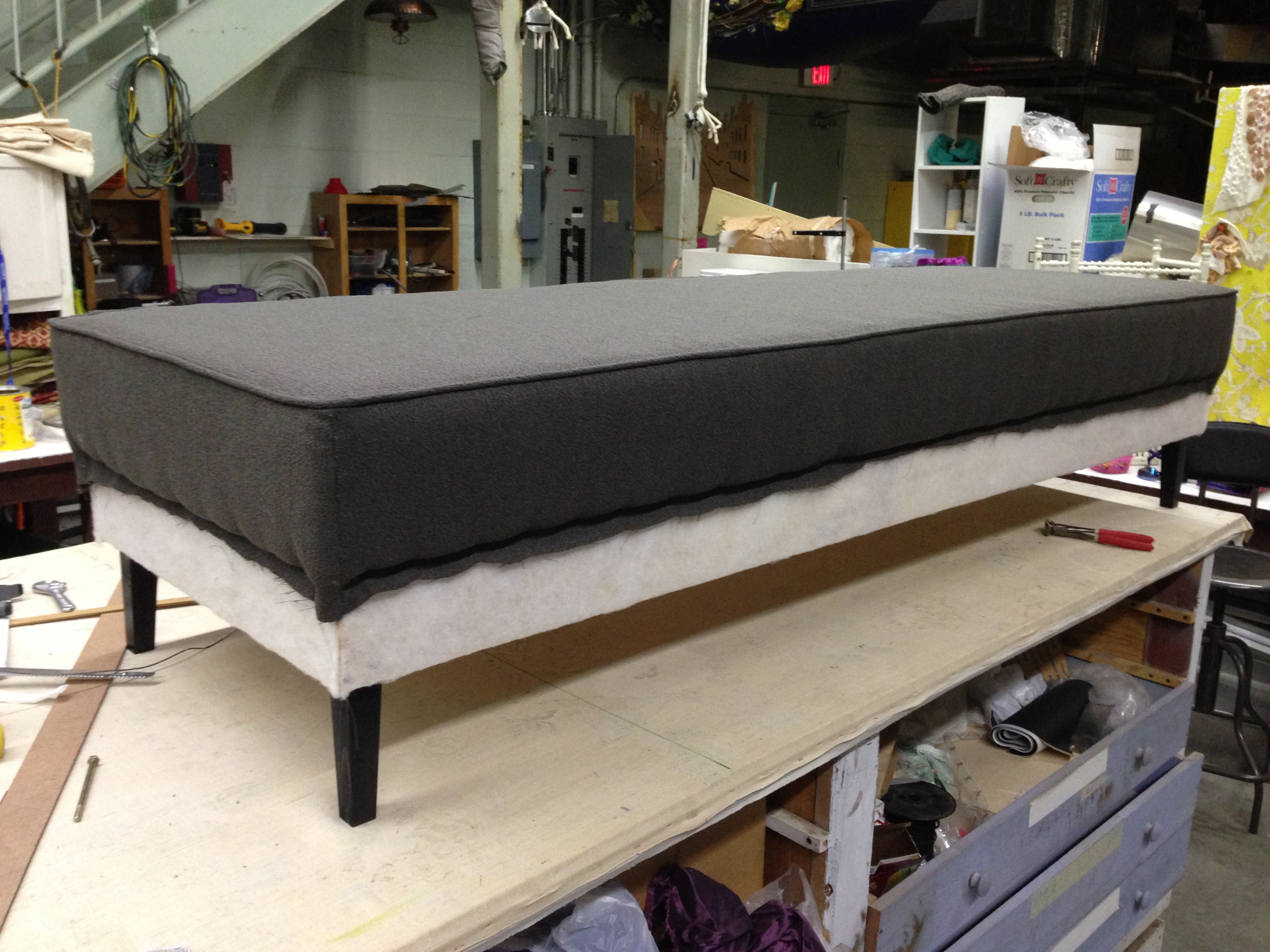
I was lucky to have the costume shop pitch in and help me with the fabric parts. Once I found a fabric the designer approved of, my intern cut all the pieces, and the costume shop made all the piping and stitched the pieces together. All I had to do was staple it on.
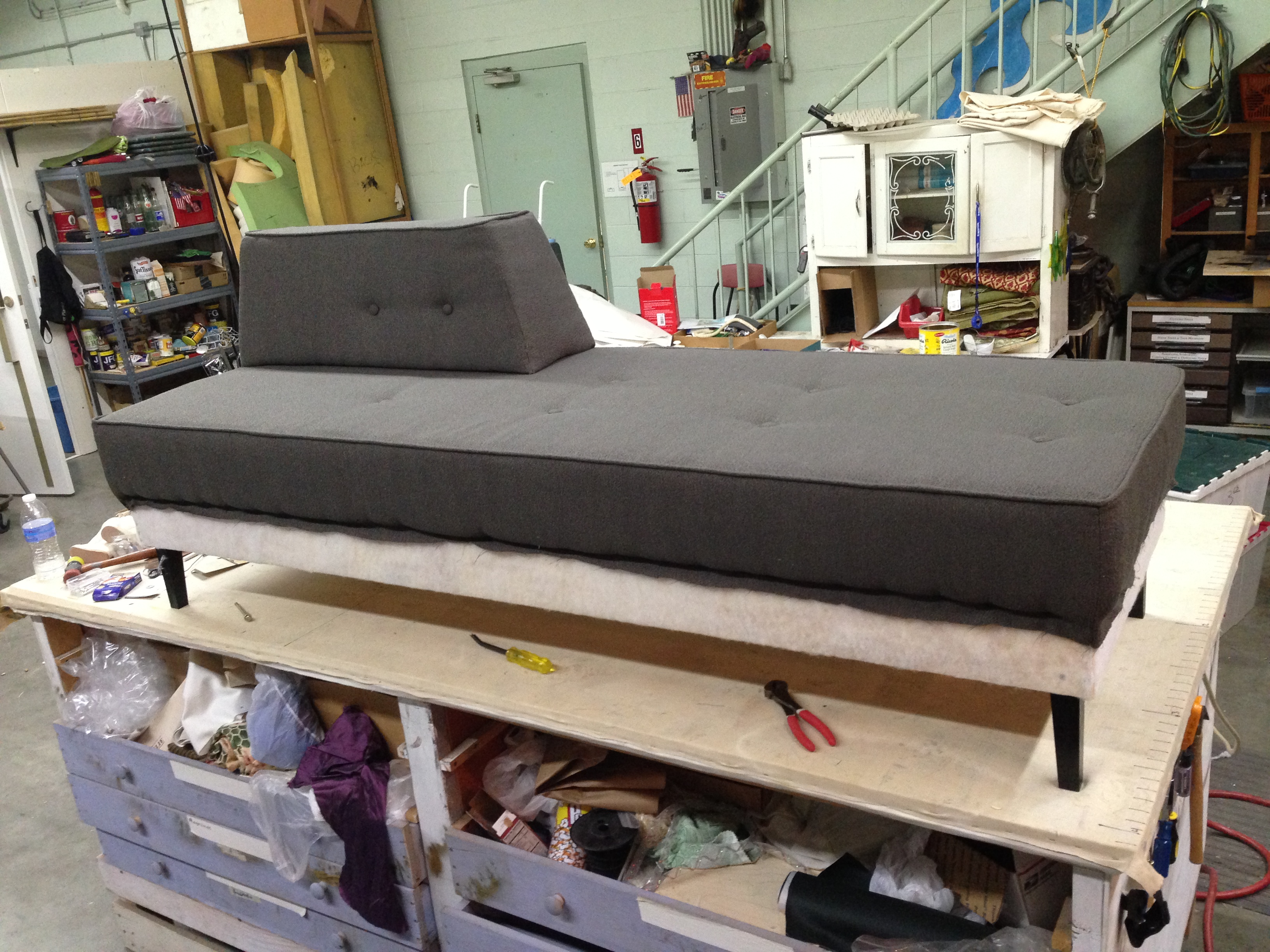
This particular settee had some buttons, so I got to try button tufting for the first time. It only had nine buttons laid out in a simple grid, so it was relatively easy to figure out. The cushions on top were attached by bolting through the settee into the plywood below. Again, that was only possible by planning it all out ahead.
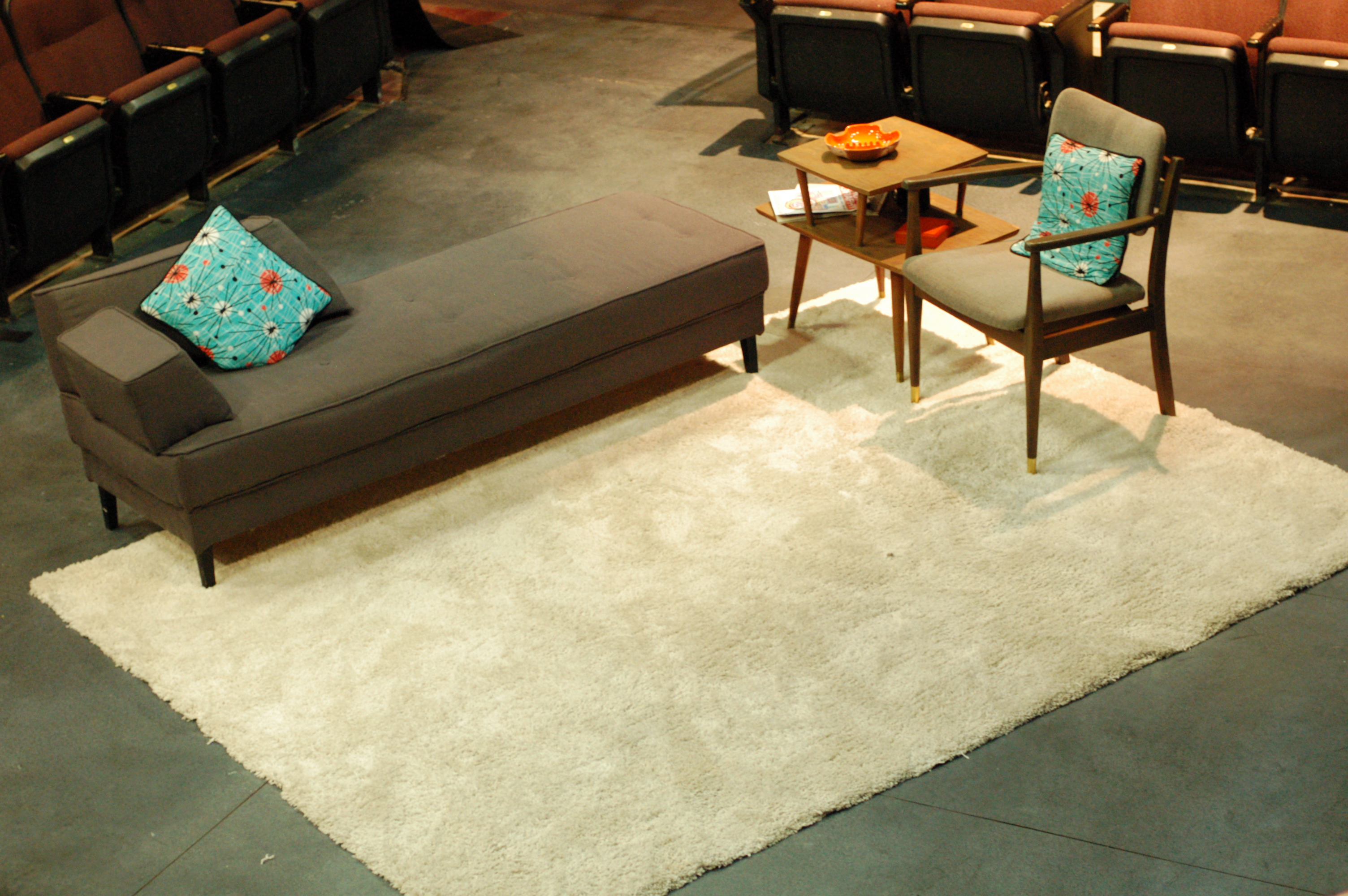
So there is the final piece with all the fabric attached. It was very much a group project, with the other people at Triad chipping in, as well as my wife giving me a crash-course in upholstery as I built this. The result was a piece of furniture that helped give the set the right touch.
Friday Links
Before I jump into this week’s links, I wanted to mention that next Saturday (October 26th), I’ll be traveling to Central Pennsylvania for a book signing at my alma mater, Bucknell University. If you’re in the area and want a signed copy of my Prop Building Guidebook: For Theatre, Film, and TV, or just want to say hi, swing on by the Barnes and Noble from 10-11am!
First up is this fantastic glimpse into the Trinity Rep prop storage. Take a look at the thousands of props which props master Michael Getz keeps in what was once an old cotton mill.
Dug North has another great installment of 10 Handy Tips for Woodworkers and Automaton-makers. The tips are useful for anyone working on smaller and more detail-oriented props, not just automaton or wooden pieces.
Collectors Weekly has a great article on the history of amusement park dark rides. A “dark ride” is like a haunted house, except you ride in a car, rather than walk. Collectors Weekly interviews George LaCross, one of the leading experts on dark rides. LaCross has produced a documentary on the history of the Knoebels Haunted House, a well-known dark ride which I must have ridden at least once a year throughout my entire childhood.
Fresh has a quick little interview with Alexis Labra, props master on the film Bunks…
and Marvel has a short interview with Barry Gibbs, prop master on Thor: The Dark World.
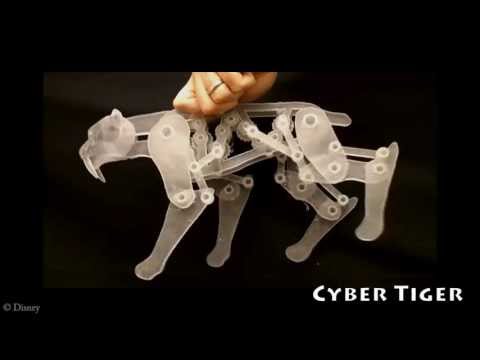
Finally, this is interesting in its possibilities. Disney is developing software to help design automaton and other moving machines. It looks like you just draw what you want a figure to do, whether it is a cheetah that runs or a man that pushes a block, and the software will automatically position levers, linkages and gears to create that movement from a single rotating axle. The video below shows it much better. Not only can you design it all, but it looks like you can then send the drawings of the parts to a 3D printer or laser cutter and have them fabricated exactly as they were in the software. It’s the future!