
Category Archives: Reprints

Dinners are Real, 1905

The following is the fourth excerpt of an article which first appeared in 1905 in the St. Louis Republic. You can read the first part here, the second part here, and the third part here.

When the Thanksgiving dinner is brought on before the critical eye of the house full of patrons it consists of a genuine turkey, smoking from the baking pan. Rich red cranberry sauce is piled up and celery, potatoes and all the little side dishes come on just as they would at the home place. What the performers cannot consume in the precious few minutes of the act goes to the stage hands after the show.

McCarrick was with a company at one time which demanded the real thing in the dinner line. He arranged with a near-by restaurant to bake the turkey and cook up the “fixin’s.” Eight times a week it was one of his principal tasks to see that the fowl went into the oven at the proper moment. He states that when the company reached Thanksgiving Day on their tour that without exception the members ordered beefsteak and fried potatoes for their holiday dinner at the hotel.
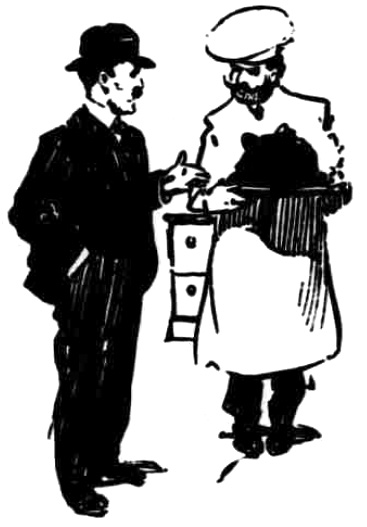
Has to superintend the stage dinner

Since the demand for realism has become so pronounced managers and property men have been driven to desperation by the extremities to which they have been put. When it came to a question of getting an outfit for the cow punchers of “The Virginian” New York was searched over for a respectable equipment, which in this case meant the well-worn, greasy and prairie-stained accouterments of the typical cowboy. It was a simple matter to go into the theatrical outfitter’s and buy the clean pretty suits of leather and the broad-brimmed sombreros. These answered the purpose of neither the manager or the demands which the public would make.

The solution was reached by the happy thought that a Wild West show then appearing in the city might have some performers who would trade the old for the new, and they were at once sought out. It took some parley to convince the genuine plainsmen who were then on exhibition that there was not a joker concealed in the transaction. Eventually enough of them were convinced that everything was “on the square” to supply McCarrick with what was wanted and the result is a band of Westerners which would be satisfying even in the heart of the cow country.

Originally published in The St. Louis Republic, January 1, 1905.
How Times Have Changed, 1905

The following is the third excerpt of an article which first appeared in 1905 in the St. Louis Republic. You can read the first part here and the second part here:

One can readily imagine the lack of imperial presence and the regal authority of Mansfield’s Richard minus the ermine robes and the crown and scepter. As greatly would the audience miss the “props” which go to make up King Dodo. The Virginian without his revolver in the climax of the closing act, which brings down Trampas and sends the spectators home satisfied with the turn of events, would better have left town before sunset. The property man is all that saves him and restores him to his winsome New England school ma’am.

A visit behind the curtain to James L. McCarrick, the property man who is responsible for all the matters of seeming minor importance in “The Virginian,” brings out the importance of this official when the final and desired result is accomplished of giving to a dramatic production the genuine and realistic settings and accessories which are demanded now by the theatre-going public.

In days of old, when McCarrick was new at the business, say twenty-five years ago, any old thing would do for a stage dinner. Cold tea in a black bottle answered the requirements of beer, champagne or soothing sirup. A loaf of bread stood for the usual essentials of a square meal. The audience was satisfied and the actors had to be. One big costumer’s shop in the city was the rendezvous for the manager about to exploit a new play. There he could pick out a wardrobe for each individual member of his cast without leaving the house. War bonnets and tomahawks for the Indian braves, velvet and glittering ornaments for the court ladies and uniforms for the soldiers which were suitable for any army of any nation. Out of the same box came equipment which would permit anything but the most presuming theatrical venture to be staged and with the utmost satisfaction as far as the public was concerned.

To-day it is an entirely different proposition, as is evidenced by the “stunt” which Mr. McCarrick was called upon to perform ere he had secured sufficient properties to permit the first production of such a simple-appearing play as “The Virginian.”

Now there is a definite and certain disappointment if there is lacking the least detail of costume or stage settings evident to the discriminating audiences which at every performance of a play are prepared to criticise the least fault. Everything must be perfect and managers have bent to the popular demand in this line, and money without stint is expended to satisfy this very demand, costumes, scenery and smaller paraphernalia now ordinarily costing much more than do the actors receive in salaries.

Originally published in The St. Louis Republic, January 1, 1905.
Property Man is “It”, 1905

The following is the second excerpt of an article which first appeared in 1905 in the St. Louis Republic. You can read the first part here:

When the leading woman swooned at the sight of the tragic and thrilling vision she would have had a bitter bump on the hard floor had not the property man thoughtfully supplied an upholstered divan at the exact spot, and thereby broke the fall and saved the dramatic situation.

After all is said and done the property man is “it.”

The ordinary theatrical programme carries on the first page of the bill of the play the cast of characters in which the principals see their names in the largest letters, which do not interfere with the typographical make-up of the folder. After the synopsis and the lesser details, in these days so necessary to the proper enjoyment of the drama, musical comedy and other what nots of the theatrical world, one comes across a list of officials which is seldom perused were it not interspersed with stereotyped humor. This list embraces the persons who have made possible the evening’s pleasure to the spectator.

The stage manager and the assistant stage manager come first, since it is their executive management which directs the efforts of everyone else. Frequently are found the stage carpenter, who is responsible for the scenery and stage settings, and the electrician, who handles the light effects and transforms noontide to twilight and black to dawn without batting an eye.

The mistress of wardrobes, who checks up the gauzy gowns of a half hundred coryphées, or who bosses the packing of the Gainsborough hats of a handsome bunch of show girls, at times sees her name among those of the executive staff. The head usher is never missing, and there have been instances where the head bill poster has been enumerated. The piano that was used and the maker of the gowns worn by the principal women of the cast is sure to be found.

But when one cares to know who has made the show what it is, the name is usually missing from the rolls, and back through the stage entrance he must go and around corners of scenery and through crowds of supes until he reaches the den of the property man. Then, indeed, has he come to the beating heart of the production.

Is first to get an idea of the new play

When the modern comic opera, drama or extravaganza is being prepared for its initial performance, the first man to get a copy of the lines and an idea of the theme of the play is the property man. After the playwright has finished the book and the librettist has turned out the tuneful melodies, all of which comes after the financial backer has set his official seal of approval upon everything that has been done, the property man is taken into the consideration, and while the manager is jaggling over contracts with his stars and secondary representatives are looking up available timber for the lesser parts, the property man is skirmishing the city and country over seeking for those little essentials without which the scenery might as well not be painted and the performers, as in the old Shakespearean days, would as well perform in ordinary street costume.

Originally published in The St. Louis Republic, January 1, 1905.
The Indispensable Property Man, 1905

The following first appeared in 1905 in the St. Louis Republic:

Theatrical managers depend much for the successful production of their play upon the Property Man: With the first-class companies this individual, whose name is not on the programme, is considered the most indispensable personage in the make-up—some of the things he has to do.

The Property Man's corner
The Property Man’s corner

In the present-day theatrical production there is a man behind the gun, and he is the party with the cash. The man in charge of the powder magazine and the man who sends the ammunition to the firing line is the property man.

All things considered, he is the most indispensable personage included in the make-up of the modern theatrical company, especially the first-class productions. While not in the least a dictator or the one above all others of whom the principals even, to say nothing of the lesser lights, stand in awe, he is of more supreme importance to the management than is many another who gets his picture in the dramatic columns of the daily prints, or who is posted upon the bill boards weeks in advance of the arrival of the show.

In most of the productions which appear at the better theaters nowadays, the leading man or the leading woman has an understudy who, in case of a sudden emergency, may throw on a costume, and without a moment’s extra preparation, go ahead with a part which may mean the making or breaking of the show for that performance. Not so the property man. Rain or shine, fair weather or foul, one-night stands or seasons of two or three weeks, there is no excuse for his absence from his post of duty, and usually no one who can step into his shoes at an instant’s notice.

When the question of putting on a show is resolved into its essential details, the solution gives to the man who handles and who is responsible for all the little things about the production, the largest proportion possibly of responsibility as is assigned to any man or woman connected with the company.

Naturally it is the star who catches the eye and ear of the audience. When the hero does and dares it is he whom the spectators are with heart and soul, and the curtain goes down upon the last set while auditors join in exclamations of rapture over the work of their idol. They fail to take into consideration that when from his trusty revolver sped the fatal bullet which winged the bold, bad villain, none other was responsible for the blank cartridge and the wreaths of white smoke which curled above than the humble property man.

Originally published in The St. Louis Republic, January 1, 1905.

Mysteries of the Prop Room part 3, 1902

The following tour of a property room at the Grand Theater in Saint Paul, MN, first appeared in The Saint Paul Globe in 1902. This is the third selection from that article, with the first appearing here, and the second here.

The visitor decided she had acquired the taste for property rooms and dropped in at the Grand. The big stage was dark and deserted. At one end there stood a tall, rickety-looking arrangement with a bell at the top.

“It’s what the lady swings out on,” explained a voice from the gloom.

“In the ‘Heart of Maryland,’ you know,” the voice further vouchsafed.

“Is it what you would call a ‘prop?'” queried the visitor.

“Yes, it’s a ‘prop,'” admitted the voice which happened to belong to the Property Man of the Grand. The visitor asked for the property room, and after she had surveyed it she was willing to admit that there were property rooms and property rooms. The property room at the “Met” is picturesque in its disorder. The property room of the Grand is distractingly neat and beautifully decorated in red. The room is triangular in shape, very, very tiny and distinctly ornate. It is just the sort of room in which one would expect to have pink tea served. But not at all the kind of room in which one would expect to find housed all kinds of odd, dirty, quaint, delightful and smelly things. And, as a matter of fact, none of these things are housed here. For this tiny, scarlet room is only one of the property rooms of the Grand. There are four others, one in the “fly gallery”—the Property Man’s expression—and the others tucked away in unexpected places at either side of the big stage. But in spite of the many articles stored away in them all were spick and span like the first property room.

“We keep things very neat here,” explained the property man with pardonable pride.

The visitor agreed and suppressed a wild desire to destroy the spick and span effect. To punish herself she went back and gazed once more at the room “done in red.”  This room is partly Oriental and partly American. A swinging Oriental lamp burns redly in one corner. A similar lamp throws a faint light from a curtained niche. A cabinet holds dainty bits of china. A long table is doubtless intended to hold the various “props” that are to be used in the play that is on, but at the time of the visitor’s visit it held only an elaborately gilded clock and a very large vase, so variously decorated that it made one wink to look at it. For a fresco about the walls there is a row of photographs of actors and actresses.

“It’s always just like this,” the Property Man assured here convincingly. “Come here any time of the day or night and you’ll find it just the same.”

Originally published in The Saint Paul Globe, February 23, 1902, page 22.