Category Archives: Reprints

Mysteries of the Prop Room part 2, 1902

The following tour of a property room at the Metropolitan Theater in Saint Paul, MN, first appeared in The Saint Paul Globe in 1902. This is the second selection from that article, with the first appearing here.

“There are two more property rooms above this one. Perhaps you would like to see them,” he suggested hospitably.

The second property room was reached by means of a narrow and very straight-up-and-down ladder. If the first looked like an old curiosity shop, the second seemed, in the dim light that came from a solitary incandescent light, a veritable chamber of horrors. From a nail driven in one side of the wall there hung an iron cauldron that suggested the three weird sisters in “Macbeth.” A cotton velvet cloak with a big collar of stringy white fur took on, in that dull light, the shape of one of the witches herself. A skull and cross-bones grinned cheerfully from a niche above a black table. Several masques peered down from a shelf and a big collection of drinks, daggers and swords did not detract in the least from the high tragedy effect of this second property room.

“There is still another property room directly above this one.

“Perhaps,” suggested the Property Man, “you would like to see that also?”

The visitor surveyed the iron ladder that was even narrower and very much straighter-up-and-down than the one she had just mounted and shook her head.

“It’s just full of things like this,” he said. “Tables and chairs and battle axes and churns and band boxes and things!”

The visitor decided she had acquired the taste for property rooms and dropped in at the Grand.

Originally published in The Saint Paul Globe, February 23, 1902, page 22.

Mysteries of the Property Room, 1902

The following first appeared in The Saint Paul Globe in 1902. Pay particular attention at the end where he talks about the different “kinds” of props; they’re somewhat different from how we deal with props today:

Sweeney, the property man of the Metropolitan theater—”Old Props,” of course, he is called—entered his dusty little sanctum sanctorum the other afternoon and placed on a wobbly pine table a long, flabby article. The visitor poked it gingerly.

“It’s the seal that they use in ‘The Chaperone,'” explained the Property Man reassuringly. “And this,” he continued obligingly, “is the mummy. You remember the mummy?” The visitor nodded dubiously. This object that resembled nothing so much as a coffin covered tightly with a bit of Oriental cotton did not look a bit like the object she had viewed from the other side of the footlights during one of the performances of “The Chaperone.”

“Things generally do look different when you see them in here,” said the Property Man apologetically. And the visitor, as she surveyed the stuffy little room, agreed. For instance, it was disillusioning to find that the golden goblets from out of which she had seen the noble Romans drink in “Quo Vadis” were simply painted wooden cups. And there was the grandfather’s clock!

As a part of the furnishing of an old farm house kitchen this grandfather’s clock had seemed the very realest bit of realism. Its honest old face, shining in its humble surroundings, had always seemed to say, “Yes, it is all false, this stage atmosphere of paint and tinsel, but I, at least, am real.” As a matter of fact it is not a bit real. On the contrary, indeed! For a long box, properly cut and painted, with a painted dial at one end, is all that that deceitful clock is. The visitor turned from it in disgust.

“There are two kinds of ‘props,'” explained the Property Man, absentmindedly polishing one of the painted wooden goblets with a bit of cotton tapestry which hung from a nail. “There are personal ‘props’ and stage ‘props.’ Now, suppose a man plays the part of a waiter in a play. If he carries a towel over his arm, then it is a stage ‘prop.’ If he wears it tied around his waist, it is a personal ‘prop,’ and he himself looks after it. But we look after the stage ‘props.’ They are all placed here.”

“Here” was the stuffy little room which is just to the right of the big Metropolitan stage.

“Do you see that large trunk over there? It contains the mandolins used by the girls in the first act of the play. Each mandolin is numbered and each girl knows where to find her own instrument.”

Originally published in The Saint Paul Globe, February 23, 1902, pg 22.

Always Check Your Props Preset, 1896

The following article comes from an 1896 article in The New York Times:

Edmund M. Holland Destroyed $5

In the first act of “A Social Highwayman,” at the Garrick Theatre, a game of poker is played. One of the players, William Norris, puts a fifty-dollar bill, stage money, on the table and makes an uncomplimentary remark about thieves just as Edmund M. Holland, who plays the part of a valet, is entering the room. Mr. Holland approaches the table when nobody is looking and steals the fifty-dollar bill.

The property man forgot to give the bill to Mr. Norris last Wednesday night and Mr. Norris did not discover that he had forgotton to ask for it until he was on the stage. Then there was great finessing to get a bill without letting the audience know anything was wrong.

Finally Mr. Norris slipped toward the wings and asked several employes of the theatre to let him have a bill. The stage carpenter was the only financier in the party, and he promptly handed to the actor a five-dollar bill, good money.

Mr. Holland has a habit of destroying the stage money after he makes his exit. The act is unconcious and due to nervousness.

After the performance Mr. Norris went to Mr. Holland’s dressing room and asked that the stage carpenter’s bill be returned to him.

“Oh, I tore that up,” remarked Mr. Holland, pointing to a lot of pieces on the floor.

Mr. Norris said a few terse words, looked ruefully at the small pieces of greenback, and went sadly away.

He gave the stage carpenter $5 and tried to keep the story quiet.

First published in The New York Times, February 9, 1896.

Props from “You Can’t Take it With You”, 1937

The following article, by Eugene Kinkead and Russell Maloney, first appeared in The New Yorker in 1937:

“You Can’t Take it With You,” Moss Hart’s and George Kaufman’s play about that mad Morningside Heights family, the Sycamores, recently established a theatrical record by putting seats on sale eighteen weeks in advance. Also, it probably holds some kind of record for the number and complexity of its props; all in all, there are about seven hundred props, requiring the attention of three property men instead of the customary one. “We have more props than ‘White Horse Inn,'” the head prop man, Al Burkhardt, told us when we went backstage to investigate. As we probably need not tell you, the play has only one set, which represents the living room of the Sycamores’ apartment. First thing you notice is the magazines scattered here and there in corners. There are about three hundred and fifty of them—1929 Navy-Princeton football programs, and back numbers of Review of Reviews, Magazine of Wall Street, New York Masonic Outlook, and other conservative publications; nothing exciting, like The New Yorker, because that might distract from the actors.

The three snakes in a solarium are mechanical ones; Al Burkhardt works them from backstage, by means of a lever. The flies, brought on in a bottle to be fed to the snakes, used to be fishing flies from Davega’s; now, for some reason, they’re raisins. The letters scattered about, some of which Grandpop reads aloud, are mostly letters from hotels, soliciting the patronage of the “Of Thee I Sing” company when it was going on tour. The wastepaper basket is filled mostly with crumpled-up jottings made by Mr. Kaufman during rehearsal. We fished out one of the sheets, and found it covered with vague but stimulating phrases: “Stamp scene messy—Penny’s red beret—You, too, can take the pimples off your face—He will get them yet if they do not get him—go right into pirouette.” The fern in the bay window of the set is a fake. The cornflakes are real. Among the “atmosphere props” (things that aren’t handled) are a Filipino fly whip, a key to the City of Buffalo, a hundred-year-old string of wampum, a palette left behind by Donald Oenslager (who designed the set), a tusk of ivory, and a real hand-carved African war shield. The ship model that hangs from the ceiling cost $100, but this is offset by Mr. Oenslager’s good luck in picking up, for a song, a print that turned out to be a Piranesi, worth $150. If there’s anything left of it by the time the play closes. The two kittens who appear in the first act come from the Medor Kennels; they are brought and called for every night by a man named Samuel. They have to be replaced every two weeks, because they have to be small kittens.

One of the hardest things to acquire was a Meccano model of a ship, called Queen Mary in the play. Originally, they had a model of the Empire State Building, with the line “I christen thee ‘Empire State,’ and I wouldn’t be in your shoes for anything.” The present gag, with the ship, is “This is the Queen Mary.” “No. She hasn’t got the right hat on.” Well, the stagehand who was assigned the job of finding a Meccano Queen Mary scoured New York for a week, without success. Finally he thought of telegraphing the Meccanno factory at New Haven, and they sent him just what he wanted. He rushed up to Mr. Kaufman at rehearsal with the thing, and said, “L-look, M-mr. K-k-kaufman.” (We forgot to tell you he stuttered.) Unable to get any further with that sentence, he pointed at the model and said, “F-from, f-from N-new Haven.” “Did you run all the way?” asked Mr. Kaufman.

Originally published in The New Yorker, February 13, 1937, written by Eugene Kinkead and Russell Maloney.

Advice on Wood Graining, 1828

Since I just wrote about wood graining, I thought it would be appropriate to share this passage written by Nathaniel Whittock back in 1828 on the subject:

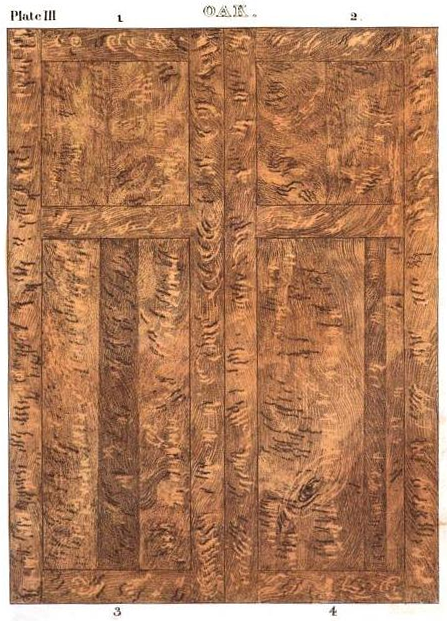
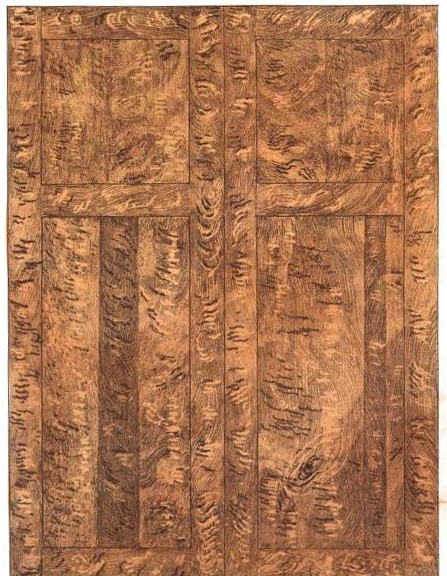
It is of great consequence in imitating oak that the joiner’s work should be represented naturally as well as the wood. The practitioner in graining who resides in any large town, will have ample opportunities in observing the work of others, and improving from their beauties, and even from their defects. If a new oak door is to be formed, the joiner is solicitous to select wood as finely flowered and free from knots as it can be procured; and if a join is made in a panel he is anxious that the wood should be of the same colour, and if possible that the grain and flower should match, as nothing would look worse in his eye than knotty wood and difference of colour.

And yet it is the constant practice of the painter, in order to shew his skill in graining, to make both those faults show as glaringly as possible. Nothing can be more offensive to the eye of taste than to see the panels of a door joined at all; but if the painter chooses to shew his skill, let the joint appear neatly put together, and shew the joint by combing the grain in opposite directions. The common error is to form the joint by glazing part of the panel with a glaze of vandyke brown, leaving the other part the natural color of newly cut oak. This certainly shews a joint, but shews it much in the same way that a tailor would shew his skill in patching a hole in a black coat with a piece of scarlet cloth.

Oak panel door
Oak panel door

Editor’s note: The word “shew” used here is simply an older spelling variation for the word “show”. Originally published in The Decorative Painters’ and Glaziers’ Guide, by Nathaniel Whittock. London: Isaac Taylor Hinton, 1828, pp 24-25.