
Category Archives: Reprints

A Television Hero: The Property Man, 1949

The following article first appeared in The New York Times on April 3, 1949.

A Television Hero: The Property Man

by Arthur Altschul

The property department, always an essential element of the theatre, is becoming equally important in television production. During the years of radio, the responsibility for creating an illusion of reality rested with the sound effects department. Now the principal headaches of manufacturing veracity for video belong to the property man.

An indication of the expanding importance of the property department is seen in a few statistics. Last week, for example, NBC had to produce more than 3,000 props for forty-eight television shows. A year ago the same network found its demand for props approximately 5 per cent of what it is today.

Variety shows, dramatic shows, and children’s programs-in that order- take up most of the time of the station’s property man, who every day is in touch with an assortment of museums, antique stores, prop shops, furniture and department stores, factories and zoos, tracking down the more elusive objects required for a show.

Hours of exhausting search culminate in the effect which an audience takes as a matter of course. The type of work and problems that beset a station’s property department are evidenced in the following excerpts from the property sheet for one of Milton Berle’s recent “Texaco Star Theatre” shows: Continue reading A Television Hero: The Property Man, 1949
Costumes and Scenery for Amateurs, 1915 (part 2)

The following comes from a 1915 book called “Costumes and Scenery for Amateurs”. I published the first portion of the chapter on props way back in 2009. Here, without further delay, is the conclusion.

Stimulate initiative and invention wherever possible. A round collar box is only a collar box until you use it for an earthen bowl. A white cardboard shoe box is cut down a little, covered with black tissue paper, has a little yellow pane inserted in each side, and a curtain ring for a handle. Behold a lantern for a Yankee minute-man, or Paul Revere, or anyone else who wants to use it.

Remarkable stage furniture can be made from wooden boxes of all sizes. A packing case makes a dais. Several boxes nailed together and stained brown will make a peasant’s cupboard.

Three boxes nailed together like this |¯| will make a hearth. If it is to be a mediæval or fairy tale hearth, cover it with cheap gray cambric, bulked to look like stone, and marked with splotches of white and brown chalk. Be sure you turn the unglazed side of the cambric outward. Use chalk because paint will not show up well on cambric. A brick fireplace for a modern scene can be made in the same way, covering the boxes with brick chimney paper than can be bought at Dennison’s Tissue Paper Co., Boston, Chicago, or New York. One of their catalogues will prove invaluable to directors living in the country. A narrow box on rockers, stained brown, becomes a Puritan or eighteenth century cradle. Gilded and hooded it is the cradle of a royal Princess. Couch seats can be made from boxes, only be sure that they are secure.

Originally published in “Costumes and Scenery for Amateurs”, by Constance D’Arcy Mackay, 1915 (pp 95-96)

Hand Fire-Arms through History

Hand fire-arms
Hand fire-arms
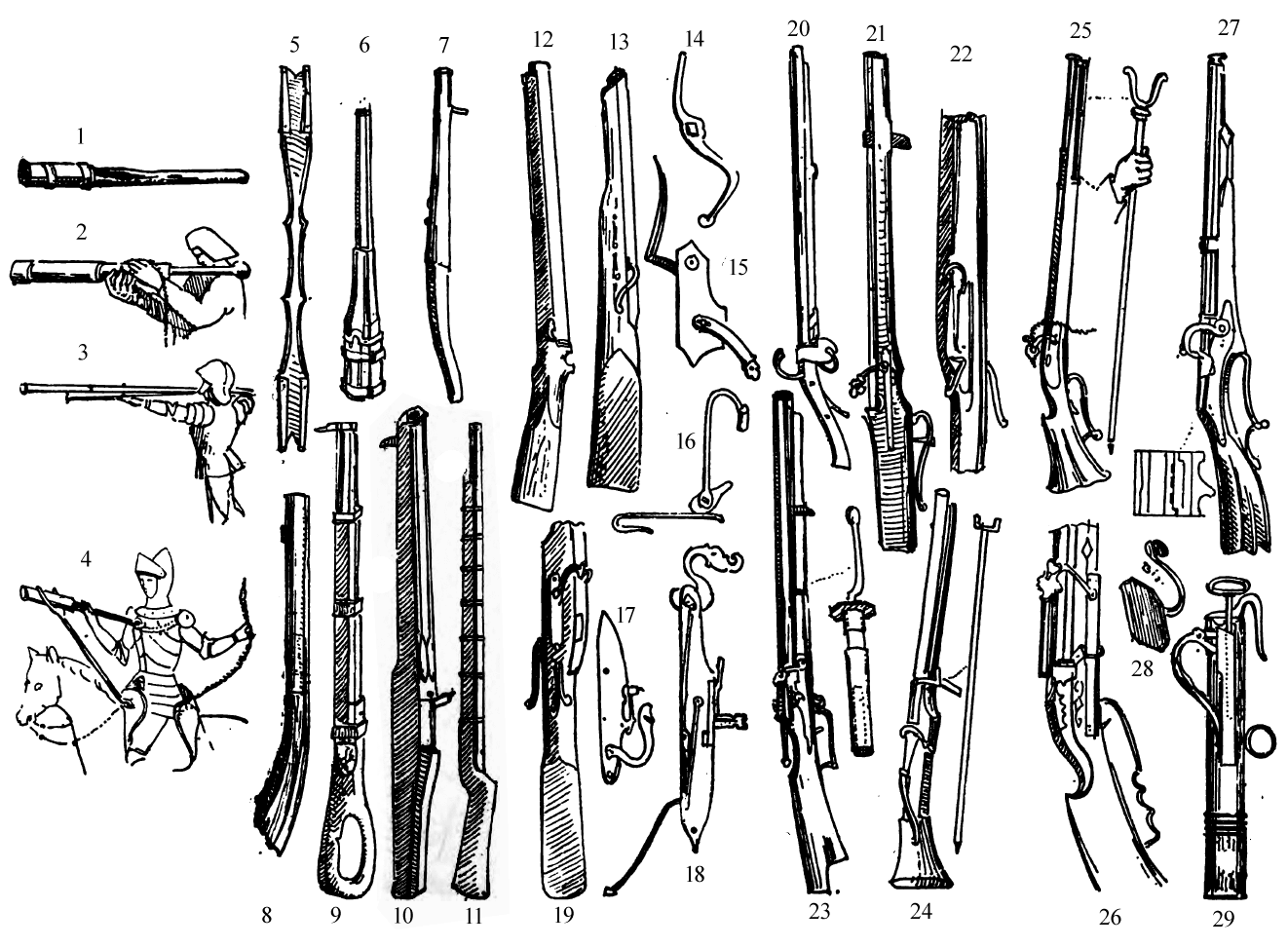
  1. Hand cannon for foot soldier in cast iron, belonging to the first half of the fourteenth century. The touch-hole (German, Zünderloch) is on the upper part of the cannon.
  2. Hand cannon for foot soldier, from a MS. of the end of the fourteenth century. The touch-hole is on the top of the cannon.
  3. Hand cannon for foot soldier, from a manuscript of the year 1472, in the library of Hauslaub at Vienna.
  4. Hand cannon for a knight, called a petronel, from a manuscript in the ancient library of Burgundy. The articulated plate armour is characteristic of the latter half of the fifteenth century, though the bassinet has a movable vizor. These hand cannons were in use at the same time as the serpentine arquebuse, and even as the flint and steel arquebuses and muskets, ie till the beginning of the sixteenth century, as may be seen from the drawings, by Glockenthon, of the arms of the Emperor Maximilian I. (1505).
  5. German hand cannon, fixed on wooden boards or stands, belonging to the beginning of the sixteenth century. The touch-hole is still on the upper part of the cannon. From the drawings of Glockenthon, done in 1505.
  6. German hand cannon in fluted iron, of the beginning of the sixteenth century, or end of the fifteenth century. It is only 9 1/2 inches in length, 2 inches in diameter, and is fixed on to a piece of oak about 5 feet in length. In the Germanic Museum, where it is wrongly ascribed to the fourteenth century.
  7. Hand cannon in wrought iron, called a petronel, to be used by a knight. It is of the end of the fifteenth century.
  8. Hand cannon with stock of the end of the fourteenth century. The touch-hole is on the top of the cannon.
  9. Angular hand cannon on stock; to be used in defending ramparts. It is a little over 6 feet in length, and the touch-hole is on the top of the cannon. This piece was used in the defence of Morat against Charles le Téméraire (1479).
  10. Eight-sided hand cannon with stock. The touch-hole, which is on the top of the cannon, has a cover moving on a pivot. This cannon is 54 inches in length, and the balls or bullets about 1 1/2 inch in diameter. It belongs to the first part of the fifteenth century.
  11. Persian matchlock cannon, copied from the Schah-Namen, in the Library of Munich.
  12. Hand cannon on stock, end of the fourteenth, or beginning of the fifteenth century. In this piece the touch-hold is on the right side.
  13. Hand cannon with serpentine, a match-holder, without trigger or spring, invented about the year 1424.
  14. Serpentine or guncock for match, without trigger or spring.
  15. Serpentine without trigger, but with spring.
  16. Serpentine with spring, but without trigger.
  17. Serpentine lock, without trigger or spring.
  18. Hackbuss lock with spring and trigger.
  19. Hackbuss (in German, Hakenbüchse) or hand cannon, with butt end and serpentine lock. It belongs to the second half of the fifteenth century. The match is no longer loose, but fixed to the serpentine, which springs back by means of the trigger. This sort of cannon is generally about 40 inches in length, and it is usually provided with a hook, so that when it is placed on a wall it cannot slip back. The hackbuss without a hook is, as a rule, better made, and was subsequently called arquebuse with matchlock. It had also front and back sights (in German, Visir und Kern).
  20. Chinese arquebuse.
  21. Swiss arquebuse of the second half of the fifteenth century.
  22. Double arquebuse (in German, Doppelhaken). This weapon had two serpentines, or dogheads, falling from opposite points, and was generally used in defending ramparts; the barrel was usually from 5 to 6 1/2 feet in length.
  23. Hackbuss, loaded from the breech by means of a revolving chamber, a weapon belonging to the beginning of the sixteenth century.
  24. Hackbuss and gun fork (German, Gabel), from the drawings of Glockenthon; it may also be seen in the engraving of the “Triumph of the Emperor Maximilian I.” From this we see that the hackbuss, or match arquebuse, was used for a long time together with the wheel-lock arquebuse.
  25. Serpentine hackbuss with match, also called musket. It is also furnished with a fork, called a fourquine in French.
  26. Hackbuss or musket, with link.
  27. Serpentine hackbuss with link, also called arquebuse, loaded from the breech by means of a revolving chamber. It dates from the year 1537, and bears the initials W. H. by the side of a fleur-de-lys.
  28. Eye protector, belonging to a musket in the Arsenal of Geneva.
  29. Hand cannon with rasp, early part of the sixteenth century. It is entirely of iron, and is called Münchsbüchse (monk’s arquebuse). For a very long time it was wrongly thought to be the first fire-arm ever made, and to have belonged to a monk named Berthold Schwartz (1290-1320), who was also said to have invented gunpowder. This little weapon is about 11 1/2 inches in length, and the barrel 5 inches in diameter. It preceded the wheel-lock, and appears to have suggested the idea of it. A rasp scatters sparks from the sulphurous pyrites by friction.

The illustrations and descriptions have been taken from An Illustrated History of Arms and Armour: From the Earliest Period to the Present Time, by Auguste Demmin, and translated by Charles Christopher Black. Published in 1894 by George Bell.

Pistols, 1500-1856

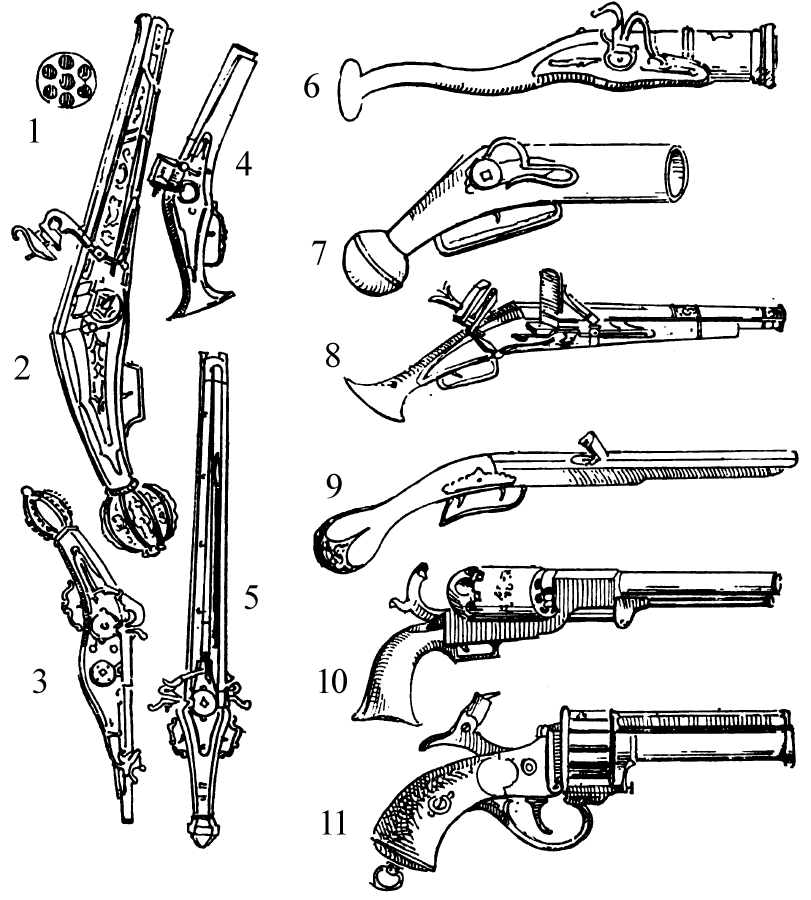
Here is a small collection of typical or notable pistols spanning from the sixteenth century to the middle of the nineteenth century.

Pistols, 1500-1856
Pistols, 1500-1856
  1. Barrel for number 4.
  2. Wheel-lock pistol of the sixteenth century. This was the sort of pistol used by the German cavalry, and also by the Ritter, or knights.
  3. Wheel-lock pistol with double barrel, beginning of the seventeenth century.
  4. Wheel-lock pistol, firing seven shots.
  5. Double wheel-lock, end of the sixteenth century. Arsenal of Zurich.
  6. Wheel-lock and mortar pistol, called in German Katzenkopf, of the seventeenth century.
  7. Wheel-lock and mortar pistol of the seventeenth century. It is entirely of iron.
  8. Flint-lock pistol, end of the seventeenth century.
  9. Pistol with flint-lock, of the beginning of the eighteenth century.
  10. Colt’s revolver, invented by Samuel Colt, of the United States, in 1835.
  11. Mat revolver, invented a short time back by M. Le Mat.

The illustrations and descriptions have been taken from An Illustrated History of Arms and Armour: From the Earliest Period to the Present Time, by Auguste Demmin, and translated by Charles Christopher Black. Published in 1894 by George Bell.

Prop Man’s Predicament, 1937

The following amusing anecdote was found in a 1937 issue of The Christian Science Monitor.

An ingenious piece of fiction from one of the studios tells of the literary adventures of one Arthur Camp, a property man. It seems (according to this press release) that Camp needed a manuscript rejection slip for use in a picture to which he had been assigned.

Prop men pride themselves on being able to produce anything, so Camp sat down and penned an article on movie-making and sent it to a national magazine.

He thought, of course, that he would get it back with a rejection slip. However (surprise! surprise!), the magazine bought the article.

Of course, Camp could have had the studio printshop make up some of the slips. Or he could have borrowed one from any of a thousand unsuccessful Hollywood authors. But that wouldn’t have made a good story. —Milwaukee Journal.

This article was found in the Christian Science Monitor, December 27, 1937.