
Category Archives: Reprints

An All-Women’s Theatre Company from 1905

I came across the following article in The Bystander, No. 98, Vol 8, Wednesday, October 18, 1905. Sexist language aside, I thought it gave a glimpse of an interesting theatre company that many of us would not have thought existed at the time. It is also a fascinating article to present during Women’s History Month.

A Novel Theatrical Company: Financed, Managed and Run by American Women

(Mailed by our Correspondent in America)
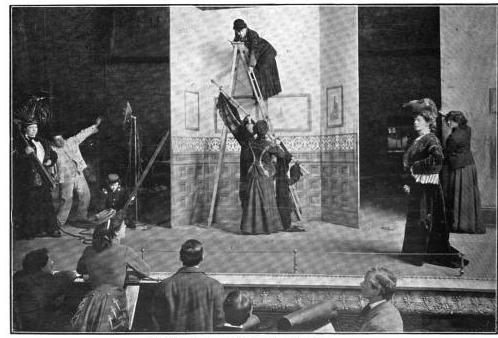
Miss Gertrude Haynes directing the setting of the scenes

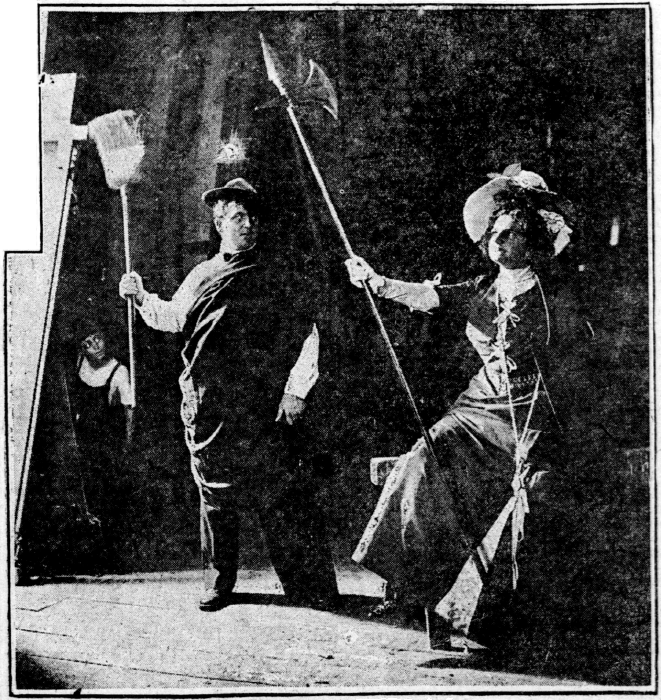
The American woman is proud in the knowledge that she can stand alone without the support of mere man. She has taken her place in the world of affairs, and now she is to prove that she can run, entirely on her own, that most difficult of businesses—a theatre. Miss Gertrude Haynes is at the head of a Company which will present a woman’s play, written by a woman dramatist, financed by a woman “angel” (this is as it should be). Advance agent, doorkeeper, treasurers, scene-shifters, attendants—all will be of the fair sex.
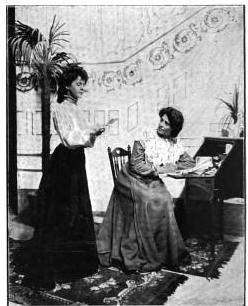
In the Treasurer's office, where the "ghost" walks every Friday. For the benefit of the unitiated, it should be explained that the payment of salaries is referred to in the profession by the spiritual simile of a ghost walking.
In the Treasurer’s office, where the “ghost” walks every Friday. For the benefit of the uninitiated, it should be explained that the payment of salaries is referred to in the profession by the spiritual simile of a ghost walking.

Miss Haynes is one of the best-known new stars in the country, her “Choir Celestial” having been presented in all of the theatres of the big circuits. She was the originator of the religious act on the stage, and has won both fame and fortune. But let her speak of her own project:—

“My determination to use women stage hands, advance women, and ticket-takers, is not a freak notion,” said Miss Haybes. “I have tried women for the work and found them better than men. They are faithful, work harder, and can always be trusted to be on hand. And that is more than can be said for some of the men who have been in my employ.

“My sister, Miss Tessie Haynes, went out as my advance agent two years ago, and her success was remarkable. No man ever did so well for me. And it wasn’t six months before she was engaged.

Some of Miss Tessie Haynes’ experiences were more strenuous than most men in the same position are called upon to undergo. In Chicago, she encountered a strike of bill-posters, and could not get the Company paper out. Finding that appeals to the strikers availed nothing, the plucky little woman determined to put up her own bills. Hiring a wagon, she went out supplied with paste bucket and brush, and posted the bills.

Her action caught the fancy of the men, who cheered her bravery, and her bills were not disturbed. She has the record of being the only woman bill-poster in the world.
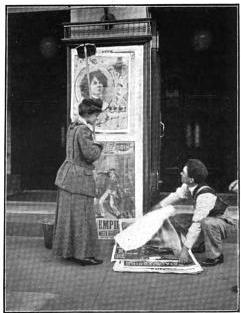
Miss Tessie Haynes, sister of the manageress, acting as a bill-poster

Miss Gertrude Haynes is not exactly preparing for trouble, but she is prepared to meet it if it comes. The man who thinks to have a joke at her expense will “get left” as his countrymen say.

Thus: “My property woman weighs 160 pounds, is strong and vigorous, and can hustle a trunk if necessary,” declares the indomitable manageress. Nor will she stand any love-making nonsense to interfere with the work in what she calls her “Adamless Eden.”

“No, my doorkeeper won’t flirt with the men. She is a fine, handsome woman with grey hair, inexpressibly dignified, and no man will take liberties with her. At least, I pity the one that tries.”

Man will not be entirely banished from the Company. He will be suffered to play the male roles, but otherwise will be quite subordinate. Listen to this strike-loving scene-shifter of the sterner sex!

“I expect to get a cleaner production by reason of my woman stage director. A woman is naturally artistic. She will not take more time to set the stage than a man, but it will be done infinitely better.

“My artists would fall down every night if I did not go after the men and smooth the wrinkles out of the carpet. A woman would never do such clumsy work.”

Miss Haynes’ final word breathes the very spirit of determination. “I have always come off ahead in our battles, and I’m sure that my new venture of an Adamless troupe will succeed.”
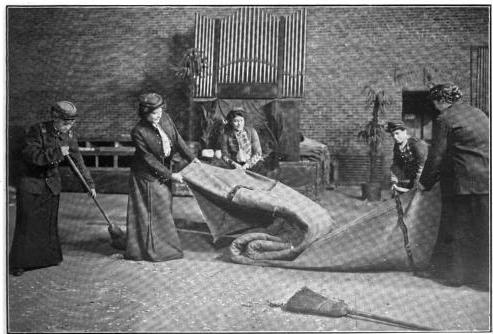
Members of the manless theatrical company engaged in scene-shifting

This article and images were originally printed in The Bystander, No. 98, Vol 8, Wednesday, October 18, 1905.
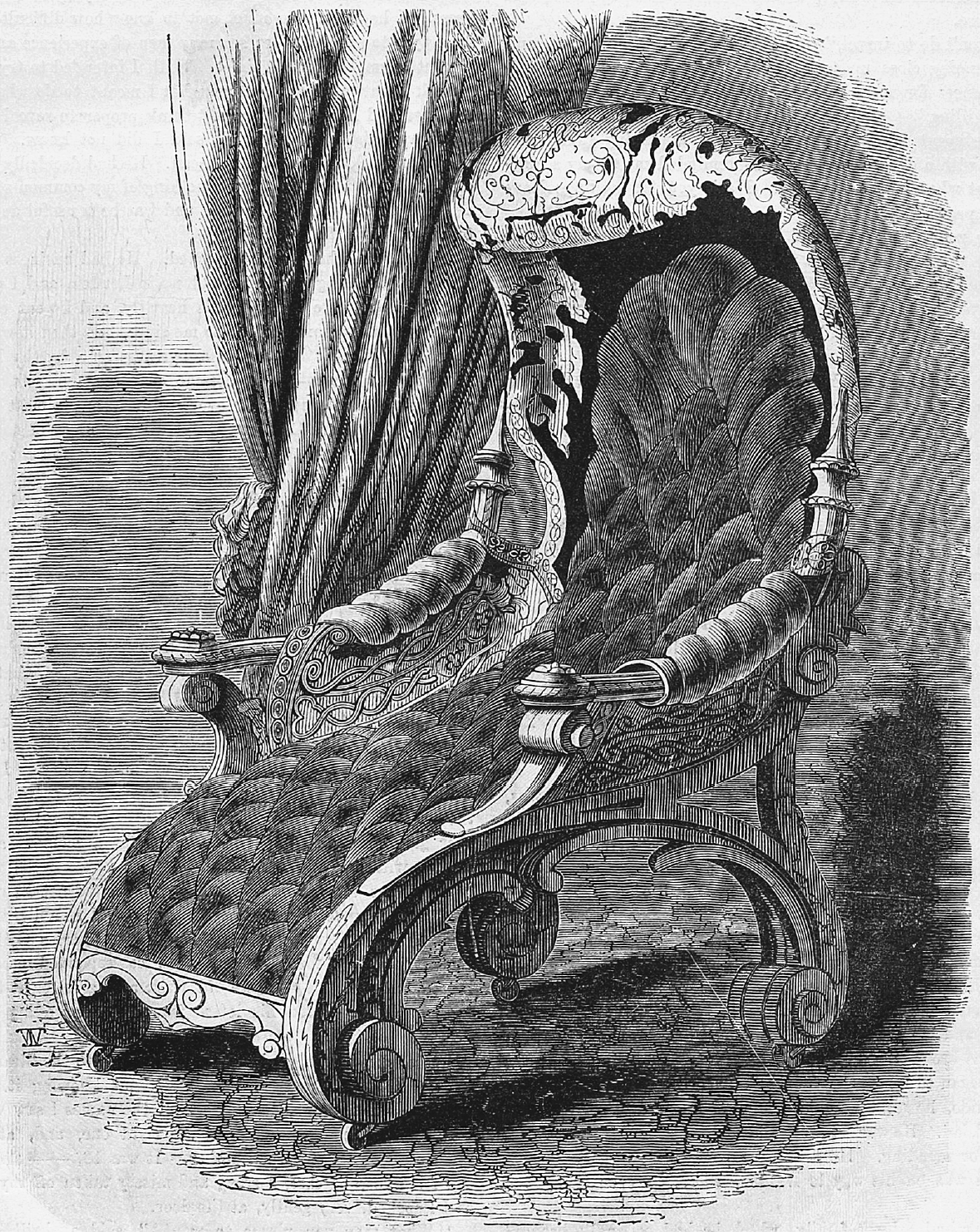
A Papier Mache Chair from 1854

The following comes from “The Illustrated Magazine of Art”, Volume 4, Number 24, page 344, published in 1854. I thought the process they described was interesting. First, it is the first time I’ve heard of using metal molds for papier maché; second, they let each layer dry fully before applying the next (I learned to lay up each layer while the previous is still damp).

The polished French claim the honour of being the original inventors of the papier maché. In Paris the manufacture of the article is carried on very extensively; but far beyond the articles produced there—articles both of utility and ornament—stand those of the Birmingham manufacturers.

The old method of manufacturing papier maché is as follows:

—The paper for use is gray in colour, but similar in texture to ordinary blotting paper. Prior to using it, the paper is well saturated with flour and glue mixed with water, in about equal proportions, and is then laid on the mould of the article intended to be produced. These moulds are of iron, brass, or copper. The mould, coated with the first layer of paper, is then dried for twelve hours. A careful smoothing by a file follows, after which another deposit of paper is made. The processes of drying and smoothing are successively repeated with each additional layer of paper, until the article assumes the required strength and thickness. When the newly-formed article is taken from the mould, the several parts are planed, filed, and trimmed, so as to be quite correct and level. The process of stoving then follows; after which the varnish is laid on, and brought to a smooth, hard, brilliant surface. The article is then coated with several layers of shell-lac varnish, coloured, which, after being hardened, are scraped quite level. The different varnishings and smoothings are carried on for a period varying from twelve to eighteen days, according to the purpose for which the article is required. The exquisite surface is produced by manual polishing with rotten stone and oil; but the finish is obtained by the process of handling alone.

Various alterations and improvements have been made from time to time in the manufacture of papier maché; and sometimes the paper is reduced to pulp, cast to the form required, and then rendered compact and solid.

The specimen which we present is of a chair in papier maché; the grace and elegance of the design deserve especial attention.

Papier Mache Chair
Papier Mache Chair

Papier Mache Chair. The Illustrated Magazine of Art, Vol. 4, No. 24 (1854), p. 344

The Carpentry of the Musical Show, 1910

The following article was first published in The San Francisco Call, August 28, 1910, page 14. It is excerpted from a larger article called “The Carpentry of the Musical Show”, by Garnet Warren, and describes the process a Broadway show travels from inception to opening night.

The gentleman of theatrical properties has also had pressed into his hands that universal scenario, with rough sketches of furniture by the scenic artist. The stage managers have been conferring, too, with the busy author as to the lists of properties required. Rough instructions are all that are sufficient for most of these.

So away goes the propertyman to his workshop among the dust and cobwebs. It is large and has rough, red bricked walls. Fifteen to eighteen men work here in the busy summer season—fellows in blue shirts and overalls and the clothing of toil. The floors are bare and loaded up with dust, shavings, paint, unfinished carpentry, finished chairs and statues. The practical propertyman would seem able to construct most things. He makes machines for wind effects; he paints the odds and ends of scenery; he builds furniture and electric light fixings and makes rugs and carpets and door knobs and even paper mache statues from his own designs. In the six busy weeks before a production begins, too, his work is of a feverish description. About 3,000 separate pieces are sometimes required. The busy bee would appear to come a disastrous second to the propertyman.

The First Rehearsal of Principals. Photo by Byron.

Editor’s note: Notice how the photograph above shows the use of rehearsal props and costumes.

Excerpted from “The Carpentry of the Musical Show”, by Garnet Warren, first published in The San Francisco Call, August 28, 1910, page 14.

Managing a Mimic World, 1885

The following is an interview given to a Sun reporter by one identified only as a “veteran stage manager” of one of New York’s stock theatres. It was originally published in the New York Sun, February 15, 1885, on page 6.

“Five different and entirely distinct departments must work harmoniously and without the slightest hitch or delay,” continued the stage manager. “These are the actors, the musicians, the carpenters, the property men, and the gas men. A trifling failure made by the least of any of these may turn a performance into ridicule. Each of the mechanical departments has its own boss, but all are subject to the stage manager’s orders, and he in turn is responsible to the manager.”

“To the property-man’s department belong all furniture, carpets, curtains, ornaments, and all the small articles used by actors, and known in theatrical parlance as hand or side props. Among these are letters, books, guns, pistols, knives, purses, pocketbooks, money, lamps, candles, cradles, and doll babies. Live props, such as dogs, cats, birds, donkeys, and horses, are also under his charge, and are much disliked, as causing a vast amount of trouble. The side props are taken from the property man every night by the call boy, whose duty is to deliver them to the actors and return them after they have been used to the property room. A good property man is hard to find, for he must be something of a carpenter, an artist, a modeler, and a mechanician [sic].

“Papier-maché has come of late years to be largely used in the manufacture of properties, and nearly all the magnificent vases, the handsome plaques, the graceful statues, and the superb gold and silver plate seen to-day on the stage are made of that material. Some of the imitations of china are so perfectly done and so admirably painted that it is not unusual to see an actor tap them to find out if they are real. In making statues a cast is taken from the clay, and the pulp is then firmly pressed into the moulds. Life-size statues which seem to be of bronze or marble do not weigh more than five or six pounds, look just as well as the genuine, and are easily and quickly handled. For traveling purposes the saving in freight alone is a great economy. Entire suits of armor and fruits of all kinds are made of this useful and inexpensive material. The late Mr. Wallace, the husband of Mme. Ponial, was in his day a celebrated property man. Perhaps the two best now living are the brothers William and George Henry of the Union Square and Madison Square Theatres. Both are really excellent artists, and their salaries are deservedly as large as those of good actors.

“In most New York theatres the property man has one regular assistant and two night aids, who are needed to handle heavy carpets, pianos, and furniture. In the old days carpenters and property men were often prone to dispute about the exact lines which divided their duties, but in well-regulated theatres the departments are now generally willing to help each other. Still, a carpenter or grip is not actually bound to put a finger to a carpet or piece of furniture, nor is a property man, even if not occupied, obliged to help with a scene. Some of the distinctions drawn by custom seem to be singular; thus, a whole tree, if set upon the stage and screwed to it for support, is considered a part of the scene, and, as such, belongs to the carpenters, while a stump upon which a person may sit is in the property man’s department. Again, a flight of stairs is set up by the carpenter, but if a carpet is put on it, that must be done by the property man.”

William Bradley, Property Man, 1927

This article first appeared in the February 20, 1927, issue of The New York Times.

With the trend of the drama toward realism it is obvious that the relative importance of the property man in the theatre must have increased considerably. In the barn-storming days of the early ’90s a revolver, a window-sash and a back-drop depicting Niagara Falls at its most gushing moment, comprised an almost complete set of props. Today, the man whose business it is to supply all the effects necessary to create an authentic background must produce as part of his day’s work everything from a flying carpet to a cat’s meow.

It is just such effects that William Bradley, who has been tracking the prop to its lair for lo, these many years, has on tap at his studios. Bradley’s first experience in playing valet to the stage began in 1885 when he worked at the old Standard Theatre. In 1892 he wandered out to Dayton, Ohio, with his trusty three-piece set of props. There he not only dressed the stage, but he also did a song and dance turn, tended door on the balcony, and also rehearsed the orchestra for the incidental music.

In 1908 Bradley returned to New York to begin work as property man with the late Henry B. Harris. It was while furnishing the Harris productions with properties that he conceived the idea of opening a studio upon which producers could call for data and incidentals. On Mr. Harris’s death Bradley started in the property supplying business. Today, no matter what article of stage adornment is necessary to a show he will usually find it.

Any number of interesting quests fall to his lot. Take, for instance, the little matter of shark teeth. It isn’t often that the voracious specimen of cartilaginous fish, or even any portion of his anatomy, is called upon to make a public appearance. Naturally, Bradley thought that the shark would be pleased—nay, even willing—to turn professional. But not a bit of it. The property man spent a lively few days trying to gather together enough shark teeth to make a necklace. He searched high and low and at last rounded up two stuffed shark heads with the idea of extracting the necessary ivories. But the heads refused to lose their teeth. So the hunt for the necklace continued.

It was a week later that Bradley journeyed to the Syrian quarter on Washington Street looking for some pipes for another production. He happened into a Turkish delicatessen store. It was bargain day for dried okra, and Mr. Bradley was the recipient of an idea. Buying the okra, which is usually used for soups, he took the bag of herbs to his studio, hung the pieces on a string, and thus was born a necklace of shark teeth that, so it is said, would have turned any South Sea Islander green with envy.

It was in Dayton that Bradley first met George C. Tyler, whose productions he now outfits. Mr. Tyler was, at that time, a press agent with an eye on the producing end of the business. But the two did not meet again until Mr. Tyler did Tarkington’s “Clarence.” Ever since then Bradley has found the props for all Tyler shows, whether they be modern comedy or historical drama.

It is necessary for the property man, if he is to make a real business of his work, to have at his disposal a fund of information concerning almost every historical period in almost every country. In “The Constant Nymph” for example, Bradley was called upon to supply the props for a Tyrolean home. This meant that he had to furnish the potato barrels, the clumsy stools and tables, the pottery from which the characters eat, and that they all had to be true to life. For the property man never knows when some experienced traveler or historian, or even a native of Tyrol, may be sitting out front waiting to catch him up. And natives of Tyrol, it seems, are given to doing this.

Periodicals from a specific locality are often difficult to procure. There is in “Tommy” a call for a telephone book from a small town in New Jersey. This was fairly easy, for it meant that the property man made overtures to the town and procured the required prop. The question of having newspapers of a definite date and place on the stage is another problem—not a difficult problem, to be sure, but one that demands the attention of the property man. Should the “prop plot” call for the current issue of a daily paper, it is that functionary’s job to see that each day a fresh paper is supplied. Only he knows how many people out front will catch a slip-up on his part—and how many have!

The greatest demands on the property man today are for modern appliances, such bathtubs and kitchen furnishings as are used, say, in “Saturday’s Children.” These are easy enough to furnish and a supply is always at hand.

Originally published in The New York Times, February 20, 1927.