Mechanical Sound Effects

Before sound could be reproduced by recorded means, any sound effects needed in the theatre had to be created by mechanical means. The props department was in charge of coming up with the machines and devices to achieve that. In the rare cases that live sound effects are used in a modern performance, it still tends to be props’ responsibility, though with the advent of sound designers, you will always have some cross-departmental collaboration.

The devices used for the most common sounds were fairly standard during the last few centuries. I found some great illustrations of these in a 1900 book entitled Secrets of Scene Painting and Stage Effects by Van Dyke Browne (what a name for a scene painter!)

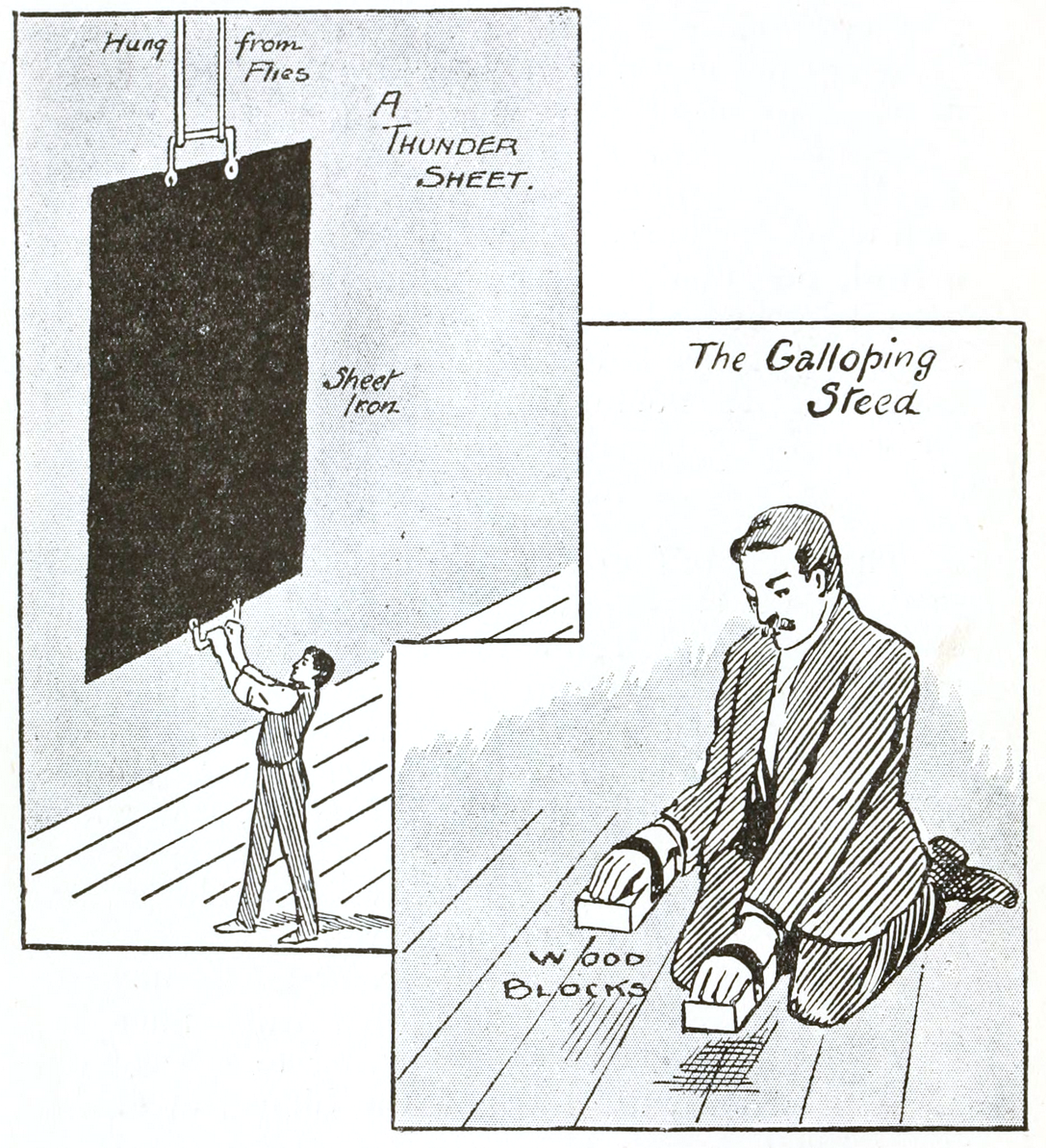
Thunder sheet and Galloping steeds

Thunder was created by hanging a large sheet of thin iron and shaking it. If you’ve ever carried a large sheet of thin sheet metal, you can imagine the sound something as large in the picture can create.

Wood blocks were used to generate the sound of galloping horses; they had elastic bands to keep them on the prop-person’s hands. The book points out that some property masters preferred the use of coconut halves, though this required the cut ends to be perfectly flat and smooth.

Rain and Wind
Rain and Wind

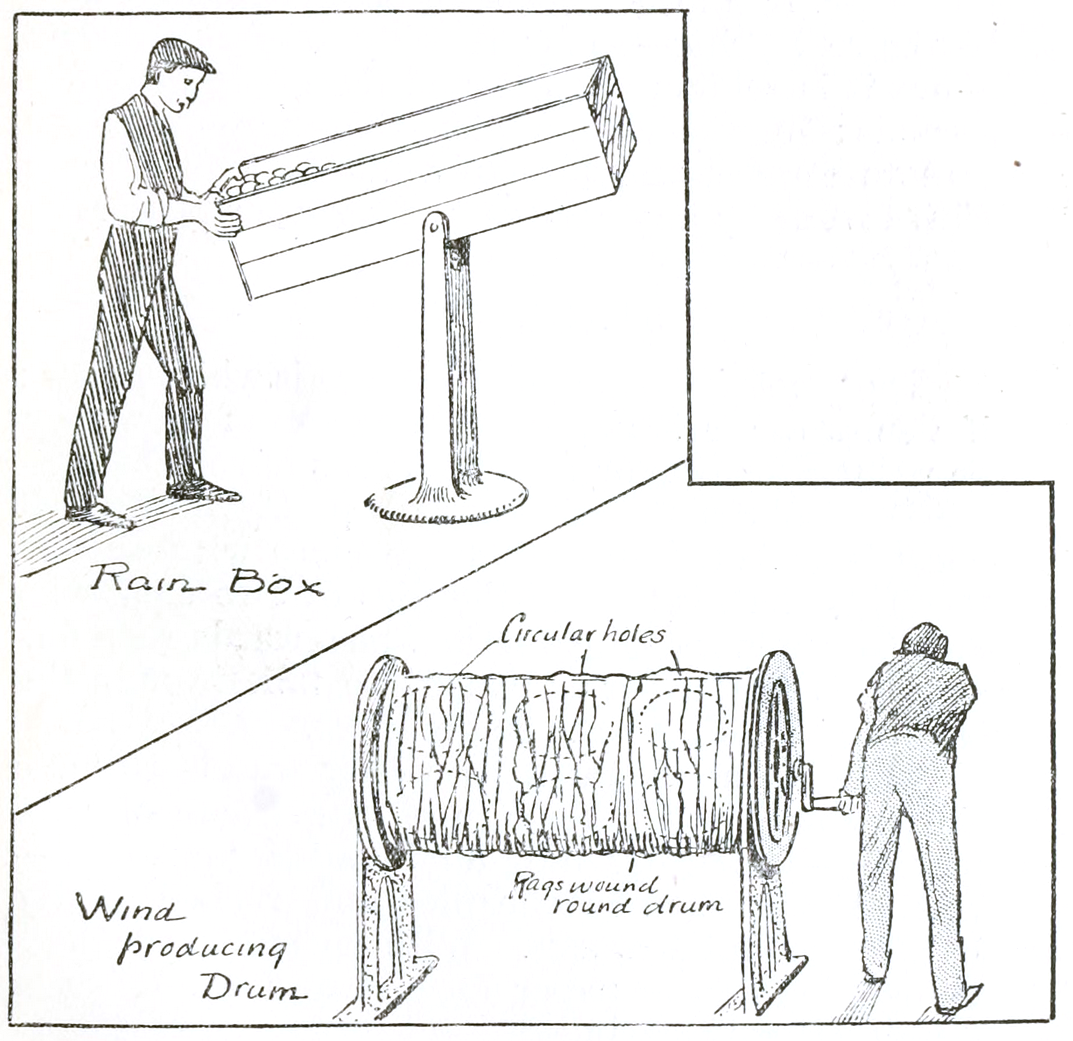
The sound of rain was made by filling a long box with small pebbles. The box had a center pivot point which allowed it to tilt; all the pebbles would tumble to the other side. If you’ve ever played with a rain stick, it is the same general idea.

The “wind-producing drum” is a bit of a mystery to me. Browne neglects to describe this drawing, and I cannot be certain of its possible sound or intended use. Most of us are more familiar with the next drawing as a machine to create the sound of wind.

Wind Machine
Wind Machine

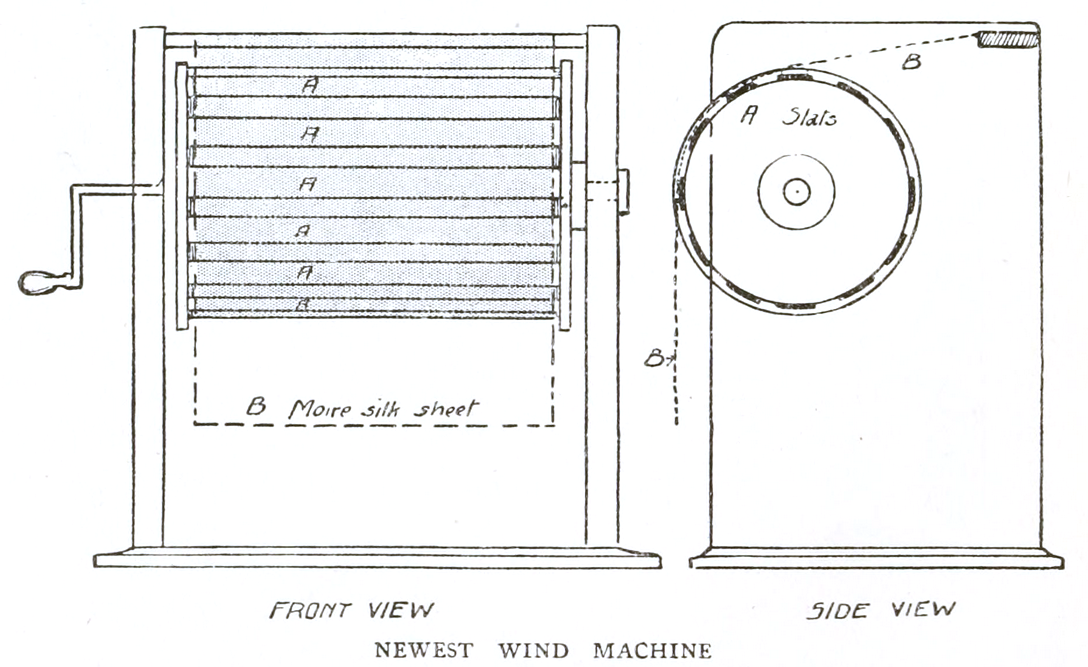
A piece of silk is draped over a drum made of slats of wood with spaces in between. The drum can be turned to create the sound of wind.

The following are more esoteric devices. With the advent of cinema, foley artists (as the creators of mechanical sound effects were called) had to come up with ways to create sound effects in much smaller places; after all, a cinema has far less space backstage than a theatre for plays.

Horse Trotter
Horse Trotter

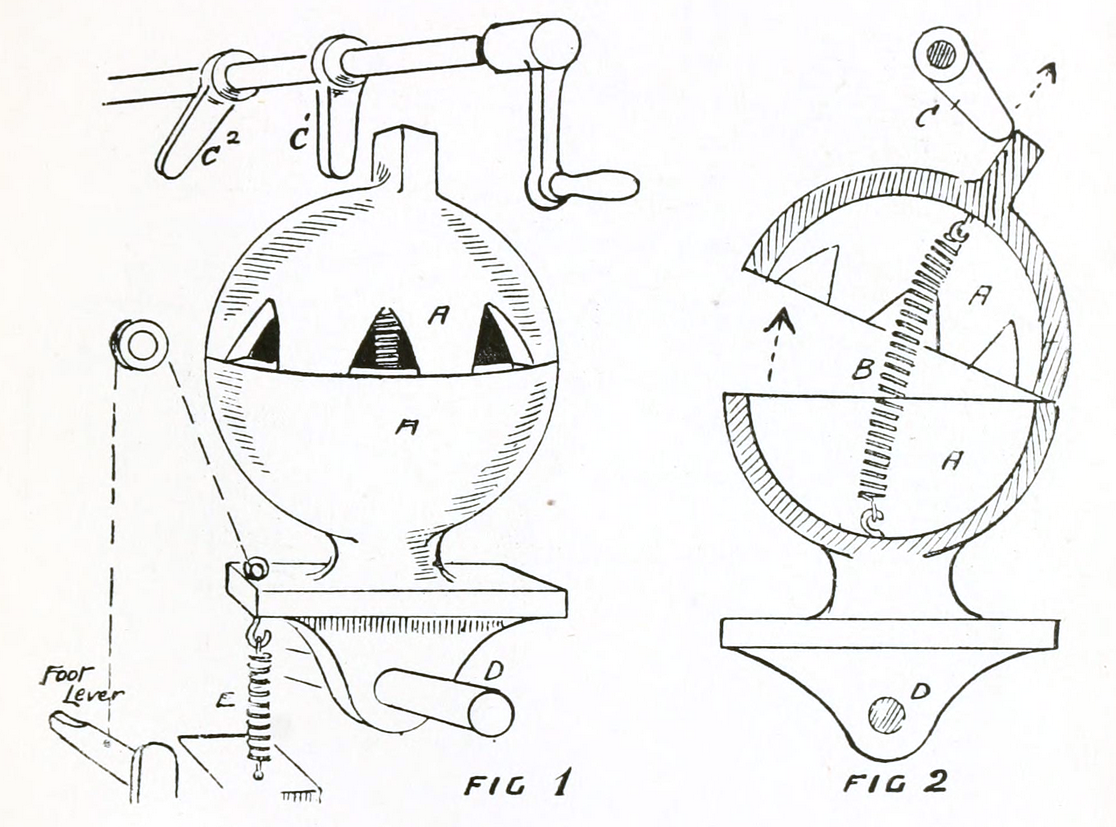
This is a horse trotting machine. It acts like a more automated version of hitting two coconut halves together. A shaft above has a number of “tappets” (C1 and C2) which pushes the top cup away from the bottom cup (Fig 2). When the tappet clears, a spring connecting the two cups pulls them back together, creating the sound. The triangular cutouts in the top cup help make a louder and richer sound. The “foot lever” on the bottom is used to adjust the distance of the cups from the shaft. When it is further away, the tappets do not push the cup as much, creating a softer sound. Thus, it gives the operator some control over the volume of the galloping horses.

Sound Machine
Sound Machine

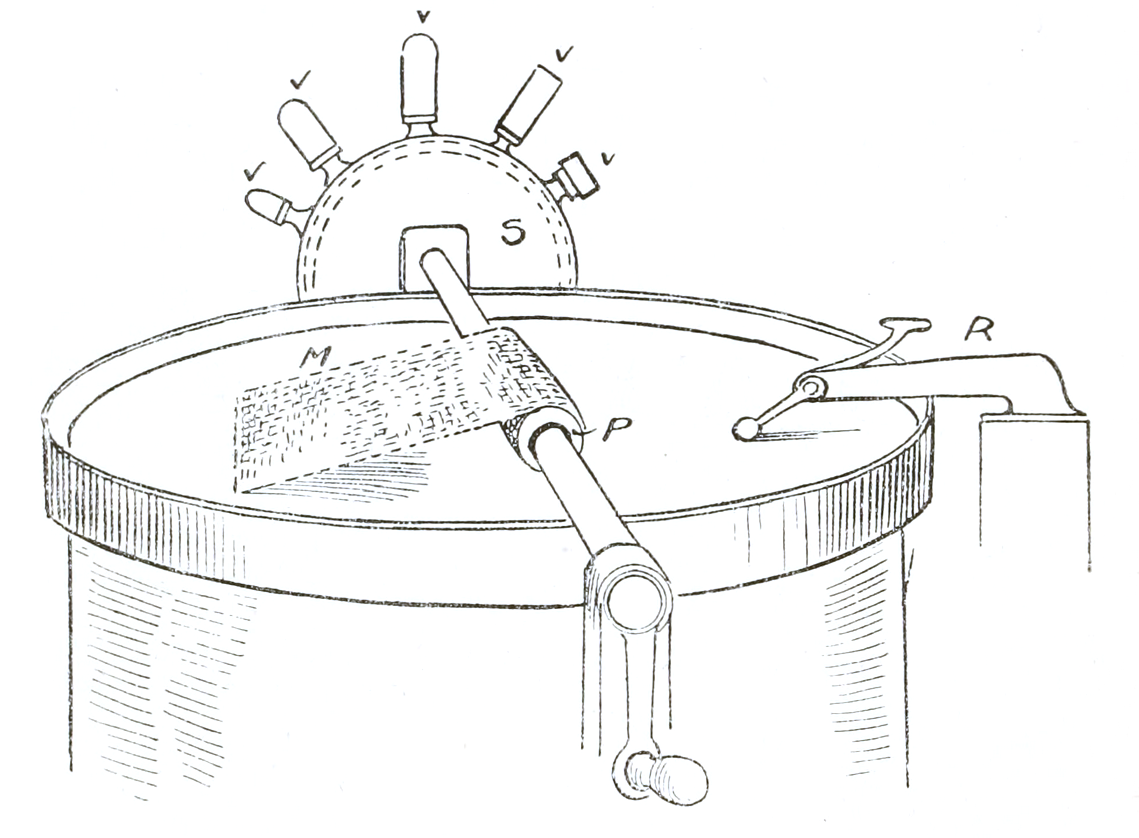
This last machine is an attempt to combine a whole bunch of sound-generating devices into one. The back part (S) has a number of pipes, whistles and bells (V), through which compressed air is run. You can trigger each one individually by turning the air on and off. In the middle of a large drum is a thin sheet of stiff metal (M). Using the handle, you can slap it against the drum to simulate artillery fire. Because it is on a roll (P), you can alter the length of the sheet to control the volume of the slap.

A final lever (R) can be used to generate a rolling effect on the drum, which apparently mimicked the sound of automobiles quite successfully.

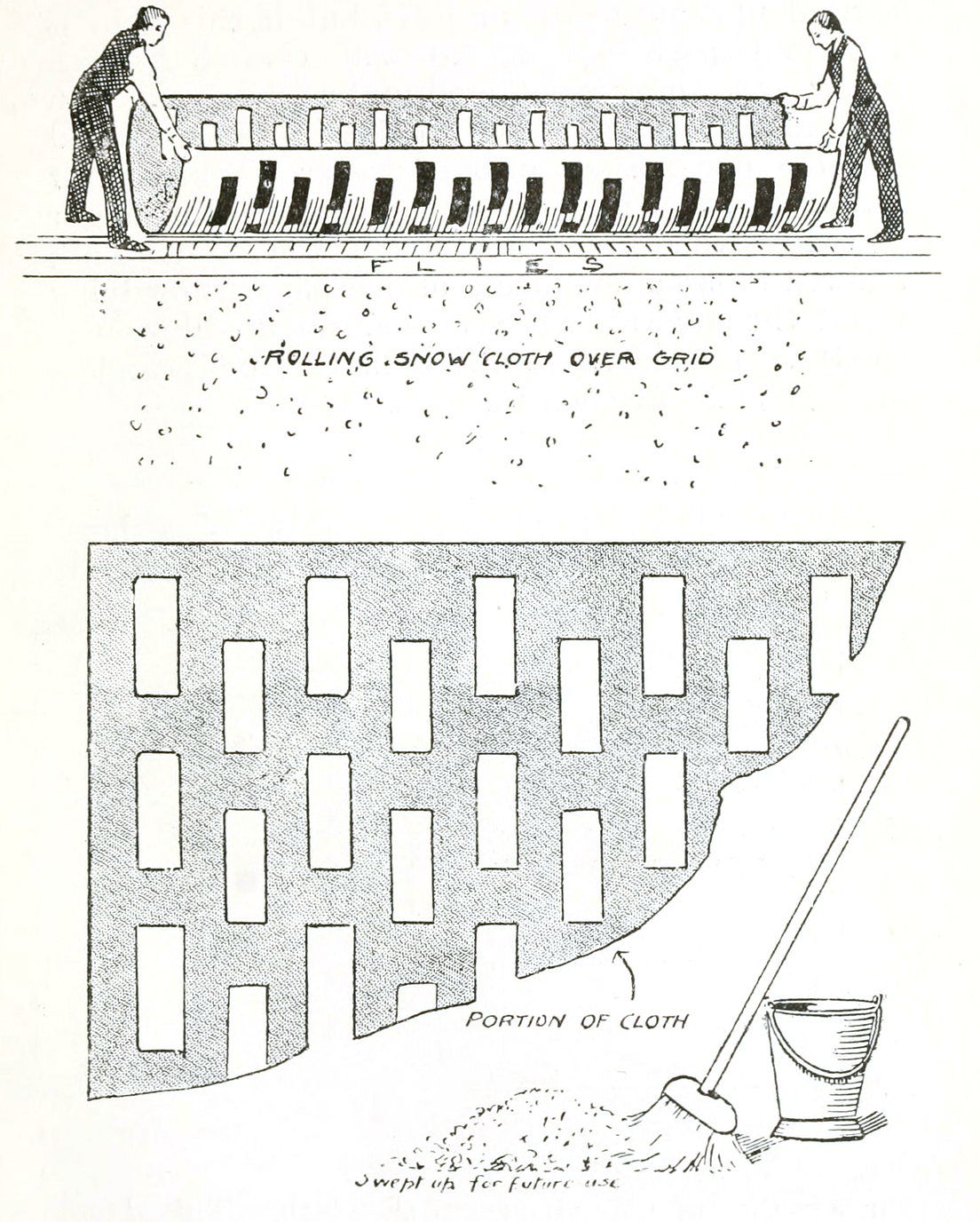
The final illustration does not have to do with sound, but it was in the same chapter. I recently wrote a post about the variety of ways a props person simulates snow on stage. Though a snow drop itself is not usually a prop department’s responsibility, it is helpful to know how one works, and so I include the illustration below.

Snow Drop
Snow Drop

Illustrations originally printed in Secrets of Scene Painting and Stage Effects by Van Dyke Browne. 5th ed., 1900, George Routledge and Sons, Limited. You can read the whole book at the Internet Archive.

Review: Making Stage Props by Andy Wilson

Making Stage Props - Andy Wilson

This is a story about Making Stage Props: A Practical Guide. A very good story indeed.

This book is tailor-made to anyone who works as a props artisan. In many ways, it is the book I wish I had when I first started out as a props carpenter. It does not talk about shopping, or organizing a prop list, or talking with directors. It is not a collection of tips and tricks used by props people, such as breakable glasses, blood knives, or fake food. Quite simply, it deals with how to construct props the way a professional prop shop constructs props. For the most part, that means furniture, though it also includes examples of large decorative pieces, masks, and some weaponry.

Because it deals with more tried-and-techniques (and it was written in 2003), it is one of the most up-to-date books about making stage props you can find.

Wilson divides the chapters by material and/or process: wood, steel, modelling, making moulds, casting and laminating, expanded polystyrene, upholstery, and paints and finishes. So while you can read the book from cover-to-cover, it works just as well as a reference which you can refer back to over and over again, depending on what your next project is. I would, however, recommend reading the introduction first. I had a strong sense of déjà vu the first time I read it; the way Wilson describes approaching a project is similar to what I wrote in my paper for the SETC Theatre Symposium. Guess that means I’m on to something

As you may have noticed from his spelling of “moulds” above, Wilson is British. The book is still highly useful even with a few linguistic and cultural differences—20mm plywood instead of 3/4″, for example.

The photographs, though all black-and-white, are very clear. He also includes a lot of diagrams and illustrations. Obviously, a book on prop-making can never hope to contain all the materials and processes one can ever use; he does, however, cover the most common ones which can be used to build probably 90% of the props you will ever build for the stage. Some of the information he includes can be oddly specific; for example, in the chapter on “wood”, he includes a diagram for a lathe, with all the parts listed. This is the only tool that gets such a diagram in that chapter. Why? I’m not sure.

Overall, the amount of information Wilson packs into this compact book is amazing, and it has something for prop-makers of all skills, whether new to the field, or experienced artisans. I feel strongly that it is one of the few “necessary” books for prop-makers, and even for prop people in general.

“Going Green in Theatrical Design: Set & Props” Workshop

Updated 12/14/10 – See Below

Last Wednesday, I attended a “Going Green in Theatrical Design: Set & Props” Workshop, organized by the Broadway Green Alliance. As you may infer, the BGA is an initiative to spread information on more environmentally-friendly and less wasteful theatre practices. The workshop featured presentations by several people at Showman Fabricators, Donyale Werle, as well as representatives from companies making greener products for building sets and props, including theatre-specific ones like Rosco and Rose Brand. I absorbed a lot of material, much of which deserves their own articles, but I thought I would present a basic summary of most of my notes first.

The first half was on “reduce, reuse and recycle”. I missed the “reduce” part because my train broke down on the way there. Donyale led the presentation on “reuse”, talking not only about Bloody Bloody Andrew Jackson, but also on Broke-ology. Bloody Bloody is, of course, a cornucopia of reused elements; we gave them our two horses from Kicking a Dead Horse and parts of the body from Bacchae. That’s just a small percentage, as the show also includes a chandelier made of cat food cans, and assemblages of broken umbrellas and jujubees. Our props shop takes advantage of reused materials frequently; I built the furniture in Slave Shack with pieces of the floor from the Brothers/Sister Trilogy, and all of the rehearsal furniture for last summer’s Merchant of Venice was constructed from pieces of the floor from the previous summer’s Bacchae which I had set aside. Finally, of course, a prop stock room itself is a commitment to reuse.

New York City has a number of organizations which collect and redistribute building materials and theatrical sets, such as Build it Green (which I wrote about as well), Materials for the Arts, NYC WasteMatch and Film Biz Recycling. The BGA website has even more links. Like many other theatre professionals, this is the reason I began getting interested in all this; it’s absolutely heart-breaking when you see a show or exhibition close, and all of the set and props head straight to the dumpster, even if the show only lasted a few days. It’s even more heart-breaking if you’ve worked in low-to-no budget theatre where just a tenth of those materials would help you achieve your design.

Showman Fabricators discussed recycling next. I learned the difference between Post-Consumer Recycled content, Post-Industrial (or Pre-Consumer) Recycled content, and Total Recycled content. “Post-Consumer” is when a manufacturer takes items that have been used and reforms them into new material. This is where your bottles, cans and paper goes after you put them in those blue bins. “Post-Industrial” is when a manufacturer takes the scraps and waste from their own processes and turns them into other products. For instance, MDF is made from the sawdust at lumber mills. It’s the “we use all parts of the cow” approach. “Total Recycled” content is the combination of Post-Consumer and Post-Industrial content.

Next, he discussed the embodied energy of materials. Embodied energy is how much energy it took to create a material. Thus lumber has less embodied energy than plywood. To make lumber, you need to cut down a tree, drive it to a sawmill, cut it to size, dry it, and ship it to the store. For plywood, you need to do the same things as lumber, than also cut it into thin strips, glue them up, sandwich them together, cut veneer, and lay that over top. Thus, it takes more energy to create a sheet of plywood than it does to create an equal amount of lumber. We looked at a chart that showed some common theatrical materials and their embodied energy; I didn’t copy it down, but it looked very similar to this one I found online.

The embodied energy is not the only aspect you need to consider. For instance, steel and aluminum are both infinitely recyclable. Wood, on the other hand, is not. Maybe you can turn old wood into particle board, and after that, it might (though rarely) get ground down into some kind of composite material. So while it may have less embodied energy than steel, you have to keep creating more wood and growing more trees, where the same chunk of steel can be used over and over and over again.

The embodied energy chart can also be misleading because it goes by weight. Paint has a high embodied energy, but you only use a thin layer on the outermost portion of your set; a whole set can be painted with just a few cans. You use far more steel and wood by weight to construct your set. You should also remember that different materials have differing strength-to-weight ratios. Aluminum has a higher embodied energy than steel, but a structure constructed out of aluminum would weigh far less than one out of steel while being just as strong. Thus, an aluminum structure could potentially use less embodied energy in its materials. It’s a lot of math on your part though.

They told us of a number of waste management companies in New York City (also found on the BGA website) that will take your set away, recycle and reuse as much as possible, and tell you how much was kept out of a landfill. The idea is that when a show closes, rather than calling for a dumpster, a truck shows up and you load everything in their. In many cases, they can reuse and recycle 80–90% of your garbage, and it can sometimes end up costing less than a dumpster. A green alternative that costs less and doesn’t add additional labor? That’s gold!

The most important lesson is to make it easy. If you place bins for recycling next to all your trash cans, than it’s just as easy for an employee to toss his or her recyclables into the correct receptacle. If, however, you make your employees walk out to the loading dock to throw away their off cuts of steel, then more often than not, they’ll toss them into the regular trash “to save time.”

The second portion of the evening was headed by manufacturers touting their wares. Rose Brand talked about their Repreve yarn polyester fabric, which is made of 100% recycled fabric. Chad Tiller of Rosco (a friend of this blog) talked about their Iddings deep color (soy-based paints) and Roscoleum flooring (made from cork).

The other manufacturers had a whole range of green products typically used in more architectural settings: agri-fiber boards such as Kerei Board, NAUF (no added urea formaldehyde) MDF, Dakota Burl, Wheat Board, Paper Stone (recycled paper thermoset with a phenolic resin) and American Clay, to name a few. These are all interesting products, but for theatrical use, they still remain out of the price-range; a sheet of bamboo plywood costs about $200 as opposed to a comparably-sized sheet of construction ply for around $48. The exception is NAUF MDF, which is becoming more and more commonplace.

Finally, the scenic charge at Showman Fabricators had some closing words of wisdom. She pointed out that it is hard to switch products when time, money, and your reputation are on the line. You need to be able to depend on the materials you use, and you can’t just switch to a new “green” material in the middle of a project. You need to be constantly sourcing, requesting samples and testing new products on a small-scale and in between projects to find the least damaging solutions. One way to do so is to be open and share your solutions and experiments with everyone: your employees, your employees, and other shops. Being green is not proprietary. If you find a great new alternative to some product, tell other shops. It shows you are open to sharing, and if they find an alternative to another product, or a new way of organizing their shop for better “greenliness”, they will share that with you. Read my article “On Sharing and Secret Knowledge” to learn more about this philosophy.

Update – 12/14/10

Bob Usdin of Showman Fabricators, one of the presenters, emailed me and shared what I had missed from the beginning of the workshop:

The only things I would add are from the beginning (which I know you were delayed for):

  • In reality you can never be truly green. Instead, we are making efforts to be greener.
  • The single most useful thing you can do is REDUCE, particularly by optimizing your designs and engineering. If you can do the same scene with less scenery or build the same platform with less structure and still achieve the same effect (and safety), then you are being greener regardless of what materials you are using. I feel that the first “R” is often overlooked.
  • The Natural Resource Defense Council (NRDC) greening advisor is a great resource for getting green tips on a host of subjects. They are also a major supporter of the BGA and its activities and knowledge base.
  • In trying to be greener, it’s important to go beyond just the materials and techniques that go into a show. Looking at the facility and operations and how green those are can be as much of a contributing factor to greening the production. Energy consumption, renewable energy sources, water usage, location and connection to the community, materials, paper consumption, indoor environmental quality, and vehicles can all be a major part in greening the operations.

Snow

Every winter, many performing arts institutions put on some kind of winter or holiday show. From a traditional Christmas Carol or The Nutcracker Suite, to the more modern A Christmas Story and The Santaland Diaries, many of these shows involve snow to some extant. Now, depending on the context of the snow and the traditions of the theater you work at, snow can be the responsibility of one or more departments: props, scenery, sometimes even lighting. Still, it doesn’t hurt to know some of the many ways snow is recreated, whether or not it ends up being the prop department’s responsibility.

For the 1936 Broadway production of Ethan Frome, scenic designer Jo Mielziner was very specific about the properties of the snow which covered most of the stage. It fell to Joe Lynn, the property master, to come up with a recipe. After much trial and error, they arrived at a mixture of white cornmeal, ground quartz and powdered mica flakes. As Mielziner himelf explains:

The cornmeal provided the right consistency, the quartz gave the crunching sound and the mica simulated the sparkling surface of snow in moonlight.

(from Designing for the theatre: a memoir and a portfolio, by Jo Mielziner; Atheneum, 1965, pg. 90)

Joe Lynn also added some rat poison to the mix to keep vermin away, which is probably not the safest solution available to today’s theatres. Also, using particles and powders as a floor covering—this is true of sand as well—can trigger issues with your fire marshal and even Actor’s Equity; you want to make sure you involve them as soon as possible so that you don’t end up using something which is not allowed.

For snowballs, previous props people have used white bar soap shaved into bits with a cheese grater. The resulting bits can be packed into a snowball which explodes on impact. Others suggest instant mashed potato flakes. In either case, water can be mixed in or spritzed on to make the snowballs stick better. If the actors are throwing the snowballs at people, obviously you want the snowball to break apart on impact as easily as possible. A lot of variables come into play: how hard the actor throws it, what it is hitting against, the temperature and humidity in your theatre, how far in advance you need to make the snowballs, etc. As a result of all these variables, there is no “exact recipe”, and research and development is essential.

Another option is the interior of disposable diapers (new ones, not used ones). They contain a powder called sodium polyacrylate, a polymer which absorbs 800–1000 times its own weight, effectively turning a liquid into a solid gel. It is also sold in magic shops and novelty stores as “slush powder”.

If a show calls for falling snow, it is often the props departments duty to procure the snow, while scenery is in charge of making it fall from the air. I know, it’s bizarre. The preferred method for at least the past hundred and thirty years is using clipped paper. Unfortunately, regular paper will not pass today’s fire retardant standards. If the thought of fire-proofing every snowflake for every performance is too overwhelming, theatrical suppliers, like Rose Brand, sell flame-proofed paper snow flakes. Expect to pay a lot though, and be aware that everyone needs snow during the winter and they are often sold out by this time of the year.

A more modern alternative is plastic flakes. Rose Brand sells these as well, but you can make your own if you wish. You can find paper shredders (for offices) which not only cut in strips, but also crosscut those pieces to make confetti. You can run white grocery bags or garbage bags through one to make your own plastic snow flakes. Bear in mind that you need a lot of snowflakes to make even a short-duration snowfall over a small stage. You’ll need more for multiple performances. You may be tempted to sweep as much as you can from one performance to use in the next one. Be aware that when you are picking up the old snow, you are also picking up all the dirt and dust from the stage. You don’t want to rain crud down onto your performers during a show; the dust can get in their eyes, and larger particles may even injure them when dropped from the top of the stage.

Stuffed Kitten from Recycled Fabric

I’ve posted a new Instructable on making a stuffed kitten; that makes a whopping total of two since my wooden ratchet noisemaker last year. The cat wasn’t a prop for a show, but I thought I’d share it for two reasons. First, I made it out of materials from a previous show that would otherwise have ended up in the trash. Second, our prop shop had just gotten our first sewing machine. Before this, our artisans had to go to the costume shop to work on upholstery and making things out of fabric. I’m not much of a soft-goods person; in fact, the only actual item I’ve ever made out of fabric is probably a sweater in my seventh-grade home-ec class. I took this new acquisition as a chance to practice a must-needed prop skill; you’re never too old or awesome to start learning something new.


Making an upcycled plush kittenMore DIY How To Projects

Making and finding props for theatre, film, and hobbies