NYC Theatrical Weapons Permit

This week, The Great Game is playing. We had to rent a number of guns for the show, including some blank-firing ones. Now, New York City has some of the more strict gun-control laws in the US, and even blank-firing replica firearms require a “theatrical weapons permit” to rent and transport to the theatre. We’ve had a bit of turn-over in our production staff since the last time we had a show with such guns, and it turned out none of us were currently licensed. So I volunteered to be the one to bare my personal life and barter my soul to the New York City Police Department in exchange for permission to make a sound effect from a replica firearm.

As a caveat, what follows is not a “how-to”; using weapons on stage requires so much more than just having a certain license or permit. Your situation would certainly differ from mine, information becomes outdated quickly, and if you do not live or work in New York City, then this is all fairly irrelevant. As I was going through the licensing procedure though, I could not find much anecdotal information about what it’s like, so I thought I would share my tale. For those of you working in theatres outside of New York City, you may find it interesting to see what we have to go through here.

The first part was relatively easy. When we sent the list of firearms we needed to Weapons Specialists, one of our preferred–weapon rental vendors, they told us that whoever would pick-up and sign for the guns would need a theatrical weapons permit. They gave me the relevant information to get started and even have links on their website to the official instructions and forms from the NYPD. This is one of the benefits of using a supplier like Weapons Specialists; they will make sure you have all your legal ducks in a row. The kinds of prop and replica firearms that require a license to rent and transport are registered and tracked by the NYPD just like real guns, so you should never have to “guess” whether you should have a license or not; your supplier will tell you if you do. Still, it is a good idea to know what kinds of weapons require a license going into a new production so you can let the team know whether a gun they are requesting will require a license, which entails either hiring someone with a license, or allowing enough time and money in the budget to apply for one.

You can view the form here and the special instructions for the theatrical permit here. As you can see, you fill out the exact same form as if you were applying for a rifle/shotgun license; this might be confusing and even scary for the first-timer, but rest assured, you are getting an entirely different license. When I got mine, it was $140 for the license. You also have a number of forms you need to have notarized. We have our own in-house notary, so those costs were absorbed by the institution and did not come out of our budget, but otherwise you would need to be prepared to budget for those costs as well.

The proof of address was one of the trickier and more confusing parts. You need to bring your Social Security card and your passport or driver’s license, but you also need additional documentation for your address; they will not accept your driver’s license itself as proof. On the website, it says that can be a recent copy of a gas, electric or land-line telephone bill. If those are in someone else’s name, like a roommate or family member you can use a copy of their bill along with a form that is also notarized stating that person knows you are applying for a license.  I called the rifle/shotgun office to see what else they would accept. They’ve updated their rules as less and less people have land-line telephones; they will now accept a cable or internet bill in conjunction with your driver’s license, provided the addresses on each are the same. They will also take a notarized copy of your lease.

It took quite a while to get all the paperwork and documentation together, as there is a lot of pieces and parts, and you need to have other people fill out parts and write letters and what-not. Eventually, I had it all ready. I gave the NYPD permission to check my arrest record, as well as checking with mental institutions to make sure I was never officially crazy. I even had my supervisor agree that he would be responsible for my guns if I should die—on a form he had to sign in front of a witness. I felt like I was only one step away from having to gather three selectmen of good repute to forswear my strong character in front of a judge.

I left for my permit early one Friday morning. I needed to go out to a courthouse in Kew Gardens, Queens, where the NYPD’s rifle/shotgun division is located. It’s quite a distance from the Public Theater, but not terribly far from my apartment, so it made sense to do it first thing in the morning. Though the office says it is open from 8:30am to 4:00pm, the courthouse itself says it doesn’t open until 9:00am. Like every government building in New York City, I had to go through a metal detector upon entering—good thing I remembered to leave my work-knife at home! The office itself is found in the basement, where apparently nobody goes. Having dealt with jury duty, the DMV, the FDNY records department and other bureaucratic departments in the city, I was expecting more activity. Even when I got a copy of my birth certificate in Brooklyn, I had to wait in line. This place, on the other hand, was practically deserted. I struggled to follow the signs leading the way through the winding hallways underneath the courtroom. Finally, I saw the words “Rifle/Shotgun Licensing Division” in big block letters on a closed door at the end of a long passageway.

The woman looked through all my forms and paperwork one at a time to make sure they were complete and correct. She photocopied my passport, social security card, and utility bill before handing them back. Once she seemed satisfied, she asked me to wait outside for a few minutes.

The makeshift waiting room was actually just a vestibule created by various hallways joining together. I sat on the only bench in the small area, which was so long it covered half of one of the doors. I waited for about twenty minutes, completely alone except for the two times a janitor passed through. Eventually, I was called back in.

When you get a permit for a real rifle or shotgun, you hand in all your paperwork, get fingerprinted, and then come back three to six months later once your fingerprints have cleared all their background checks. For the theatrical permit, you walk off with the license on the same day. The woman had gathered all my paperwork into a single folder which I assumed they would keep on file there for eternity. She had me stand in front of a blank background, and a camera mounted to the wall took my picture. I signed my name on an electric pad so my signature showed up on her computer. The chain for the pen had long disappeared, and it had been replaced by a string of rubber-bands tied together. Finally, I placed my thumb on another device which scanned my thumb-print and saved it to the same computer. After the woman typed through a few more options, I heard the printer kick into action printing up my permit card. A few moments later, she showed me the card to check for accuracy. Satisfied, she photocopied the card and had me sign that copy, which she placed in my folder. All told, I was at the courthouse for about an hour.

The day came to pick up the guns from Weapons Specialists. We looked through the guns and checked to make sure everything was complete. For the three guns which required the license, he had to write down their serial numbers for another form. I had to fill out another form as well; this was a federal from from the ATF for the actual transfer of the firearms. This was similar to forms I had already completed, but it included a series of additional questions, some quite bizarre—I had to swear I had never renounced my citizenship to the US and that I never threatened a child, for example. Once the form was complete and my license was photocopied, he had to call in to the rifle/shotgun division and check my license against their records. All in all, I don’t think I’ve ever had my legitimacy as a law-abiding citizen so closely scrutinized.

Part of the application process includes getting a notarized letter from an officer of my production company listing the types of guns being used and for what purpose. The license itself is valid for a year. I asked Weapons Specialist whether the license is only valid for the guns I listed on that letter. He said that you need a specific reason to apply for the license, but once you have it, it can be used to rent and use other guns for other productions. Also, the license allows me to rent, buy, acquire, transport and possess special theatrical guns, but once at the venue, anyone can load and operate them.
Behind the Scenes of an Opera House, 1888: Dangerous Effects

The following is an excerpt from “Behind the Scenes of an Opera-House”, written in 1888. The author, Gustav Kobbé, tours the backstage of the Metropolitan Opera in New York City. Be sure to check out the previous excerpts on building a singing dragon, technical rehearsals, constructing a giant “Talepulka” idol and introducting the series when you are finished here!

Behind the Scenes of an Opera-House, by Gustav Kobbé.

Two light-properties in “Faust”—the fire-cup and the spark-emitting sword of Mephistopheles—are worth describing. The fire-cup is a goblet in the bottom of which are chlorate of potash, red fire, and sugar. Above these is suspended a thimble three-quarters filled with sulphuric acid and so delicately balanced that a slight movement causes the acid to drip on the powders and to ignite them, the fumes of the sugar leaving an agreeable taste upon the lips of the singer.

The method of causing the sparks to fly from the sword is as follows: Two wire-gauze plates connected with electric wires are placed upon the stage at the points where Mephistopheles and Valentine are to stand. A metal socket is sunk into the heel of the right buskin of each of the singers, and a wire of the same color as their costumes is attached to each socket, wound around the leg and passed through the belt. Standing upon the gauze plates they, as they draw their swords, slip the ends of the wires into the hilts and, when the swords touch electrical connection is made.

The flash of Wotan’s spear when Siegfried cuts it through with one stroke of his sword is produced by an explosion of gun-cotton in the spear and ignited by electricity, the electric wire passing through the weapon.

First printed in “Behind the Scenes of an Opera-House”, by Gustav Kobbé. Scribner’s Magazine, Vol. IV, No. 4, October 1888.

Behind the Scenes of an Opera-House, 1888: A Singing Dragon

The following is an excerpt from “Behind the Scenes of an Opera-House”, written in 1888. The author, Gustav Kobbé, tours the backstage of the Metropolitan Opera in New York City. Be sure to check out the previous excerpts on technical rehearsals, constructing a giant “Talepulka” idol and introducting the series when you are finished here!

Behind the Scenes of an Opera-House, by Gustav Kobbé.

It is noteworthy in connection with this circumstance that the apparatus was devised by an Englishman and that Wagner employed an English property-master to design and make the dragon for the “Siegfried” performances at Baireuth. The English pantomime productions, which involve the manufacture of numerous mechanical and trick properties, have sharpened the ingenuity of English property-masters until they have come to be acknowledged at the head of their profession. “Siegfried” never having been given in England by any but a German company whose scenery and properties were brought from Germany, the combat with the dragon remained as ludicrous a feature of the performances of this work as it was conceded to have been at Baireuth, until the production of “Siegfried” at the Metropolitan Opera-House. For this a dragon was designed and manufactured which the German artists declare to be the most practical and impressive monster they have seen.

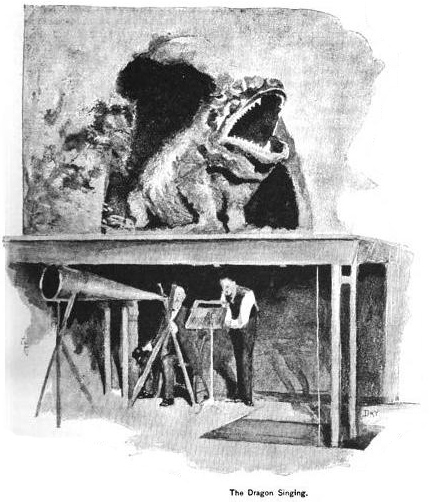
The singing dragon from "Siegfried"

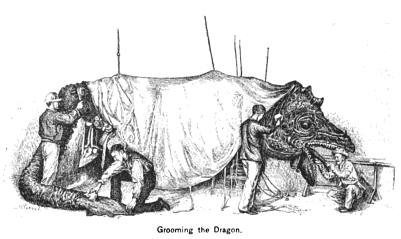
The head of this dragon is of papier-mache. The body, thirty feet long, is of thin wire covered with curled leather scales, which are bronzed and painted. This monster, in spite of its size, is worked by a boy who is the dragon’s front legs. He is dressed in a suit of canvas painted the color of the dragon’s hide and having curled leather scales on the trousers below the knees, his shoes being the huge clawed feet. He gets into the dragon behind its head, which conceals him from the waist up, his legs being the dragon’s front legs. With his hands he opens and closes its huge mouth and shoves its eyelids over its eyes when it expires. The steam which it breathes out is supplied through an elastic pipe which, entering at the tail, runs through to the throat. The scene lasts about forty minutes and is very exhausting to the front legs. In Germany the artist who sings the dragon’s part is inside the hide and sings through a speaking trumpet. At the Metropolitan Opera-House the artist sits under the raised bridge upon which the dragon is placed and sings through a speaking trumpet. His music is on a stand, a stage-hand throws the light of a lamp upon it, and the solo répétiteur gives him his cues from the wings. The voice sounds as though it issued from the dragon’s throat. The advantage of this arrangement is that it places in the monster a person whose attention is concentrated upon working this mechanical property in the best possible manner. The dragon when not in commission is stabled in mid-air under the paint-bridge. The day of the performance it is lowered by ropes, thoroughly groomed, and then allowed to stretch itself out upon the floor against the rear wall and lie there until the end of the first act.

Grooming the Dragon
Grooming the Dragon

First printed in “Behind the Scenes of an Opera-House”, by Gustav Kobbé. Scribner’s Magazine, Vol. IV, No. 4, October 1888.

Behind the Scenes of an Opera-House, 1888: Technical Rehearsals

The following is an excerpt from “Behind the Scenes of an Opera-House”, written in 1888. The author, Gustav Kobbé, tours the backstage of the Metropolitan Opera in New York City. Be sure to check out the previous excerpts on constructing a giant “Talepulka” idol and introducting the series when you are finished here!

Behind the Scenes of an Opera-House, by Gustav Kobbé.

The first feature of an operatic production to have the benefit of a rehearsal is the scenery. As soon as the scenic artist and the scene-painters have finished their work the stage-manager orders a scenic rehearsal. This might be called a performance of an opera without music. The scenes are set up and changed, light effects tried, and mechanical properties like Talepulka, the “Lohengrin” swan, and the “Siegfried” dragon “worked” and tested until all goes as smoothly as it should at a performance. This is a rehearsal for the men who set and change the scenes—the master-machinist and his subordinates—and for those who manage the light effects—the gas-engineer and the “gas-boys”—and for the property-master and his men. Before the scene can be set it is necessary to “run the stage,” that is, to get everything in the line of properties, such as stands of arms, chairs, and tables, and scenery, ready to be put in place. If there is a “runway,” which is an elevation like the rocky ascent in the second act of “Die Walküre,” or the rise of ground toward the Wartburg in “Tannhäuser,” it is “built” by the stage-carpenters; and for this purpose the stage is divided into “bridges”—sections of the stage-floor that can be raised on slots. Meanwhile the “grips,” as the scene-shifters are called, have hold of the side scenes ready to shove them on, and the “fly-men” who work the drops and borders are at the ropes in the first fly-gallery.

The scene set, it is carefully inspected by the scenic artist and stage-manager, who determine whether any features require alteration. A tower may hide a good perspective bit in the drop: it may be found that a set-tree at the prompt-centre second entrance will fill up a perplexing gap—but changes are rarely needed after the scene has been painted, because a very good idea of it was formed from the model. The length of a scenic rehearsal depends upon the number of the light-effects and mechanical properties. For instance, in the first act of “Siegfried” the light-effects are so numerous and complicated that it is a current saving in opera-houses that the success of this act is “all a matter of gas.” When all effects and contrivances of this kind have heen thoroughly tested, the stage-manager gives the order: “Strike!” The “grips” shove off the side-scenes, the flymen raise the drops, the “clearers” run off the properties and set-pieces, and the stage-carpenters lower the bridges. The scene of the second act is immediately set, and the time required for the change of scene noted. If the change is not so quickly accomplished as it should be, it is repeated until the weak spot in the work is discovered.

When all know their parts, the stage is at last given up to features of the productions other than the scenery. The work is performed with scenery, light-effects, properties, chorus, ballet, and supers, but without the principals and orchestra, the solo répétiteur being at the piano. There are two or three such “arrangement” rehearsals for drilling the chorus and supers in the stage “business.” These rehearsals are followed by two in which the artists take part; the final test being the general rehearsal with orchestra. Then at last the work is ready for production.

First printed in “Behind the Scenes of an Opera-House”, by Gustav Kobbé. Scribner’s Magazine, Vol. IV, No. 4, October 1888.

Behind the Scenes of an Opera-House, 1888: Constructing a God

The following is an excerpt from “Behind the Scenes of an Opera-House”, written in 1888. The author, Gustav Kobbé, tours the backstage of the Metropolitan Opera in New York City. Be sure to check out the previous excerpt when you are finished here! The following details the construction of a large idol for the Met’s 1888 production of “Ferdinand Cortez”. As an added bonus, you can read the original New York Times’ review of that production.

Behind the Scenes of an Opera-House, by Gustav Kobbé.

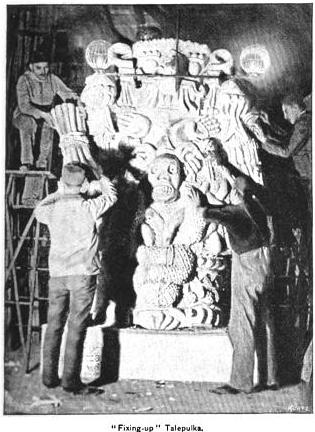
[T]he property-master had made out a list of the articles to be manufactured in his department. He had not been hampered by the problem of historical accuracy. He found drawings of Mexican antiquities from which he made sketches of the Mexican implements of war and peace to be used in the opera, and from a genuine Mexican relic of that period, seen by chance in the show window of a store, he obtained his scheme for the principal property in the work, the image of the god Talepulka. He found he could have all these historically correct, except that he did not think it necessary to go to the length of decorating the idol with a paste made from a mixture of grain with human blood. A problem arose, however, when he considered the construction of the idol. He ascertained from the libretto that the idol and the back wall of the temple are shattered by an explosion, and that, just before the catastrophe, flames flash from the idol’s eyes and mouth. He consulted with the gas-engineer, who had already considered the matter, and concluded that it would be most practical to produce the flames by means of gas supplied through a hose running from the wings.

The property-master then made the following note in his plot book: “Flames leap up high from the heathen image—the gas-hose must be detached and drawn into the wings immediately afterward so as not to be visible when the image has fallen apart.” The necessity of having the gas-hose detached determined the method of shattering the idol. It is a theatrical principle that a mechanical property should be so constructed that it can be worked by the smallest possible number of men. This principle was kept in view when the method of shattering Talepulka was determined upon. The god was divided from top to bottom into two irregular pieces. These were held together by a line, invisible from the audience, which was tied around the image near the pedestal. Another line, leading into the wings, was attached to the side of the top of one of the pieces. At the first report of the explosion a man concealed behind the pedestal, whose duty it also is to detach the gas-hose, cuts the line fastened around the idol, and the pieces slightly separate, so that the image seems to have cracked in two jagged pieces. At the next report a man in the wings pulls at the other line and the two pieces fall apart.

The manner in which the effect of flames flashing from the eyes and the mouth of Talepulka was produced was only outlined in the statement that it was accomplished by gas supplied through a hose. The complete device of the gas-engineer, a functionary who in a modern theatrical establishment of the first rank must also be an electrician, was as follows: Behind the image the flow of gas was divided into two channels by a T. One stream fed concealed gas-jets near the eyes and mouth, which were lighted before the curtain rose and played over large sprinkler burners in the eyes and mouth. These burners were attached to a pipe fed by the second stream. When the time arrived for the fire to flash, the man behind the pedestal turned on the second stream of gas, which, as soon as it issued from the sprinkler-burners, was ignited by the jets. By freeing and checking this stream of gas the man caused the image to flash fire at brief intervals. Thus only two men were required to work this important property.

Constructing the "Talepulka" prop

The idol was but one of four hundred and fifty-six properties which were manufactured on the premises for the production of “Ferdinand Cortez,” and when it is considered that the average number of properties required for an opera or music-drama is three hundred and fifty, it will be understood that the yearly manufacture of these for an opera-house which every season adds some three works to its repertoire is an industry of great magnitude. For instance, one ton and a half of clay was needed for modelling the Mexican idol, and that property represents three months’ work. It was first sketched in miniature, then ”scaled”—that is, projected full size on a huge drawing-board—next modelled in clay, and then cast in plaster. The modelling and casting of properties are done in a room in the basement of the building, on the o-p-side [Eric: opposite-prompt side, in this case, stage-left] of the stage. The idol was cast in twenty pieces. These were transferred from the modelling-room to the property workshop on the third floor of the building, prompt side, where are also several other rooms in which properties are made, the two armories, the scenic artist’s studio, and the property-master’s office. In the workshop the properties are finished in papier-maché, the casts being used as moulds. They are not filled with pulp, which is one method of making papier-maché, but with layers of paper. The first layer is of white paper, moistened so that it will adapt itself to the shape of the cast. Layer after layer of brown paper is then pasted over it. The cast having been thus filled is placed in an oven heated by alcohol, and baked until the layers of paper form one coherent mass the shape of the cast. Properties thus manufactured have the desirable qualities of strength and lightness.

First printed in “Behind the Scenes of an Opera-House”, by Gustav Kobbé. Scribner’s Magazine, Vol. IV, No. 4, October 1888.

Making and finding props for theatre, film, and hobbies