Objet is a company that specializes in rapid prototyping. They produce machines that use inkjet print-heads to spray layer after layer of a UV curable liquid that hardens into a solid. Using a software developed by Laica (not to be confused with camera-maker, Leica), animators were able to create scenes in 3D animation software like Maya and send the results directly to the printer.
Unfortunately, the cheapest printer at Objet will set you back $40,000. Probably out of the range of most props shops. And by “most”, I mean “all”.
That doesn’t mean you can’t use this new technology. Bucknell University, where I got my BA, had these kinds of machines for their Small Business Development Center. If you work at a university theatre, or are still in school yourself, you may find another department has one of these. You may even be able to gain access if you develop a good relationship with that department.
Molière (1622-1673) performed his plays in Paris, where theatres were inside and lit by candles. He performed at the salle du Petit-Bourbon at the Louvre, followed by the Palais-Royal. Finally, he performed some of his works at Versailles for King Louis XIV. We know quite a bit about the acting styles, the sceneography, and the costumes of his time. But how were props dealt with? Where did they come from, and who was in charge of them?
We can piece together information of how Molière acquired and used props by looking at the general theatre conditions in France at the time. We also have some actual surviving props from his theatre company, and several record books. The picture which forms is similar to conditions in theatres of adjoining countries and eras, such as Elizabethan England. There is some form of bureaucratic control in the theatre buildings, including people responsible for commissioning props. There does not appear to be “prop makers” or “prop masters” per se; rather, the theatre troupes, composed of the actors and a manager, are responsible for maintaining their own stock of props for the shows they perform (this, of course, is where the term “property” comes from).
General Theatre Conditions
The French theatre in Molière’s time customarily employed several people. The decorateur, or theatrical painter, decoraged the stage and auditorium. He worked with the machinest to produce all the scenery and machines.
We can glean some more information from L’Impromptu de Versailles (The Impromptu at Versailles, written in 1663). This one-act farce by Molière was written in response to criticisms against him, and the actors in this troupe played exaggerated versions of themselves as they rehearse a new play. We can pull off-handed remarks about the props and their use to construct a bit of information about standard practices of Molière and his company. For example, in scene IV, Molière instructs his actors: “Those coffres, Mesdames, will serve you for easy-chairs.” The actors obey; we can assume that the actors would have been familiar with using rehearsal furniture at least some of the time, otherwise they would have expressed objection or confusion. The French word “coffres” translates to “chests” or “trunks”. As for the easy-chair, the fauteuil was an upholstered arm chair popular at that time.
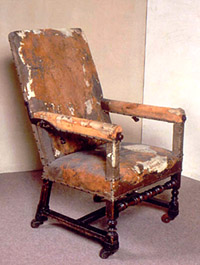
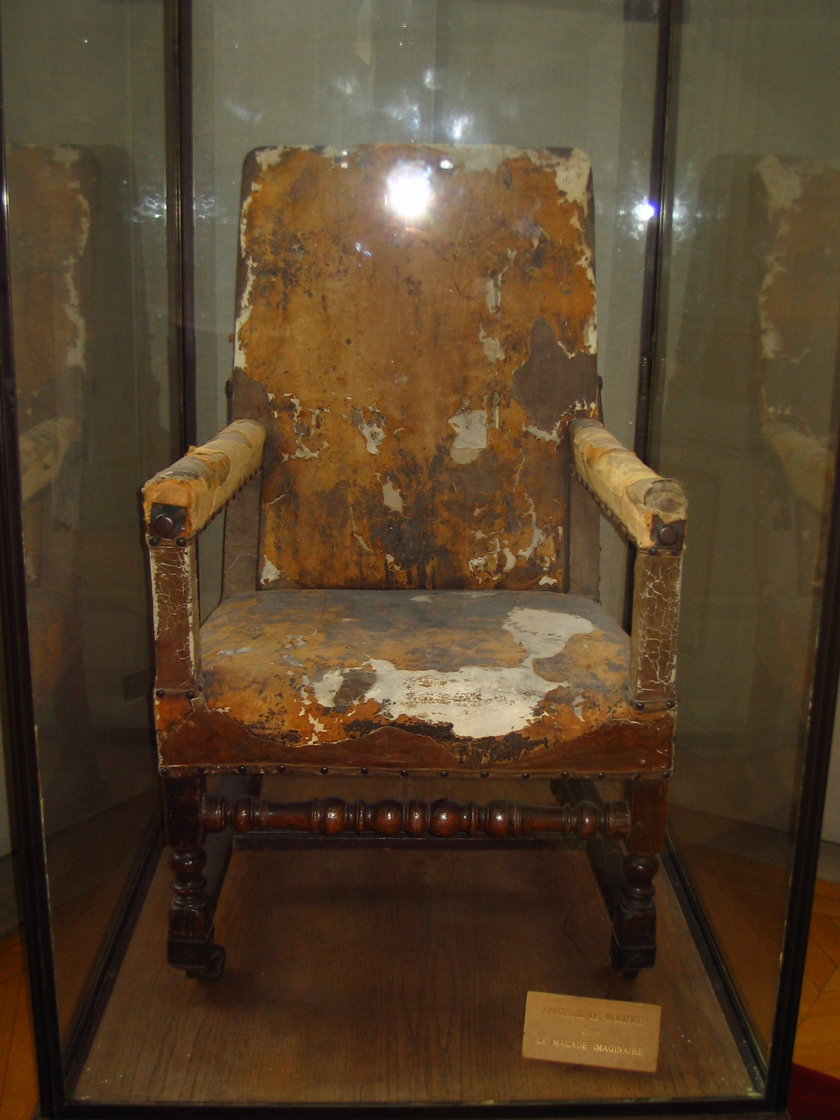
The chair Moliere died in during The Imaginary Invalid
The chair is a Louis XIII style armchair made of wood, upholstered with black sheepskin, and set on casters. It is 4 feet by 2 feet 2 inches by 2 feet 8 inches (123 x 68 x 82 cm). It was first used in 1673 by Molière for the premiere of Le Malade imaginaire, and is the chair he died on during the performance. It was used by successive actors playing Argan until 1879. That’s 209 years, math-wizard. At that point, it had become so worn that a replica was made for the current Argan and the original placed on display.
Click for a larger view of Moliere's chair
A nitecap worn by Argan (played by Molière) is also housed there.
Engravings
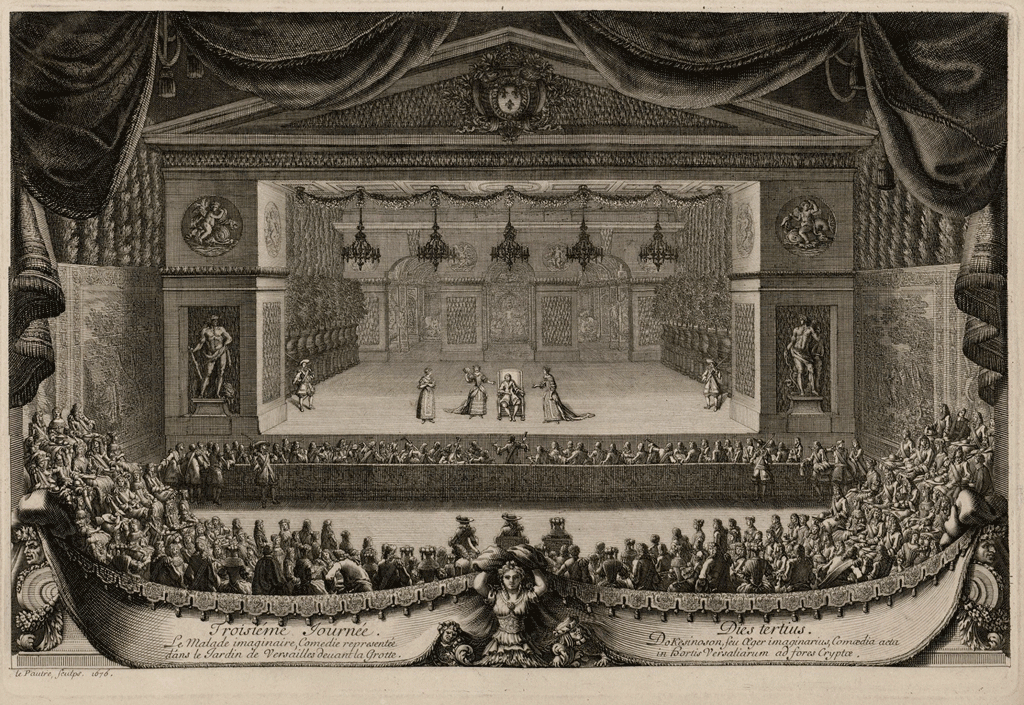
A 1674 remount of "The Imaginary Invalid"
An engraving of a 1674 remount of The Imaginary Invalid (the year after Molière’s death) shows the stage picture.
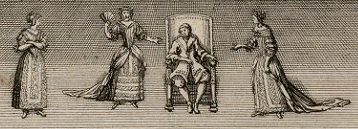
Close-up of props in "The Imaginary Invalid"
The armchair appears to be the only set prop. Set dressing is nonexistent. The only hand props are the fan, and the spears held by the guards on the far sides of the stage. Really, the fan should be considered a personal prop. At this time in France, it was the actress’s (and actor’s)Â responsibility to costume herself, even at great expense. Conceivably, the fan could have been her personal property as well. Since the plays at the time used archetypal characters, and the settings were very consistent, one might surmise that props were mostly pulled from their stock, which would have been fairly modest. After all, if they used the same armchair for 209 years, the modern convention of purchasing and constructing new props for every single production was probably not practiced at that time.
One of these accounting books is the register of Charles Varlet de la Grange. He was an actor in Molière’s troupe and kept a daily account of the business dealings, as well as major events in the members’ lives. You can check out a description and photos of La Grange’s register, or read Édouard Thierry’s edition (in French). By studying this register, we can find out what props were used in his various plays, and whether there were any “prop” tricks. For example, in L’École des femmes (The School for Wives), first performed in 1662, props mentioned include a chair in III.2 and a purse with some counters to serve as coins for I.4.
According to La Grange’s reports, Le Malade imaginaire received a lavish staging with “the prologue and intermèdes filled with dances, vocal music, and stage properties”. The theatre troupe had to order the wood, iron, and canvas for carpenters, upholsterers, and painters. The first two carpenters were named Caron and Jacques Portrait. The workers were paid by the day. For its 1674 revival, La Grange listed the following production expenses: menuisiers (carpenters), ouvriers et assistans (workers who operated the machinery and set-changes), 2 laquais et decorateur (2 lackeys and the set-designer), and surcroist de chandel (candle supplement).
Similar records can be found in registers by La Thorillière and Hubert, two more members of Molière troupe. You can read the original register of La Thorillière (in French) for more fun.
The following tale was recounted in the Dublin University magazine in 1868 concerning Molière. This occurred in 1662:
But instead of settling the company at the Tuilleries they made over to them the theatre built by Cardinal Richelieu at the Palais Royal, for the performance of his poor play “Mirame.” Alas! it was now in a deplorable plight, the great beams nearly rotten and the audience portion half unroofed.
Leave was given by Monsieur to transport the loges, and other accessories of the Salle (audience portion) of Le Petit Bourbon to the Palais Royal. Moliere might also have taken the scenery, machinery, properties, and other furnishing of the theatre behind the curtain, but the detestable vandal, Vigarani, machinist to the king, put an effective veto on the removal. These ingenious and splendid scenes and pieces of machinery designed by Torelli, were the wonder of the age, and had contributed to the glory of L’Orpheo of the Italian company, and L’Andromède of Corneille. Vigarani, despairing of producing anything like them for the king’s private theatre, had them destroyed. We read in the Register of La Grange, “He made these decorations be burned, ay to the very least, in order that nothing should remain of the invention of his predecessor, the Sieur Torelli, whose very memory he wished to bury in oblivion.
So here were our poor theatrical friends driven to the ruinous house, now a thorough desert behind the curtain. As to the Salle and its parcel-roof the inconvenience was not beyond remedy. Had not the ingenious and gifted company often performed in more wretched places in the provinces? But scenery and some simple machinery were absolutely necessary, and till these were forthcoming Moliere and his people remained “on the flags,” as they say in Paris.
One of the trick props we needed for The Book of Grace was a phone which John Doman smashed during every performance. We decided that the phone receiver would remain real, but the part it hung on would be cast from plaster. It would all hang on a wooden base, and a collection of “phone innards” will be held inside the plaster part, so when it broke, an assortment of metal bells, chip-boards, and other electronic components would be left hanging on the wall.
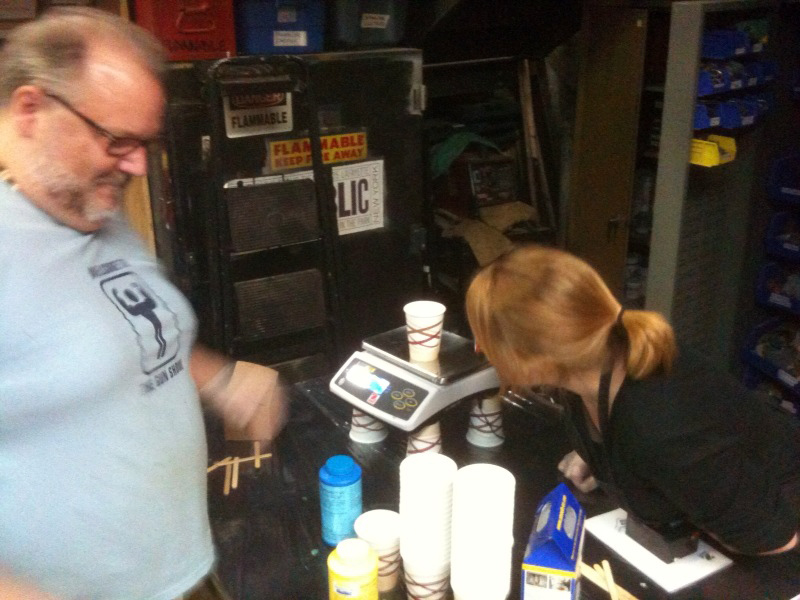
Carefully weigh out the silicone
We made a two-part silicone mold of the phone. Making a two-part silicone mold is beyond the scope of today’s post. However, I did get a photograph before the pouring of the first part. At this point, Natalie Taylor Hart took over the project.
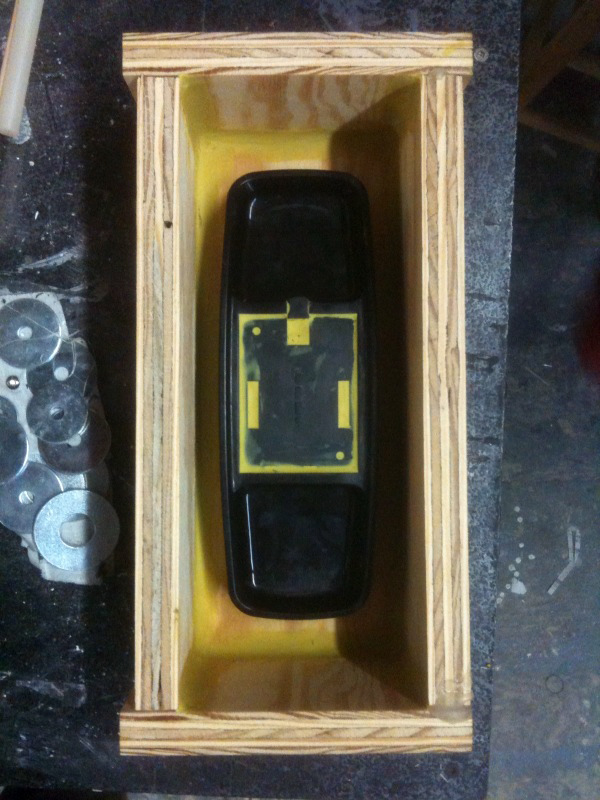
Preparation for making a mold of the phone
Normally, the next step is to make the second half of the mold from the back of the phone. In this case, the shape of the back was far more complicated than what we needed, and we were worried the plaster cast would be too thin. So we took the first part of the mold and built up the thickness we wanted to achieve out of Klean Klay. The Klean Klay is the yellow substance in the photograph above, and remains flexible like plastiline. It also does not contain sulphur, which reacts with the silicone mold-making compound. The mold still needed some tweaking, so Natalie carved directly on the silicone to perfect it.
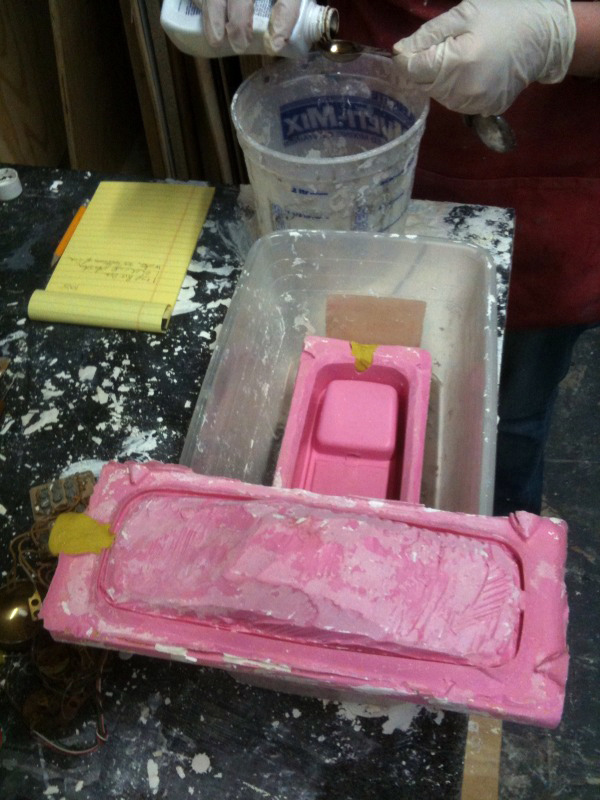
A view of the mold
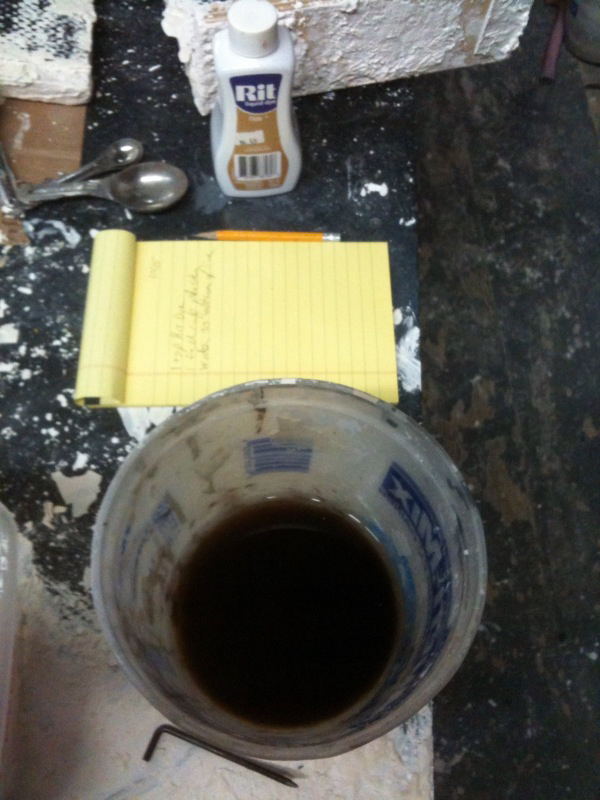
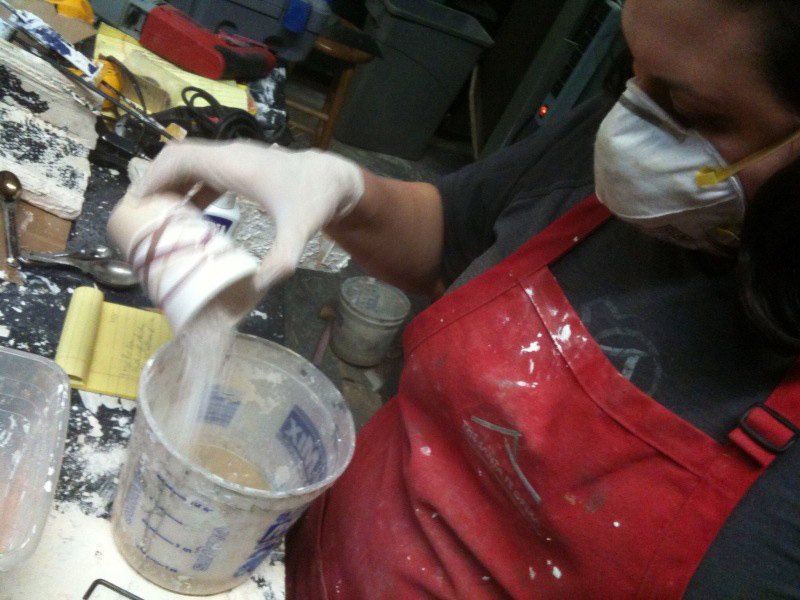
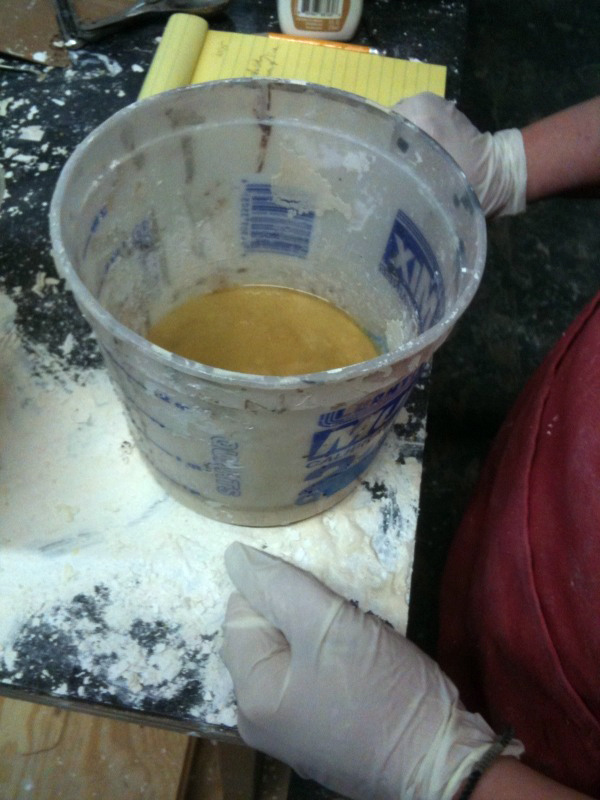
We wanted the color of the phone receiver to match the back part, which was the sort of taupe that most appliances from the late twentieth century came in. When the plaster phone gets smashed, the broken edges would show up white. Thus, we needed to dye the plaster while it was still in liquid form. Natalie found that a tablespoon of Rit tan dye in the mix made the best color match.
Adding dye to the plaster mix
Natalie sifted the plaster into the water until tiny islands of plaster began to form on the surface. Once she had made a few phones, she had the exact measurements of both plaster and water marked down.
Combining the plaster into the water
Next, she let the plaster sit in the water for about 30 seconds. “Wetting” the plaster allows it to mix more thoroughly.
Letting the plaster wet up
With such a small amount, she mixed it by hand. This also gave her a tactile way to ensure all the lumps were worked out of the mix.
Mixing the plaster
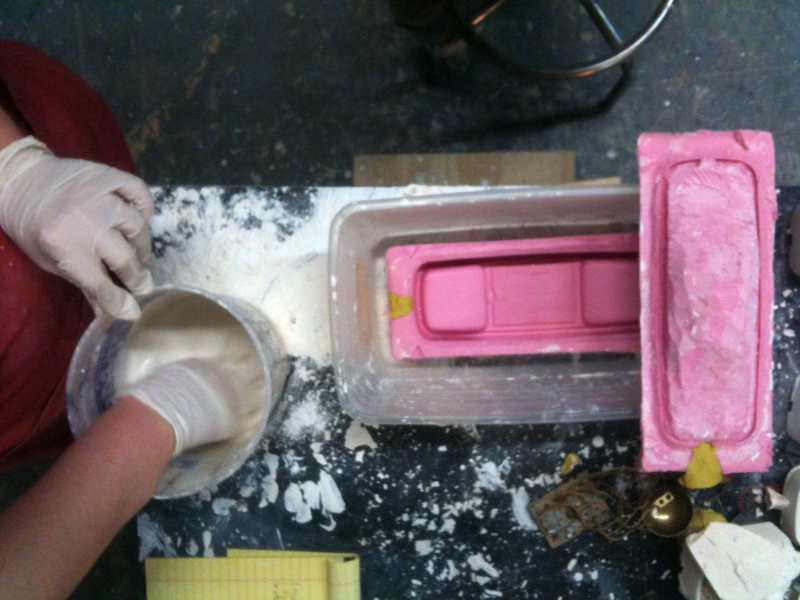
Natalie discovered the best way to pour this particular mold was to slosh plaster over the top half before putting it together. It was important to get plaster in all the cracks and crevices or the strength would be compromised.
Pouring the plaster into the mold
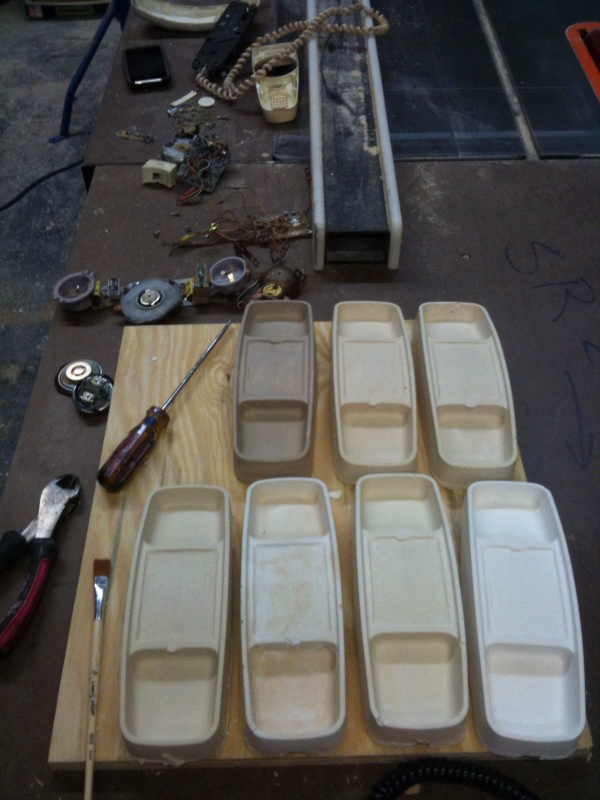
The phones set up overnight, but they actually took two to three days to fully dry. We could not get any kind of adhesive to keep the plaster parts onto the bases until all the moisture was completely out. We ended up needing around 40-50 phones for the run of the show, but since we could cast more than one a day, we could make them throughout the run rather than all at once.
Phones
Finally, here’s a video showing the end result. This was taken earlier with a different phone model, before they changed it to the slimmer model.