Old Maps

World Map by J. Blaeu, 1664

Who doesn’t love old maps? Maybe you don’t love them so much that you made your wedding invitations in the style of an old map (like my wife and I did). But maps pop up in plays all the time. Whether you need a large wall map for King Lear, or a small battlefield map for Arms and the Man, here are some sites that will help you find what you need.

David Rumsey Map Collection – Over 22,000 maps, focusing on 18th and 19th century North and South America, though other continents and time periods are available.

Perry-Castañeda Library Map Collection – Links to hundreds of maps on other sites, as well as a small collection of its own historical maps.

Wikimedia Commons Old Maps – Dozens of maps categorized by location.

World Digital Library Maps – Over 300 high-quality scans of original historical maps (browse the rest of the site for lots of other historical artifacts).

Genmaps – Old maps of England, Wales and Scotland, navigable by county.

National Maritime Museum– Over 1700 historical sea charts and maps from the medieval period to the present.

Library of Congress – Some of their map collections are available online, though the navigation is horrendous.

National Library of Scotland – Over 20000 historical maps of Scotland available.

The 1895 U.S. Atlas – From Rand McNally.

Holy Land Maps – Maps of Judea, Palestine and Israel at the University of Florida.

Stuckenberg Map Collection – Gettysburg College’s online collection of mostly United States maps.

Antique Atlas – A site which sells old maps, currently offering images of over 900 of them.

Hargrett Library Collection -Over 1000 historical map images in another difficult to navigate format.

Historic Cities – Offers a number of old maps from a number of cities throughout the world (mostly Europe).

Reinhold Berg Antique Map Shop – Sells prints of the numerous historical maps on their site.

Old Map Gallery – Another site selling maps with many images.

If you still haven’t found enough map porn, you can peruse larger lists of sites at Odden’s Bookmarks. The site is a little out of date, so many of the sites are no longer available.

Play Production in America, 1916

(this article originally appeared in the book Play production in America in 1916)

“Props,” as I have remarked before, is the property man. He is in command of usually four or five “clearers” — the New Theater that was, had thirty-two — who carry off the furniture, rugs, and so forth, and place them in convenient but unobtrusive positions at back or in the wings.

In some of the older theaters, a trap was opened in the middle of the stage, and through this the properties were passed below; but the practise was generally abandoned in favor of leaving space for the property man and clearers to go on and off the scene while it is in course of erection or in course of dismantling. I have seen a property man with an armful of china, walk nonchalantly through a doorway to the stage, while the doorway, as part of the scene, was being slid into place from a distance.

The next set may be an exterior. The ground cloth is spread first, or the cloth of the preceding act may be removed revealing the new one already in place beneath it. Then the property man brings on the movable objects in his charge, benches, rocks, flower-beds, and so on, and piles them in the middle of the stage so that the grips may build the scene without interruption. He works from the middle outward, usually completing his work at about the time the grips do theirs. Flymen are occupied, meanwhile, in the lowering of drops and borders, and the grips in placing the flats, representing houses, perhaps, or walls.

At this point the electrician becomes active. He must adjust his border lights, place his wing lights, strips and bunches. After connecting the plugs, he places an assistant at each open lamp, as the law requires, and tests the entire arrangement to insure smooth operation. This over, the scene is ready.

Props, Juice, and Carp notify the manager to that effect, and the second act is called. “Clear!” and “Places!” bring the actors into position. A red lamp, w1nking of the musicians’ lights, or a buzzer, tells Herr Director to conclude his entr’acte music. The foots go on and the house lights out. The bell rings, or the switch is turned, and the curtain rises.

Three Departments Of The Crew

It will be observed that the stage crew is divided into three departments, Carpentry, Property, and Lighting, each independent of the others, but all three working harmoniously toward a common end. Largely for purposes of publicity—although the stage manager declared he did it for convenient identification — the three stage departments of the Punch and Judy Theater, New York, were once outfitted respectively with red, white, and blue caps.

At the Metropolitan Opera House, New York, where the change of bill is frequent during the season, day and night crews are maintained. The night crew takes down all the used drops and carefully packs them with reference to their numbers, and next day the day crew places them in the storehouse.

The force at the New York Hippodrome is frequently as many as two hundred men—about sixty electricians, sixty property men and clearers, twenty-five grips, and thirty-five engineers who attend the pumps that fill and empty the big tank. All properties and scene pieces there, are numbered to correspond to the men who are to handle them, while cues, on a darkened scene, are given by lights placed high in an alcove on one side of the stage. All men in the crew are rehearsed in their parts as thoroughly as the actors; consequently few changes of scene there — and there may be nineteen or twenty — take more than thirty seconds each.

It would require many pages to do more than indicate the duties of the various members of the stage crew, for they are constantly being confronted with new problems. A stage hand has little time to loaf, and full opportunity to build himself up from trade to profession.

Occasional disagreements are about all that inform the great theater-going public that such occupations exist. It is at such times that one hears talk of “unions” and “associations” that sound singularly inappropriate concerning attaches of Fairyland.

Unions

When one hears of union stage employees, he should remember that there is a distinction between their union proper — the I.A.T.S.E. (International Association of Theatrical Stage Employees) — and their fraternal order — the T.M.A.’s (Theatrical Mechanics’ Association). To join the first, one must have worked in a theater two years, and, before going on the road, been in the union two years. It is a powerful organization, and has settled, as an instance of its value in arbitration, what was formerly a prolific cause of argument — what is property, and what is scenery? Say a fountain is used in a set. What is it to be called? The union calls it property; so Props and his clearers are compelled to set and to strike it.

originally published in Play Production in America, by H. Holt and Company, 1916, (pp. 235-237)

Friday Box of Links

Here are some links I’m sharing with you on this glorious Friday:

  • Time Out New York has a slideshow on the set of Bloody Bloody Andrew Jackson, which just opened here at the Public Theatre. Check out all the work that Jay, Meredith and I did with Donyale Werle and her assistants to transform the theater.
  • Stolloween is a site with an impressive array of Halloween props made entirely out of papier-mâché. It also has tutorials and process photos.
  • Courtesy of Jesse Gaffney is this article about building fewer cages and dropping more keys. Basically it sums up (much more eloquently) a lot of the reasons why I started this blog; by sharing what I do, what I know, and what I learn, I hope to help everyone reach the next level of skill so we can all create better work.
  • LUNA Commons are a collection of hundreds of thousands of historical images and items from institutions and universities from around the world. If you need a reference image of an “I Like Taft” necktie or a seventeenth-century map of the world, you can find it here.

Making Fake French Fries

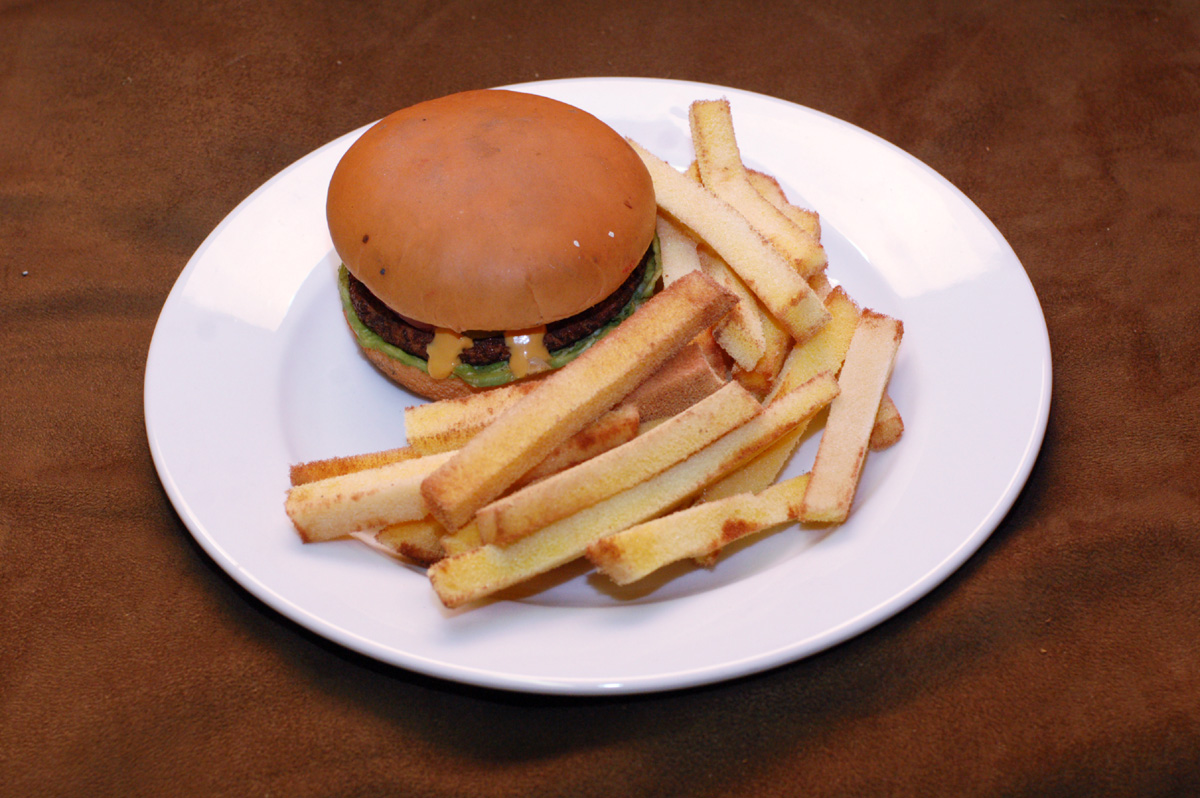
The Book of Grace had a moment where Grace, a diner waitress, carried a tray of food across the stage. She started out with a hamburger we had in stock. The director wanted us to add some french fries. To the French Fry Machine!

Hamburger and French Fries

Natalie Taylor Hart took on this project. She began with an old scrap piece of upholstery foam. She set the fence on the bandsaw and cut thin strips out of the foam. She then ran these strips through the bandsaw again to get long bars of foam. Finally, she cut the bars to a variety of lengths, leaving the edges at a variety of slight angles to keep them from looking artificial.

Since the piece of foam was fairly old, it was turning yellow in areas. Natalie used a can of yellow spray paint to add color in the rest of the areas. She did not completely coat the fries with a single color; the variety of tones on a single fry help give it more realism. You can see the fries in this state in the photograph below.

Painting the fries
Painting the fries

She next used a shade of brown acrylic paint to add the “cooked” (and burned) parts of the fries. This is the part where subtlety and artistry (and a good reference photograph) help make the fries seem real. None of the fries should look the same. Fries tend to turn browner on the edges, or toward one side. She also made some of the fries browner than others.

Fake French Fries
Fake French Fries

For her final step, she dabbed some artist’s gloss medium onto the lighter parts to give the fries a greasy highlight.

I arranged the fries on the plate, and then secured them into place with several dots of hot glue. Order up!

“The Book of Grace” Props

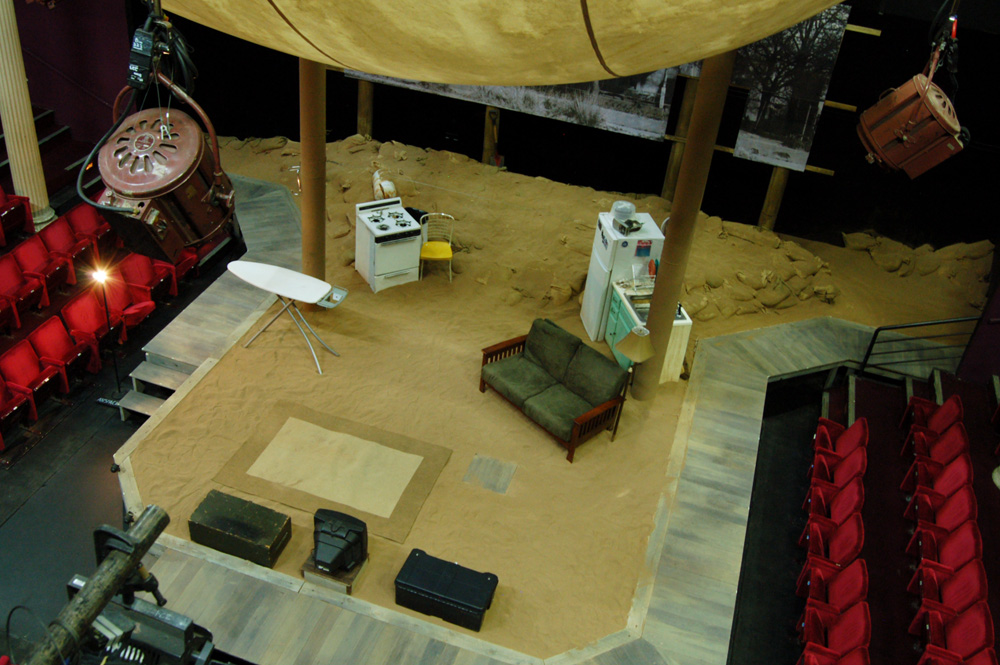
The Book of Grace, by Suzan-Lori Parks, closed yesterday here at the Public Theater, so I thought I’d write about some of the props. I’ll start with the set props and some of the tricks that may or may not have been apparent.

The set of "The Book of Grace"

This show had a lot of tricks. The iron actually ironed, the stove actually cooked eggs, and the sink actually ran water. Sometimes, the simplest of shows actually have the most complex of prop needs. It becomes less overwhelming if you break it down into simpler parts.

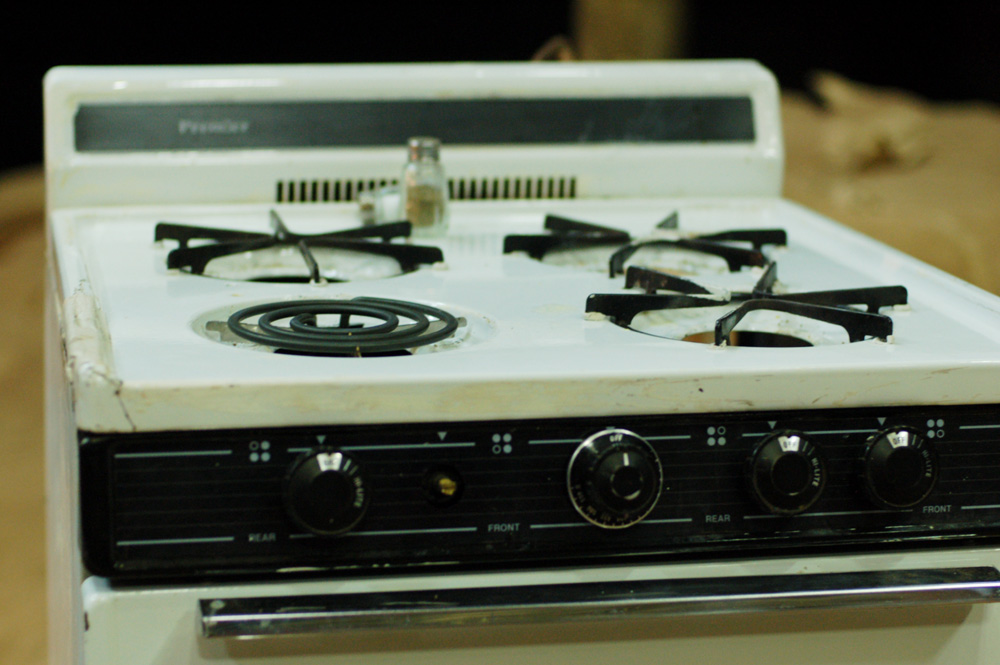
The Stove

Top of the stove
Top of the stove

The stove was originally a gas stove. In order to make it cook an egg, I took a hot plate apart and placed the burner in place of the original burners. I ran the cord out the back, and it was all run by the light board.

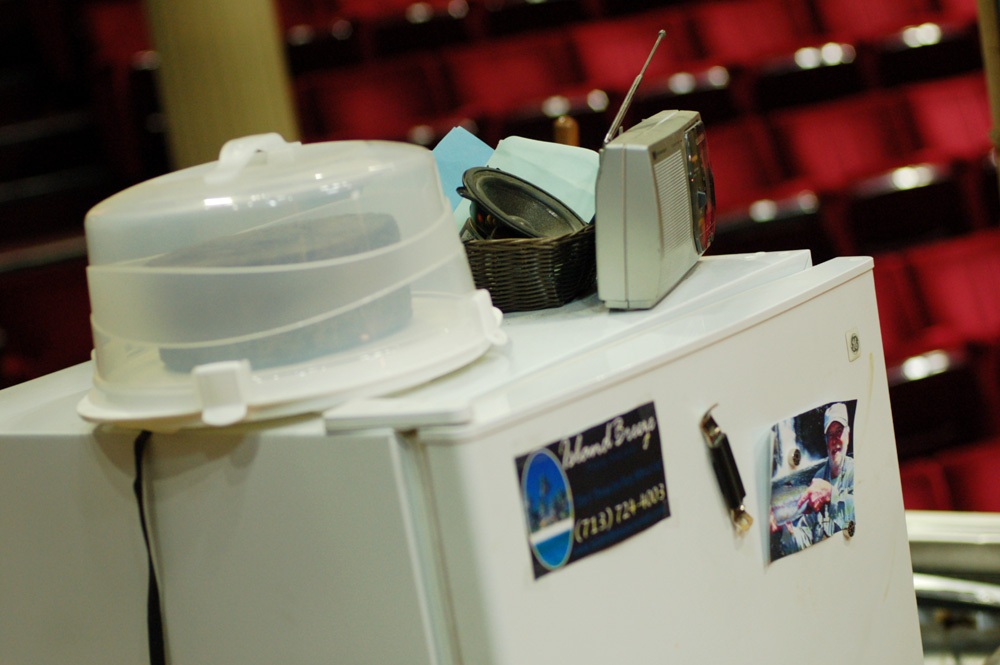
The Fridge

Top of the Fridge
Top of the Fridge

The refrigerator had a radio on top of it, which was played at one point. We needed to sneak a speaker in there somewhere; the fridge was actually from our prop shop, so we didn’t want to drill any holes or cut any parts out of it to hide the speaker. As you can see in the photograph above, by placing it in a basket and surrounding it with old mail and take-out menus, we kept it out of view from the audience.

The Sink

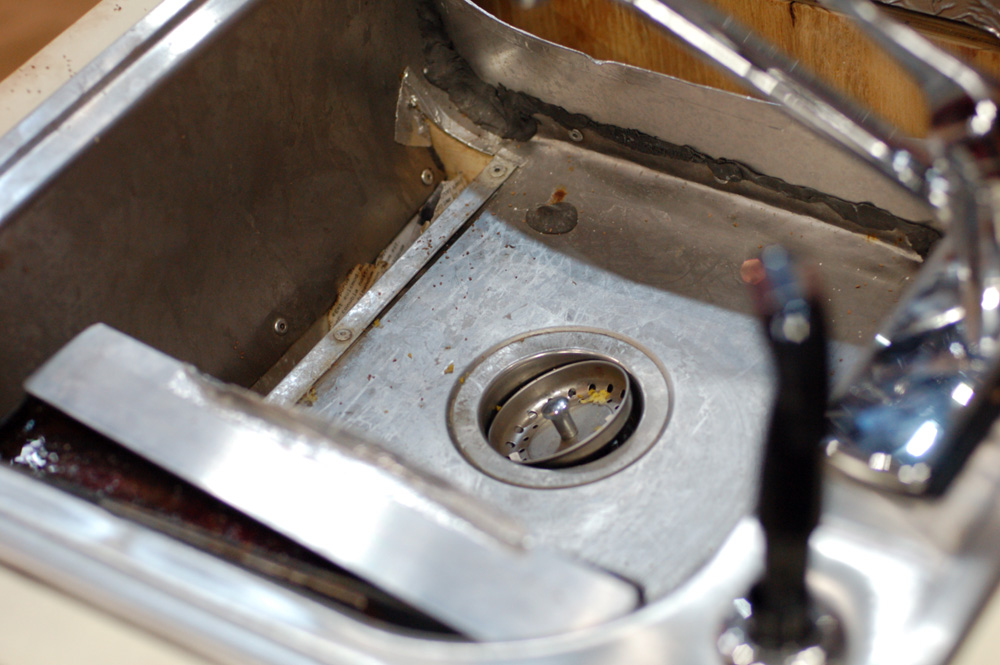
The sink had some of the toughest challenges. Making it run water was the easiest; since the Anspacher Theater has a sink directly backstage, we just needed to run a hose from it under the deck and to the faucet. The tricky part had to do with the end of the scene. The titular book of Grace was torn up by Vet, the father, thrown in the sink, set on fire, and then the charred pieces were pulled out.

The actual book was a custom scrapbook with many parts created and modified by the actress playing Grace. As such, we didn’t want them to tear it up and burn it every night. Second, if we burned an actual book, the ashes would float up and set the ceiling on fire. Finally, there would not be any way to consistently control what the charred pieces looked like after burning the book.

Interior of the sink

On the top of the photograph, you can see a pocket in the sink. Before tearing up the book, the actor grabbed a duplicate copy, which was similar but simpler. After tearing it up, he dropped the pieces down this pocket. Along the bottom of the picture, you can see a bar of metal which covered a trough filled with campfire gel. This is what the actor set on fire. On the left side of the photograph is another pocket. This one held the pre-charred scraps of paper which the actress pulled out at the end of the play.

Making and finding props for theatre, film, and hobbies