
Breakaway Window Pane

A few months back, I did the props for Arms and the Man at Triad Stage. Set during the 1885 Serbo-Bulgarian War, the first scene revolves around a Swiss soldier breaking into the bedroom of a Bulgarian woman. The war rages around them, and at one point, a bullet shatters through the glass of her balcony door. That’s a prop.

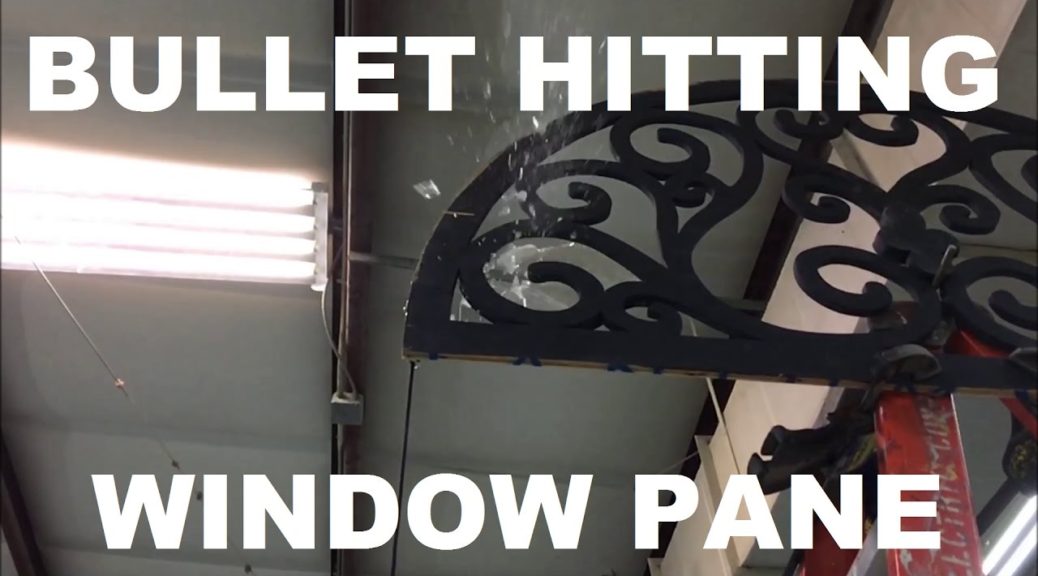
We not only needed to make a breakaway window pane that would fit the decorative transom, but I had to come up with a way to break it. Obviously, we couldn’t fire a bullet through it; we couldn’t fire any projectile through it because it was facing the audience. I needed something that could be triggered from offstage and remain hidden both before and after the trick. Luckily, the audience could not see the upstage side of the door unit. The video below shows the mechanism in action.

Essentially, I took a mousetrap and tied a nut to it. When triggered, the mousetrap flung the nut into the window, breaking it, and then it hung out of sight. The rest of the mechanism is simply to keep the mousetrap secure so it will not trigger prematurely, but also to make it easy to pull the string when the cue is called.
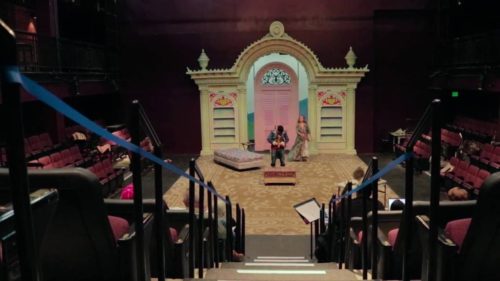
The Bedroom, Act One

The photo above shows the window in the context of the set. Somehow this is the best photo I could find.
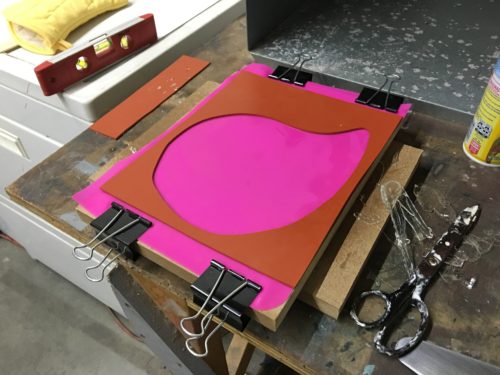
Glass mold
Glass mold

The window pane itself was made from isomalt, a sugar substitute which works a lot better for breakaways than traditional sugar glass. I get mine from Make Your Own Molds, but you can find it at many baking and confectioners shops since it is used for sugar sculpture on cakes.

For the mold, I cut the shape of the pane I needed out of a sheet of silicone rubber, and placed it on a silicone baking pad.
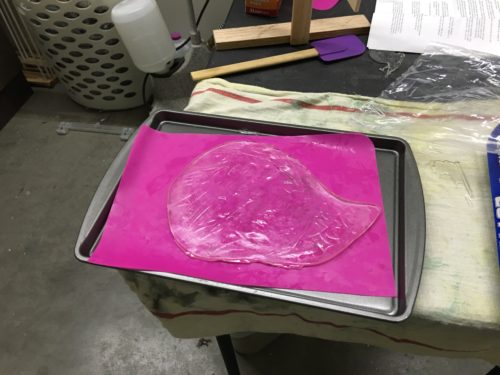
Breakaway glass pane

Above is one of my first attempts. The panes became a little clearer and smoother as I made more of them and experimented with the process. Below is a behind the scenes video put out by Triad Stage for this production. It has a bit of footage showing me making the breakaway window panes.

The effect was eventually cut during tech. The scene was rather dark, so the audience could not see the glass breaking. The setup and cleanup of the effect was not worth the little it added to the scene, so it was replaced with a sound and lighting effect.

Prop Stories on This Friday

At a Brooklyn High School, Plenty of Drama Before the Curtain Goes Up – The New York Times takes a backstage look at the Edward R. Murrow High School in Midwood, Brooklyn. They have an absurd amount of students in technical theatre classes working to put on shows with production values that rival many smaller regional theatres. I think my high school had one kid who did tech.

Jay Duckworth: Proptologist, Bear, Philosopher of the Hand – Stage Directions interviews Jay Duckworth, prop master at the Public Theater. While his prop creds are truly remarkable (including the pre-Broadway Hamilton), this interview focuses on what it means for Jay to be an out gay man working in technical theatre.

Peter Jackson’s Movie Prop Collection – It turns out that Peter Jackson, maker of both awesome and horrible movies, has an overwhelmingly extensive collection of props, puppets, and practical effects from films throughout history. Tested and Adam Savage take a look at it in this large photo essay. There’s a video, too, if that’s more your speed.

Happy Halloween – The Home & Family Yard 2016 – Every year, Dave Lowe goes all out to decorate a house for Halloween as part of his job as props master for the Hallmark Channel. Check out pictures of the final result, then browse the earlier entries in his blog where he photographs the process of building all the various elements.

The Staging of the Picture, 1909

The following is a very early “advertorial” from an antique shop extolling the benefits of historical accuracy in the props in films:

It is astonishing to note how rarely the moving picture is accurately staged; by staging we mean correctness as regards details of scenery, dress, furniture, etc. Only the other day we saw a great picture, the scene of which was laid in a distant foreign country; and yet the furniture in an interior scene belonged to American colonial days. Now this, as we have repeatedly pointed out in these pages, is an example of what is known as a glaring anachronism. How rarely the pictures are correctly produced, correctly lighted, etc.! These reflections were suggested to our mind by an interview with Mr. S. M. Jacobi, the art director of the Genuine Antique Shop, 34 East 30th street, New York city. The Genuine Antique Shop has retained Mr. Jacobi’s services in a new capacity, which, we think, should be of great value to moving picture film makers.

Mr. Jacobi, a trained artist and authority on artistic matters generally, has had wide experience in theatrical producing, and also in supplying the furniture, dresses, costumes and accessories for notable productions. The Genuine Antique Store possesses a unique collection of very beautiful paintings, furniture, costumes and refined accessories, which it is willing to let out on hire to moving picture makers who are anxious to have their historical and other productions accurate in respect of accessories and costumes. This is a very important point, as everybody who has the smallest regard for the welfare of the moving picture must realize. At the Genuine Antique Store you see relics of the Colonial period, paneling from old chateaux in France, and even the very finest of furniture from Fraunce’s Tavern, where George Washington met his officers, so that there is a good collection from which to choose. Mr. Jacobi has given attention to the moving picture for a great many years, both in Paris and New York. Besides being an artist, he is a trained photographer, and his services are to be available for the designing of studios for moving picture work and generally in the production of the picture with regard to its accurate presentation, photographic lighting, grouping, etc. We advice all to get in touch with the Genuine Antique Shop at the address given, either by mail or, better still, by a personal visit. We feel convinced that they will come away as we did; namely, with a feeling of envy for the treasures it contains—treasures that will look good in a moving picture.

“The Staging of the Picture.” Moving Picture World Vol 4, Num 26. 26 June 1909: 18. Print.

Links for the End of the World

This week has been especially hard for a lot of us in theatre in the US. A lot of the diversity inherent in our community feels threatened, both by potential policies that will pass, and by the implicit approval of hateful behavior in people across the country. We are also anxious about the safety nets and health insurance we rely on for some semblance of financial security in our lives. We are worried about our international collaborators, who already face difficulty crossing our border and working here. And of course, we worry about the theatre itself, which now must work under a President-Elect who has crossed IATSE picket lines in the past and shown no hesitation to jackhammer artwork into a thousand pieces if he can make a buck off of it.

Theatre can survive. We’ve survived the complete banning of our craft by governments and religions in the past. Modern theatre continues to survive its complete censorship (Belarus Free Theatre) and even survives in war zones where its leaders are assassinated (Jenin Freedom Theatre).

But we need to recommit to protecting everyone in our community and making sure the theatre remains a safe space for us to work and tell our stories. And we need to continue telling stories to ensure our country can stem the tide of demagoguery and bigotry that has plagued it throughout its history.

That’s my piece for now. Onto the links:

The USITT Member Spotlight shines its light on Jeff Bazemore, the props master at the Philadelphia Theatre Company. Jeff only finished graduate school a few years ago, and he has already proven himself to be a rockstar in props and an integral resource for others.

Popular stage shows like ‘War Horse’ are leading a puppetry revival. If the world is having a puppetry revival, perhaps there’s some hope after all. Macleans takes a look at some of the puppeteers and companies leading this revival.

Wired showcases the work of Jordan Boltan, who constructs hundreds of tiny props, set pieces, and costume elements, then arranges them to make delightful posters for various films.

Props and Animals in the English Mystery Plays, 1906

The following comes from a 1906 master’s thesis by Allie V. Parks titled, “Stage Properties, Costumes, Scenery and Music of the English Miracle Plays” (see part 1 here and part 2 here). These were religious pageants performed in England from the 10th to the 16th centuries. I’ve reformatted the text a bit to make it a little more readable, since it is already challenging trying to decipher the Middle English text:

In the Crucifixion scene a cross seemed actually to be used. Chambers quotes on page 276 from “The Hall book of the Corporation at Leicester, 1504. Paid for mending the garment of Jesus and the cross painting“. In the Shakespeare Society Chester Plays, in the play ‘The Histories of Lot and Abraham’ p. 59. here the Messenger doth offer to Melchesadecke a standinge cupe and bredde, and again on page 61, Here Lotte dothe offer to Melchesadecke a goodly cupe. Undoubtedly a cup was part of the properties in this play. On page 72 Abraham is directed to “kisse his sonne Isaake, and bynde a charchaffe aboute his heade“. Page 49 of the same edition, in the ‘Noah’ play, the following directions regarding the building of the Ark occur: Then Noye with all his family shall make a signe as though the wroughte upon the shippe with diverse instruments, and after that God shall speake to Noye, sayinge,

This direction would seem to show that a sort of pantomimic performance was gone through with and not any real work in the Ark building.

I found one reference to the use of straw, on page 370 of Chambers ‘Mediaeval Plays’ in the accounts of the Trinity House at Hull, Yorkshire: “Straw, for Noah and his children ijd.”

The stage directions for the use of animals are very few. The Chester Plays of the Shakespeare Society give on page 74, Then let Abraham take the lambe and kille him, and on page 150, Then the kinges goe downe to the beastes and ryde aboute. It seems hardly probable that Abraham really offered a lamb in place of his son, but he may have gone through the motions of doing so. This is the only stage direction in any of the cycles which might lead to the supposition that a lamb was really used for the sacrifice.

I have already quoted the directions for the use of horses on page 150, Then the kinges goe down to the beastes and ryde aboute. There is one other reference to the use of horses on page 253 of this edition of the Chester Plays, in ‘The Entry Into Jerusalem,’ Here Cryst rydyth out of the place; The animal may have been an ass; there is nothing to indicate what animal he rode upon.

There is one stage direction regarding the use of fowls in the Coventry cycle. This occurs on page 178 as follows: and ther Mary offery the ffowlys onto the auterre, and seyth.

Parks, Allie V. “Stage Properties, Costumes, Scenery and Music of the English Miracle Plays.” Thesis. University of Illinois, 1906. Internet Archive, 29 Oct. 2013. Web. 18 Oct. 2016. <https://archive.org/details/stagepropertiesc00park>.

Making and finding props for theatre, film, and hobbies