Friday Night in Props

Building a Sci-Fi Cyber Octopus for 80’s Style Practical Effects – Make Magazine talks with Nicola Piovesan, creator of an indie film called Attack of the Cyber Octopuses. He is 3D printing the titular cyber cephalopods to use as practical effects in the film. Cool stuff.

Sombra Gun Replica – Part 1 – Eva Foam Build – Kamui Cosplay is currently shooting a series of videos as she replicates a video game weapon out of flexible foam sheets. The first part on fabricating the gun is here, and you can find the next video on painting as well.

The Rise and Fall of the Everyman Tycoon – Or the 3d printing revolution that wasn’t. This article is more about the rise and fall of the Makerbot company; you can still find plenty of cheap, tiny 3D printers on the market. But the hype seems to be dying down. A few props people are experimenting with them, but many have discovered their limitations. The machines which are actually affordable print items that are too small for stage use, and the time it takes to draft and print an item can actually be longer than ordering and overnighting an actual item.

A Trick to Sawing Compound Angles & Odd Shapes – Christopher Schwartz has a great technique for cutting a compound angle on an odd shaped piece. For the one-two punch, follow this up with Get Four Feet Flat on the Floor to make sure all your chair or table legs are even.

Recollections of Stage Suppers

The following first appeared in a 1916 book titled “Recollections of a Scene Painter”,  written by an E.T. Harvey. We’ve heard about Matilda and the food in “Camille” in this previous blog post.

Matilda Heron had very strong likes and dislikes, and if you were not a favorite of hers, it was best to keep out of her way. Coming to Pike’s one season [editor note: Pike’s Opera House, Cincinnati, Ohio, 1863], she was overjoyed to find an old friend of hers, the property man, Jim Charles. She opened in “Camille,” and her first greeting was, “Now I am sure of getting a good supper to-night.” The supper room scene in the second act is one of the features of the play.

This leads me to say there is much more realism about supper room scenes then is generally supposed. One time here John T. Raymond opened in a play called “Risks.” George Morris, one of the best property men in the business, had worked for two weeks making artificial plants for the garden scene, and a French fireplace for a fancy interior. But he was called down badly because there was “too much salt in the soup.”

When Grace George had the “try-out” at the Grand some time ago in “Divorcons” (this was the play it will be remembered that she took to London with such success), it had been rehearsed at the Grand during the week and a trial performance was given Thursday afternoon. The quiet “tete-a-tete” between man and wife at the cafe, where the obnoxious lover is kicked out, is the most delightful scene in the play. W. A. Brady, whose devotion to his lovely and accomplished wife is one of the beautiful things of the modern stage, had ordered real champagne for the scene. Grace George was carried away with the character. And when the curtain had gone down and they were talking it over on the stage, she said to Frank (Frank Worthing): “What do you think? I drank four glasses of that champagne, upon an empty stomach.”

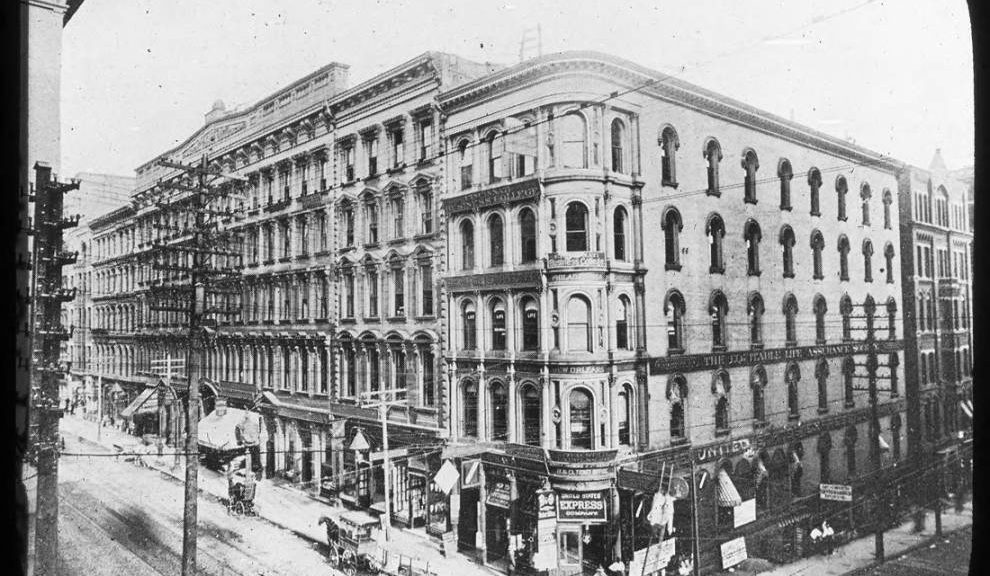
Pike's Opera House, 1892
Pike’s Opera House, 1892

Original Publication: Harvey, E. T. Recollections of a Scene Painter. Cincinnati: W.A. Sorin, 1916. 32. Google Books, 15 Feb. 2008. Web. 5 Sept. 2012.

Prop Rehearsal Notes

Behind the Scenes at Playhouse in the Park – Take a read through this wonderfully written and gorgeously photographed article on the scene and prop shops at Cincinnati’s Playhouse in the Park. Their shop is built in an old skating rink; if you look at the photo of the props shop, you can see how the floor is made up of curved wood boards.

Lyceum Theatre Flamingo Puppets – The Prop Solve is back with a post about foam and fabric flamingo puppets she made for Alice in Wonderland. The flexible neck mechanism is particularly ingenious.

How to be a Prop Maker with “Evil” Ted Smith – The Pod Sequentialism podcast has a new episode where they talk with Evil Ted Smith, who has worked on a number of film and television projects. You may recognize his name from his numerous flexible foam tutorials found online. If you have an hour to kill, give it a listen.

Creating Molds for Handmade Porcelain Dolls - Bill Chellberg guides us through the steps to make a mold for porcelain dolls. You can adapt these techniques to make molds for anything, or you can create your own cute (or creepy) doll heads.

Flame and Pyro Survey Results

I recently put out a survey to see how various theaters and other live venues deal with open flame and pyrotechnic effects.

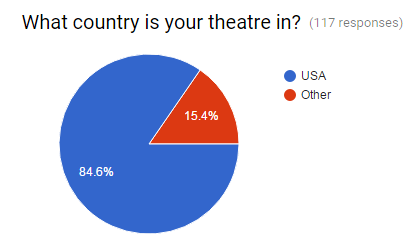
I received a total of 118 responses. The chart below shows the breakdown by country.
geography

Responses from outside the USA came from Canada, the UK, and Australia, as well as from Belgium, the Netherlands, and Finland.

The responses were from a healthy mix of companies, from the largest regional theaters to the smallest community theaters. There were responses from Broadway and off-Broadway houses, as well as theme parks, opera companies, and educational programs.

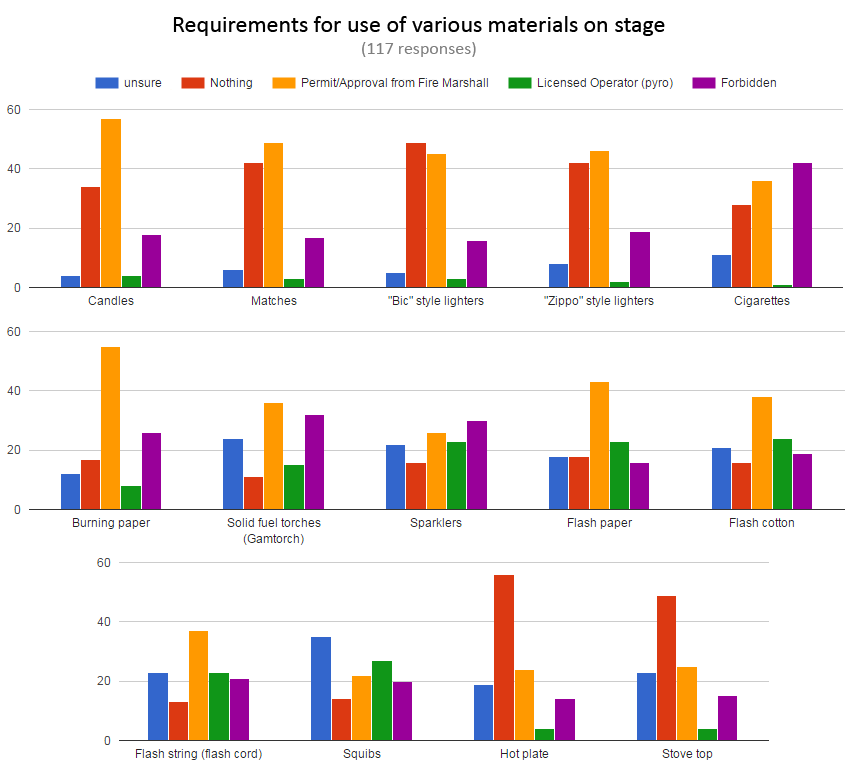
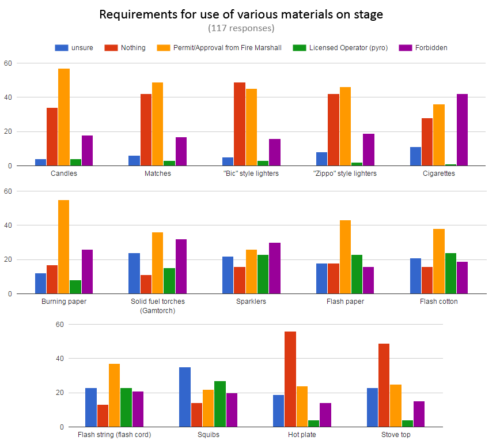
The meat of the survey was a series of questions asking about the requirements for using various items. The items included open flame devices like candles and matches, pyrotechnic devices like squibs and sparklers, and heating elements like stoves.
requirements

Every answer has at least some variety. Perhaps the closest ones with any sort of “consensus” were burning paper and a hot plate. But it goes to show just how different every venue could be.  Even within the venues, the requirements could change on a show-to-show basis. A lot of what is “allowed” comes down to the fire marshal’s approval, and that can change depending on which fire marshal visits your theatre, or even how you present the effect to the fire marshal.

I also wanted to point out one interesting distinction between “Bic-style” and “Zippo-style” lighters. You can see in the chart above that a Zippo-style lighter is more likely to require a flame permit than a Bic-style lighter. Not all lighters are the same!

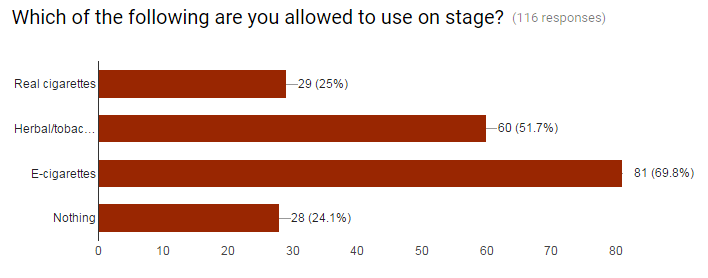
The use of cigarettes is not just dependent on the fire marshal; you also have to contend with tobacco and smoking regulations. I asked a question about what types of smoking products are allowed:
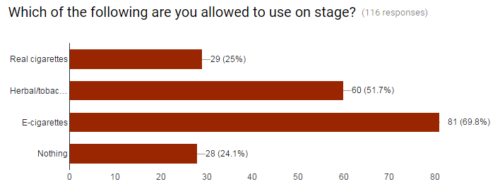
cigarettes

I was actually surprised at the percentage of theaters that could still use real cigarettes. From talking with other props masters, it sounded like they were all but completely banned by this point. But apparently a few places can still use them, usually citing free speech as their defense.

Looking at the individual responses, I found another surprise. In some venues, real and herbal cigarettes were allowed, while e-cigarettes were not. Usually, though, it is more likely to be the case that e-cigarettes were the only option where all others were banned.

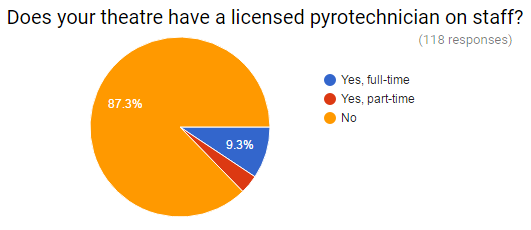
The last graph shows whether theaters have a licensed pyrotechnician on staff.
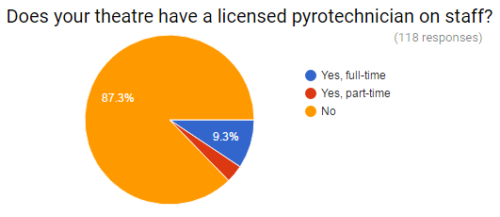
pyrotechnic

Having someone on the theater’s payroll makes a big difference with what types of effects they use regularly. Using flash paper on stage gets a whole lot more expensive if you have to hire an additional crew member. If you ever wondered how some companies can afford to use a lot of pyro, this may be the answer.

The final question of the survey asked for additional comments on the use of flame and pyro effects. Many responses discussed the safety procedures they had to follow, such as maintaining a fire watch or flameproofing all the surrounding scenery. A few places mentioned they are only allowed to light and extinguish candles and matches on stage, not off.

A couple of responses reiterated just how arbitrary the rulings of a fire marshal can be. In one case, effects which followed national and state guidelines were banned simply because of city politics. Every theatre and every show is different, and you should never assume you can do certain effects just because you saw another theatre do them.

Prop News and Views

Some of you already saw this yesterday, but I began a quick little survey on how your theatre uses fire and pyrotechnics. Please take a moment to fill it out; it will only take 3 to 5 minutes. Even if your theatre bans all types of fire down to the smallest candle, that information will still be useful.

Take a listen to this podcast with Ellen Freund, a prop master in film and television for 35 years. Her credits include Mad Men, Masters of the Universe, Night at the Museum, Twilight (no, not that Twilight), Twilight Saga: New Moon (yes, that Twilight), and so many more.

Karestin Harrison and Tammy Honesty are working on a recipe book of fake food due out in early 2018. Rosco has a few sample recipes up on their blog. It’s a much needed and much anticipated book for many prop builders, and one more step for Routledge in creating the ultimate prop library.

Collectors Weekly consistently publishes the most in-depth and interesting articles, and this one on the history of Holiday windows is no exception. After reading the article, take a moment to go through the photo gallery showing Holiday windows dating as far back as the 1800s.

Finally, in angrier news, the UC San Diego Department of Theatre and Dance and La Jolla Playhouse recently laid off 21 production employees, and then “invited” them to reapply for their jobs at a severe pay cut. These employees include most of the department heads of the various production departments, including the props master. Read this article on Broadway World for the specifics of how and why this happened, then head on over to the UCSD Theatre & Dance – Help Save Our Jobs! Facebook Group to see what you can do to help and to continue following the story.

Making and finding props for theatre, film, and hobbies