Minor Details Aren’t Unnoticed, 1895

The following article first appeared in the San Francisco Call in 1895: 

An exceptionally good performance was that given of “Diplomacy,” at the Columbia Theater last week. The leading parts, particularly those of Beach and Richman, were in the hands of actors who made them artistic pictures, and even the minor characters were finished studies.

The propertyman made the performance of “Diplomacy” remarkable by some rather clever compromises, which showed that he desired to give the French coloring and at the same time did not intend to lose his hold on local interest.

For instance, in the English embassy in Paris the newspaper which the unhappy husband snatched up in his despair and affected to read in the lull glare of the footlights was unmistakably a French journal, for the people in the stalls could read the type of that politest of languages, though they were a little staggered to see that the British diplomat was consoling one of the most trying moments of his life by studying Le Franco-Californien. Perhaps the propertyman wished to convey the impression that if Dora’a conduct forced her husband to fly to happier climes he could not do better than turn his steps to California.

It was a patriotic inspiration, too, to decorate the Parisian office of her Britannic Majesty with three large and handsome maps of the United States. Great rareties they must have been considered in Paris, too, for everyone who is familiar with that giddy capital knows that the outside world cuts very little figure in its geographies. You can buy “France in Provinces,” “France in Departments,” “France With Railroads” — canals, mountains, hedges and ditches— if you choose, but anything outside of France is always represented as of microscopic dimensions, scarcely visible to the naked eye.

Such little touches of local coloring apart, the staging of “Diplomacy” was finished and handsome, as is always the case at the Columbia Theater.

The San Francisco call. (San Francisco [Calif.]), 29 Sept. 1895. Chronicling America: Historic American Newspapers. Lib. of Congress. <http://chroniclingamerica.loc.gov/lccn/sn85066387/1895-09-29/ed-1/seq-20/>
The Blog of Eternal Prop Links

Hollywood is Running Out of Tombstones, according to this article from Bloomberg, featuring the world’s worst stock photo. So much film and television is being produced these days that prop rental companies are running out of stock, studio spaces are booked to the max, and production crew is impossible to find. If you wanted to work in props, this article makes it seem like all you have to do is move to Atlanta or Los Angeles. Do any of my readers have any first-hand knowledge to back that up? I’d love to hear about it.

Food styling for photography is always interesting, and Tienlon Ho wrote an article about how it is changing. Gone are the days of mashed potatoes for ice cream. Ho talks with master food stylist Delores Custer about the tricks of the trade and how they are evolving.

Playmakers Rep’s production of Sweeney Todd features some interesting paper masks during the masquerade scene. Rachel Pollack details how the costume crafts shop brought them to life for designer Bill Brewer.

Popular Woodworking has a list of the 16 dumbest woodworking mistakes, along with a link to their magazine article where they go into more detail. Let’s see… yep, I’ve done all of these.

The House of Eternal Return in Santa Fe sounds like an amazing experience. Owned by George RR Martin and run by artist collective Meow Wolf, it’s a massive Victorian house that may have just slipped into another dimension. Reminiscent of Sleep No More, with some elements of Escape Games, the house is designed for visitors to freely roam, explore, and interact with all the props and furniture. It’s a prop builder’s paradise.

Prop-a-palooza

Butcher John Wildenborg has become a meat expert for Hollywood. He started with providing meats for Fargo and evolved into becoming an on-set butcher consultant. He now supplies meat and meat-related props to a number of Hollywood films and shows.

Speaking of butchers, two high school students were hospitalized after having their necks cut with razors during a performance of Sweeney Todd.  As with most news stories of prop mishaps, the details are confused. It appears they were using real razors that were filed down and wrapped in duct tape. These stories are always presented the same way; a spokesperson gives all the reasons and excuses why this shouldn’t have happened. They list all the precautions they took and safety measures in place. But the simple fact that an accident did happen points to a problem somewhere. But no one ever reveals what those problems are.

Miss USITT this year? Stage Directions has a lengthy roundup of the conference, along with tons of videos. A lot of them have to do with lighting and sound, which is true of the conference in general. Hey, props may have the skills, but lights pay the bills.

Speaking of USITT, they released a statement on the surprise HB2 bill that recently passed here in North Carolina. They join SETC, who released their own statement last week. SETC is actually headquartered in North Carolina, just down the street from me, and will feel the effects of this horrendous piece of legislation. They did not go as far as Stephen Schwartz, who has banned productions of his musicals (such as Wicked, Pippin, and Godspell) in North Carolina while the bill is in place.

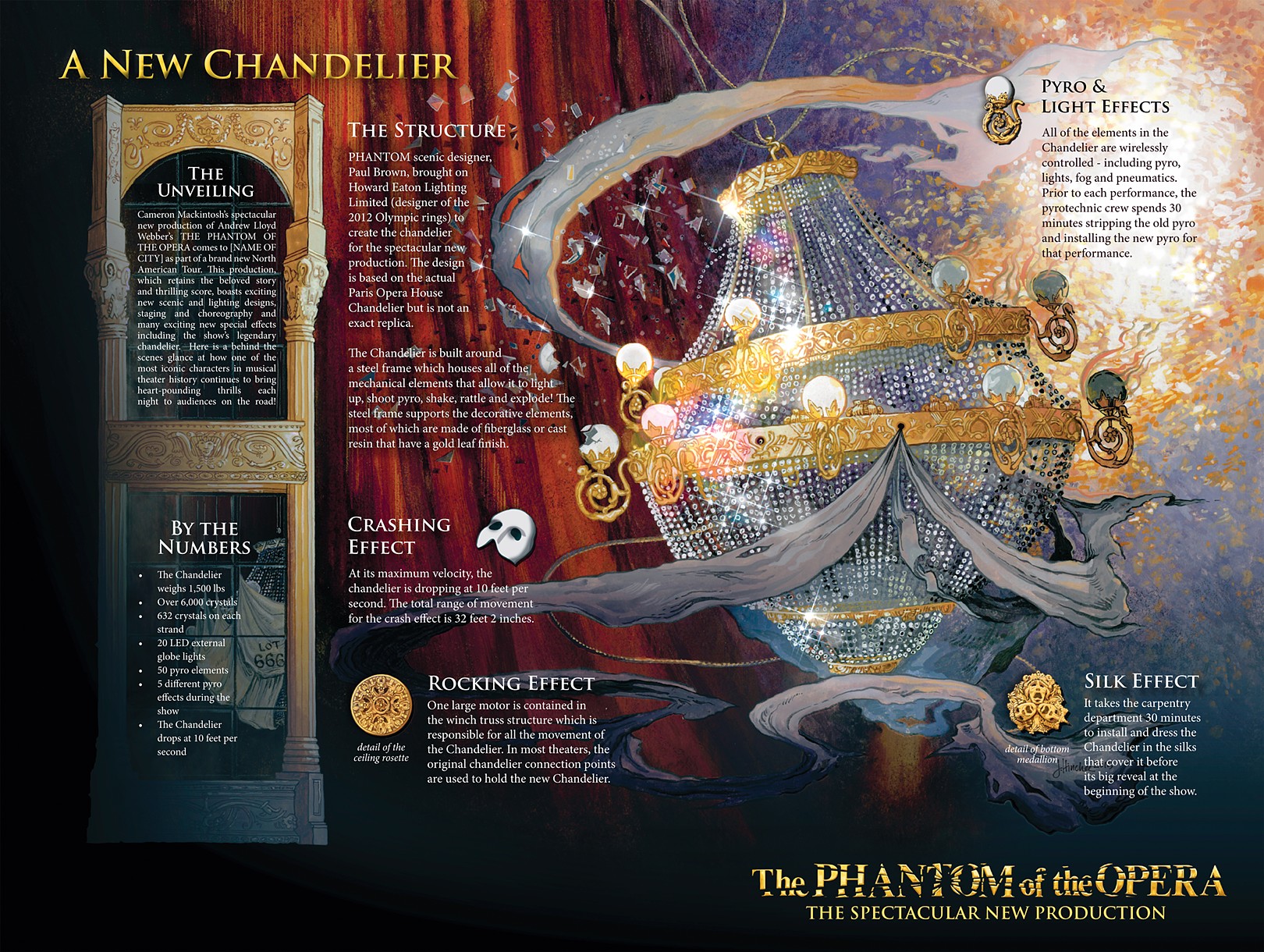
Speaking of bad musicals, Syracuse.com has a great piece on the chandelier in the touring production of Phantom of the Opera. It rocks, it crashes, it has pyro, and it sucks in silks. They have a great diagram of the massive prop, but the image is too low-res to make out the text. Luckily, you can head to the webpage of the diagram’s artist, Jeff Hinchee, to see a bigger version.

New Cover for The Prop Building Guidebook

We are still about a year away from the release, but I just turned in my last chapters for the second edition of The Prop Building Guidebook: For Theatre, Film, and TV. I am very excited about this book. The first edition filled a void in the props world, and continues to be a great success. Now that it has been out for a few years, I can take everything I learned from it and incorporate that into a new edition.

But let’s skip all that for now; I really want to talk about the cover. I always wanted to do a custom setup showing a prop being built, but did not have time during the first edition.

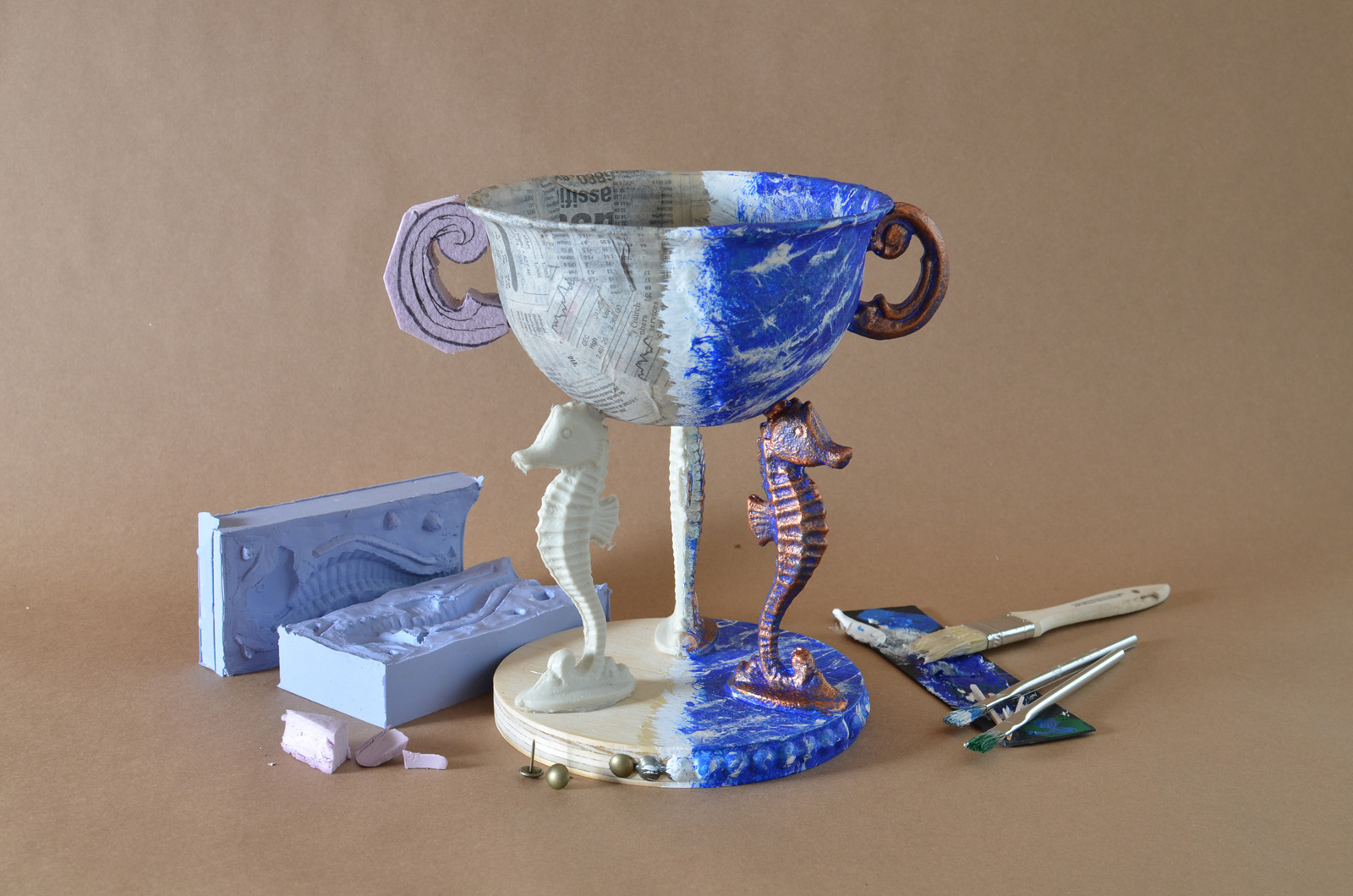
Coming up with a cover idea for prop building is tricky. Most finished props just look like a regular object. If you have a picture of a chair, people will think it’s a book about chairs. A picture of a treasure chest will make it look like a book about treasures. I needed a process shot. I did not want a collage or series of images for the cover, so I realized I would need to build some weird hybrid prop where half of it was finished, and the other half was still raw materials.

I wanted to incorporate the “most proppy” kinds of materials and techniques into the cover. I knew I wanted foam carving, molding and casting, paper mache, and a cool paint job. I would have loved to get some metal and thermoplastics in too, but I only had a weekend to plan, build, and photograph this. I did manage to get some plywood and found-object decorating in though.

Figuring out the prop itself took some thinking. It would have to be something that could conceivably come from a show; something you would not just buy or adapt from existing items. With the different materials I wanted to show off, I realized it would need to be quite fanciful. It would be the proppiest prop that ever propped.

I also needed it to fill the square cover. I could not make anything long, like a staff or wand. I did not want to stick a gun or other weapons on the cover either. I dug back into my opera roots and decided some kind of chalice or vase would be best; a bowl with carved handles, held by three sculpted figures.

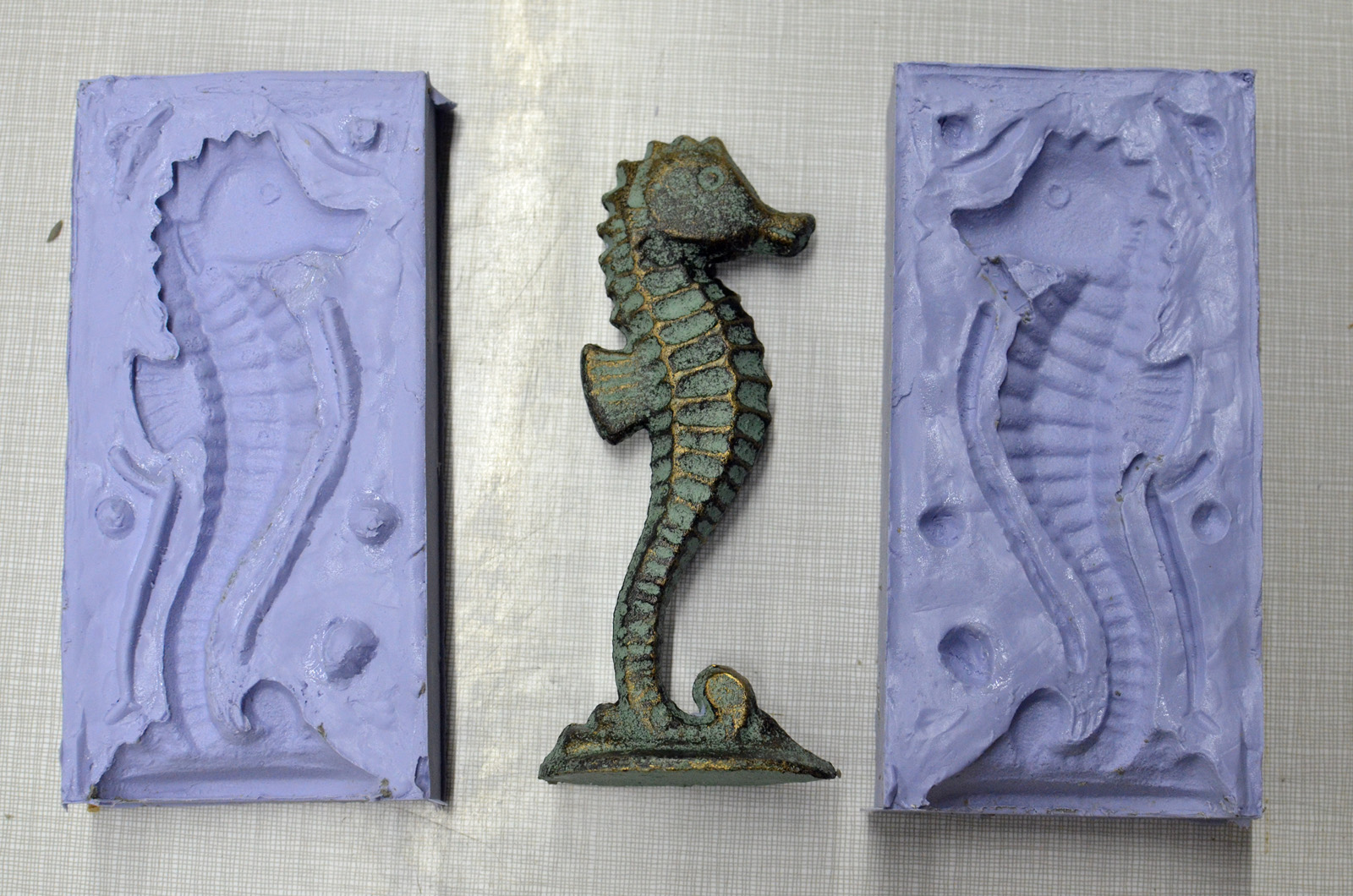
First I had to find the sculpted figure that I would mold and cast. I had nothing in stock and I did not have the time to sculpt something. I headed out to the stores and looked high and low. I needed something that would be easy to mold and cast, but that looked cool enough to warrant molding and casting. I finally found a little seahorse figurine. My prop would now have an underwater theme.

Seahorse mold
Seahorse mold

I made a two-part mold using Smooth-On Oomoo 30. I realized using $20 in materials to make three copies of a $3 figure was silly, but hey, he’s going to be a star.

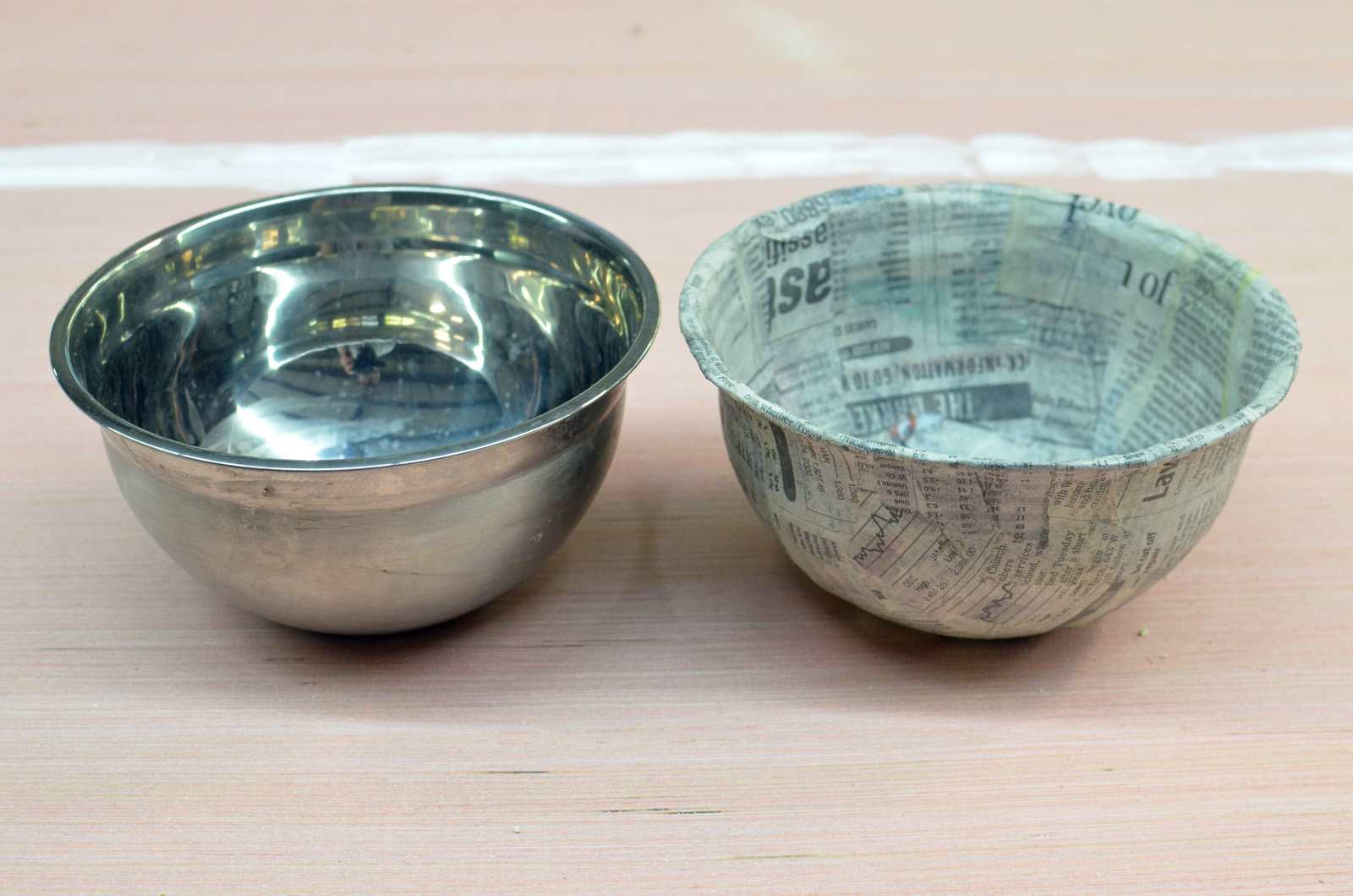
With the seahorse in place, I searched for a bowl that would look good on top. A stainless steel mixing bowl in stock fit the bill perfectly; it was also a good shape to use as a form for the paper mache. I cheated a bit here; I did not have time to actually paper mache a bowl and wait for it to dry. I molded a piece of Wonderflex over the bowl first, then added a single layer of paper mache to the inside and outside of that. So now my prop was actually a prop version of a prop.

Bowl
Bowl

With these in place, all that remained were the handles and the base. I carved a piece of foam into a handle, and cut another one out so it looked like it was about to be carved. I cut a circle of plywood and nailed some upholstery tacks along the edge for decoration.

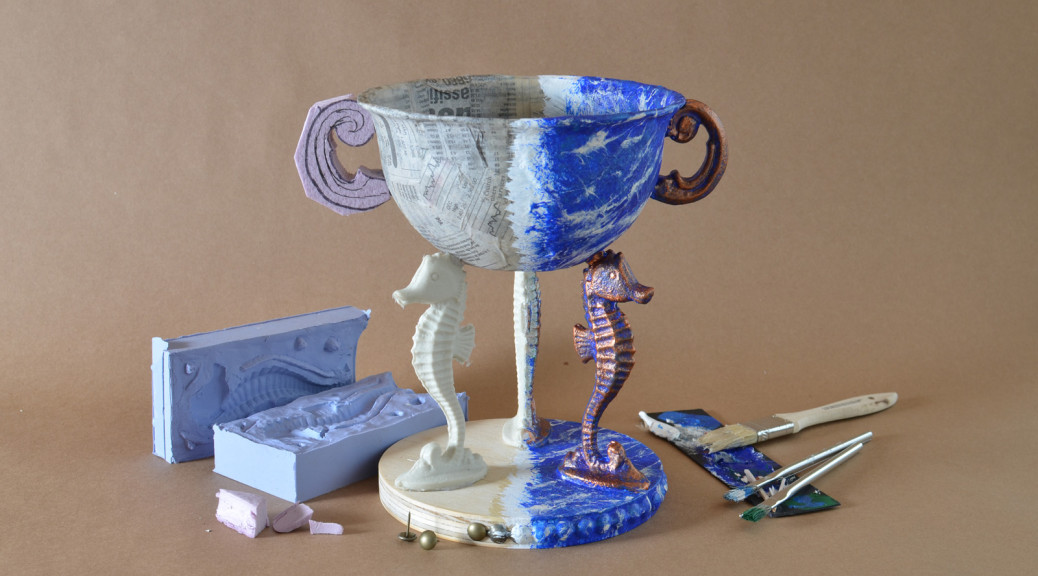
I painted half of the prop with a faux marble treatment and a drybrushed brass. All that was left now was to pop it onto some butcher paper in my “photo studio” and artfully arrange the various materials, tools, and molds around the prop.

Cover photo for The Prop Building Guidebook

Ta da! I feel like I have an image that better captures what the book is about. And now I have a weird half-finished seahorse trophy I can carry around with me.

No Fooling with These Stories

Cinefex has a very awesome and very thorough look at the use of puppets in cinema.  They cover the history from 1906’s The Witch all the way up to Star Wars: The Force Awakens. The article also features interviews with a whole bunch of practical effects artists using puppets in film.

“Once you have the basic set of tools and know how to use them, your work will dictate the specialty tools you might need.” Chris Schwartz reminds us that the most common tools are the most useful. Rare tools are rare either because they are commercial failures or they have highly specialized uses. When buying your tools, be sure you have the ability to do the tasks you do on a daily or weekly basis before you buy the tools that you will only use once a year.

The New York Times takes us backstage at the Metropolitan Opera in this fantastic photo essay showing the lead up to the first performance of Roberto Devereux.

The Daily Record takes a glimpse into the props stock at Central Washington University. They talk with David Barnett, who runs the stock and props the shows, as well as Marc Haniuk, who teaches a props class every year.

Yahoo TV talks with John Sanders, prop master on The Walking Dead, to learn more about Daryl Dixon’s motorcycle on the show. They claim it’s “everything you need to know”; I don’t know if that’s true, but it’s certainly all you could possibly care to know.

Making and finding props for theatre, film, and hobbies