
The Elephant Kicks, 1891

This article first appeared in an 1891 newspaper. The elephant discussed here was built by famed Met Opera technical director Edward Siedle.

Update: I found another article which claims this elephant was built by Woolson Morse. I now think Siedle built the elephant for the 1904 remount of this show.

Actor DeWolf Hopper’s big elephant that drinks a quart of beer every night and on Saturday afternoons at the Broadway Theater, threatens to become troublesome to the management, says the New York Sun. The elephant has been kicking vigorously for a week past. The kick comes from the elephant’s hindquarters. In order to understand the full significance of the insubordinate behavior it is necessary to explain that in private life the “Wang” elephant is Mr. James Flynn and Mr. Mike Stevens Holahan. Mr. Flynn is the accomplished front legs and beer-drinking trunk of the elephant, and Mr. Holahan is the hind legs, and it is he who initiated the kicking. Mr. Flynn shows a disposition to join in the protest, and favors an elephantine strike.

When he is not the hind legs Mr. Holahan is the property-man of the opera company. He has to look after the costumes and wax candles, spears, bits of cut paper, Wang’s treasure-chest, and a lot of other miscellaneous stuffs used in the stage production. He was requested the other night to work on Sundays, too, and look after the distribution of display posters along Broadway on that day, and to paste the posters on the bill-boards. He intimated that this was crowding him a trifle too much, and that he did not propose to dabble in paste-pots at all. The matter was compromised by hiring a professional bill-poster to do the work.

Mr. James Flynn’s complaint is based on the plain ground of overwork. Mr. Flynn is a strong man, but he asserts that it is getting to be pretty tough work on hot nights carrying Mr. de Wolf Hopper on his head, and working the trunk of the elephant at the same time. Mr. Hopper is about seven feet high and weights in proportion to his towering stature. Mr. Flynn says this weight, combined with a Turkish bath atmosphere inside the papier-mache head of the elephant, and the necessity of keeping track of the innumerable pulleys that operate the rubber trunk of the elephant, gives him a headache every night. Moreover, he says that after he escapes from his half-hour imprisonment in this oven, he has to appear as a dancing master, and lead a dance of Emperor Wang’s twelve Siamese daughters-in-law, and later he has to climb on stilts and become a high priest—considerably higher, in point of fact, than Mr. Hopper himself. Mr. Flynn says that he quits the performance completely played out after his triple achievement. Manager Ben Stevens said last night that he thought he could square matters temporarily by allowing Mr. Flynn to partake of a bumper of beer as generous as that consumed every night by the elephant.

A funny thing in connection with the discontented elephant is that any number of children and adults, too, have written to Manager Stevens to find out whether the elephant is really alive. A Broadway merchant made a bet a fortnight ago, after he had seen the elephant drink its beer, that it was really a live baby elephant. He bet a new white tile on the point.

“The Elephant Kicks.” The Morning Call [San Francisco] 8 June 1891: 7. Print.
Some Good Links for Friday

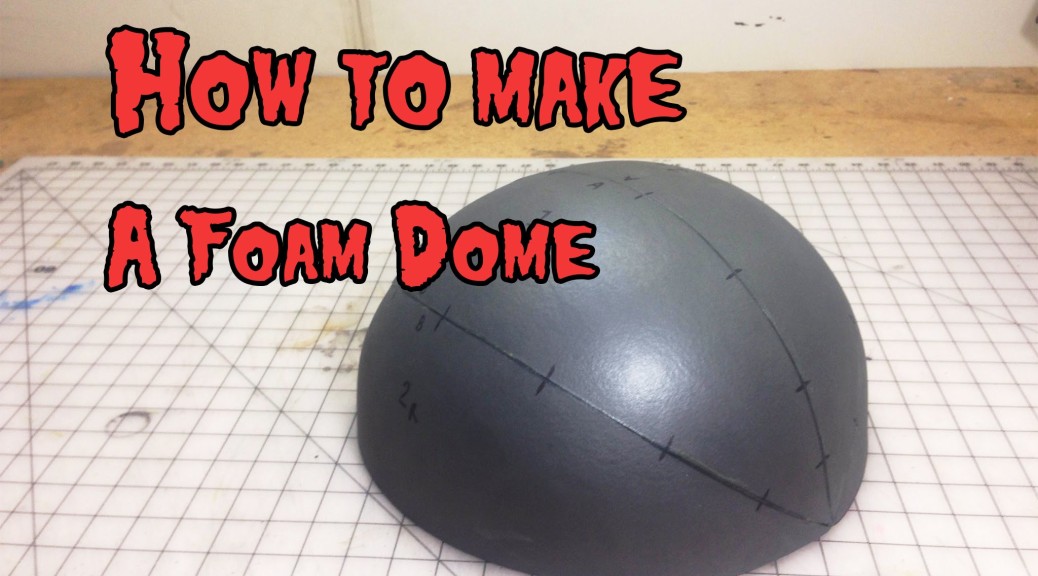
Hey Foam Dome! Want to learn how to make a foam dome? Evil Ted shows some great tips for patterning and forming a dome shape out of flexible foam rubber sheets.

Make has rounded up five basic hand stitches you need to know and illustrated them with some great diagrams. As a bonus, they have a few other tips for working with textiles.

Batman V Superman comes out this weekend, and DC All Access has a look at the props. They visit prop master Douglas Harlocker, who shows us some of Batman’s weapons and talks about how their design came to be. You have to skip past about two and a half minutes of the ultra-bubbly hosts talking about upcoming comic books before you get to the props stuff.

Chris Schwartz shows how to make custom sanding sticks for smoothing the edges of really hard-to-reach places. I’ve also seen people buy those disposable nail files to achieve a similar goal.

Do Good Work, Get Along With People, and Be On Time

Some of us props people have been talking recently about what advice to give to new props people entering the field. You need to know more than just what machines and materials to use, or what stores to shop at. This snippet of a commencement address given by Neil Gaiman was very relevant:

People keep working, in a freelance world, and more and more of today’s world is freelance, because their work is good, and because they are easy to get along with, and because they deliver the work on time. And you don’t even need all three. Two out of three is fine. People will tolerate how unpleasant you are if your work is good and you deliver it on time. They’ll forgive the lateness of the work if it’s good, and if they like you. And you don’t have to be as good as the others if you’re on time and it’s always a pleasure to hear from you.

Gaiman’s quote reminds me of another saying I’ve heard; I don’t remember the exact words, so I’ll paraphrase: “If you’re nice, you don’t always have to be right. If you’re a jerk, you have to be right all the time.” In other words, if people hate you, as soon as you make one mistake, they’ll use that to stop working with you.

Hard skills like welding, molding and casting, and upholstery can be difficult to learn when you don’t have a teacher or the resources needed. But you can always work on the soft skills that will help you get jobs: getting along with a variety of people and hitting your deadlines.

More Prop Links for Your Friday

The folks over at Center Theatre Group had to make a whole lot of fake salad for their production of Women Laughing Alone With Salad. Find out how Jon Ward and his props team honed in on the perfect recipe for a pretend salad.

Here we have 9 Real Job Skills You Lean From Being a Cosplayer, which is remarkably similar to the job skills you learn from being a prop maker. Of course, that assumes that they ever let you out of the props shop to look for another job. Back to work!

Whatever happened to Tony Montana’s “Little Friend”? Not that I was wondering, but this Hollywood Reporter article is a fascinating look at an iconic movie prop. Watch as it meanders its way around LA over the next few decades, popping up in other films here and there.

If you’ve never seen Adam Savage’s One Day Builds, you’re missing out! In his latest, he builds a sword from Hellboy. What makes these great is that they do not really skip over anything; it’s just a cameraman in the shop, showing every step he takes, and every mistake he makes. I also like how he doesn’t really use anything that’s out of the realm of the average props shop. His materials come from typical hardware stores and auto body shops, and his tools are pretty standard issue (well, that disc sander is kind of a beast).

You wouldn’t be a props person if you didn’t use hot glue. Make Magazine has 7 cool tips for working with hot glue.

Grand Opera Beyond the Curtain Line, 1915

The following originally appeared in a 1915 issue of Theatre Magazine:

Grand Opera Beyond the Curtain Line

by Mercy Gorham

“Every night is a first night with us,” observed Edward Siedle, Technical Director of the Metropolitan Opera House, as he watched a scene “break” in “Koenigskinder.” He stood talking of that mysterious realm beyond the footlights, always an enigma to the average operagoer, and he talked entertainingly, too, as a man is apt to do when his work is his hobby…

“I suppose the ‘property’ department is most popular with the laity, doubtless because it is better understood than the rest. It is a very important division, too, as will be seen when one takes into consideration the enormous number of properties used in all the operas and the vital importance of each in its turn. Take the matter of floor coverings alone, such as carpets, medallions and stage cloths, for in every scene the stage is covered with a cloth in keeping with the ensemble, and one can compass in a small measure the enormous amount of material there is to be cared for.

“Each scene calls for its own equipment. If it is a garden then there is earth and grass, benches and marbles to be provided. A street scene calls for paved ways; palaces for tesselated floors; the small parlor for its hard-wood floors and modern rugs and carpets; doors and windows for curtains and draperies; tables for pedestals and bric-a-brac; gardens for trees and flowers and rock scenes for their practical rocks.

“As the scenes of operas are laid in every part of the world, there must be a great variety of settings provided. Not a few illustrate mythological subjects, while others are Oriental in spirit. The properties of each require not only care in the handling, but a lot of research, trouble and expense in the making. These have all to be listed in their plots, showing precisely where they are placed when on the stage. Those not on the stage, but which are brought on during the performance, must also be carefully marked on the plot.”

Gorham, Mercy. “Grand Opera Beyond the Curtain Line.” The Theatre Magazine Jan. 1915: 21. Google Books. Web. 15 Mar. 2016.

Making and finding props for theatre, film, and hobbies