As the year draws to a close, I wanted to remember some of the people who have passed away in 2015. These are either people who work in our industry or do work closely related to our own. If I have missed anyone, let me know.
Eddie Aiona, props master for Clint Eastwood, died at 83. Aiona first worked with Eastwood on Magnum Force (1973), and propped all his films until retiring after The Bridges of Madison County in 1995. He also propped films for directors like Martin Scorsese, Sydney Pollack, John Carpenter and Robert Redford.
Blaine Gibson, sculptor of figures in Disney Parks, died at 97. Gibson sculpted hundreds of the figures used for Disney’s Audio-Animatronics, including the first one, Abraham Lincoln. His work also included characters in the Pirates of the Caribbean ride, the Haunted Mansion, and It’s a Small World.
George Barris, Batmobile Creator, died at 89. Barris worked on some of the most iconic cars in Hollywood, including the aforementioned Batmobile from the 1960s Batman with Adam West . He also built the Munster’s Koach and worked on cars for Knight Rider, Mannix and North by Northwest.
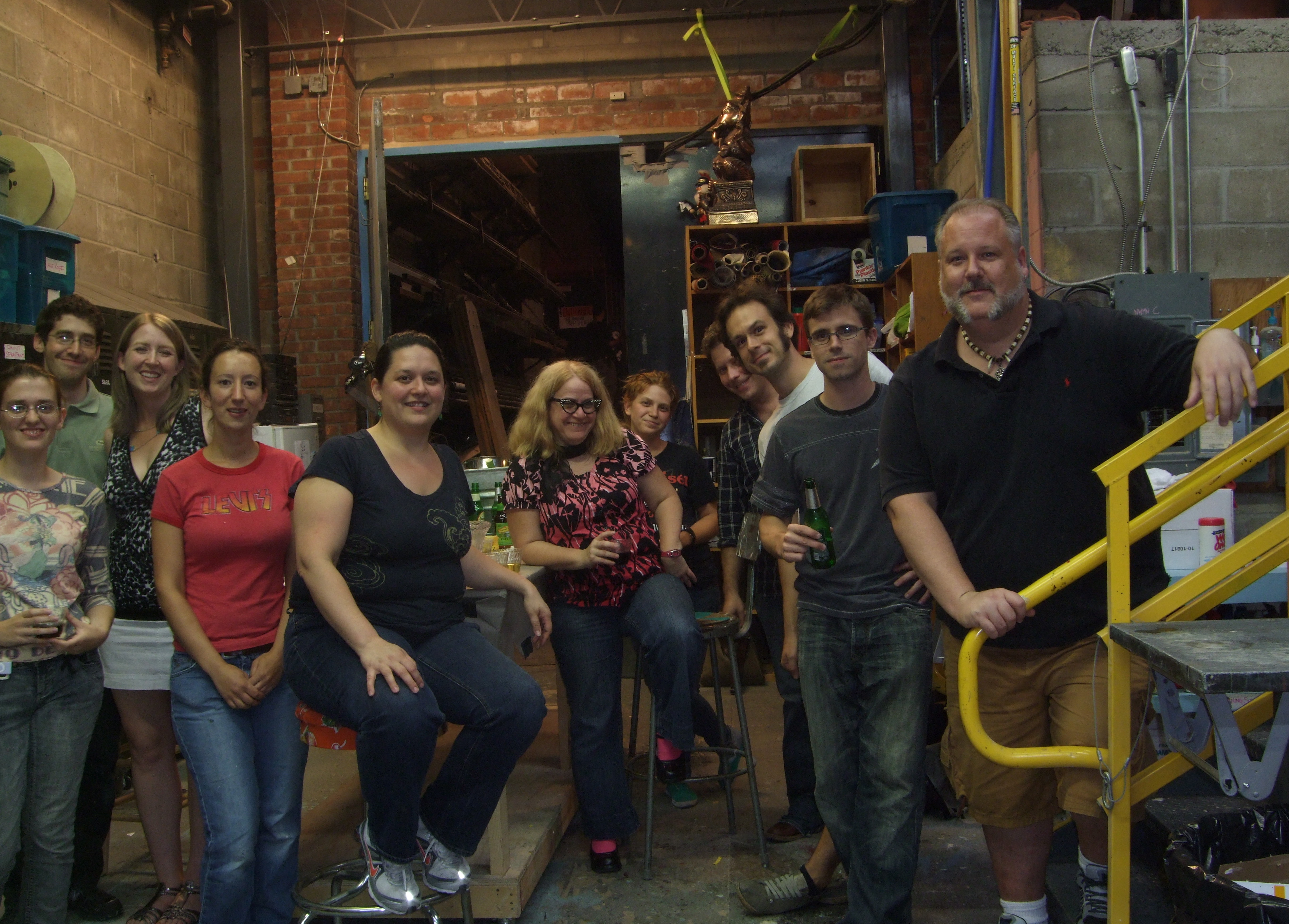
Mark Gill, Macy’s Parade Studio, 32. Mark was a props carpenter at Julliard before leaving to work on the floats for the Macy’s Parade. His wife was in props as well, working as the props master at NYU while I was at the Public Theater (and just a few blocks over). Both of them attended the inaugural NYC Props Summit in 2009. His death was far too soon, and he will be missed greatly.
The attendees of the 2009 New York City Props Summit
Though there’s only one more week until Christmas, you still have enough time to order The Prop Building Guidebook for that special prop maker in your life!
Frank Ippolito has a post out called “Blame the Maker, not the Material“. He reminds us that many of the more complicated materials – resins, rubbers, laminates, etc – have so many specific variations, that you cannot expect consistent results if you use them in a different manner than expected. Or if you substitute brands when following directions. These materials are manufactured to do what they are meant to do, and if you are not getting the results you expect, you are either using the wrong materials or using the materials wrong.
Now this is street theatre: La Machine brings massive mechanical marvels to life, free to roam the streets around the world. François Delarozière is the artist behind these gigantic moving contraptions, such as a 50-foot spider or Da Vinci-esque elephants.
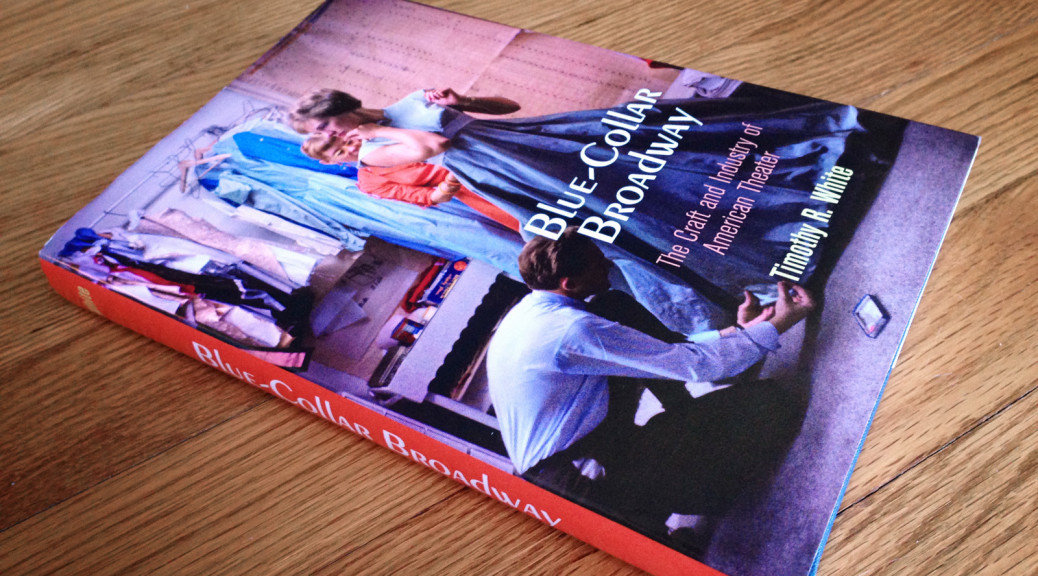
I just finished reading Blue-Collar Broadway: The Craft and Industry of American Theater by Timothy R. White. It is a thoroughly fantastic read for anyone interested in the history of technical theatre and Broadway. Rather than another history of shows and stars, White lays out the history of scenery studios, prop shops, costume shops, lighting rental houses, rehearsal studios, and more. While many audiences (and producers) think that a show is just conjured up through imagination, White understands that imagination only becomes reality when you can hire skilled craftspeople and give them the space and tools to make it happen.
This is not just about Broadway. As any theatre technician can attest, Broadway is more of a brand than a location. Shows are built out in the regional theatres and shipped to New York. Tours have their technical rehearsals in performing arts centers far from Manhattan. As we learn in this book, it was really only the heart of the twentieth century when Broadway shows were built, rehearsed, and performed solely in the area around Times Square.
Prior to that, the work was done all over. White profiles one business, Armbruster Scenic, which provided painted drops to companies all over the country, despite its location in Columbus, Ohio. In the early half of the nineteenth century, every town had its share of stock theatre companies giving regular performances.
Yet, as White carefully details, it wasn’t film, television or Broadway that decimated the local theatre industry as many of us typically assume. It was the railroad. Once this network of rails sprung up around the country, all the stuff of theatre (as well as the actors) could be shipped from city to city. It created the idea of a “national” theatre, and how could the little stock companies compete when national stars were performing just down the street? It was still a few more decades before Broadway positioned itself to be the center of American theatre, and by then, the blue-collar theatre jobs around the country had shriveled to a percentage of what they used to be.
White does a fantastic job of digging into all the details to paint a picture of the technical theatre industry at various points in time. He includes a number of maps showing where scenic studios, costume shops and footwear rental stores were located throughout the city. He focuses on two shows in particular, Oklahoma! and Evita, to highlight the state of Broadway at their respective times, and to contrast the drastic changes that occurred in just a few decades. And he maintains perspective with the larger trends in history to show how Broadway’s history was not happening in a bubble.
Blue-Collar Broadway also gives a history of some of the larger regional theatres which began appearing in the 1950s and 1960s. After all, if blue-collar theatre workers were leaving the city to work at the Guthrie, it only makes sense to explain why. The regional theatres marked a new era in American Theatre history, when all the physical production elements could be built in one facility.
Though a lot of this history seems so long ago, most of it is fairly recent in perspective. Dazian Fabrics, which opened its doors in 1842, long before the golden age of Broadway, is still selling fabric to the performing arts industry. Nino Novellino, mentioned in this book for his work on the original Evita, is still building props in the same upstate New York building as he was back then. He’s still using the same machines that his predecessor, Peter Feller, built to make armor for The Man of La Mancha.  Feller’s father worked as a stagehand at the Metropolitan Opera, probably around the same time Edward Siedle was the technical director there. And Siedle was touring the US as a props hand before Broadway was Broadway. So we’re not very far from the beginning of Broadway’s history.
One aspect I missed from the book was any talk of opera, or other performing arts outside of theatre. The rise of the Metropolitan Opera as a national institution was simultaneous with the rise of Broadway, and many theatre technicians flow back and forth between the two. When talking about where all the scenery, costumes and props come from, and what keeps stagehands employed, surely the Met could warrant a mention. I’m sure there just wasn’t room in a book already overflowing with information.
Blue-Collar Broadway offers so many other avenues to explore in our collective history. It is truly a one-of-a-kind book for any worker in the performing art who wants to know what our predecessors did. It’s also a fine read for anyone who needs to convince the higher-ups of the validity and necessity of our work. As White writes, “While plenty of show ideas have sprung from inscrutable seeds of divine inspiration, the mundane reality of the finished Broadway show is far less glamorous. Every single show to have raised its curtain on Broadway was crafted through a long, sometimes painstaking process of rehearsal and construction within workshops and rehearsal studios. Even the most well-conceived show must be built to exist, and it must be built by craftspeople.”
The following is the conclusion of an article which came from the 1921 collected edition of “Our Paper,†put out by the Massachusetts Reformatory. The first part and second part were previously posted:
Bossing the World
by John B. Wallace
This is only a sample of the painstaking care with which pictures in the larger studios are filmed. It explains why so many persons who have been abroad have been fooled into exclaiming, “Why, I know that was taken in France, because I have been on that very spot,” when in reality, the “scene was shot” in California. The pictures are made with such careful attention to detail that directors and property men who know every trick of the trade are often imposed upon.
The research department is the prop that Wells leans upon in times of doubt. Three persons are employed who do nothing but look up the proper costuming and settings for scenes laid in times other than the present. In addition to a large library maintained by the studio they have the Public Library of Los Angeles to fall back upon, as well as several splendid private collections of millionaire book fanciers.
Other departments that come under Mr. Wells’ supervision are the large repair shops. In the drapery department curtains and draperies are constantly being altered, cut and repaired. Furniture is revarnished, repaired and reupholstered. In the pottery department antique vases are duplicated in cheaper materials and the bric-a-brac that is to be smashed in comedy and battle scenes is made out of plaster of paris. Costumes require a large force of seamstresses to make and alter. The electrical department requires a large force of electricians and expert mechanics are employed in the upkeep of the motor trucks and automobiles.
Wallace, John B. “Bossing the World.†Our Paper. Vol. 38. N.p.: Massachusetts Refomatory, 1921. 153. Google Books. Web. 24 Nov. 2015
Making and finding props for theatre, film, and hobbies