All posts by Eric Hart

A Gift of Prop Links

8 Behind-the-Scenes Secrets of the Pretty Little Liars’ Vengeful Board Game – We head to Cosmo this morning to learn about the elaborate board game created by props master Chris Vail. Unlike “Cones of Dunshire,” this game is actually played on screen over several episodes. The details are gorgeous and Vail explains how they built the various mechanisms we see in the show.

Paul Huston on Making Models and History for Star Wars: A New Hope - Star Wars turns 40 this year, so StarWars.com talks with Paul Huston, who has worked on all eight Star Wars films so far. It is amazing to look back and realize just how much movie-making technology was invented solely to create that film.

Oregon Shakespeare Festival Scene Shop Skips the Fasteners – OSF needs to rep ten shows at the height of their season, so they are always looking for ways to make change-over go quicker. For the set of Shakespeare in Love, they have come up with a way to sleeve pieces together without requiring fasteners. Check out the video to see how they make custom 3D-printed hardware to pull this off.

Beowulf Boritt, Set Designer, Renovates His Home – It’s always great to see a theater person’s home, especially when they do a lot of the renovation themselves. Check out all the custom parts that have gone into Beowulf’s Sutton Place co-op. My favorite bit is the framed electrical outlet from Hand of God which an audience member famously tried to charge their phone from.

How to Fix a Split Seat – Finally, Chris Schwartz show his method for fixing a split seat, which can be used to fix any piece of split wood.
Ancient Cherokee Box

Our final production of the season at Triad Stage was a new piece called And So We Walked. Written and performed by DeLanna Studi, it recounts her journey to walk the Trail of Tears with her father and rediscover her Cherokee roots. The show itself is traveling around the country for the next few weeks before another full production at Portland Center Stage next spring.

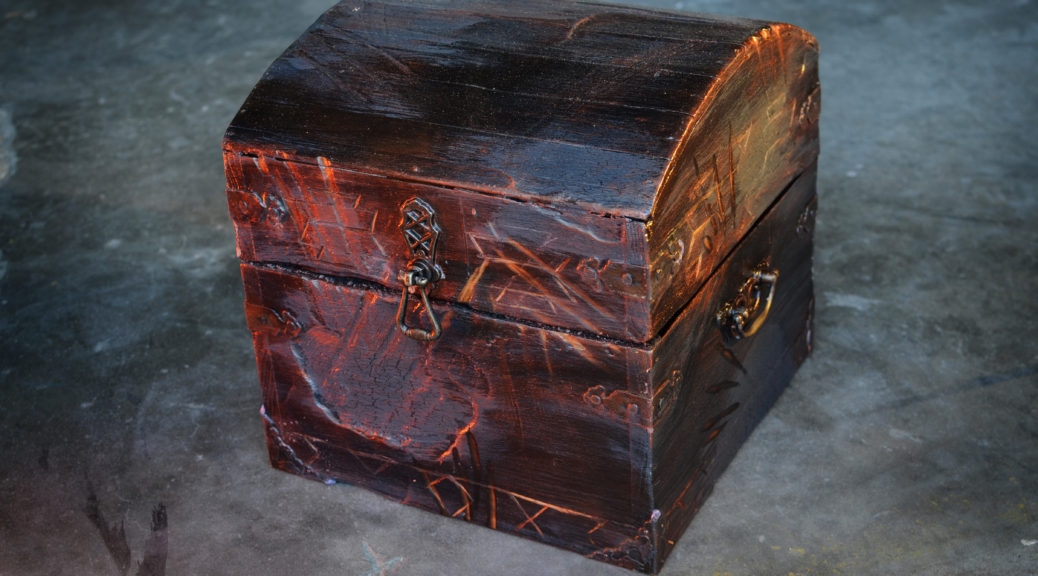
The show takes place in both the real world and a theatrical dream world, and one of the props I built was an ancient burned box which held secrets. We determined the size and shape in various devising sessions and rehearsals, so I simply made another box out of nice materials to match a rehearsal version I had already made.

Constructing the box

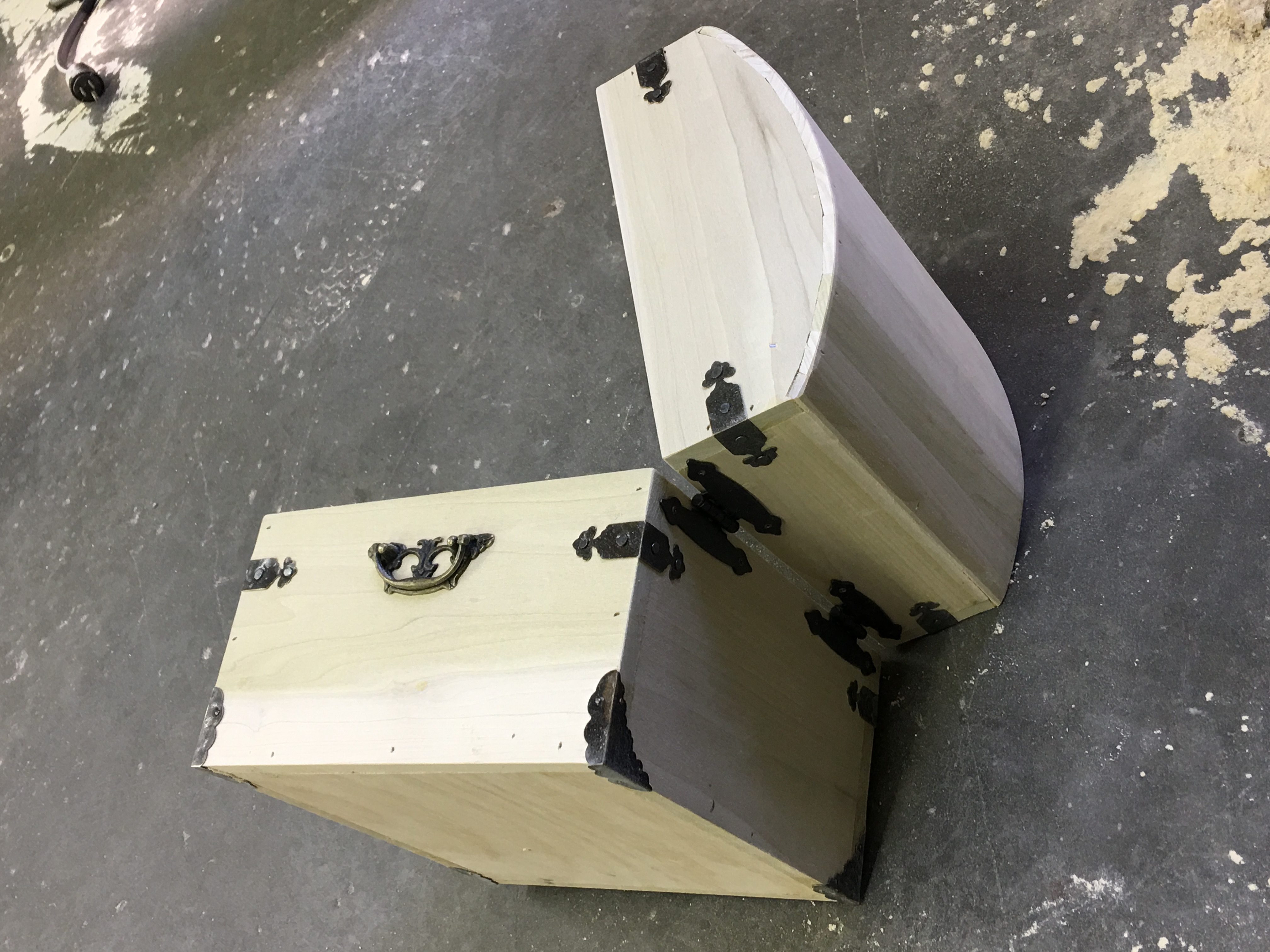
The carcass was constructed from half-inch poplar I bought at Home Depot (my planer was broke), with a piece of plywood for the bottom. The top wanted to be vaulted, so I ripped a number of slats from quarter-inch poplar, beveled the edges, and glued them together to make the vault shape.

Attaching the hardware

Once the top was all glued together, I ran a belt sander over it to transform the faceted surface into a smooth curve.

The hardware was a mix of stuff from the hobby store and pieces I had in stock from other boxes I had built. A lot of this decorative brass box hardware comes straight from China, so you have to wait a few weeks or even months to get it shipped. Whenever I order some, I get several options and extras so that I slowly build up a stock to use on projects that have too tight of a deadline to wait for the shipping.

Burning the outside
Burning the outside

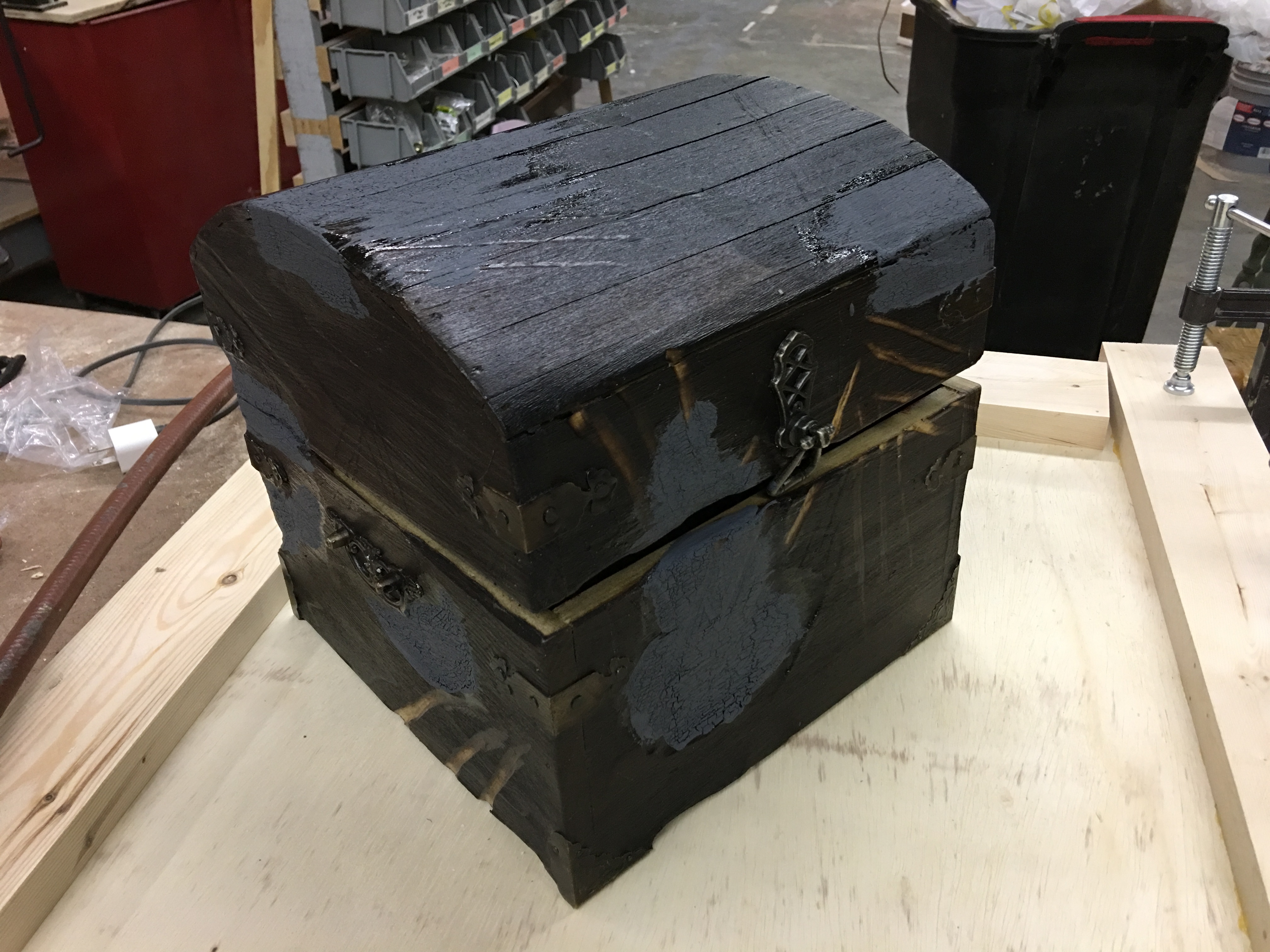
The box is described as “burnt”, so my next step was to burn it. I used a basic propane torch you can get at the hardware store. I charred the whole outside of the box, and allowed the flames to go to town on a few areas to really break up the surface.

Once it was cool, I removed all the charcoal with a wire brush. I sealed it with shellac to keep any charcoal remnants from staining the actress’ hands or white costume.

In the areas which burned away the most, I applied some grey crackle paint to simulate the charcoal I had just brushed away. The box is also described as having deep scratches, as if some mythical being had been trying to claw it open, so I added those with a grinder and Dremel.

Painting the inside
Painting the inside

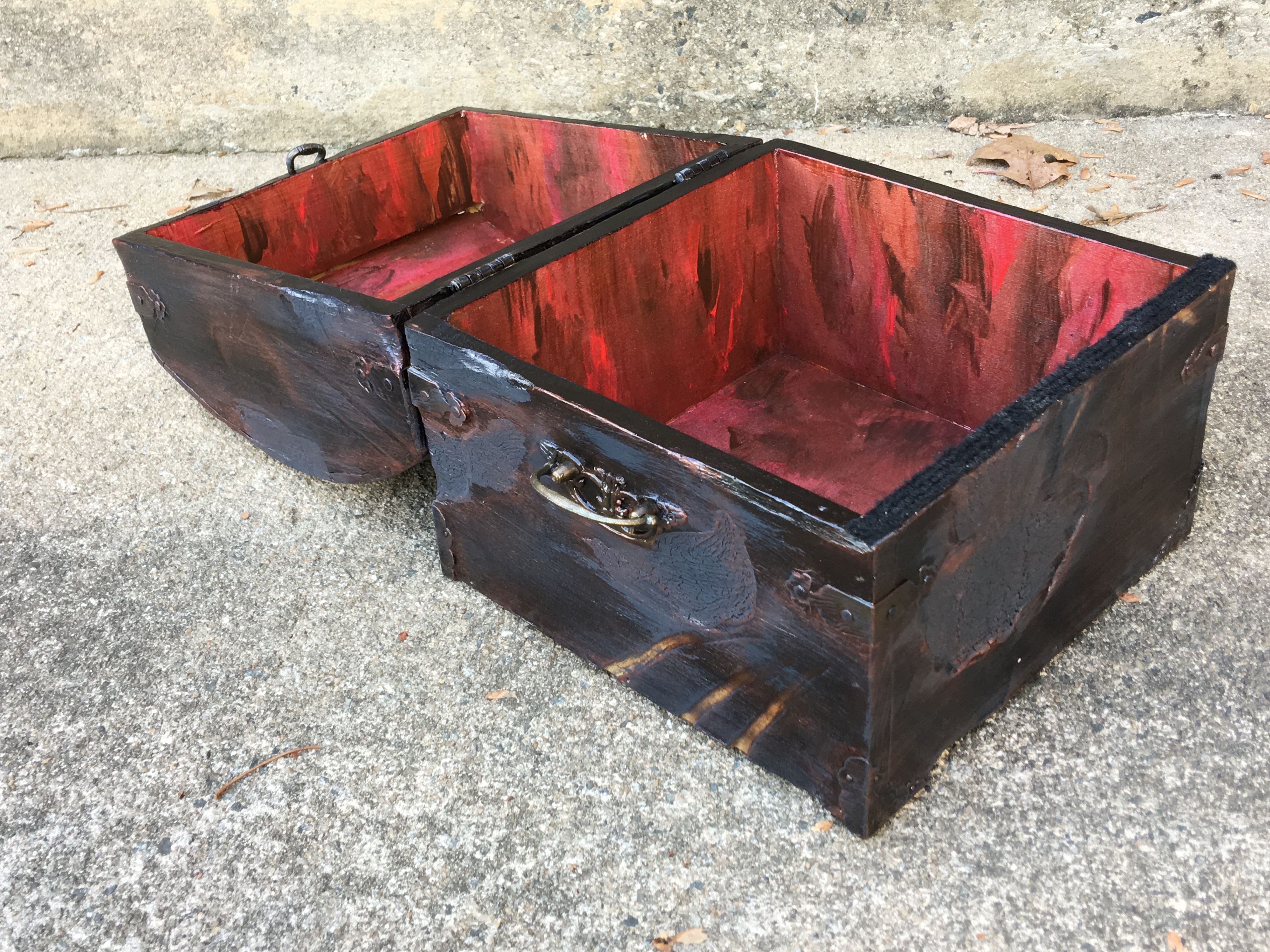
The inside received a wet blend of various acrylics to give it a deep red aged appearance that suggested blood. I dry brushed a few other colors, including some metallics, over the outside to help accentuate the imperfections and texture.

Ancient carved box
Ancient carved box

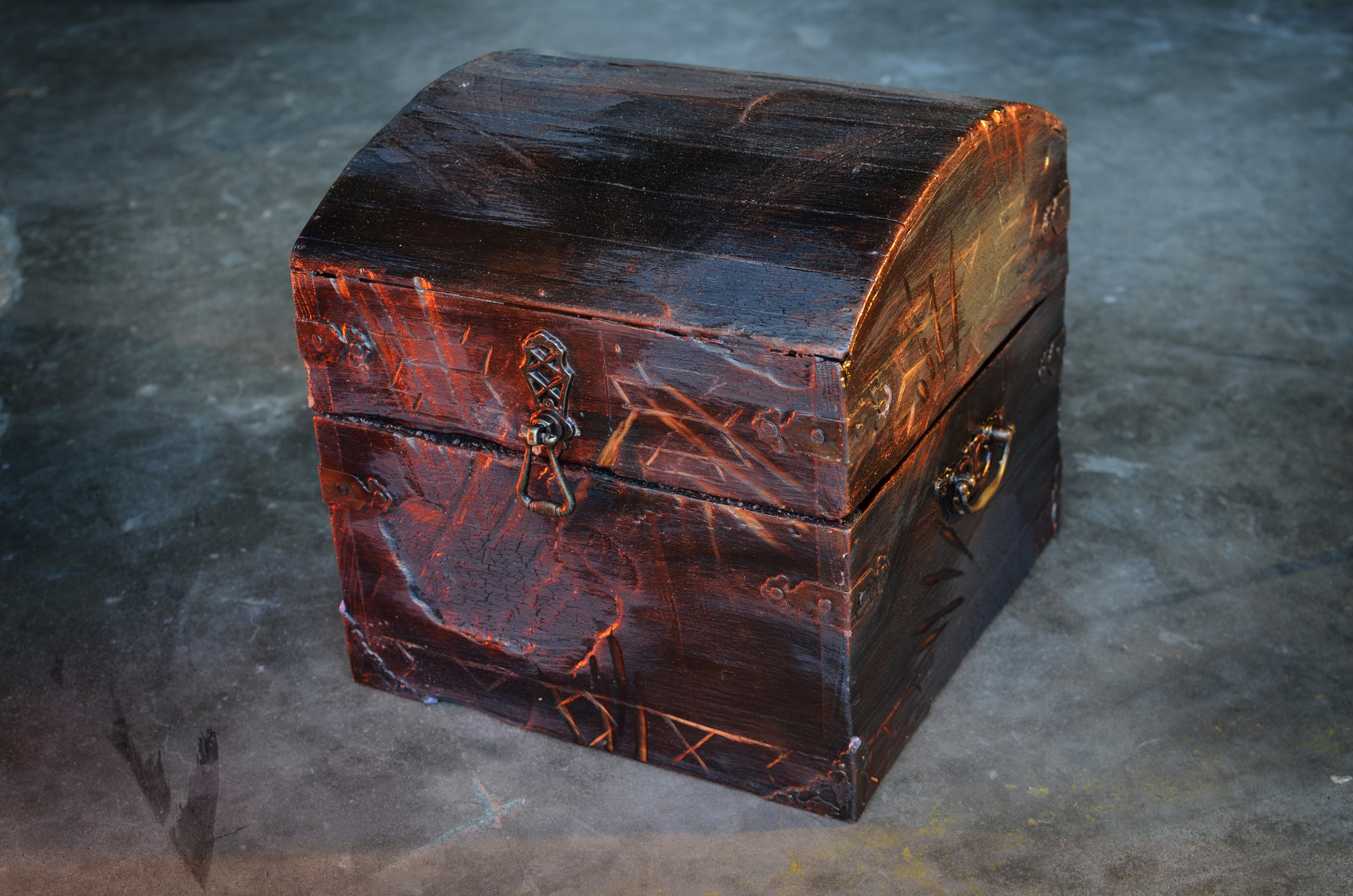
During tech, the director really liked the way the scratches looked on the box and wanted some more. She asked for some Cherokee patterns to be engraved around the edges as if some primitive creature had carved them in by hand. Once I added those, the box was complete.

Great Big Prop Links

When Broadway Actors Sit Down for an Onstage Meal, Who Makes the Food? – The prop master, of course! Although, in this article, we find out that the Broadway musical Waitress also has a pie consultant working on the show. Read all about the complicated maneuvers it takes to get a fully-cooked meal on stage every night on cue.

Meet SNL’s 78-Year-Old “Heart Of The Show” – If you know anything about American theatrical set design, you know the name Eugene Lee. Chances are, if you’ve worked in regional or New York theater long enough, you’ve worked on a show he’s designed. Eugene has also designed the sets for every episode of Saturday Night Live since the beginning. Read all about his crazy schedule to make that happen.

Use a Drill to Shape a Chair Seat – Christopher Schwartz demonstrates a technique for using a drill to rough out the complex curved shape of a wooden seat before shaping it by hand. I’m sure this technique has a name, as I’ve seen it used in a variety of ways with other materials.

The Passion of Phil Tippett: Building Stop-Motion Masterpieces by Hand – Great Big Story looks at the latest project by Phil Tippett. Phil has worked in various capacities as a visual effects artist on films like Star Wars, Jurassic Park, and RoboCop. But his labor of love is a stop-motion film he has been creating entirely by hand for the past 30 years.

How Expensive Properties are Made, 1914

The following comes from a 1914 issue of Popular Electricity and Modern Mechanics:

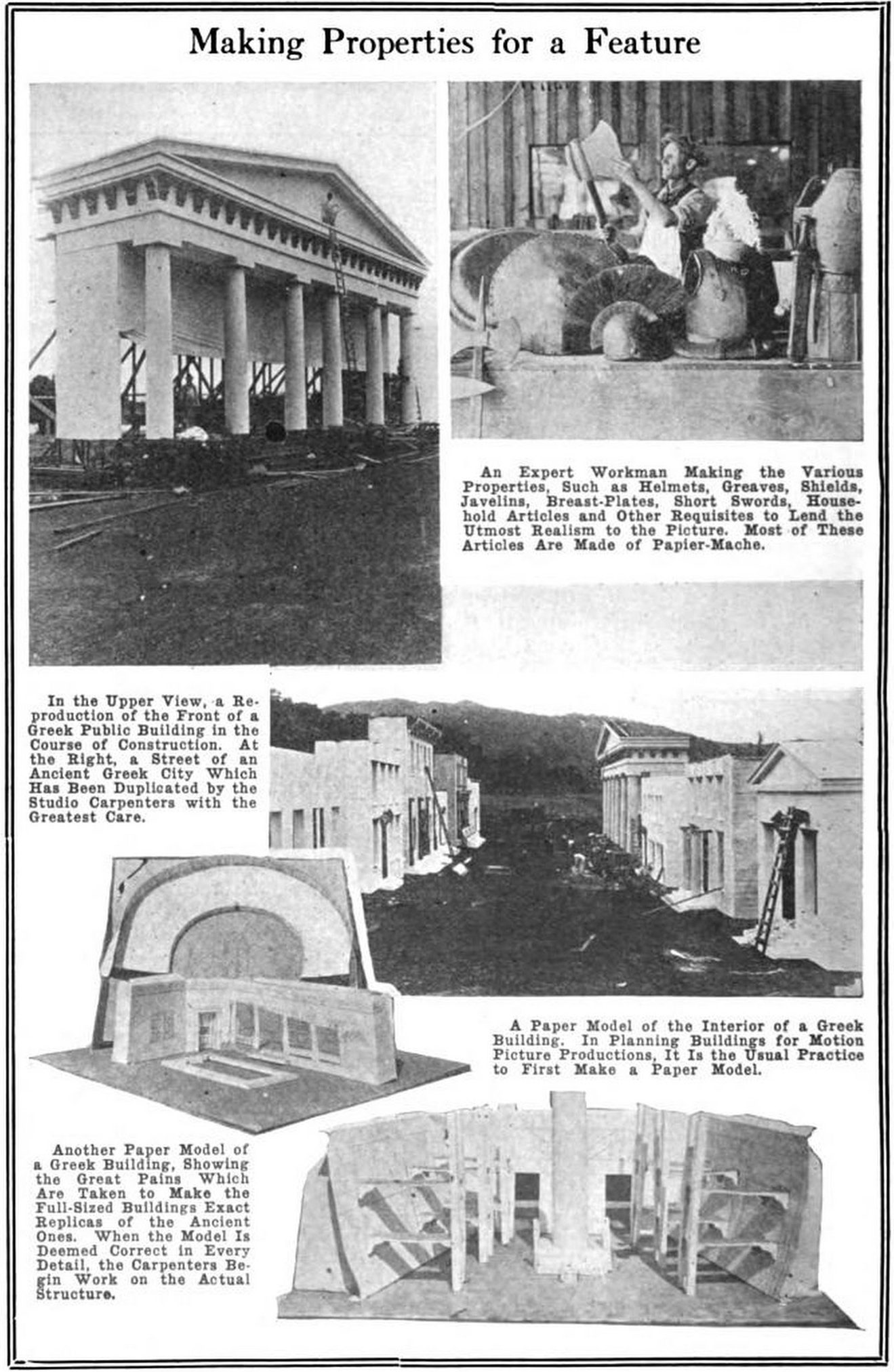
How Expensive Properties are Made

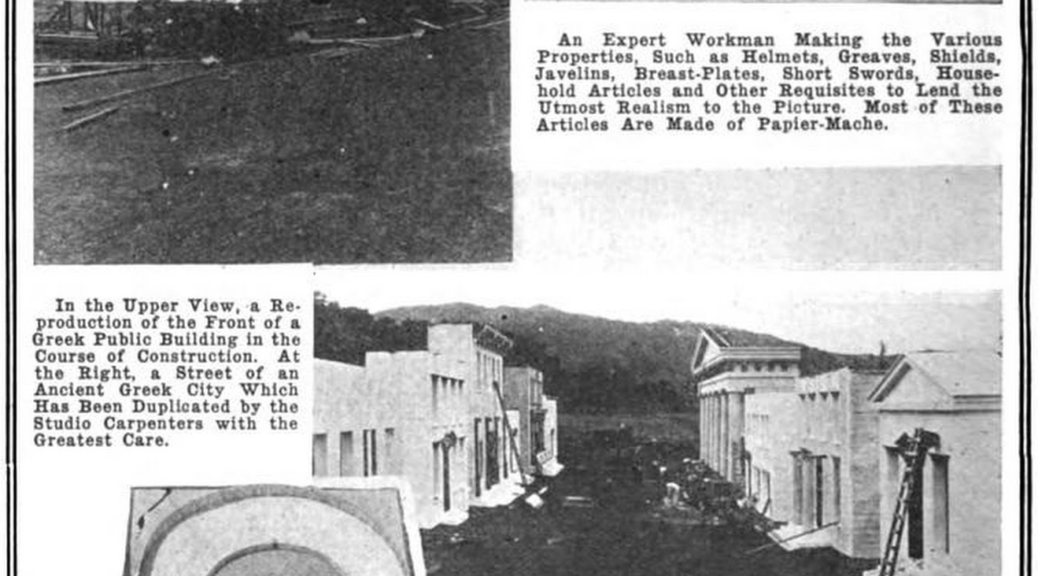
As an illustration of the rapid strides made during the last few years in the production of motion pictures, a sight-seeing trip through the Universal Company’s studios in California uncovers the fact that twenty-five classes of skilled artisans are at present employed in making the properties for a feature film production. It is stated on good authority that half of the expense in producing pictures of the pageant type is incurred before the actual staging of the drama begins. Upon the screen the spectator sees armies in conflict, reproductions of ancient cities wrecked solely for a camera spectacle, streets of forgotten cities swarming with people costumed in conformity with historical record and all properly fitted out with the accouterments of war and habiliments of peace.

But behind all these shows of pageantry is a large corps of technical experts, craftsmen, mechanics and workmen who transfer these pictures of ancient life from historical records and cuts to so many replicas of the things themselves. General knowledge is all but useless in such productions. When the multiple reel production of “Damon and Pythias” was planned, every detail of scenery and of properties was not only planned and designed upon paper, but everything was modelled in miniature. A replica of the stadium was made of pasteboard. The interiors and exteriors of houses were modeled. Every property was brought down to a definite basis when it was put to the two tests of historical accuracy and adaptability to the camera. During this stage of the work the drafting and the designing rooms had the appearance of a toy shop and would have brought delight to the heart of any child.

Making Properties for a Feature

Specifications completed, blue-print designs and colored models were distributed to the various workshops. Helmets, greaves, shields, javelins, breast-plates, short-swords and the smaller household articles were manufactured in the papier-mache department. This work requires considerable time and only expert labor can handle it. The papier-mache department was busy for three months in manufacturing some of the properties for “Damon and Pythias” alone.

Twelve extra seamstresses were employed in the costume department for two months and aside from costumes for the principles, complete outfits were made for five hundred soldiers.

On the company’s ranch, situated in the San Fernando valley, Greek streets, detached dwellings and a stadium grew up and assumed shape and color within a month after the first ground was turned.

The joining and carpenter shops were busy with the wooden properties and frame-work for the large pieces of scenery. Twenty-five chariots were turned out within a period of two weeks. The carpenters work completed, the properties are turned over to the scene painters and decorators, and where iron work was required, to blacksmiths and ironworkers.

In many scenes of this production it was necessary that large pieces of statuary be in evidence. This statuary was made in the company’s shops and only skilled alabaster workers could even attempt the work.

Shops for the manufacture of all description of properties used in motion pictures are something new in the industry. Not longer than two years ago, when a big production was to be made, as few properties as possible were manufactured on account of the extra expense of this work. In those days all properties that could be obtained were rented and the others were improvised.

Thus the advance in this branch of the industry can be appreciated when the fact is brought forth that every property with one exception for the “Damon and Pythias” production was manufactured in the company’s shops. The ancient sets of harness to be used with the chariots was manufactured outside the company’s shops.

“How Expensive Properties Are Made.” Popular Electricity and Modern Mechanics. Ed. Austin C. Lescarboura. Vol. 29. New York: Modern, 1914. 153-55. Google Books. 11 Dec. 2008. Web. 24 May 2017. <https://books.google.com/books?id=1_HNAAAAMAAJ>.

Props for the Weekend

Gamora’s Godslayer – Guardians Of The Galaxy – I lost track of the “Man at Arms” show for awhile. It turns out they’ve rebooted it as “Man at Arms: Reforged.” The original show saw Tony Swatton use forging, blacksmithing, and metalworking techniques to build real metal versions of movie and video game weaponry. The new show is the same, just with a different shop. I have a lot of episodes to catch up on, but I definitely wanted to share this one where they make Gamora’s sword from Guardians of the Galaxy, since it is such a cool blade. You can pick up a lot of techniques by watching them work.

Twin Cities actor blows the whistle on ‘unsafe’ theater production – The production of “Medea” at the Lab Theater in Minneapolis is described as having a three-to-four thousand gallon pool with a 30 -foot long exposed electric circuit along the drip edge. I can’t quite picture that in my head, but it was scary enough to get the actors to call Equity and shut the production down.

The Creature and Special Effects of Alien: Covenant! – Adam Savage’s new life involves visiting every movie set and playing with their props. It’s not a bad gig. Plus, as a former model-maker/prop builder, he knows what kinds of questions to ask to make these videos more informed than your typical “behind-the-scenes” featurette that’s slapped together at the last minute.

Tips of the Week: Wire Splicing, Table Saw Router, and Flea Market Brainstorming – Make Magazine publishes a short list of tips and tricks every week, and I found this week’s collection particularly useful.