All posts by Eric Hart

The Property Man, 1884

The following appeared in an 1884 issue of the Bismarck Weekly Tribune:

One of the Most Important Individuals About a Theatre

“One of the most useful and important functionaries about a theatre is the property man,” said one who has grown gray in the business the other day. “By the property man is meant the person whose duty it is to furnish the properties for all the plays produced, and to see that they are placed conveniently at hand to be ready when wanted. Properties are everything used in a play except the scenery. The carpets, furniture and curtains, guns and pistols, pocket-books, money, candles, matches, cigars, pianos, pictures, food and drink, letters, musical instruments—all these and countless other things come under the head of properties.

The Property-Room

“Every theatre has what is called a property-room where these things are kept. It has very much the appearance of a pawn-broker’s shop, except that nothing is wrapped up and there is no counter. Come in here and see for yourself,” he continued, as he led the way into a dingy room at the back of the stage, where there was a most heterogeneous collection of such articles as he had named.

“Few people have any idea of the care and responsibility of a property man. He has more on his mind than anybody else about a theatre. There are 150 different things, large and small, that he must remember, and woe betide him if he forgets any one of them or fails to have it in its proper place at the right time. People who visit the theatre have no idea how dependent they are on the property man for their pleasure, for if he forgets anything or does not have everything just as it should be it will give rise to a contretemps, which will retard the action of the scene and mar its whole effect.

A Choice of Pistols

“For example; It is part of his duty to attend to all the fire-arms used on the stage. In the most critical part of the play the leading man is to rescue the leading lady from the tolls of the villain by killing him with a pistol shot. The property man selects the best pistol in his collection, cleans and loads it carefully, fires it off in the property-room to make sure that it won’t miss fire, loads it again, and in a perfectly comfortable frame of mind gives it to the leading man as he goes on for his great scene. The critical moment arrives. The leading man cries out in his most terrible voice: ‘Die villain!’ and pulls the trigger, but the pistol doesn’t go off, so the villain must either fall and die without having been shot, or else he must live on, succeed in abducting the beautiful maiden and thus ruin the play.

I am sorry to say that property men, being somewhat given to profanity, divide their firearms into three classes—the sure, the very sure, and the d****d sure. The first are given to the most unimportant of the supers, the second are given to those of somewhat greater importance, while only the last are ever given to the people who play important parts and whose guns must go off in order to carry out the plot of the play.

“The Property Man”, The Bismarck Weekly Tribune, Oct 31, 1884, pg 2. Reprinted from The Philadelphia Times,
Another Fine Set of Links

Puppets are still very much a thing, according to this American Theatre article. Scott Cummings checks in on some of the companies, festivals, and books dealing with puppetry in a contemporary context.

The costume shop at PlayMakers Rep is working on the enviable task of recreating costumes for the Museum of Science Fiction. Rachel Pollock takes us through the steps of making Neo’s costume from The Matrix.

Popular Woodworking magazine brings us this awesome process for faking antique wood. It uses just paint, lacquer and a heat gun. No crazy chemicals or stains needed!

Propnomicon shows us some great primary research on “Things in a Jar”. If you’ve ever made preserved specimens, Britta Miller works at a museum specimen collection, and has kindly shared all kinds of visual and technical details about the actual jarring and labeling of things in jars.

Finally, Make Magazine shares top tips from 17 amazing makers. I wanted to point out one quote that many of us props people can relate to:

“He was giving the interviewer a tour of his shop, showing the towering shelves of carefully-sorted industrial junk. He said something like, ‘Properly sorted, this is a parts library and a useful tool. Unsorted, and it’s a pile of junk and a curse.'”

Wax Paper Transfer to Wood

Triad Stage just closed a production of Fences which I prop mastered. One of the set dressing items was a wooden plaque with a prayer written on it. I tried out a technique I saw where you print onto wax paper and transfer that to wood. It worked well, so I experimented with it some more, making this video in the process.

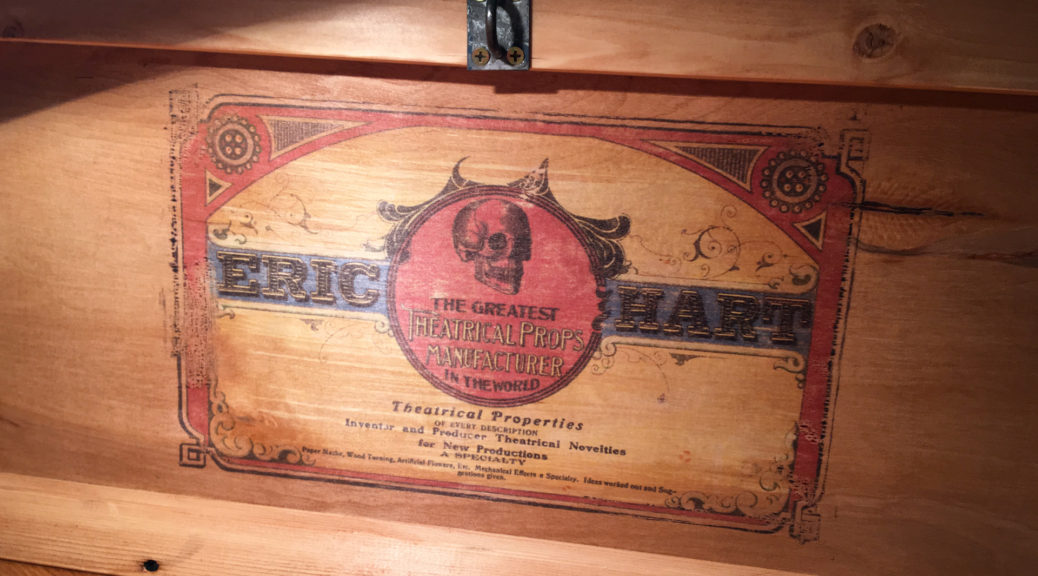
I wanted a crate to haul around the props I bring to Maker Faires, so I designed an old-timey crate label for it.

Wax paper transfer
Wax paper transfer

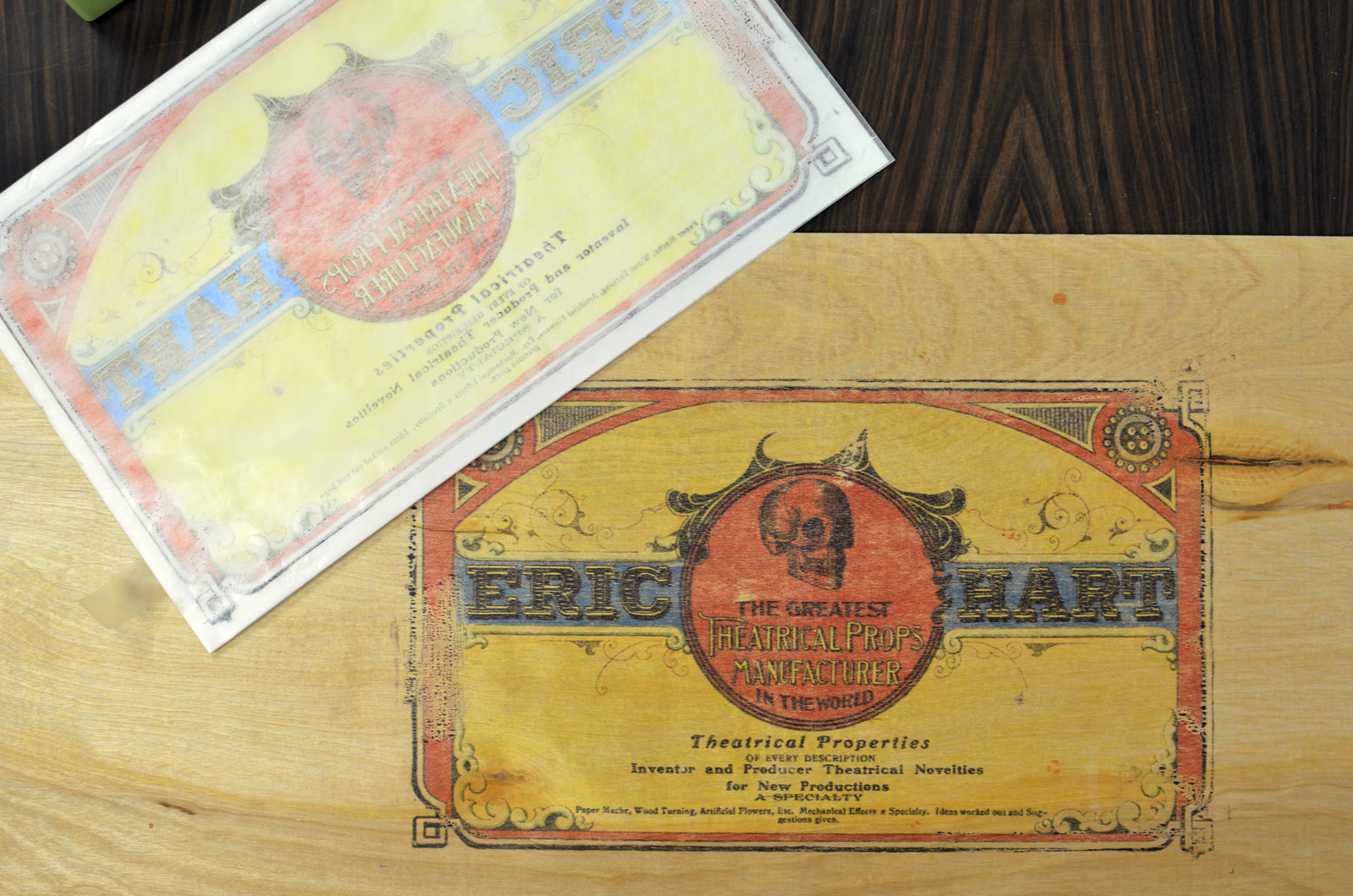
As you can see in the video, the process is very simple. Cut a piece of wax paper. Attach it to regular printer paper. Get an image on your computer and mirror it so it prints out in reverse. Send your wax paper through your inkjet printer. Lay it on your piece of wood and burnish the back of the paper so you rub all the ink off. Be careful not to move the wax paper around once it is on the wood.

In the picture above, you can see a few spots along the edges where the ink sort of blotted up and didn’t transfer as well. The wax paper wants to curl as it goes through the printer, and the ink will not sit right if it is too far or too close from the print head. The first time I tried this, I sent just the wax paper through, and most of the image ended up blotted. Attaching the wax paper to a piece of regular paper helps keep that from happening. The next time I do this, I may try using spray adhesive to attach the wax paper to regular paper, or just use an image that does not go so far to the edges of the page (the edges are where you get the most curling).

Four Hot Prop Links

What’s the difference between Worbla and Wonderflex? Kamui Cosplay puts these low-melting thermoplastics through the ringer to find out how they differ. She also looks at lesser-known brands like Thibra and Cosplayflex.

BBC asks ten questions of Craig Williams, props master on Orphan Black. Find out what his favorite prop is and whether the crew plays pranks on each other. Oh, there’s a bit more useful information here too.

Ward Works builds a vacuum former and presents the whole step-by-step process with photographs. The whole thing was done for under $600, though you can save money if you have a lot of scrap around the shop.

Make has 11 hot glue tips, tricks and hacks. Most of these go outside the realm of normal hot glue usage. I especially like the one of using hot glue to glue your hot glue into your hot glue gun.

Death of a Mask Maker

Last Saturday, we found out that Donato Sartori passed away. His father, Amleto Sartori, was responsible for reintroducing the art of leather mask making for Commedia dell’arte after World War II. Commedia was outlawed by Napoleon in 1797, and its craft traditions were lost until Amleto reverse-engineered them and shared them with the world. Donato continued his work; most of what we know about the use of masks in Commedia come from these two.

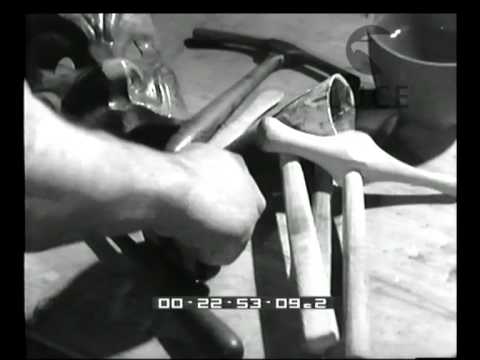
Here we have a video from 1955 showing Amleto at work. It is unfortunately in Italian and only a minute long, but it gives a good overview of his process for creating a mask out of leather.

Here we have a much longer video showing Donato and his workshop from just a few years ago. Again, it is in Italian, but you get to see many steps of the mask-making process, as well as a glimpse inside the studio that both Donato and Amleto worked from.

I got to visit that studio in 2012 when my wife was taking their mask-making workshop. It is difficult to convey just how influential the Sartoris were in the world of modern theatrical masks. We do not have much of a mask tradition here in the US, but it is very popular in Europe and Asia. My wife once bought a Balinese mask, and she told the mask-maker that it reminded her of Commedia masks. It turns out he had met Donato a few times and they shared techniques with each other.

RIP Donato Sartori (1939-2016)