Category Archives: Reprints

Bossing the World, 1921

The following article comes from the 1921 collected edition of “Our Paper,” put out by the Massachusetts Reformatory:

Bossing the World

by John B. Wallace

Certainly in comparison with the property man of the speaking stage, a motion picture property man can most properly be called a super-property man. Accordingly I feel that my action is justified when I dub Howard S. Wells, manager of the property department of the largest film studios in California, a super-property man.

He not only has charge of all the properties used by the dozen companies working out of the studios, but he must house and feed the companies that are out on location. He also has charge of the many motor trucks maintained by the company and must see to the transportation of the actors and supplies.

He is responsible for the issuance of the supplies from the immense warehouses in which they are stored. Under him are dozens of set dressers, warehouse men, truck drivers and laborers.

As soon as it is decided to film a certain story, the scenario—or a copy of it—is turned over to Wells and he makes a list of the properties required. The assistant director is also required to make a list and this is compared with that prepared by Wells. This double check is very important.

Suppose, for instance, that a company is in the mountains or in the desert. The absence of one property which the property man has forgotten or overlooked might cause a delay of several days. Such delays would run into thousands of dollars. The old days are past, and efficiency and accuracy are watchwords. He must be a man of infinite resource as well as of practical knowledge.

A set dresser—as the name implies—dresses the set—distributes the articles that belong to a set. He works under the direction of the assistant director. He comes in after the carpenters and painters have finished their work and is the last man on the scene before the actors and camera arrive.

Small articles that can be carried about by the actors, such as guns, suitcases, and so on, are called hand properties and it is the set dresser’s duty to keep a vigilant eye on these to see that they are on hand when required. Every article required by a director in filming a picture is charged against his company. A requisition is issued through Mr. Wells’ office for each property required. The requisition is placed on file and the article charged against the director ordering it. Every property thus issued must either be returned or a proper accounting be made for it.

Notwithstanding the careful check kept upon properties the leakage runs yearly into large figures. Actors are proverbially a happy-go-lucky folk with most inconsistent ideas of thrift, and the motion picture variety is no exception.

Breakage is another cause of loss, in certain plays, especially comedies, the destruction of properties is the action and although such articles are constructed as cheaply as possible the loss often runs into big money.

A walk through the vast storerooms is certainly illuminating to the uninitiated. One entire building is devoted to period furniture, another to draperies and another to bric-a-brac, which embraces everything from antique vases and statuary to oil painting copied from old masters. In one room are dozens of immense chandeliers and ornamental lamps. In another are swords, guns and side arms, dating from every period in history from remote ages to the present. A particular interesting collection at Universal City embraces every vehicles from the “one-hoss shay” to the modern limousine.

Wallace, John B. “Bossing the World.” Our Paper. Vol. 38. N.p.: Massachusetts Refomatory, 1921. 153. Google Books. Web. 24 Nov. 2015
Belasco’s Property Room Part 4, 1920

The following is the fourth part of a 1920 article on David Belasco’s property collection. The first part, second part and third part were published earlier:

Mementoes of Napoleon

by Frank Vreeland

He knows every object in this store-room by heart, and when he discovers that one of them is missing not even the omniscient property man questions his memory. That singularly retentive memory is one quality which Mr. Belasco has in common with Napoleon and may perhaps account for some of his admiration for the great Corsican, for the manager might be said to have acquired the remnants of Bonaparte’s empire. Continue reading Belasco’s Property Room Part 4, 1920

Belasco’s Property Room Part 3, 1920

The following is the third part of a 1920 article on David Belasco’s property collection. The first part and second part were published earlier:

Oddities From the Orient

by Frank Vreeland

Near a Mexican guitar used in “The Rose of the Rancho” and a moon harp played in “The Darling of the Gods” hangs a pair of Chinese torture pliers which were originally intended for use in “The Son-Daughter” and which look like a pair of exaggerated lemon squeezers. Buddhist bronzes and Japanese tea sets of valuable teak wood are mingled with Oriental steel mirrors bought in a New York department store. Beneath a large part of the ceiling spreads the spokes of a large wheel from a loom that is 150 years old and casts its shadow on a set of telephone books from “The Woman,” which Property Chief Purcell remarks drily “are being kept as a souvenir of the day when you could get your call.

“And besides,” he adds with a twinkle, “they’ll be handy if the ghost of one of the men in the cast who died wants to look up a number.”

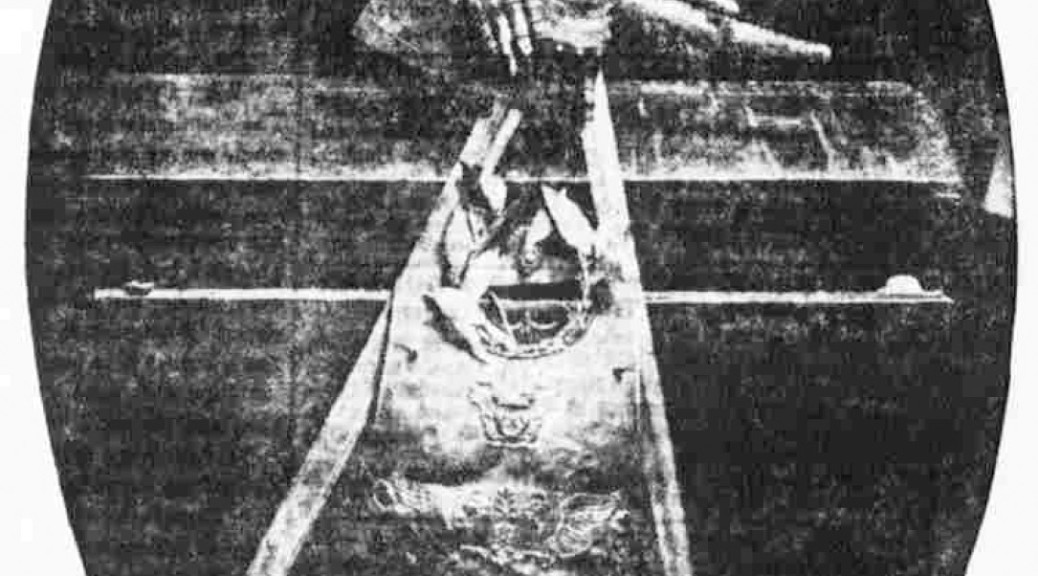
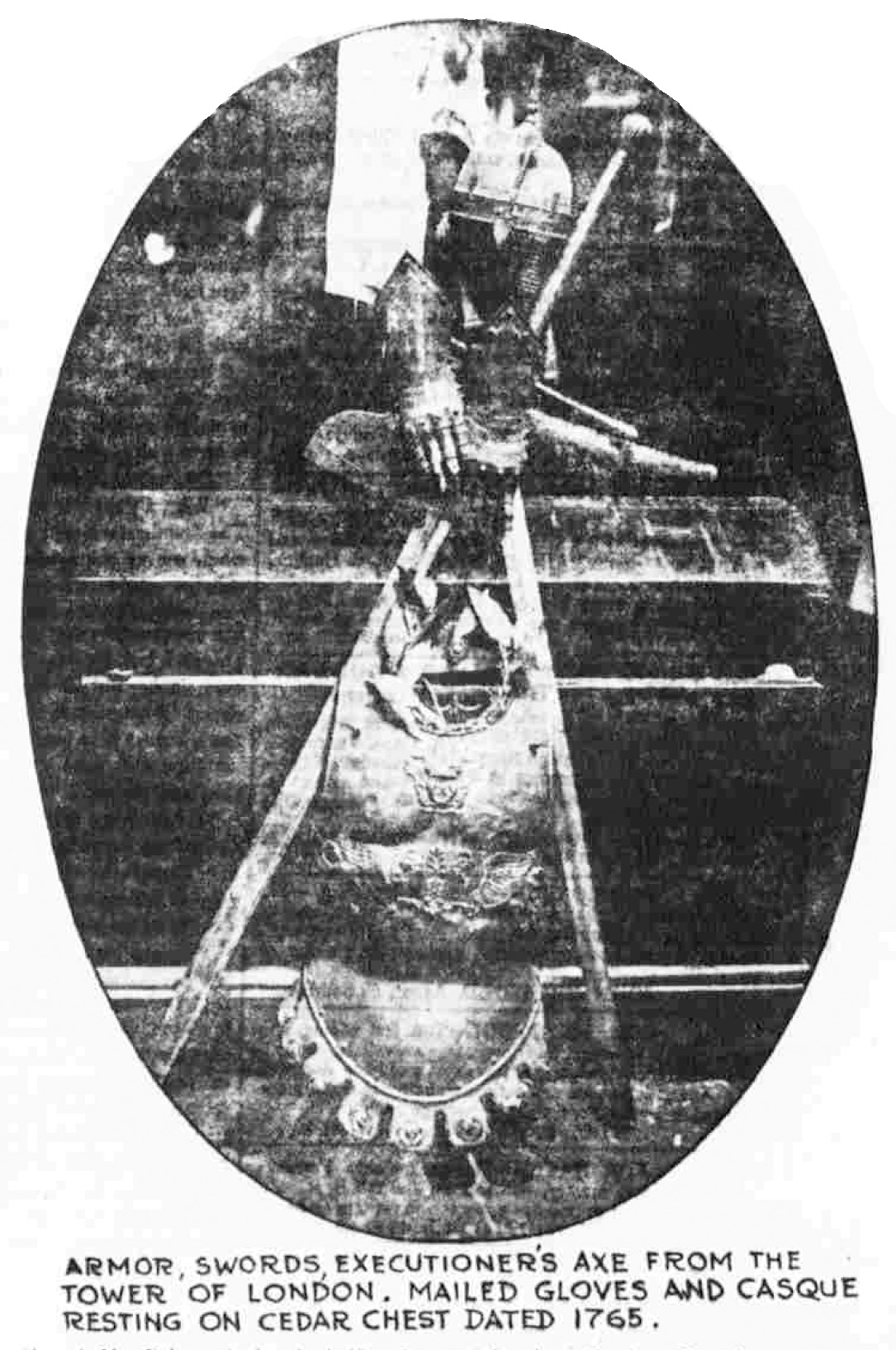
The room is especially prolific in swords. A bushel of them are rammed into a high vase in one corner, and the room sprouts them elsewhere—Roman swords, old English sabres, heavy five foot blades swung in the Crusades, and an ancient English executioner’s axe, which Mr. Purcell exhibited as a very efficient means of promoting the acquaintance of ancestors with their descendants.

A cabinet with one of the most interesting arrays in the whole exhibition—which is ticketed and catalogued, by the way—is that containing the bed quilts of the epoch when they used the bed warmers on view in one corner and didn’t depend on the janitor for heat. There are comforters and counterpanes with the sort of zigzag designs and chromatic convulsions that would warm a cubist’s heart, let alone his feet. Some of them are beautiful even from a modern standpoint, however, and those that are ugly are none the less valuable, like the Paisley shawls, of which Mr. Belasco has his fair share. Many of these coverlets were bought by Mr. Belasco without any intention of applying them to the A. H. Woods kind of production, simply being purchased as part of the entire contents of Gen. Braddock’s house in Washington, which Mr. Belasco snapped up as part of his unending campaign to equip himself with a full line of antiques.

Armor

Original Publication: Vreeland, Frank. “Belasco’s Property Room Houses Antique Gems.” The Sun and New York Herald 1 Feb. 1920, Sunday Magazine Section sec.: 7. Print.

Belasco’s Property Room part 2, 1920

The following is the second part of a 1920 article on David Belasco’s property collection. The first part was posted a few weeks ago:

The Array of Relics

by Frank Vreeland

The cabinets which line the walls and occupy the middle of the room have their contents classified and arranged in order. One contains scores of French clocks which have long since ceased to keep tabs on eternity, another has dozens of colonial candlesticks and mediæval lanterns, and a third holds yards of cut glassware of all periods that would cause a high priced smash if any spook started skylarking among them. On wires near the ceiling are strung expensive violins in cases, ancient Indian wicker work which was used in “The Heart of Wetona,” and Crusaders’ helmets with chain mail netting to ward off stings more vicious than the best Jersey mosquitoes could give. Continue reading Belasco’s Property Room part 2, 1920

Belasco’s Property Room, 1920

The following is the first part of a 1920 article on David Belasco’s property collection:

Belasco’s Property Room Houses Antique Gems

by Frank Vreeland

Fortunate is the man who has a theatre where the memories of past triumphs of the stage linger about rare souvenirs of the occasion, but if that man has also a storage place filled with curios which is considered to be haunted he is thrice blessed, according to current ideas.

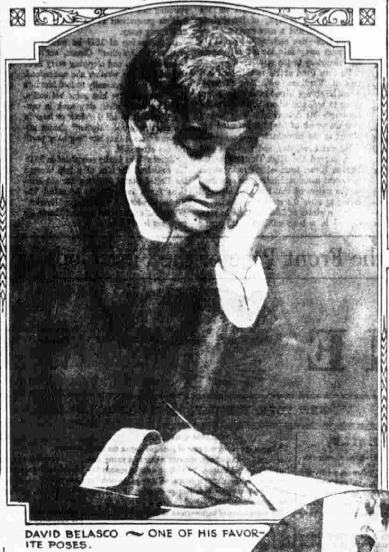
In such a happy situation is David Belasco, whose Belasco Theatre is filled with old hand bills of Booth and other stage celebrities and unusual prints of theatrical performances—besides mementoes of Napoleon—so that it might be said to be a paper monument to past glories. In addition he has a storeroom in connection with his warehouse at 511 West Forty-sixth street, where many of his most valuable “props” are kept, dating back to his first managerial experiences, as well as pounds and pounds of antiques which Mr. Belasco is constantly collecting, even if they are not to be used to make any production more realistic, but merely to complete his assortment of relics. Continue reading Belasco’s Property Room, 1920