
Category Archives: Reprints

Backstage Views from 1900.

I found the following images in a copy of “The Century Illustrated Monthly Magazine” from 1900. They appeared in an article about performing Wagner’s Ring Cycle. I love how they give a glimpse of what backstage life was like over a hundred years ago. In most respects, it is very much unchanged from the present form.
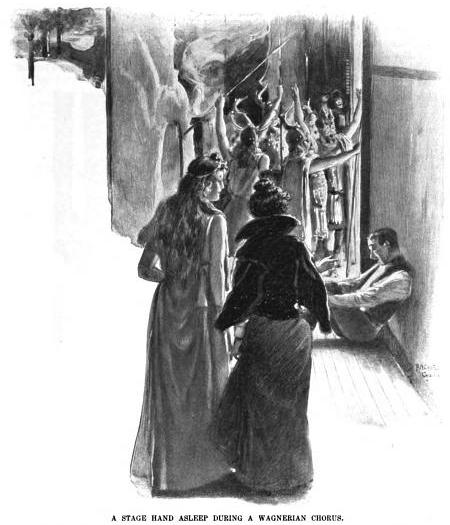
A stage hand asleep during a Wagnerian chorus

Though asleep, the stage hand above is “better dressed” than the typical stage hand today. Than again, most stage hands need to wear all black clothes, and the fabrics today stand up to much more wear and tear and are easier to clean than the suits and trousers of 1900.
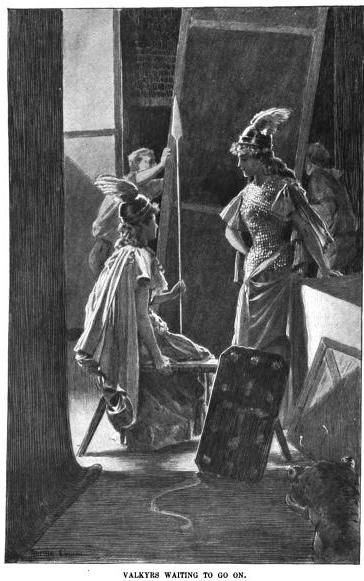
Valkyrs waiting to go on.

I love the looks of these chorus members as they wait for their moment on stage. What is also interesting is the flat in the background, which is constructed in exactly the same way that modern flats are.
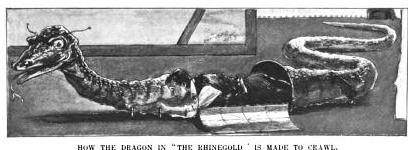
How the dragon in "The Rhinegold" is made to crawl.
How the dragon in “The Rhinegold” is made to crawl.

This moving dragon shows a low-tech but reliable solution that is still utilized in all but the highest-budget performances today.
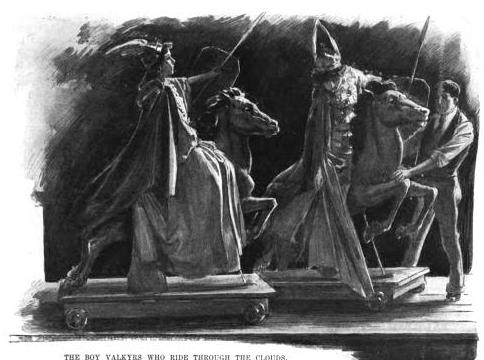
The boy Valkyrs who ride through the clouds.

The wagons which carry these boys would not look out of place in a modern opera production. I find it interesting again how the stage hand is dressed; it is not just that he is wearing a vest and tie, but that his shirt appears to be white rather than the dark colors we usually wear back stage.
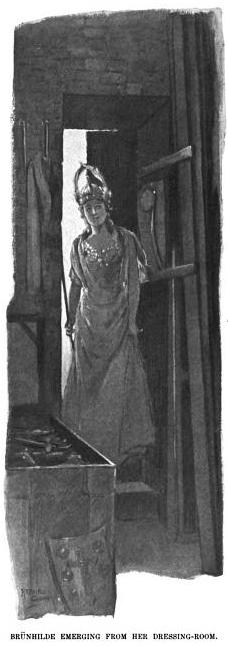
Brünhilde emerging from her dressing-room

Finally, this illustration goes to show you that back stage areas have always been cramped.

Images originally appeared in “The Century Illustrated Monthly Magazine, Volume 59, Richard Watson Gilder, The Century Co, 1900.
The Covetous Property Man, 1904

The following first appeared in The New York Times, July 24, 1904:

“There is no more assiduous collector of odds and ends than the average theatrical property man,” said a well-known actor. “Everything is fish for his net, you might say, and the contents of the chest or trunk of one of these individuals after a forage through the country would easily hold its own with Dickens’s famous curiosity shop…

“If you wish to find out the thoroughness with which the average property man accumulates, just ask him for any article, I don’t care what, and see if nine times out of ten he won’t produce it.”

“By accident I was a witness once of the manner in which a property man adds a coveted object to his collection. Our show was playing at Richmond, Va., at the time. Among the ‘props’ furnished by the theatre’s property man was a handsome rifle, which he had borrowed from a local firearms firm for the week.

“On Friday I had occasion to go to the theatre to get something I had forgotten. As I made my way to the dressing rooms I noticed our company’s property man standing to one side of the darkened stage, in a ray of sunlight, examining this rifle with the air of a connoisseur. There was nobody else in the theatre at the time, and he apparently had not seen me. I would probably have passed him by unnoticed but for the fact that he was holding a conversation with himself, which ran thus:

“‘You seem to be a pretty nice gun,’ he said, holding the rifle up to his shoulder and running his eye critically along the sights.

“‘Ever been on the road?‘ he continued, carefully scrutinizing the stock of the weapon.

“‘Why, you have no idea what a lot of fun you can have out on the road,’ he kept on seductively. ‘A great deal better than being stuck in a little town like this.

“‘How would you like to go on the road?‘ he queried, as if he had a sudden inspiration.

“‘You would? All right. I think I can fix it for you.’

“And he made for his trunk to see if he could lay in the rifle crosswise. He was just able to get it in, and the last words I heard him say to the enraptured weapon were:

“‘I’ll sign you with this company right away.‘”

Originally published in The New York Times, July 24, 1904.

Prop Makers Must Know a Lot

The following comes from a newspaper article about the property shop of E. L. Morse on Twenty-ninth Street in New York City. The article first appeared in The New York Times on May 8, 1904, and Mr. Morse property shop is long gone.

Maker Must Know a Lot

Any one who thinks the making of properties requires only mechanical skill is vastly wrong. The artisan must know much about the art and customs of the time in which the action of the play takes place. If the scene is in Venice, he must not make a vase that looks as if it had come from Grand Rapids, Mich., or some other American manufacturing center. If he has to furnish to a follower of Richard Plantagenet an axe or spear it would never do to make one such as a North American Indian used on the scalps of the early settlers.

When Mr. Morse undetakes to furnish properties for a play, the book of the play is given to him, just as it is to the actor or the scenic artist. He reads not only the play itself, but any books that may gibe him information about the customs and arts of the people and times. He tries to absorb as much of the atmosphere of the play as he can before he begins work on the articles themselves. In short, he does not merely copy. He creates.

He not only molds the properties. He designs them. Before he thinks of forming the final objects he makes a miniature model of the entire scene. If a visitor once sees one of these tiny models he wonders why such things ever should be thrown away. But, as the skilled artisan has told him, they generally are tossed aside when the job for which they were made is finished.

Weapon Safety is Nothing New

As a reminder that accidents with stage weapons are nothing new, I have two brief stories of mishaps from over a century ago. The first comes from The San Francisco Call, September 27, 1896:

A few weeks ago a tragic accident happened in London. The actors had to fight a duel on the mimic stage. They did not rehearse with swords, but on the night of the first performance the property-man gave them their weapons, which they used so realistically that the delighted audience wanted to give a recall. Rounds of applause came again and again, but the man who had fallen did not get up and bow before the footlights as dead actors are in the habit of doing. He was dead in real earnest, killed by a thrust of his comrade’s sword. When the horrible truth dawned upon his comrades the curtain was lowered and the audience dismissed from the play, which had ended in an unrehearsed tragedy. The next day the papers were full of lamentations over the sad event and blame was given to the management for the carelessness which had permitted sharp swords to be used without first testing them thoroughly at rehearsal.

No training, no rehearsal, weapons that should have been dulled… these are the exact same reasons accidents happen today.  This isn’t new technology or unknown knowledge; we know, and have known for well over a hundred years how to prevent accidents from stage combat weapons, yet they still happen.

The second comes from The New York Times, September 12, 1907:

Maz Davis, 30 years old, of 434 West Thirty-eight Street, a property man for David Belasco, was injured on the right hand last night by the accidental discharge of a stage gun, the “wad” of which pierced his hand, while the powder burned both his hands and face. Just before a rehearsal of the “Girl of the Golden West,” he was examining a revolver when he accidentally pulled the trigger. He was taken to the Roosevelt Hospital.

Ouch. Remember, stage guns are still dangerous, even if they are only “blank-firing”, “powder” or “toy cap” guns.

The Construction of a Table

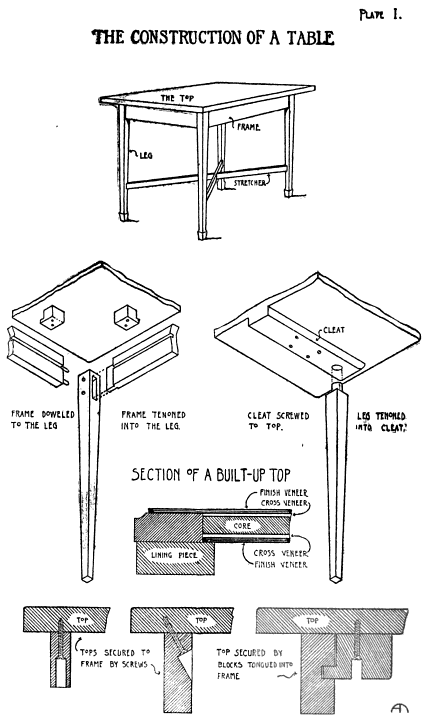
From Furniture Designing and Draughting (1907), by Alvan Crocker Nye, we have this wonderful diagram on how to make a table.

Construction of a Table

The top row shows names of the common parts of a table.

The next two images show a number of ways of attaching the legs. The one on the left shows the frame both being doweled to the leg and using a mortise and tenon. The frame itself is connected with blocks which tongue into a groove in the frame. The drawing on the right shows a cleat screwed to the top, with a leg tenoned into the cleat.

Continuing down the drawing is a “section of a built-up top”. As a solid wood top is expensive and hard to come by, tops were often built up with a core and covered with a finish veneer to make it look like a piece of solid wood. A piece of cross veneer was placed between the core and finish veneer; this is a piece of veneer in which the grain runs perpendicularly to the core and finish veneer.

The bottom row shows various means of securing the top to the frame. The left shows a screw which is countersunk nearly halfway through the height of the frame. The middle illustrates a pocket hole screw. The drawing on the right shows the blocks which were previously illustrated up above.