Category Archives: Reprints

A Factory for Making Plays

The following article was originally published in the New York Times, November 25, 1906:

Situated in the storehouse and wharf district of the extreme west side, and running through the entire block from Twenty-seventh to Twenty-eighth Street, the casual observer would never imagine by a glance at its unpretentious exterior that a veritable fairy-land lurked within its four plain brick walls.

The person who is fortunate enough to gain admittance past its argus-eyed German watchman stationed at the main door will be amply repaid for the visit. Erected by Henry W. Savage, a theatrical manager, for the building of his plays, the play factory is capable of turning out even the largest productions complete without their leaving the building for anything whatever, and here one may watch the entire construction of a play underneath one roof. The greater part of the time there are 250 people at work in the factory. These include scene builders, painters, electricians, costumers, florists, and property men. Continue reading A Factory for Making Plays

Daggers and Poniards of the Christian Middle Ages

I’ve previously shown illustrations and descriptions of Ancient Egyptian weapons,  Ancient Greek helmets and weapons, and Ancient Roman weapons. Here are some daggers and poniards from the Christian Middle Ages.

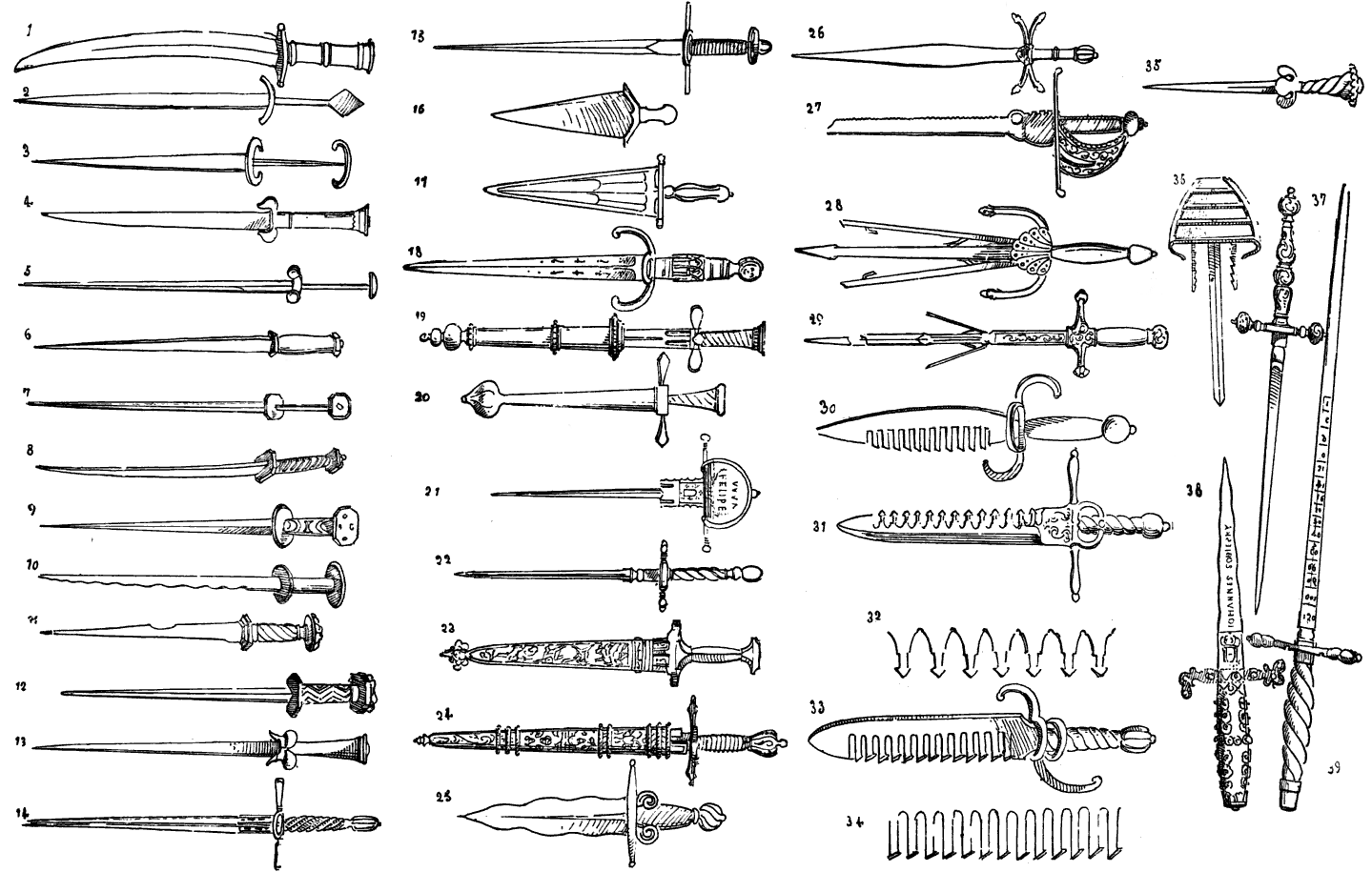
Daggers and Poniards of the Christian Middle Ages

  1. British cutlass, tenth century. It bears on the blade the names “Edwardus,” and “prins agile.” It is attributed to Edward II.
  2. Iron dagger, about a foot long, thirteenth century.
  3. Iron dagger, thirteenth century. Blade measures about 12 inches, and the haft about 5 inches.
  4. Iron poniard, probably Scottish, fourteenth century.
  5. Same as above.
  6. Poniard, beginning of the fourteenth century.
  7. Iron dagger, about 14 inches long, beginning of the fourteenth century. The haft is very long.
  8. Iron dagger, about 19 1/2 inches long, end of the fourteenth century.
  9. Iron dagger, 14 1/2 inches long, end of the fourteenth century. The handle is of carved bone.
  10. Iron dagger, end of the fourteenth or beginning of the fifteenth century.
  11. Poniard, end of the fourteenth century.
  12. Dagger, fifteenth century.
  13. Scottish dagger, about 14 1/2 inches long, wooden handle, fifteenth century.
  14. Dagger with single thumb ring, about 16 inches long, fifteenth century.
  15. Dagger with double thumb ring, sixteenth century. The two rings were placed there to fix the dagger on a shaft, or at the end of a lance, to resist cavalry.
  16. Dagger, anelace, or Verona dagger, fifteenth century.
  17. Dagger, anelace, fifteenth century.
  18. Dagger, fifteenth century.
  19. Dagger of a German lansquenet, sixteenth century, about 14 inches long. Polished steel sheath.
  20. Dagger of German lansquenet, sixteenth century.
  21. Main gauche, Spanish, with the inscription “Viva Felipe V.,” which shows that this weapon was in use in the year 1701.
  22. Stiletto (Spitzdolch), about 12 inches long, end of the sixteenth century. In Germany these weapons were also called Panzerbrecher, or cuirass-breaker.
  23. Dagger, Swiss, sixteenth century. These daggers are often provided with small knives, which served to cut the thongs of the armour, to pierce holes, and for various purposes.
  24. Dagger, German, sixteenth century.
  25. Poniard, German, with wavy blade, very short and broad.
  26. Poniard, German, sixteenth century. The guard has four quillons.
  27. Main gauche, sixteenth century.
  28. Main gauche, German, sixteenth century.
  29. Main gauche, German, about 20 inches long, sixteenth century. Engraved handle.
  30. Main gauche, German, with indented blade for breaking the enemy’s sword; thumb ring, and quillons curved in inverse directions; sixteenth century.
  31. Main gauche, German, with indented blade for breaking swords, sixteenth century.
  32. Close-up of indented blade of previous dagger.
  33. Large German brise-épée, sixteenth century.
  34. Close-up of indented blade of previous dagger.
  35. Poniard, German, sixteenth century.
  36. Large main gauche, German, with indented quillons, and grated guard as sword-breaker, seventeenth century. It measures about 25 by 10 inches.
  37. Stiletto, German, called Panzerbrecher, or cuirass-breaker, about 12 inches long, sixteenth century.
  38. Poniard, about 10 inches long, richly studded with precious stones. This weapon belonged to Sobieski, King of Poland.
  39. Poniard, German, called Panzerbrecher. The numbers on the blade probably used for measuring the bore of cannons.

The illustrations and descriptions have been taken from An Illustrated History of Arms and Armour: From the Earliest Period to the Present Time, by Auguste Demmin, and translated by Charles Christopher Black. Published in 1894 by George Bell.

How David Belasco shops for props, 1919

The following is an excerpt from “The Theatre Through its Stage Door”, written by David Belasco, and published in 1919.

During all the time that rehearsals have been in progress—and perhaps for many weeks or even months before the first reading—other preparations for the production have been going on. Carpenters have been building the scenery in my shop, artists have been painting it at their studios, electricians have been making the paraphernalia for the lighting effects, property men have been manufacturing or buying the various objects needed in their department, and costumers and wig-makers have been at work. All these adjuncts to the play have been timed to be ready when they are needed. At last comes the order to put them together. Then for three or four days my stage resembles a house in process of being furnished. Confusion reigns supreme with carpenters putting on door-knobs, decorators hanging draperies, workmen laying carpets and rugs, and furniture men taking measurements.

Everything has been selected by me in advance. My explorations in search of stage equipment are really the most interesting parts of my work. I attend auction sales and haunt antique-shops, hunting for the things I want. I rummage in stores in the richest as well as in the poorest sections of New York. Many of the properties must be especially made, and it has even happened that I have been compelled to send agents abroad to find exactly the things I need. For instance, I sent an agent to Bath, England, to buy all the principal properties for “Sweet Kitty Bellairs.” It was necessary, also, to send to Paris to obtain many of the objects which fitted into the period of “Du Barry.” I purchased the old Dutch furniture I used in “The Return of Peter Grimm” fully two years before I had put the finishing touches on the writing of that play, and most of the Oriental paraphernalia of “The Darling of the Gods” I imported direct from Japan.

When I produced “The Easiest Way” I found myself in a dilemma. I planned one of its scenes to be an exact counterpart of a little hall bedroom in a cheap theatrical boarding-house in New York. We tried to build the scene in my shops, but, somehow, we could not make it look shabby enough. So I went to the meanest theatrical lodging-house I could find in the Tenderloin district and bought the entire interior of one of its most dilapidated rooms—patched furniture, thread-bare carpet, tarnished and broken gas fixtures, tumble-down cupboards, dingy doors and window-casings, and even the faded paper on the walls. The landlady regarded me with amazement when I offered to replace them with new furnishings.

While the scenery and properties are being put together I lurk around with my note-book in hand, studying the stage, watching for defects in color harmonies, and endeavoring to make every scene conform to the characteristics of the people who are supposed to inhabit them. However great the precaution I may have observed, I generally decide to make many more changes. Then, when the stage is furnished to my satisfaction, I bring my company up from the reading-room and introduce them to thme scenes and surroundings in which they are to live in the play.

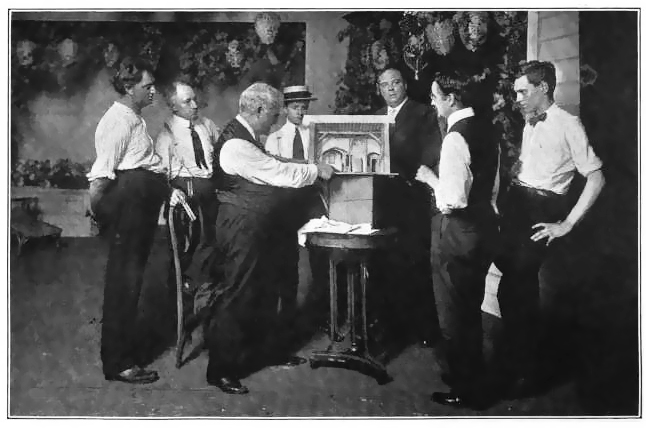
David Belasco with the Heads of His Artistic and Mechanical Departments

In the above photograph, “they are building a miniature stage-setting of the play, ‘Marie-Odile.’ Every stage-setting used at the Belasco Theatre is built from an exact miniature model which is fully equipped, even to the lighting.”

Text and photograph originally published in “The Theatre Through its Stage Door”, written by David Belasco, and published in 1919.

Good Furniture and the Moving Pictures, 1915

The following article was originally published in Good Furniture Magazine, October, 1915.

Good Furniture and the Moving Pictures

by William Laurel Harris

Few people realize the prodigious growth of the motion picture business or how this sudden development of public entertainment has reached out into every walk of life. Not only in our big cities but in every town, village and hamlet the motion picture theatre holds its place and prospers. Ten million people, it is said, visit the “movies” every day. It has been said that through the “movies” a propagandum of art might be established to spread grace, beauty and culture throughout the land. It has even been suggested that architects might take a hand and find their vocation in directing the composition of scenes for the film makers.

With these ideas in mind, it was the intention of the writer to develop the theory of such a work in a solemn and learned editorial. But first he had the happy thought of visiting the people that have to do with busy “movies” and of learning first hand just how the situation stands from their point of view. His first impression, of course, was “confusion worse confounded.”

The point of view of one man interviewed is of special interest to readers of Good Furniture. He is a dealer and maker of furniture in every style to be used in making motion pictures. His main shop on a side street near Sixth Avenue is jammed from basement to attic with furniture piled tier on tier in every direction. Censers, sanctuary lamps, beer-hall signs, chandeliers and lanterns in every style are hanging from the ceiling. Pictures are along the walls, stand in corners and are piled against the stairway. Here one sees portraits of Abraham Lincoln, Julius Caesar, Napoleon, Frederick the Great and decorative panels, stained glass windows of religious subjects, with modern landscapes and figure work of a widely varied character, all jumbled up together. In fact, everything in the way of furniture and furnishing is here represented in some way.

Noticing the surprised look on the wrriter’s face when he beheld the miscellaneous character of furniture and curios heaped up in all directions, the owner of the place said apologetically, “I never know what they will want next.”

At the rate of seven van loads a day this furniture goes out to the “movie” studios. Originally this shop of motion picture furniture was an antique dealer’s store in the theatrical district, renting things now and then for dramatic productions. About six or seven years ago calls began to come from motion picture producers for furnishings to make their scenes. One. day a request will come for the stuff to make the studio of an old Italian artist, a man of culture who has fallen into misfortune at the end of his life. The furniture must be fine but dilapidated, with some of the scats out of the chairs, and there must be portraits of great men, including one of Guttenberg. “As for the furniture, we don’t want any theatrical props; we want the real stuff.”

And so the orders go. The next one may be for the furnishings of a monastic cell or it may be for Napoleon in all his glory or for the court of Louis XIV.

“Yes,” the manager of this curious furniture store told me, “these movie men when they thought out their business, thought it out all wrong. They thought they wanted fakes and the bigger the better; but now they find they want the real thing and that is what draws the crowd.” So it appears that instead of the motion picture men educating the public, as has been sometimes suggested, the public has educated them and taught them the value of good furniture.

This enterprising furniture man then proudly took the writer into his special order department and explained how it often occurs that a motion picture producer suddenly finds he must have a picture of the Petit Trianon or of a ball room at Versailles, and no one in town has the furniture to make the scene. “He then orders it made expressly, after drawings out of books on historic furniture and furnishings. Of course, he will not keep the furniture; we charge him for making it and then later on we can rent it again. Then, too,” continued the furniture man, “we frequent the auction rooms and people think we are crazy, the prices we pay. For if we really want a table, a chair or a whole bed room suite, we never let it go. Why, we have a bed room suite that old Commodore Perry gave to Mrs. Belmont for her own use, all carved over and over with the birds cut in the wood. How all these ‘movie’ men are getting wise on styles! If we should send a Jacobean suite for a French chateau, you ought to hear the howl. Our business has grown because we are willing to take lots of trouble, and we have fine things that can give character to any show. We have the biggest business of this sort, in New York and we like the fame and reputation. But the real reason why we have fine statuary, pictures, tapestry and good furniture is because our bread and butter is in it.”

Originally published in Good Furniture, October 1915, by William Laurel Harris

Duties of a Property Man, Utah, 1921

The following comes from The Young Woman’s Journal, a self-described “organ of the Young Ladies’ Mutual Improvement Associations”. It was originally published in October, 1921, in Salt Lake City, Utah. I kept in the opening paragraphs so you get a sense of the context which the article was written, then I skipped ahead to the portion dealing specifically with props.

Technique of Play Production

by Maud May Babcock

The community theatre in the days of Brigham Young, was unique. The Latter-day Saints had an organization with such fine ideals and gave performances of such excellence that there has been no equal in theatrical history, and the theatre of Brigham Young stands today the admiration and wonder of the entire world. Have the mighty fallen? We have sold our birthright for a mess of pottage to commercial theatrical enterprise. Instead of leading, showing how communities could entertain themselves and by so doing develop a taste for only the best in music and drama, we are amused by demoralizing vaudeville, and unreal, sentimental “canned” drama. Today our taste is as low as anywhere in the United States. Verily we are what we feed upon! The Mutuals are making splendid effort to help our communities come back to their own and make their own entertainment.

There is a tremendous waste of time and effort in our Ward societies because of the lack of organization, and systematic procedure in our entertainments.

Organization in heaven, in the church, in the world spells efficiency. A successful amusement center depends upon its organization. In our dramatic activities, our organization must consist of the following officers:

  • Director
  • Business Manager
  • Stage Manager
  • Stage Carpenter
  • Property Manager
  • Electrician
  • Scene Painter

The Director and Business Manager should be very carefully selected by the local Mutual Officers, and these should be responsible to them alone. All the other officers are appointed by the Director and responsible to him or her.

The Property Man—”Props”—provides, cares for, and places in proper position on the stage all furniture, draperies, rugs, carpets, lamps, telephone, letters, documents, etc.—in fact, all articles needed in the play except the personal properties of the actor. Things only used by a single actor—such as a fan, a cane, an eyeglass, a parasol, a handkerchief, a letter, if it remains with the one person and not given to another or is not left on the stage—these are personal “props.” A small table should be provided on either side of the stage for offstage “props,” such articles as are needed to be carried on stage, or for properties brought off stage. The property man should see that actors do not carry such “props” to their dressing rooms, but that they are left on the table provided. Stage drinks—which are made of grape juice, ginger-ale, or root beer, according to the color needed, are cared for and bought by “props” on order of the director countersigned by the business manager.

The property man should take an artistic pride in his stage picture and spend a good deal of time to secure, by renting or borrowing or making, the exact style of furniture and things needed for the play. A period play with modern furniture which one sees in stock performances is ludicrous. Charlie Millard, the veteran property man of the Salt Lake Theatre made all his properties and furnished the actors in Brigham Young’s time with even personal “props.” The stage manager furnishes “props” with a property plot containing a list of properties needed for each scene in the play.

This article first appeared in “The Young Woman’s Journal”, October, 1921.