Behind the Scenes of an Opera-House, 1888: Introduction

In 1888, Scribner’s Magazine published a wonderful article called “Behind the Scenes of an Opera-House”. The author, Gustav Kobbé, visits the backstage areas of the Metropolitan Opera. He describes the various shops and workers who create an opera, from conception to opening night. It is one of the most fantastic and detailed looks at the practical construction of a theatrical production I’ve run across from this time period, and so I am presenting all of the relevant parts on properties in their entirety. As the article is quite long, I’ve broken it up to run over the next few days; this will also allow me to take a break from writing during the Thanksgiving holiday. Enjoy!
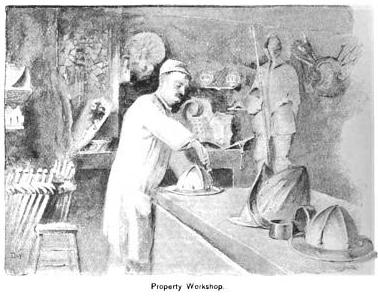
The Property Workshop at the Metropolitan Opera-House, 1888

Behind the Scenes of an Opera-House, by Gustav Kobbé.

The regions in which the labor of preparing a musico-dramatic work for production goes on are a veritable bee-hive of activity. They embrace, besides the rooms of the heads of the various departments—musical conductor, stage-manager, scenic artist, costumer, property-master, gas-engineer, and master carpenter—those in which their ideas are materialized. Connected, for instance, with the property department is a modelling-room, a casting-room, two rooms in which such properties as flowers, grass-mats, and birds are manufactured, two armories, and three or four apartments in which properties are stored—but this is taking the reader a little too far behind the footlights for the present.

Some idea of the labor this involves may be formed from the statement that at the Metropolitan Opera-House it took from August, 1887, until January, 1888, to mobilize this host for the conquest of Mexico under “Ferdinand Cortez,” [Eric: an opera by Gaspare Spontini] a period of about the same length as that usually consumed at large opera-houses in preparing a work for production. On the 1st of August, 1887, the managing director handed the libretto to the members of his staff. They immediately set to work to exhaust the bibliography of the episode lying at the basis of the action as thoroughly as though they intended to write a history.

I said that spectacular works (“scene-painter’s and property-master’s pieces”) called for a far greater quantity of material features than “Tristan and Isolde.” It can be stated of Wagner’s works in general that the properties required for their production are less numerous and that as a rule the scenery is less gorgeous than that required for spectacular opera. Yet it is more difficult to mount a Wagner opera or music-drama than it is to mount the “Queen of Sheba,” “Merlin,” “Aida,” “L’Africaine,” or “Ferdinand Cortez.” The reason is that Wagner’s works call for quality instead of quantity… [The property-master] is confronted with problems of great intricacy, the solution of which requires mechanical genius as distinguished from the mere manual dexterity called for in the manufacture of swords, shields, and numerous other properties. Indeed, the mechanical properties used in Wagner’s works are constant objects of study, attempts to improve them by simplifying the apparatus for working them being made from time to time.

First printed in “Behind the Scenes of an Opera-House”, by Gustav Kobbé. Scribner’s Magazine, Vol. IV, No. 4, October 1888.
Crack

Ever since the CIA invented crack and introduced it to America in the 1980s, this drug has found its way into a number of plays. Thus it is up to the prop master to figure out how to simulate its use on stage, since smoking real crack is often beyond the budget of most productions.

The most important step is first to research what crack looks like. With the internet, it should not be too hard to find images of the actual drug; relying on pictures from film is less reliable because these are already an interpreted facsimile of the original. If you can get your hands on some actual crack, take some pictures of it before you disappear into a years-long struggle with addiction.

In the film Half Nelson, actor Ryan Gosling smokes crack on-screen. Jeremy Balon, the prop master, explains how they achieved the effect:

What ended up working was an off-white coffee mug that I broke up into about a million little pieces, then dyed in coffee. During the scenes I would use a piece of the broken porcelain that most resembled a ‘rock’ and then set a small ball of tobacco behind it, so that when lit, a very small amount of smoke would come out.

(from the Daily Beast, Oct 31, 2010)

If your theatre prohibits tobacco, you can substitute a small amount of material from an herbal cigarette. If even that is prohibited, you will need to experiment with other materials which will give off a small amount of smoke over a prolonged period of time.

The Prop People Forum has some more helpful suggestions. One user found some white gravel in a parking lot which worked perfectly. In that case, the director did not want to see the crack actually smoking.

Other suggestions which were offered but not tested out included clear rock candy or breaking chalk or sugar cubes into irregular shapes.

The Influence of Properties upon Dramatic Literature, 1889

The following comes from The Theatre, Vol 4, by Deshler Welch. Theatre Pub. Co., 1889, pg 4.

Scenery and “Properties.”

Their Influence upon Dramatic Literature.

By scenery is meant the paintings in perspective and movable with the change of place represented in the play.

The word “properties” we find technically applied to the appurtenances of the stage in England as early as 1511. In an account of the furniture used for the play of St. George during the Revels at Court in that year, “properties” and “property making” are both used. The person in charge of them was called the “tire-man,” and the one in charge of the “apparel” was called the “garment-man.”

In the estimates of the Revels in 1563 the “properties” for five plays at Windsor are mentioned several times. The “tireman,” as well as the “book-holder” (the prompter), is also spoken of by Ben Jonson in the induction to his play, “Cynthia’s Revels,” and both are mentioned by many other dramatic writers of that time.

As long ago as 1561 the public theatres only had, instead of scenery, besides the curtain in front, other curtains at the back of the stage. These were called “traverses,” and served to indicate another inner apartment, when one was needed. These were also afterward called “arras.” In “Hamlet” we find Polonius places himself behind the “arras.” Beds, chairs, and other “properties” needed on the stage, were thrust on through these hangings.

Using soft materials to mimic hard details

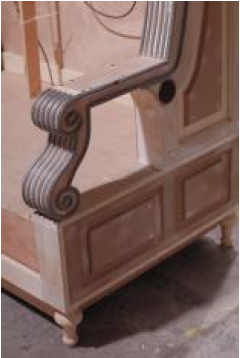
Every once in a while you come across some curved or otherwise intricate detail on a prop you wish to recreate that seems far too intense and labor-intensive to undertake by hand. Take, for instance, the curved ridges running along the front of the arm in the picture below (the parts in grey).

Ethafoam on a decorative arm

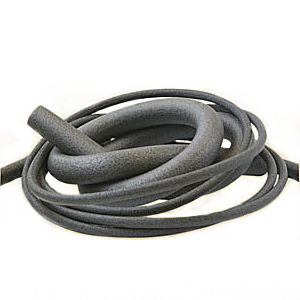
Rather than spending two weeks carving these out by hand, I made them out of Ethafoam. Ethafoam is a actually a trademark of DOW Chemical for their spongy, cushiony polyethylene foam used for packaging and wrapping pipes. It’s great for theatre because it also comes in rods, which can be cut in half to make flexible half-round molding.

Ethafoam rod
Ethafoam Rod

Now, this is not an article about the wonders of Ethafoam, but rather the idea of using soft and flexible materials to simulate hard and rigid objects. Ethafoam is just one of the many materials used in theatre for such purposes. You can see another example in the photograph below.

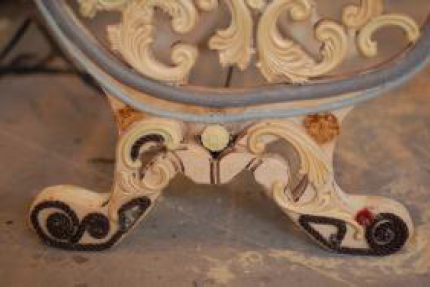
Closeup of cast iron bench

You can also see yarn used at the very bottom. This was a replica of a cast iron bench I made for the Santa Fe Opera a few years back. The research called for a very ornate and detailed-looking bench, and the short time-frame I had to build it meant I had to use a lot of found objects and unconventional materials to pull off the look.

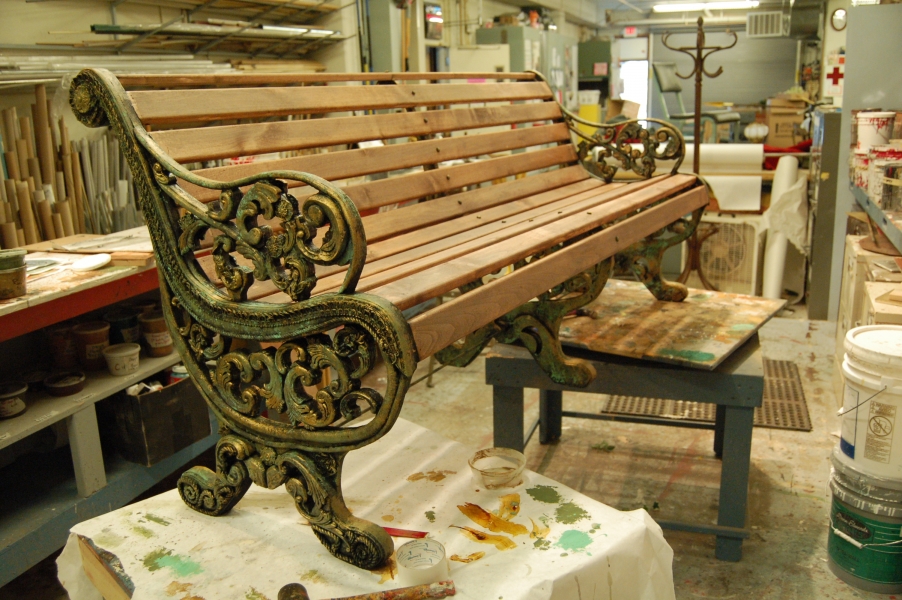
painted cast iron bench

On closer inspection, you can see more materials, such as fabric fringe were used. Once it was artfully painted, the illusion was pretty convincing, especially under stage lighting and seen from a distance. The painting of soft materials like Ethafoam or fabric can be one of the trickiest parts of this process. Either they soak up all the paint or the paint simply will not stick to it. You usually need to coat it with something first, though that can be tricky as well; because the material is flexible, you need to use a coating which also remains flexible, otherwise it may chip and flake away. Brushing on watered-down PVA glue or a coating of something like Jaxsan is usually sufficient.

When you look through older texts dealing with props, you can find numerous examples of using industrial felt, upholstery trim, or any number of other fabrics and soft materials to mimic solid decorations. If you ask prop artisans about it, you will get some mixed responses. Some love the versatility it gives them, especially on a budget. Others abhor it as an amateurish “proppy-prop” trick. In my own opinion, I try to avoid it if I am making a prop that gets handled by an actor. Nothing looks sillier than when an actor picks up a supposedly marble vase only to have the decorative ridges squish under his hands. It also threatens to break the actor out of character even if it is not noticeable by the audience. If, on the other hand, you need to add ornamentation on set dressing or on the parts of a prop that are unlikely to be touched during the performance, than it’s a great trick to use, especially when you are on a tight budget or tight deadline.

Review: The Prop Master


The Prop Master by Amy Mussman

I’m surprised more props people do not know about The Prop Master by Amy Mussman. No other book more clearly defines how to be a prop master in a contemporary setting. With a publish date of 2008, it is also amongst the most up-to-date props books out there. I feel strongly that if you read and reread this book as well as studying the Properties Directors Handbook by Sandra Strawn, you are armed with as much information as possible to prop a show short of actual experience. This is the book you want if you are in school and someone tells you, “You are the props master on the next show,” and you have no idea what that entails. It is amazing that until two years ago, a book like this had not been written.

Keep in mind that this book will not show you how to build any props. It focuses solely on the management and process of propping a theatrical show. Perhaps it is also useful to a prop master on a film, though I have no experience in that arena so I cannot say for certain.

The beginning of the book is filled with the important task of defining what props are, what props do, what a prop master does, what other props people do, and how it relates to the other departments and to the production as a whole. One of my favorite parts is where Mussman spells out a list of the basic props that a prop stock should have. From there, it delves into what skills and personal attributes a props master should develop to succeed. Where a props artisan can find success by perfecting various technical and vocational skills, a prop master’s greatest path to success is honing interpersonal skills and the proper forms of etiquette; in essence, getting people to “like you”. This book breaks that down into much more realistic and better-phrased terms than I just did. It breaks down the way many theatres are organized, how a props master relates to these various departments, and what is expected of a prop master in a professional setting.

From there, Mussman dives into how to achieve what is expected of you. Drawing on her over ten years of experience, it describes how to set up an ideal prop shop and how to organize your files. From there, she describes how to proceed through the process, beginning when you are first chosen as the prop master and receive a script, through rehearsals, into tech and when performances begin.

Not content with presenting all that information, she also includes safety information, a theatrical glossary, and a whole chapter of tips and tricks for prop-making.

In short, I cannot emphasize how important this book is for the beginning prop master and for our industry as a whole. If you were picking someone randomly to prop master a show, you can say, “I need you to be the prop master. Here is your instruction manual.”

As I mentioned earlier, this book goes well when combined with the Properties Directors Handbook. Read them both. I’ve written about the difference between a prop master versus a properties director; while they are distinct terms, they are often similar positions and career paths, and the information in each is complementary and often overlapping.

Making and finding props for theatre, film, and hobbies