It’s 2017, and All the Props are Here

Yolanda Baker is the Last Disco Ball Maker. She has made tens of thousands of mirror balls by hand for the past fifty years at Omega National Products in Louisville, the last American manufacturer of this iconic object. Chances are, if you have a US mirror ball, it was made by her. She even did all the balls in Saturday Night Fever.

Make Magazine shows us How to Make Breakaway Bottles and Window Panes.  They use sugar glass, ugggggghhh. The process they describe is easy enough to adapt to isomalt, though, which is superior to sugar glass.

Adam Savage visits Weta Workshop’s Model Painting Shop. Adam seems to be visiting all sorts of cool places lately, and the model painting studio at the shop that built Lord of the Rings is no exception. Check out all the cool work they did while learning some painting tips for yourself.

PuppetVision has a Pinterest board with 92 pins of Animatronics & Puppet Mechanisms. You can spend days looking at all the clever ways to make objects move and come to life.

“Designing Windows is an Art”. Take a look at this interview with Erin O’Brien, a freelance window designer at Bergdorf Goodman in London. She talks about how she got started and shows off some examples of her work over the years.

Magic Music Box

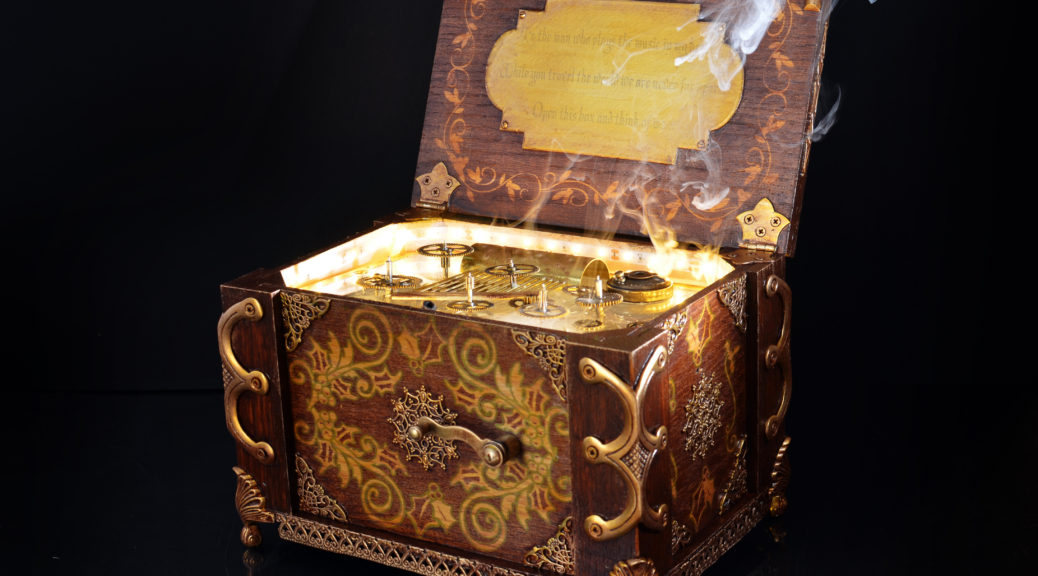
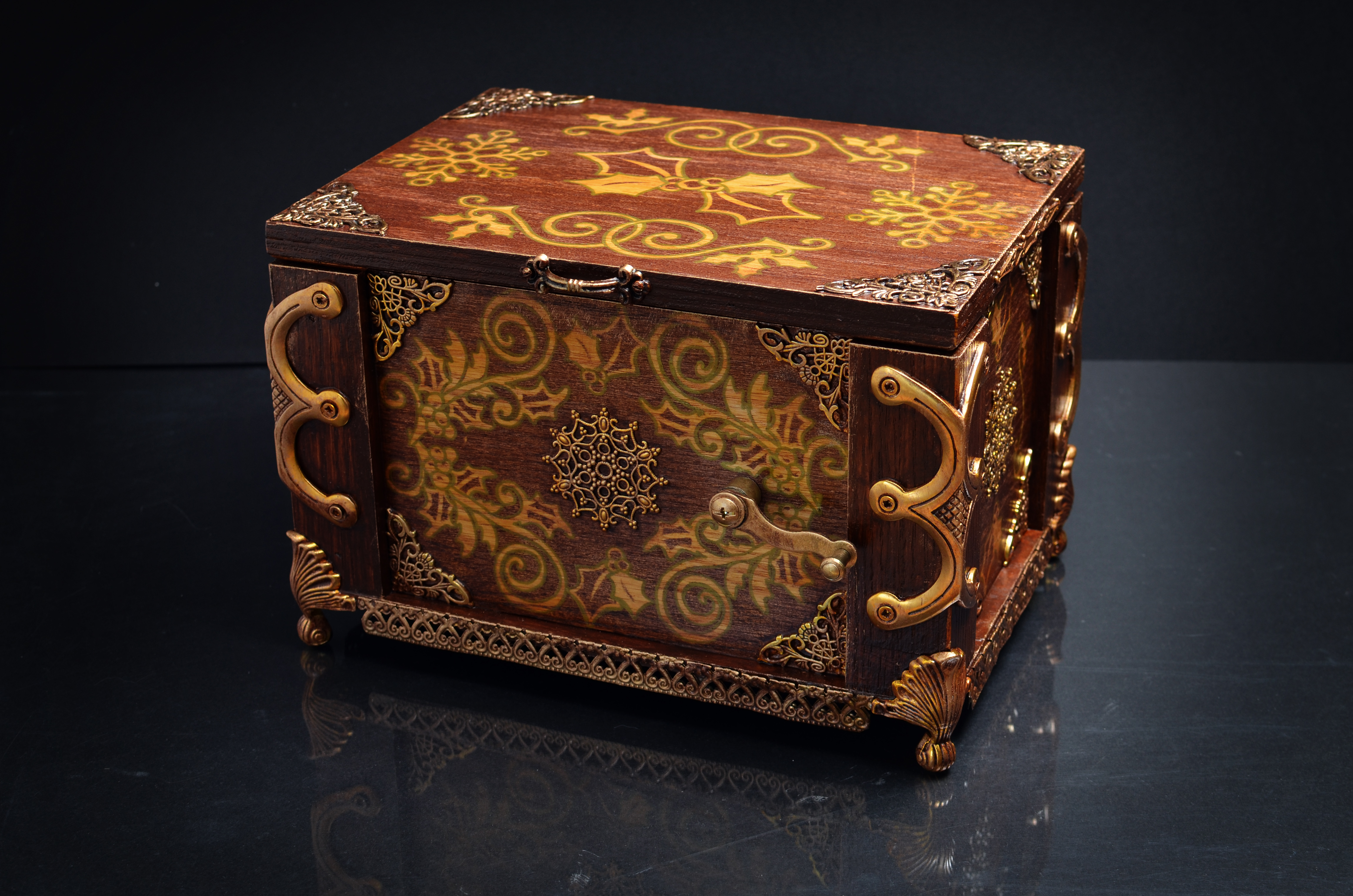
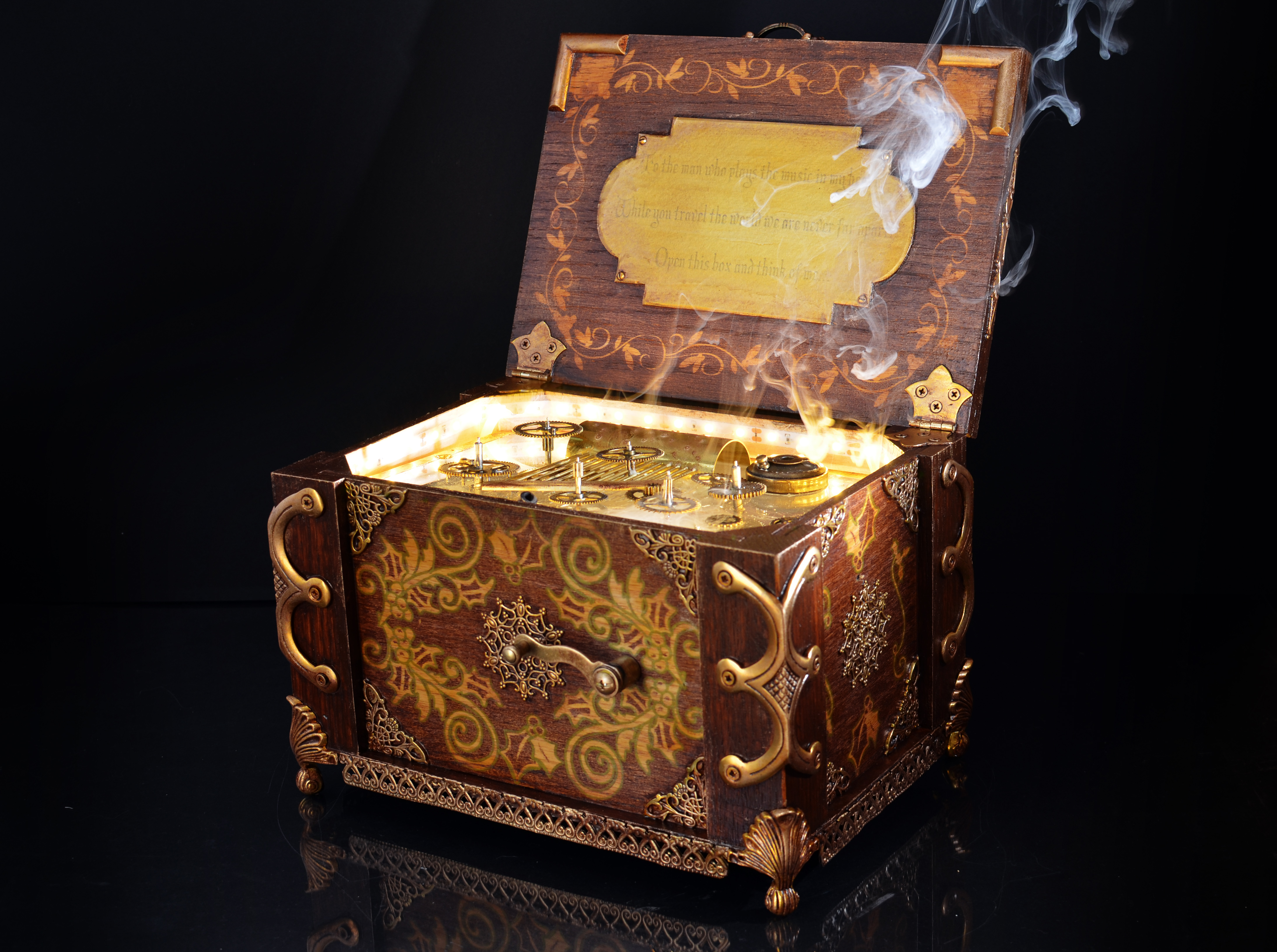
A few months ago I was contacted by Hershey Park about building a magical music box. They were doing a Christmas show and wanted an exquisite antique music box owned by Santa. It had wood inlay designs and brass details. The actors would dance with it, but they wanted it to be able to light up, emit fog, and have the winding handle turn on its own.

Exterior of box
Exterior of box

This was a tight turnaround; 34 days from initial contact to having the prop in their hands. Nearly half of that was just hashing out the design and working on the contract.

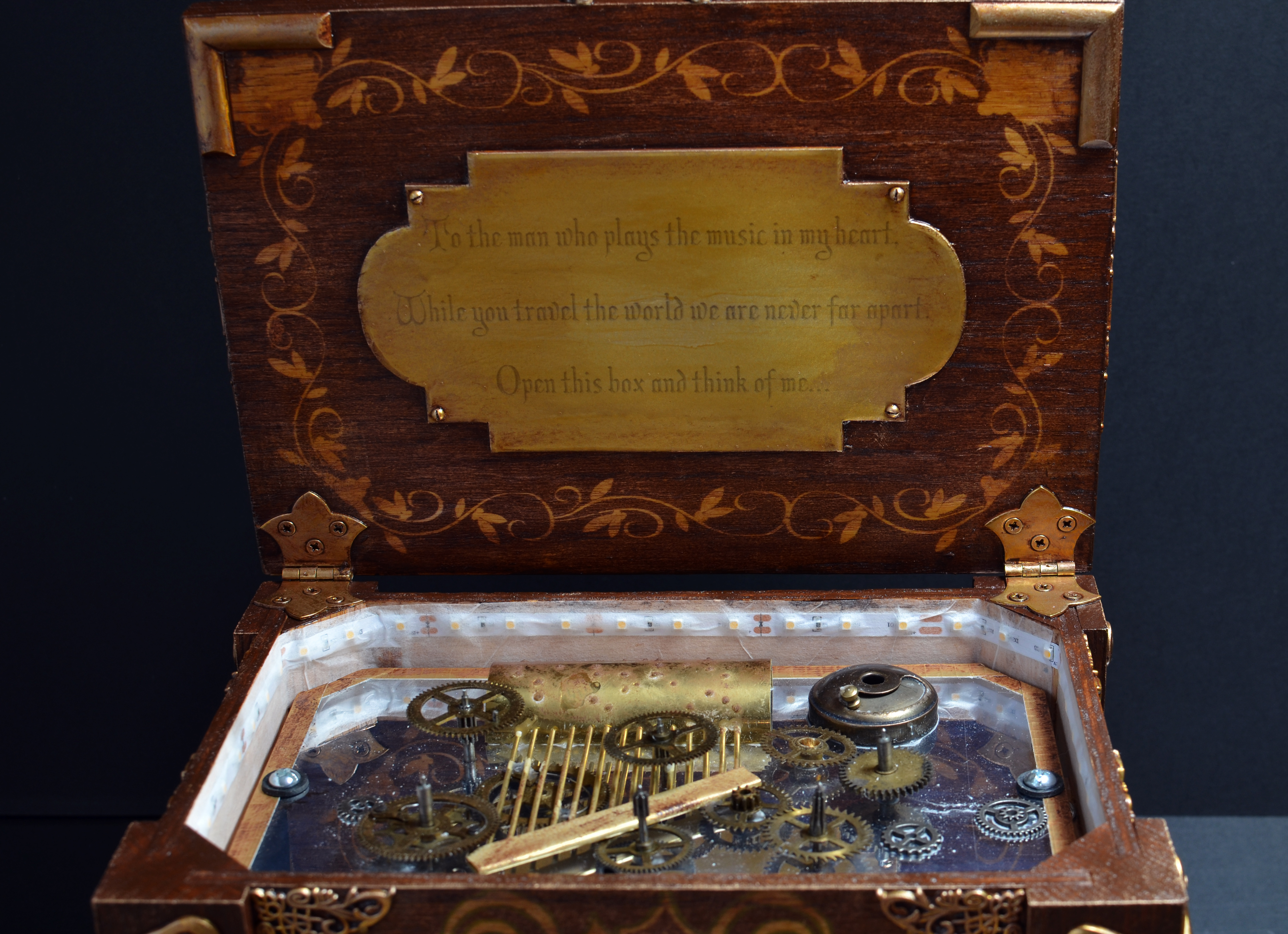
Interior of box
Interior of box

The inside of the lid had an inscription and some inlay work. The inside of the box itself had a music box mechanism and a variety of floating gears.

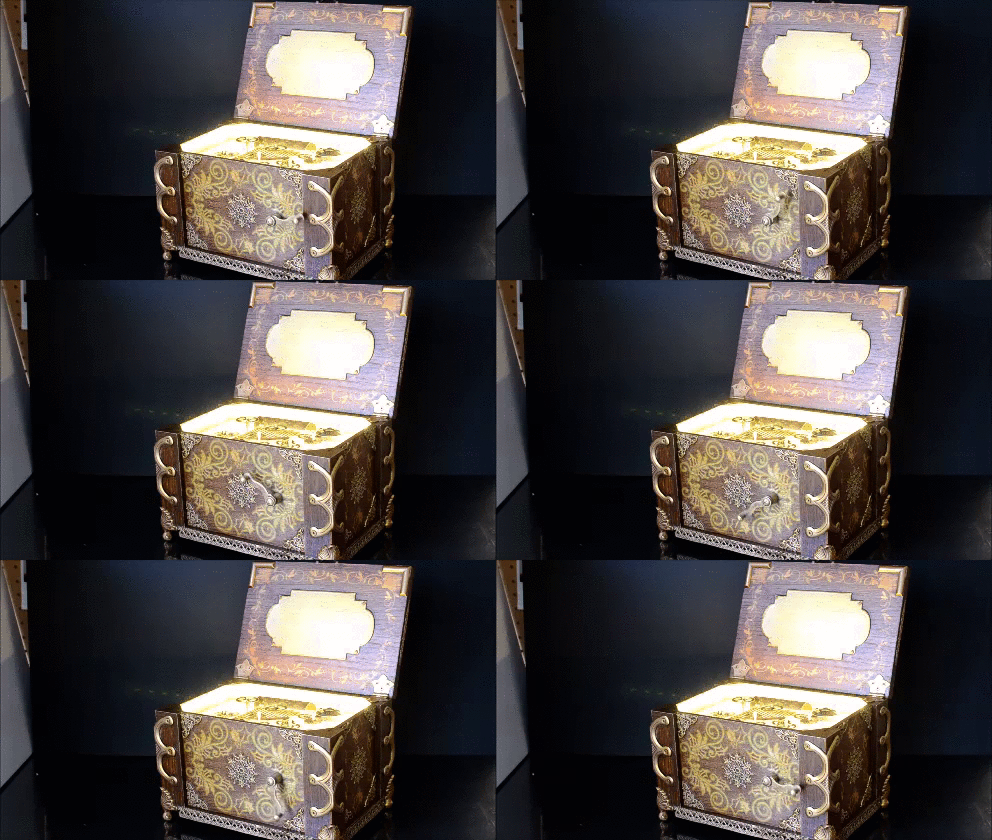
Spinning handle
Spinning handle

The handle could be turned by the actor, and it also spun magically. The inside of the box lit up as well.

Fog effect
Fog effect

Oh yeah, a puff of magic smoke also came out of the box. The lights, fog, and spinning handle could all be activated independently of each other, triggered by a wireless dimmer hidden inside.

I was really proud of how this turned out. These are the kinds of projects I love doing.

Last Minute Christmas Links

The Rooms They Left Behind – After their deaths, the New York Times photographed the private spaces of ten notable people.  The photos are such wonderfully crafted images filled with real life set dressing, hinting at the lives of these people.

Locked & Loaded: The Gun Industry’s Lucrative Relationship with Hollywood – The Hollywood Reporter has an incredibly in-depth look at guns in Hollywood. This article takes us from the NRA’s “Hollywood Guns” exhibit, to the ISS armory, with stops at the Internet Movie Firearm Database and discussions with the gun manufacturers themselves. You get a glimpse at some of cinema’s most well-known firearms, and we examine the seeming contradiction where actors can be anti-gun off-screen, but gleefully wielding weapons on-screen.

Raw Steak and The Revenant – Cinefex takes a look at the meatier effects from Leo’s Oscar-winning role, including several scalpings and a zombie skinned bear in a suit for a dream sequence. Besides the tight turn-around, most of these effects were built on set in the middle of the Canadian Rockies.

Adam Savage Visits The Lion King’s Puppet Shop – Adam Savage goes backstage while The Lion King is playing in San Francisco and talks with Michael Reilly, the show’s puppet supervisor. What more is there to say?

Artem: Inside a Real-Life Santa’s Workshop – Artem Studios has been making weird and wonderful props and effects for commercials, television, and film for the past 30 years. Little Black Book sits down with the founders to talk about some of their recent projects and how they approach their work.

Recollections of a Grumpy Carpenter

The following first appeared in a 1916 book titled “Recollections of a Scene Painter”,  written by an E.T. Harvey. This post is for all the grumpy carpenters and TDs in our lives:

The manager of a traveling theatrical company going to play “Black Eyed Susan” in a small town, inquired if they had a ship’s deck scene in the theatre, and upon being told “no,” said: “Well we’ll have to hang William again in a bloody wood.” In the old days an experience like this was often likely to occur when the traveling company playing outside the big cities had to depend entirely upon the local theatre for scenery, and anything out of the ordinary was called for. But all the well-appointed theatres carried a large amount of what was called stock, from the “Blast Heath” in “Macbeth,” to the “Palace of the Capulets,” in “Romeo and Juliet.”

The stage floor was also arranged for the special traps. There was the cauldron and apparition trap in the centre of the stage, for the witch scene in “Macbeth.” A trap a little to the right of centre, and further down the stage was the grave digger’s trap for “Hamlet.” A long trap clear across the stage at the back, arranged on an inclined plane, was the ghost trap in the “Corsican Brothers.” Besides these, were the small square star and vampire traps, each side of the stage down in front; the Star trap where the demons would be propelled from below and thrown up in the air above, the points of the star falling back in their position. The Vampire trap is where he would double, and disappear again below.

All the scenery in those days was on “Flats” (sliding frames that met and parted in the centre). Very few of the theatres had height sufficient to take up the scenery as is now done.

Most of the theatres had what was called a scene dock, where the scenery was kept; this was usually off to one side of the stage. In the old historical theatres scarce any one knew what was in the stage pack but the old “Stage Carpenter”—he was the one fixture of the house. “Actors might come and actors might go, but he went on forever.” Like many other theatrical terms that have become universal, he was the original Crank. It was natural for him to become an autocrat, and even Stars would hesitate to incur his displeasure.

One time Louis James was playing “Julius Caesar” at the Boston Theatre. At rehearsal a substitute scene was run on for the garden of Brutus. James said: “Prescott, what are you going to give me for this scene?” The old carpenter said: “I know what you want, it will be alright; but it is way back in the pack.” The scenery at the Boston Theatre was almost as complete as the Boston Library, but it was too much trouble for Prescott to go through the pack, so he took the first garden scene that came handy, and Brutus was horrified at night to see a lawn mower and sprinkling-can a conspicuous feature in his garden. It was the first scene that came handy.

Original Publication: Harvey, E. T. Recollections of a Scene Painter. Cincinnati: W.A. Sorin, 1916. 40-41. Google Books, 15 Feb. 2008. Web. 5 Sept. 2012.

Making and finding props for theatre, film, and hobbies