
All posts by Eric Hart

Stage Scenery and the Men Who Paint It, 1908

The following first appeared in an issue of Theatre magazine in 1908:

by Mary Gay Humphreys

That for the most part virtue must be its own reward is the scene painter’s ethics of his own profession. When, as it sometimes happens, the curtain goes up on an empty stage, and the audience breaks into involuntary applause over the beauty of the scene, such are his crumbs of comfort, and he takes them thankfully.

His own standards are much higher than he is able to realize. In this respect there seems to be but little difference between his attitude and that of the painter regularly accredited to the Fine Arts. But at no previous period is his discouragement greater than at this moment, when to the man in the orchestra scenic productions seem to have profited so greatly by modern inventions and scientific developments, as that, for example, of the electric light. Nor on no other man has later managerial conditions borne more hardly.
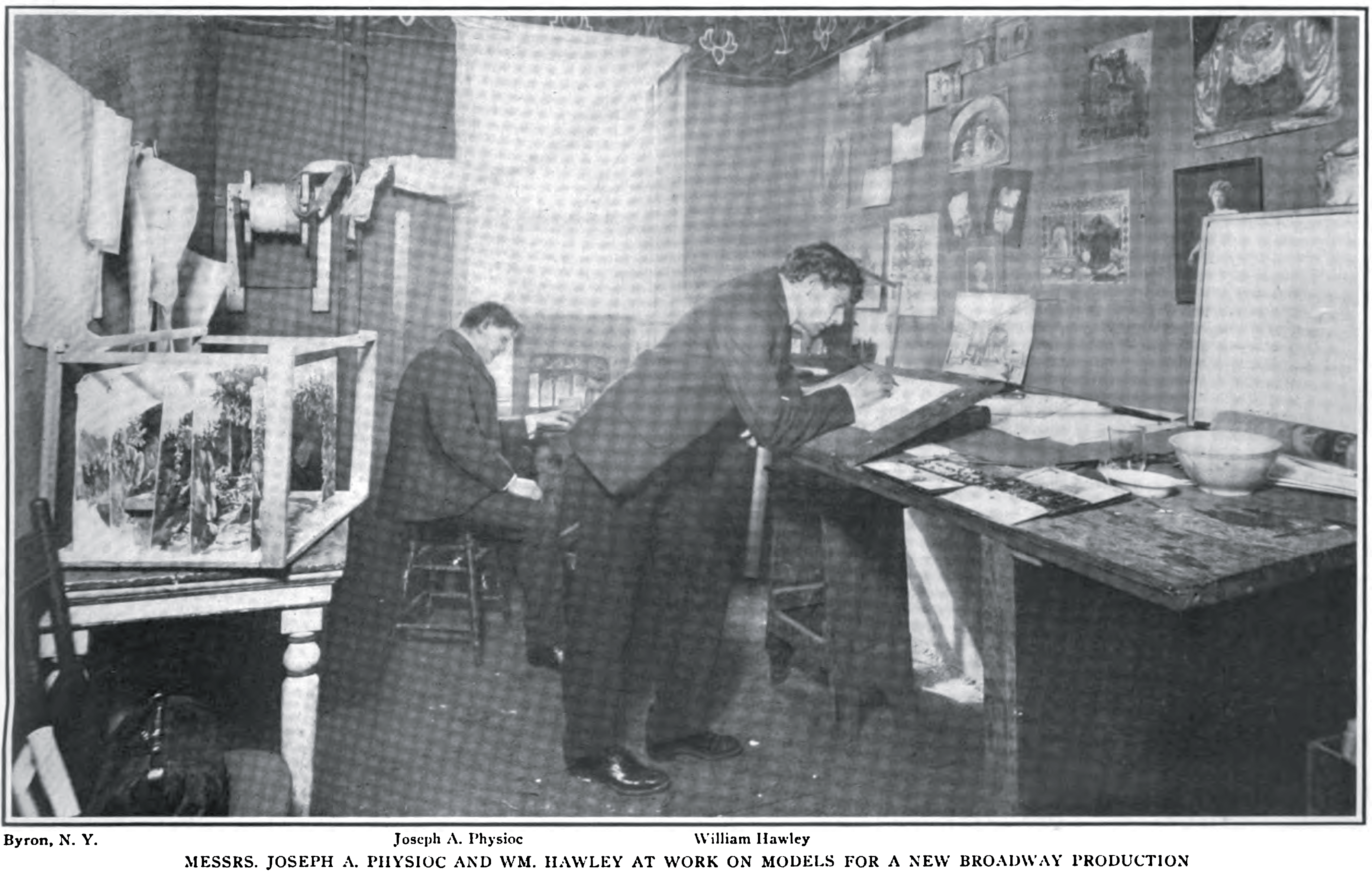
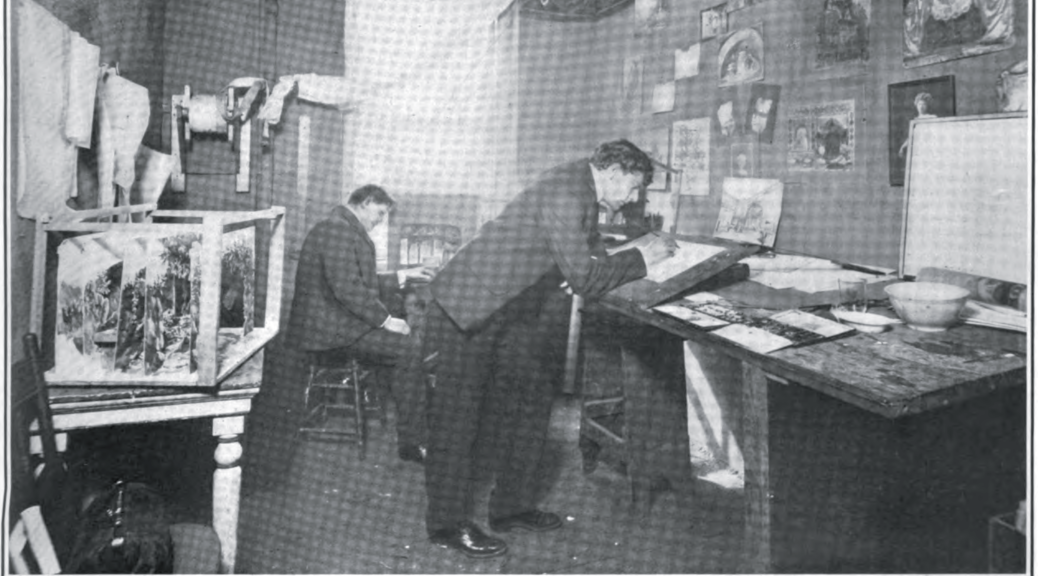
Physioc and Hawley
Physioc and Hawley

“There is no book that gives the history of scenic art. It would be too sad. It would tell only of disappointed hopes, of melancholy failures.”

This was said by Mr. Unitt in his interesting den at the Lyceum Theatre:

“Scene painting differs from the paintings known as among the Fine Arts only in degree. The principles are the same as in miniature painting. The only difference is you have forty feet of canvas. A portrait must resemble the subject more minutely than the scene resembles a situation, but that does not concern the principles involved. But, unhappily, to say that a picture represents scene painting is to make a disagreeable criticism.

“But it should be remembered that in painting, as the term goes, the artist does as he wishes; he consults no ends but his own. It is not so with the scene painter. His painting furnishes only the background, and this as a picture is likely to be thrown out of key because the other parts, of which he has no control, are not consistent with it. The lighting of the stage, for example, may not agree with the atmosphere the scene painter has given the scene. He also has to contend against costumes out of key, and as the living element of the picture is most prominent, the scene suffers.

“But nothing has tended to retard the development of scene painting as has the decay of the old stock companies. In those days the scene painter was part of the working staff of the theatre, and in daily intercourse with his principals. It took time, if you will remember, to produce such scenes as those in ‘The Amazons.’ This could be only accomplished by having a manager with artistic perceptions, and a staff that felt that pride and enthusiasm which must accompany good work.

“The method of production is now entirely different. The scene painter is not part of the theatrical staff. His is an employee of a firm. He is required to produce as rapidly as possible the scenery for perhaps twenty plays. The greater number of these will be failures, and others must be ready to take their place. This means a large plant and more rapid work. The scene painter cannot follow up his work; frequently he never sees it afterward. He has absolutely no opportunity for individuality, and naturally does not take the same interest as he did in that artistic atmosphere engendered when he was a member of the staff of a theatre.

“The conspicuous defect to-day in stage production is the lack of team work. The men who now control these matters are not distinguished for their keen artistic sense as was the manager in the old days. The commercial element, that has to be considered in view of the number of plays and possible failures, requires that the plays be put on as cheaply as possible. Suppose the scene painter attempts to carry his point and the play fails. He would probably have to listen to such comments as:

“‘Now, if you had put that girl on the fence and thrown a lot of color around her, the play would have gone far better. See?'”

Stage scenery and the men who paint it. M. G. Humphreys, il. Theatre 8: 203-4, v-vi, Aug 1908.
 

Everybody’s Propping for the Weekend

Star Trek just celebrated its 50th anniversary. Make Magazine has rounded up seven fun Star Trek–themed projects. Some are goofy (“spocks” are socks with Spock on them), while others are quite ambitious (an Enterprise Bridge playset for Star Trek action figures).

2StoryProps has started work on a replica of the spacesuit used in The Martian, and his first post is on recreating the astronaut’s helmet. The whole thing is built from scratch and is pretty cool.

Tane Williams is an illustrator who worked on the 2013 remake of Evil Dead. He has posted 15 illustrations from the Necronomicon used in that film over on his blog. Careful! Grossness ahead!

It’s not a tasty treat; Popular Woodworking shows us how “sandwich construction” can help make thick wooden panels using multiple layers of thinner plywood. I do this a lot when building prop furniture, and I’m sure others do as well, but I’ve never seen a write-up with illustrations showing the process.

Make Magazine tells us everything we need to know about lube. Ever wonder whether to grab oil, grease, or WD-40? This article breaks down all the different types of lubricants and describes when to use each one and when not to use each one.

Props is Props in the Property Room, 1920

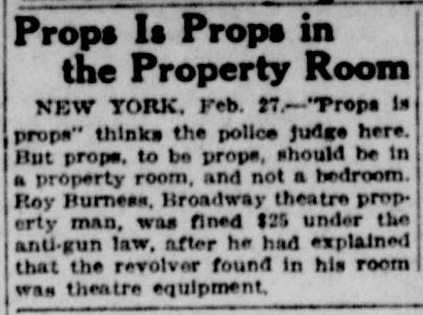
Yes, even back in 1920 it was a bad idea to use real guns as props:

Props is Props
Props is Props

“Props is props” thinks the police judge here. But props, to be props, should be in a property room, and not a bedroom. Roy Burness, Broadway theatre property man, was fined $25 under the anti-gun law, after he had explained that the revolver found in his room was theatre equipment.


The Seattle star. (Seattle, Wash.), 27 Feb. 1920. Chronicling America: Historic American Newspapers. Lib. of Congress. <http://chroniclingamerica.loc.gov/lccn/sn87093407/1920-02-27/ed-1/seq-4/>

Friday Links in September

Detached eyes, dead horses, and giant disco balls: The weird world of prop builder Seán McArdle – Seán tells City Pages how he made a horse fall over on cue and glued seashells to half a Volkswagen.

Prime and Smooth Props and Costumes with FlexBond – Rosco looks at a number of cosplayers using FlexBond to coat pieces constructed from Worbla.

Corporeal Intangibility – The Alley Theatre made custom acrylic furniture and props for their production of The Nether, including a gramophone and a rocking horse. This was clearly an interesting project.

Working with EVA Foam for Costume Construction – Make Magazine has rounded up a number of videos and tutorials dealing with using EVA foam (or, more precisely, XLPE foam) to build armor and prop pieces.

Rehearsal Notes: Chair

© Michelle Dias

Day 1
May we please have a stool?

Day 2
Thanks for the stool. May we please have a taller stool?

Day 3
Thanks for the taller stool. The director has requested a bench instead.

Day 4
Regarding the bench, would it be possible to put arms and a back on it?

Day 5
Thanks for the sofa. Although the designer would prefer it, the director feels strongly about having the bench back, and altered as requested.

Day 6
After meeting last night with the designer, the director has reconsidered the altered bench and would like to see the sofa again. We appreciate the overtime you put into the bench and apologize for the change.

Day 7
Can we please see all the chaise lounges you have in stock?

Day 8
Thanks for bringing up the chaises. The director has decided to stay with the sofa. Would it be possible to shorten it? To about loveseat size?

Day 9
The director doesn’t care for the style of the loveseat you brought in. We will ask him to discuss it with the designer. Meanwhile, can we pursue our request to have the sofa shortened?

Day 10
Thanks for shortening the sofa. Unfortunately we’ve now found the arms are too low on this one and would like to see all the other sofas and loveseats you have in stock.

Day 11
Can we please have all the sofas and loveseats removed from the rehearsal hall before 10am? The director and designer have met and have decided to try an armchair.

Day 12
Thanks for the armchair. Do you have one with a taller back?

Day 13
Although very nice, the wingback is too tall. Is there an armchair in stock with a back that’s shorter than the wingback but taller than the first armchair?

Day 14
Thanks for the Barcalounger. Wrong style unfortunately, but fun. May we keep it in the Stage Management office? Can we please try again with another armchair?

Day 15
The director loves the new armchair. Thank you.

Day 16
Regarding your note about the designer requesting new fabric for the armchair: we can free up the chair after rehearsal today. It would be great to have it back tomorrow. Is one night enough time for the re-upholstery?

Day 17
After rehearsing with a dining room chair today, the director feels he would like to use that instead of the armchair. Sorry! Hope you didn’t stay too late last night!

Day 18
Do you have another dining room chair that closely matches the one we have, but without arms and with a different fabric? And perhaps a slightly taller back?

Day 19
Thanks for the selection of dining room chairs. If we wanted to use a full set of six, would it be possible to recover the seats before tomorrow’s dry run?

Day 20
We have some news that will make you laugh. The director has decided that one of the plain black orchestra chairs will be perfect. We had one in the rehearsal hall. Thanks and have a great day.

Day 21
Re: the table…

The above was written by Michelle Dias, who passed in 2011. There is a scholarship given in her name if you are interested in knowing more. Thanks to Cindi Zuby for sending this to me and Michelle’s family for allowing me to post it.