Category Archives: Reprints

What Becomes of Stage Scenery, 1903

The following is a portion of an article which first appeared in The New York Times on June 7, 1903.

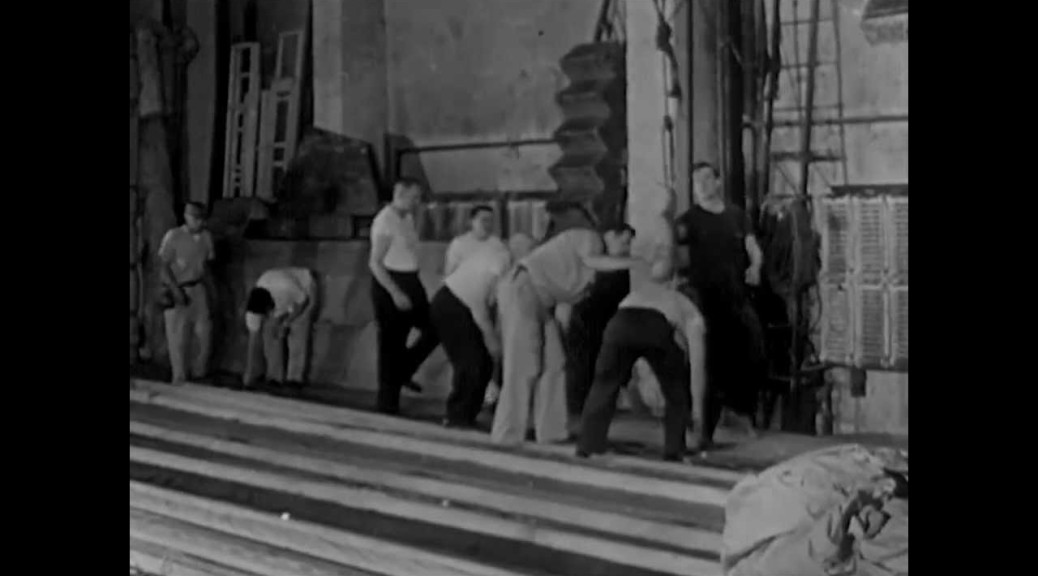
In the Spring of the year the scenery of plays that have failed in New York in the course of the Winter and the season which draws to a close may be found accumulated in a large storage warehouse far over on the west side of the city, in the locality of Twenty-eighth Street. This has served during many years as the chief mausoleum of the remains of these failures. The expenses of the interment include cartage at $5 a load, handling by the warehouse employes at $2 a load, and storage at $4 a load monthly. The acceptance states that settlement must be made quarterly, and that all goods held in arrears in payment twelve months will be seized and sold at auction. There is also the little bill for insurance which many an owner contracts with the fond hope that something may happen in the fire line before the year’s end.

In addition to this large place of storage there are a couple of rambling old stables on Thirteenth Street, east of First Avenue where much scenery that in the last half dozen years cost a snug fortune reposes in solid stacks awaiting the last judgement. In a small room of a neighboring scene painter are the models on view of the handsome interiors and exteriors piled away. Now and then somebody, harboring the notion of producing a play for trial at a nominal expense, drops in to examine this second-hand stock. Nothing results, however, satisfactory to any one concerned. The scenery representing picturesque mountain retreats and grottoes, on view once in a great spectacle, is a misfit for a domestic drama or a comedy. The nine scenes of a melodrama that sunk $6,500 are also of no use in the play, which requires new features up to date.

Mention should be made of the fact, though, that since the stock companies became more or less prosperous in and around New York, some small opportunity has come in sight to unload the scenery in storage. But such interest as there can be for the general reader in this statement must be stimulated by calling attention to the absurd difference between the cost of the scenery and its selling price. The manager, for instance, of two stock theatres in Brooklyn purchased not very long ago from a well-known player, who has given up being his own manager, five loads of scenery, nearly all new, and representing a cash outlay of almost $4,000, for $75. The cost of transportation across the bridge was $25 additional. There were seven wall-drops included in these loads, any one of which cost more originally than the whole purchase at second hand.

Originally published in The New York Times, June 7, 1903.
Memories of Shows Past, 1904

The following is the conclusion of a newspaper article about the property shop of E. L. Morse on Twenty-ninth Street in New York City. The article first appeared in The New York Times on May 8, 1904, and Mr. Morse’s property shop is long gone. I have previously posted the introduction, a bit on Morse’s career, a story of a fake fish he built,  all the skills a prop maker must possess, making things from papier mache, and dealing with people who don’t know what they want.

The old property master is thoroughly happy in his dusty den. He stays there from early morning till dusk. He likes the room so much that he brings his lunch with him to avoid going out for it. It is evident, after a moment’s talk with him, that his is not living and working at his trade every day merely for the shekels that may come to him.

Every object in the dingy place brings back the memory of some man or playhouse formerly dear to him. He hates to throw away anything that has been put on the stage and has come back to him. It is not so much that he made as it is that So-and-So wore or handled it.

The visitor to his shop some rainy afternoon will find a unique sort of gathering. Of the ten or a dozen men sitting around on old couches, chairs, or boxes, not one but is a stage carpenter, property maker, or in some way connected with the behind-the-scenes phase of the theatrical business.

They all know Morse, and they have come to chat with him. Most of them are as old and experienced as he is, and consequently they have a sort of reverence for him. They talk of theatrical affairs from fifty years ago up to the present day. They argue over whether a stage that was torn down thirty years ago had one trap door or two, whether it was 35 or 40 feet broad. Their hands linger fondly over scroll saws and other implements, and they never leave at nightfall without heaving a sigh that the hours have passed so quickly.

It is their greatest joy—this discussion of their trade and of the good old days. And there is nowhere they would rather go for their gossip than to the half-hidden shop labeled “E. L. Morse, Theatrical Properties.”

This article first appeared in the New York Times, May 8, 1904.

Morse can make anything if you know what you want, 1904

The following is a continuation of a newspaper article about the property shop of E. L. Morse on Twenty-ninth Street in New York City. The article first appeared in The New York Times on May 8, 1904, and Mr. Morse’s property shop is long gone. I have previously posted the introduction, a bit on Morse’s career, a story of a fake fish he built,  all the skills a prop maker must possess, and making things from papier mache.

Even the manufacture of an automobile does not frighten the veteran property master. He has one tied to his ceiling. To be sure it is not a real auto with a real chauffeur and real gasoline motive power, but it looks enough like it. It is entirely of wood, wheels and all. It is constructed so that a man can sit inside, invisible, working a treadle, and making the wheels go round. The chauffeur is not alive—only a dummy. His hand stays on the lever and his head is occasionally turned by a wire worked by the man on the inside.

“I don’t want the thing,” says the old maker. “The man who ordered it owes $50 on it, and the sooner he brings the cash and takes his auto away the better I’ll like it.”

“Speaking of people ordering things,” he continues, “you don’t know what a crazy man is until you see some fool vaudeville manager come here and try to get me to make things for him.

“He hasn’t the slightest idea of how anything’s made, and he couldn’t draw a straight line or cut the peeling off an apple. But he’s seen a picture in some Sunday paper and takes a notion he would like to have something like it for a show. He comes in and tries to tell me what he wants. All he can do is to wave his hands about and say: ‘Well, you know what I want.’ Of course I don’t know, and I generally end by letting the man know I think he’s crazy—which he is. Then he leaves, thinking I’m a hopeless fool because I can’t make what he wants. And he doesn’t even know what it is!”

This article first appeared in the New York Times, May 8, 1904.