
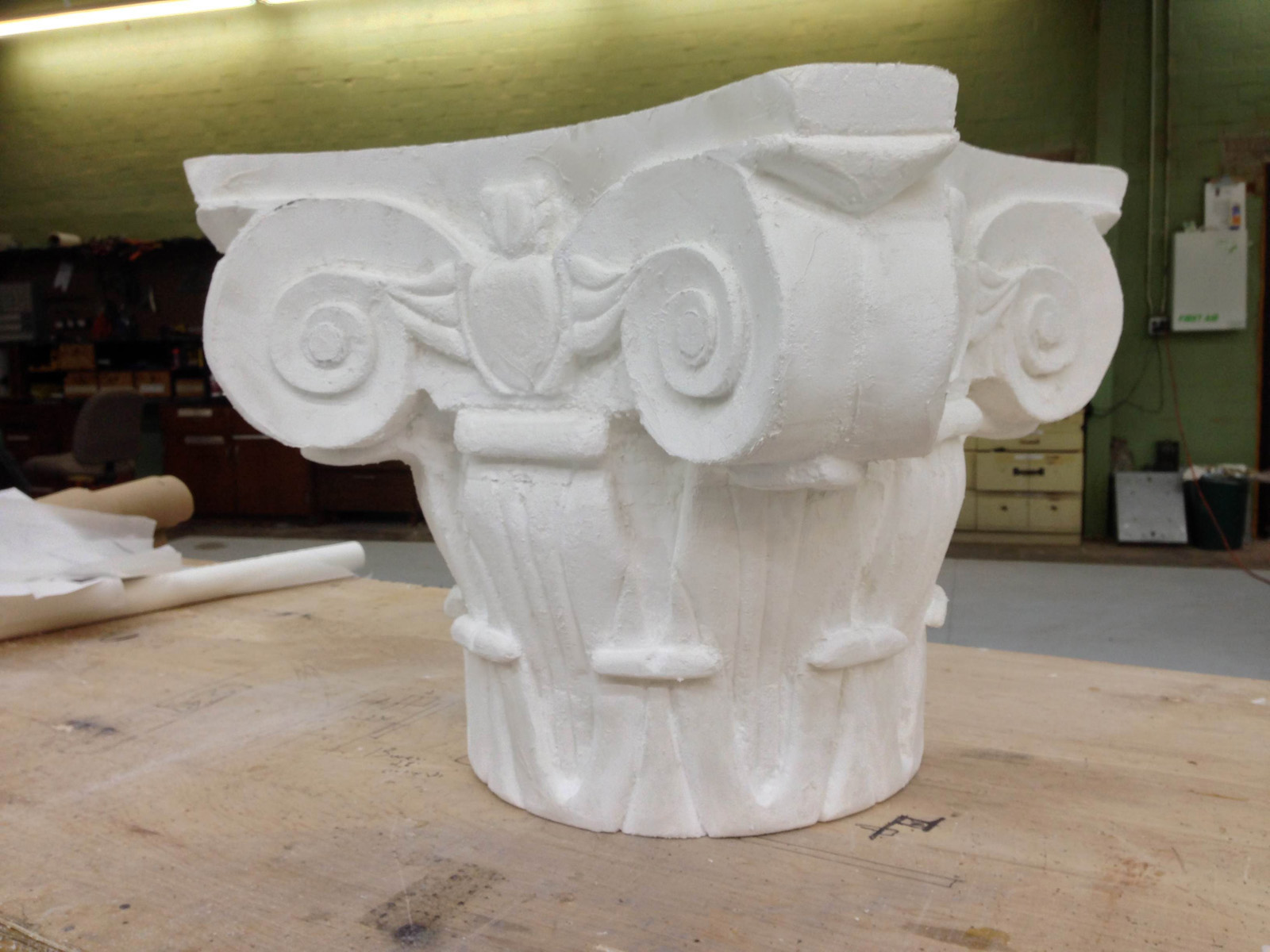
A Capital Idea

Last week I got a call from Triad Stage, a theatre over in Greensboro, NC, to do some carving for the scene shop. I had done some foam carving in the props shop last autumn, and when another project came up, they thought of me.
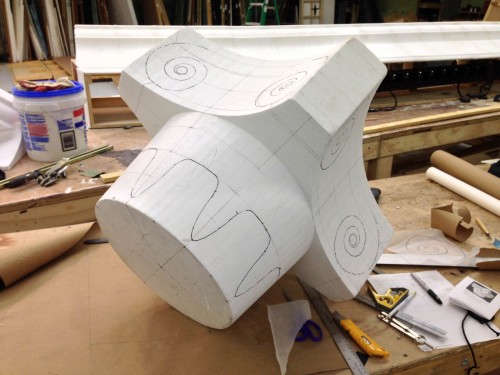
Layout on the blank
Layout on the blank

They already had a blank cut to size when I arrived at the shop. This blank was cut by the foam manufacturer, and was made of two pieces glued together (it looked like they used a 2-part polyurethane foam, or even just Gorilla Glue as the adhesive). This helped immensely in getting me started, since the piece was already symmetrical and scaled to the size they wanted. I started by dividing the piece into equal pie shapes and transferring the design from the research onto the foam.
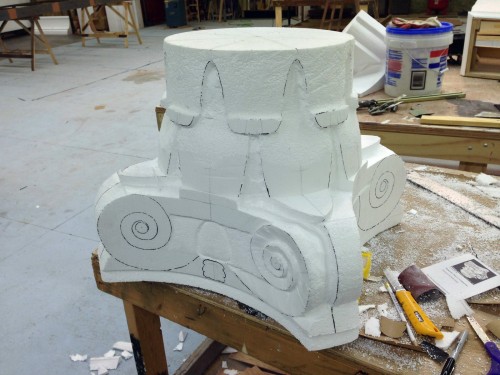
Beginning the carving

The foam they gave me was a 3 lb EPS foam, which was a lot denser than anything I had ever used before. Basically, EPS foam comes in a variety of densities, with 1 lb, 2 lb and 3 lb being the most common. The numbers come from the weight of one cubic foot of foam. So 3lb foam has three times as much polystyrene packed into the same area as 1 lb foam. Of course, EPS is the beaded foam, so it is still trickier to get a smooth surface than it is with either blue or pink foam, but those are not readily available in large blocks like this.
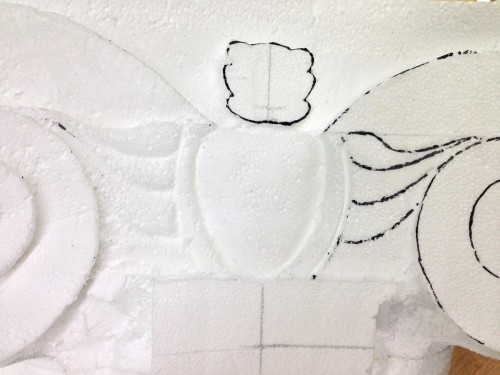
Adding details
Adding details

The designs on this style of classical capital are very symmetrical and repetitive, so I really only had to draw out one half of one side, and then just trace and transfer it to the other seven halves. I carved the whole thing mainly with my snap-blade knife, surform, sandpaper, and a big ol’ half-round bastard rasp. I broke out a router a couple of times to clear out some of the deep pockets; the router also helped me cut to a consistent depth around the whole piece.
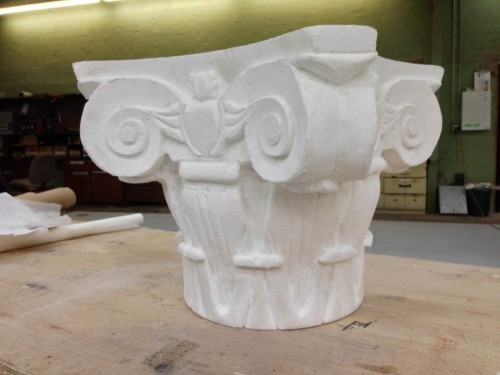
Coated
Coated

Since the capital was being placed on a column high above the set and was not going to move or be handled during the show, I opted for a simple coating of joint compound to keep the cost and time down. I basically applied just enough to give it a smooth coating and a nicer surface for paint.
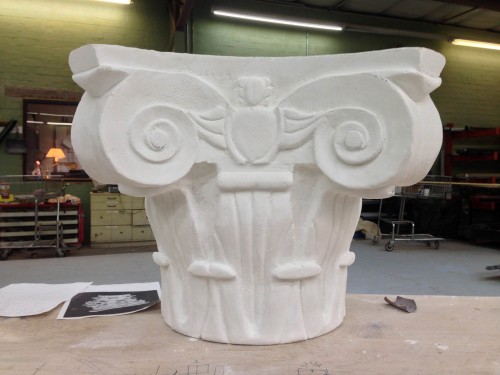
Finished capital
Finished capital

The design on this capital was greatly simplified to allow it to be carved in about half a week. Because it was going to be painted black and be placed high above the set in the shadows, it just needed to hit the high points of the shape so the audience would go “oh, there’s a fancy thing up there.” Or at least, that’s what the audience in my head says after the show.


How much does a prop maker earn (US Bureau of Labor edition)

Beginner prop makers often want to know how much money a prop maker earns. Even experienced prop makers want to know, just to compare their earnings to what is typical in the industry. These numbers are hard to come by because of the range of ways a prop maker can earn money, the vast variety of industries a prop maker can work in, and the wide spectrum in expertise of prop makers (a beginner prop maker who constructs apple crates is probably making a far different wage than a veteran who machines intricate aluminum mechanisms). Still, we have to start somewhere.

One of the best resources to learn about typical wages and contracts is from Sandra Strawn’s Properties Directors’ Handbook. She collected survey data from many of the regional and educational theatres around the United States. Another organization which collects a lot of data on employment and wages is the US government. This is what we are looking at in today’s post.

The United States Bureau of Labor keeps statistics on National Industry-Specific Occupational Employment and Wage Estimates. Now, they do not list “prop maker” as an occupation, so we have to look at a few related and similar fields to hone in on what a US prop maker might be making. I’ve pulled some numbers from their most recent report, which was May 2012[ref]http://www.bls.gov/oes/current/oes_nat.htm, May 2012 National Occupational Employment and Wage Estimates, United States, accessed April 1, 2013.[/ref].

First, a couple of caveats. The major one is that this data does not include self-employed workers. According to the IRS, if you get paid with a 1099, even if it is in a situation where you are “employed” by a company, they consider you self-employed. Many prop makers earn some or even all of their income in this way, so it really skews the data. I’ve found that it is the smaller and lower-paying gigs that will often pay you with a 1099 (not always true, but true more often than not), so these numbers are probably higher than what most prop makers earn.

As another caveat, if you look at the data yourself, you will find “annual mean wages” listed that make it seem like these workers are raking it in. However, these annual wages are calculated by multiplying the hourly wage by a typical “full-time” schedule, and do not reflect what someone actually earns in a year. Most prop makers do not work full-time every year, and even so-called “full-time” jobs at regional theatres are actually seasonal contracts ranging from 28-42 weeks per year. I’ve always found that the hourly wages offered me were well above minimum wage, but it is very difficult to string together enough jobs and gigs to work full-time year-round.

For the table, I looked at two categories: “Theatre Companies and Dinner Theatres”, and “Motion Picture and Video Exhibition”. Neither category has a “prop maker” listing, so I chose the occupation titles which I thought a prop maker would likely be categorized under. For Theatre Companies, those categories were “craft artists” and “fine artists”, while in Motion Pictures, I chose “fine artists” and “artists and related workers, all others”. Feel free to explore the data on your own and look at other industries or occupations; I am not presenting this information as the definitive guide to prop makers’ wages, but rather as my own personal best guess of what might be the wages of some prop makers.

Occupation Title   Employment   Median hourly wage   Mean hourly wage
                Theatre Companies and Dinner Theatres
Craft Artists        230             18.89                18.86
Fine Artists         100             19.03                20.67
                 Motion Picture and Video Exhibition
Fine Artists        2400             27.10                30.45
All Others           390             33.89                33.86

Despite all of my caveats and excuses, these numbers do tell us a few things. First, that the movies employ far more people than theatre. Second, that similar occupations are making around one-and-a-half times as much in movies than in theatre, at least on an hourly basis.

Another possible surprise is the small number of full-time occupations in theatre. The 330 combined craft artists and fine artists would likely include not just the people in the props shop, but also the costume shop and paints departments. That’s a tiny amount of people. Remember, though that these numbers do not include self-employed workers, of which there are many. Also, in larger markets and commercial theatre, many prop makers would be working for independent shops and studios, rather than theatre companies.


Good Links for a Good Friday

Tested has another great episode of their talk show where Adam Savage, Will Smith and Norm Chan discuss building an inexpensive toolkit for beginner makers. By “maker”, they mean someone doing small-scale fabrication of wood, various metals and plastics, some fabric and leather, model-making, and a bit of electronics, so really, it’s great advice for beginning prop makers as well. You can either watch a video or listen to a podcast of the show, which runs about 41 minutes long. They have also written down the list of tools they suggest, though it’s a good idea to listen to the show because they talk about how to buy tools and why you should get certain tools as well.

In case you missed it, I came across The Painters Journal, a publication about scenic art that ran from 2003-2010. All 22 issues are available online to read. Scenic art deals with paints, coatings, texture and sometimes even sculpting, so many of the articles are invaluable to props people as well.

Make Magazine has posted ten tips for using a circular saw. They’re all pretty good, though I would add that hearing protection should be worn too, as circ saws are almost always loud little beasts. A dust mask is usually a good idea as well.

I liked this recent article about Nick Ruiz, a theatre carpenter in the San Jose area. It’s simple and probably familiar to a lot of us in the industry, but stories like this are so rarely written.

And just a reminder that you have less than a month to enter the Prop Building Guidebook Contest! Surely you have a photograph of a prop you’ve built, and who doesn’t want a grab-bag of prop making supplies? The entries I’ve received so far look fantastic, so thanks to everyone who has already submitted.

James Bakkom: Getting Lost in My Own Art

Those at USITT may have seen a video playing on James Bakkom. Bakkom is a Minneapolis-based artist who has worked as an art director on over 500 productions, as well as a set designer around the country. He was also the props master at the Guthrie Theatre in the sixties and seventies. I heard a lot of props people raving over the short documentary about Bakkom that was screening at the conference, and it turns out it is online. So if you missed it, or couldn’t make it to the conference, check it out. It is a half hour long, so make some popcorn, shut the door, and tell everyone in the shop not to bother you because you are “doing Internet research”.

Update (4/08/13): The full version of the film has been taken down, so here is the official trailer instead. You can buy a DVD of the film at the website of Mark Wojahn, the filmmaker.

USITT 2013 Wrap-Up

This past week was the 53rd USITT conference in Milwaukee. This year’s conference featured a lot of things for props people. I couldn’t get to them all, but I saw a lot of them. I took notes which I may go through later, but since I’m writing this on the flight home (and have to work first thing in the morning), I’ll just give the highlights.

First off, there was the Expo floor, filled with companies, organizations and universities peddling their wares. Wonderflex World had plenty of samples of their products, including a sneak peek of a new product coming out soon that is pretty exciting.

Smooth-On had their usual cool booth with all the rubber monsters and foam cinder blocks you can make with their products. There’s a possibility I may start getting samples of their new products to test out for this blog. That would be neat.

StageBitz had demos of their props management and inventory software. I first tested them out about two years ago, and it’s almost completely different now (in a good way). You can do a 3-week free trial of their software from their website, which is really the only way to start discovering how easy and seamless this can make propping a show, from letting the designer share images and research with you, to letting you send the designer pictures of items in your stock, to keeping up with changes in rehearsal, creating to-do lists to send to your artisans and shoppers, maintaining a budget, to finally adding all the props to your stock when the show closes.

RC4 Wireless Dimming had tiny wireless dimmers. It sounds simple, but it’s amazing how these little devices act so seamlessly to let you control any sort of battery-powered light or motor from your theatre’s lighting console. I also attended a session called “Wireless Light and Motion for Propmasters”, where a couple theatres were showing off various ways they used the RC4 units.

One of the last sessions of the conference was on sustainability in design and production led by Donyale Werle. It included the exciting unveiling of the College Green Captain Toolkit, based off of the already-successful program which every Broadway show participates in (I’ll post a link when it appears, or you can contact the Broadway Green Alliance for more information). Jacob Coakley from Stage Directions Magazine live-blogged much of the session.

An earlier session on “Reimagining Theatre with Green Ideals” also featured information about sustainability and the Broadway Green Alliance. Once again, Jacob Coakley live-blogged the whole discussion.

“Grave Matters” was a session with a lot of good tips and tricks for making gore and corpses. One of the speakers, Gary Benson, has his presentation online , including step-by-step photographs of how he made some skulls.

“You’ll Shoot Your Eye Out” was a bit disappointing since 3 of the 4 presenters could not be there. However, you can check out the handouts on firearm safety that they had. You will also find a link for a survey they are running to discover how various theatres deal with guns on stage (and off). I’m not sure how long that link will last, so you should download those files rather than bookmarking them.

I got to check out the Young Designer’s Forum, which had some great work. I was also able to meet two of my future coworkers this summer at the Santa Fe Opera.

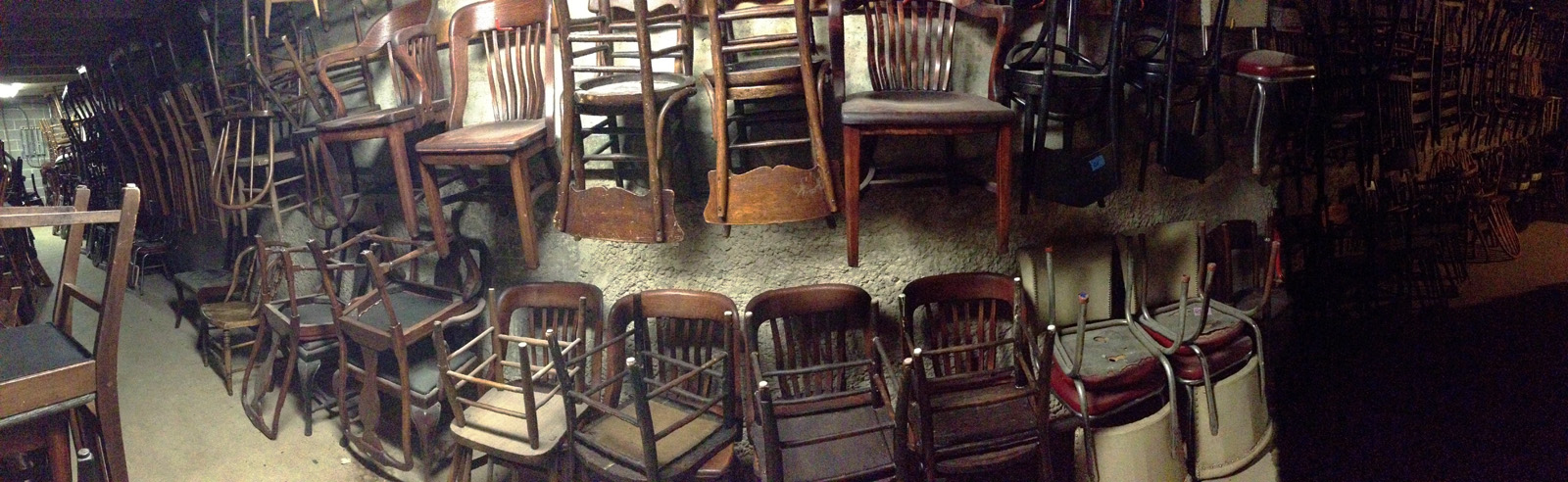
The Milwaukee Rep props shop hosted a SPAM get-together at their space, though it was nice to see plenty of non-SPAM props masters and prop makers there as well. I wrote about their shop for Stage Directions this month, but to actually see their work space and storage facilities in person was a great treat.

Chairs as far as the eye can see.

Oh yeah, I also sold out of my book by the end of my signing. The response has been overwhelming so far. I am ecstatic that so many people are excited about this book, and I can’t wait to hear back from those of you who use it or teach from it.

Did I forget anything about the conference? Was there something I missed? Let me know in the comments what you saw at USITT that excited you.

Making and finding props for theatre, film, and hobbies