Just a reminder that today at 2pm (EST), I’ll be taking part in a live chat interview at TheatreFace. Come join in the fun if you want to ask me a question.
I also have a fun new project I’ve been working on, and I might be posting photographs of it as early as next week, so stay tuned. Until then, here’s a fresh roundup of links for you to explore.
You know that Smooth-On has a plethora of videos and tutorials on their website, right? Well now, they also have a Mold-makers Exchange, where you can buy or sell molds and casts, or advertise your mold-making services. It’s like a Classifieds for all things moldmaking (or a “Craigslist” as the youngsters (and I) say). It’s very sparse at the moment, which is why I’m getting the word out about it.
The Library of Congress has a YouTube. With nearly 600 videos from their archives, there is a wealth of historical material available for free viewing. Many of these videos are great for research on the early twentieth century and thereabouts.
Erich Friend runs a Theatre Safety blog. Though focused more on theatre planning and operations, some of the information (I’m looking at you, hidden fire extinguishers) is relevant to props shops.
And finally, Volpin Props has made an awesome M8 Avenger Assault Rifle out of scrap materials he had sitting around in his shop.
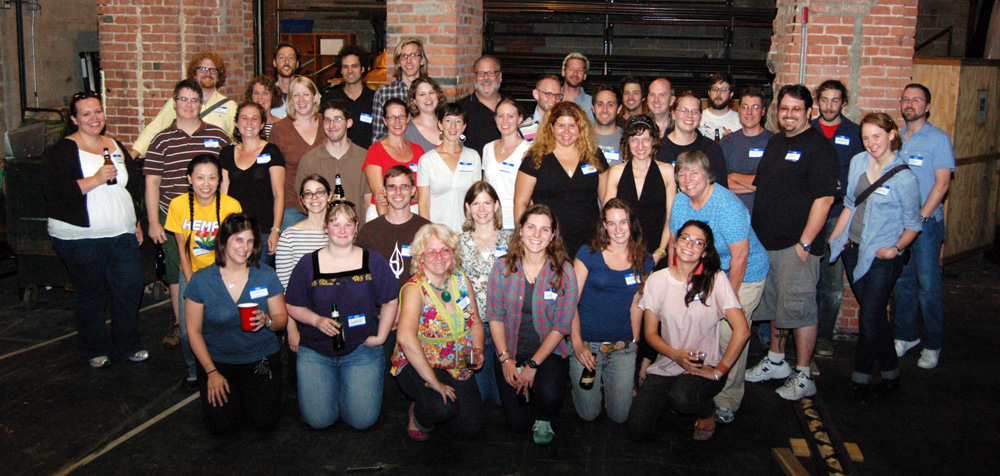
This year’s props summit was a rousing success. With over forty people in attendance, we more than doubled the attendance from last year. Upon entering, one person exclaimed, “I didn’t know there were so many props people!” In fact, if you look at the picture from the first props summit, you’ll notice quite a few people who were unable to make it back this year; there are also some who were invited but too busy to make it to either summit so far. In other words, this summit still has the chance of growing in attendance.
Attendees at the 2010 NYC Props Summit
Though this event was focused around New York City, we had folks come from Long Island, New Jersey, Connecticut, and even Boston! The great thing about this event is that all types of props people attended: prop masters, both full-time and freelance, carpenters, artisans, and every combination in-between. What’s great about getting to know your friendly neighborhood props people is that it lets you know you are not alone, and other people are going through the same things as you, and you’re probably not crazy (or we’re all crazy, and getting together just deludes us to that fact). It also helps you out when you’re in a bind; if you can’t find that one strange prop, or you need someone who can sew leather, or you have a great prop left over from a show but no place to store it, these are the people who can help you out.
Whenever a large-enough group of new people arrived, we would go around the circle and introduce ourselves, which led to stories being swapped. Later in the evening, Jay led everyone in a rousing reading of Ron DeMarco’s “Resolutions”. Ron teaches props at Emerson College, and tried to find the perfect script for his students to develop a props list from. Unable to locate such a script, he wrote his own; “Resolutions”, though only four pages long, contains many of the typical prop challenges and questions, and quite a few conundrums as well. Most of the time, though, was spent in simple drinking, eating, mingling and chatting.
I would list everyone who attended, but I’m afraid I might leave someone out. My only regret was that I was unable to speak with everyone there, particularly those I haven’t met yet. If you are interested in attending next year’s summit (or sooner, though it took us a whole year before we had this one), drop me a line.
Theatrical Design and Production, sixth edition, by Michael Gillette
I’ve decided to incorporate some book reviews into my blog. Books about props are few and far between, so these won’t be fresh reviews of books hot off the press. I will, however, start with one of the newer books. If I ever actually convince you to purchase a book from Amazon, keep in mind that by using the links in my post, I will get a small kickback from them. The price you pay will be the same, but my happiness will be higher, and isn’t that what really matters?
The Sixth Edition of Theatrical Design and Production, by Michael Gillette was published in 2008. Gillette, a retired professor at the University of Arizona, first published this seminal textbook in 1987. Though pricey (it is a textbook, after all), it has not become the go-to text for stagecraft without earning it.
My examination of it will focus solely on the prop-specific parts, though the book does cover all aspects of technical theatre. It is important to note I am looking at the sixth edition; this version has seen a substantial reworking of the properties chapter through input by Sandra Strawn in particular, and the members of S*P*A*M in general. This gives the book more authority out of any other available books on how many prop shops in American regional and educational theatres are run. Between this and Strawn’s own “Properties Directors Handbook“, you get a good sense of the “standard practices.” This chapter does well as a guide for a college class, either as a section on props in a general stagecraft class, or as a springboard for developing an entire syllabus.
The first half of the chapter deals with the process and organization of propping a show. Most prop books deal mainly with the craft side; Gillette takes the reader through the whole process step-by-step, from the moment you find out what show you are propping, through initial prop lists and planning meetings, on to rehearsals and tech, and into the opening and running of the show, ending finally with strike. Other than Amy Mussman’s The Prop Master and Strawn’s Handbook, few books lay out the process in such a clear fashion, and none have the advantage of incorporating the experience of prop directors from many of our major regional theatres.
The second half focuses on prop craft. Prop furniture construction shows four apparently common wood joints: open and closed dowel, pocket hole, and biscuit. I personally love the pocket hole; the biscuit is indispensable for long end joints, and open doweling is great for repair work, particularly on chairs. I’d like to add to his definition of a jig: “A device used [to] hold pieces together in proper positional relationship.” “Pieces” can mean either the various pieces of material you are using, or it can mean the tools and the material. In other words, a jig can also be used as a guide to keep the tool in a proper positional relationship with the material.
The section on upholstering and drapery is very informative and makes a nice comprehensive introduction to the subject. The remaining section on “crafts” seems to deal mainly with the most toxic and least environmentally-friendly materials and processes one can use in props. There is an interesting mini-tutorial on using spray urethane foam (eg, Great Stuff) to make rigid molds. Though clever, I’ve found spray foam to be finicky to work with. Great Stuff has a Threshold Limit Value of .005, making it 4,000 times more toxic than turpentine, and 100,000 times more toxic than acetone. Likewise, using heat to shape plastic, or working with fiberglass, requires much more attention to safety than Gillette implies, though to be fair, he does implore the reader to seek out proper safety procedures on their own.
Back to the review. Information of interest to the props person can be found in other chapters of the book as well. Chapter 10 has a good introduction to the types of hand tools, power tools, and construction materials found in prop shops and scene shops. With a 2008 publication date, these are probably the most up-to-date descriptions of building materials available to the theatre-maker today, including all the synthetic and engineered products that are so difficult to keep track of. This chapter is also a better source for the safety information that is not included in the chapter on properties, with the assumption being that you would read this chapter first.
The section on fasteners, glues, construction hardware and stage hardware, though not as comprehensive as The Backstage Handbook, is more descriptive, and its use comes in describing the most commonly-used items, rather that every possible iteration. The section on safety equipment is so brief it feels like an afterthought, and does nothing to address the most common areas of concern for a beginner: the difference between impact and chemical-splash goggles, the various types of respirators, and choosing the right kind of glove for working with chemicals. Using this book for a class would certainly require supplementing it with a text like The Health & Safety Guide for Film, TV & Theater by the tireless Monona Rossol. Learning how to create props without the proper safety precautions is like learning how to drive without learning to use turn signals, checking your mirrors, wearing your seat belt, or reading road signs.
Chapter 11 on scenic production techniques is also useful information for the props artisan. Though we seldom build flats, the techniques used in building flats come in handy for prop carpentry projects. Likewise, the book does a wonderful job of describing welding, soldering, and making construction drawings as well. I particularly relished the section on stressed-skin platforms and look forward to trying some of the techniques in future prop-making.
Gillette also touches on building rocks, trees, and creating objects out of foam, all necessary skills for the well-rounded props artisan. He’s a little incorrect in some of his definitions though. STYROFOAMâ„¢ Brand Foam is a registered trademark of the Dow Chemical Company for their extruded polystyrene foam, not expanded as Gillette writes. It is usually sold in blue sheets for insulating buildings and is indeed fire resistant. Different types of Styrofoam insulation can be pink or even white, though still fire resistant. Dow also makes Styrofoam in white and green for the craft and floral market, but I could not discern the fire resistance of these kinds. Disposable foam products, like foam cups, coolers or packaging materials, are not made by Dow, hence not STYROFOAMâ„¢ Brand Foam. These are usually made out of expanded polystyrene beads, and is often referred to as “bead foam”. This is what Gillette is talking about when he refers to the course texture left from cutting through foam, or the “foam sawdust” from sawing. You can also by bead foam in large sheets similar to Styrofoam. Though both expanded and extruded polystyrene are generically referred to as “Styrofoam” here in the US, it is important to note that bead foam (expanded polystyrene) is not fire-resistant and can not be used untreated or left exposes on the theatrical stage. The multitude of plastics and synthetic materials available to today’s prop maker is confusing enough without a book as commonly used as Gillette’s muddying up the next generation with erroneous information.
The chapter on scene painting (chapter 12) is also useful for a props artisan, particularly the section on texturing. The chapter on electrical theory and practice (chapter 15), though interesting on its own, does not deal much with the kind of wiring a props person may need to do. Chapter 19 (costume construction) is notable in that it describes many of the same tools, materials and techniques necessary for soft goods work, such as curtains and drapes, Likewise, the information on millinery, costume crafts and masks is very applicable to the crafting of three-dimensional prop pieces, and may be incorporated into a lesson or class on props.
Though I’ve pointed out a few shortcomings and errors in this book, let me reiterate what an incredible resource Gillette has created in the latest edition of his book. As I said at the beginning, the chapter on props can easily become the outline for an entire class.
First, this Friday will be our second NYC Props Summit. Our hope is for props professionals, both artisans and masters, to get together for an evening of fun and networking. Our first Props Summit was quite a success. If you wish to join in, drop me a line and I can give you further details.
Second, every week, Jacob Coakley hosts a live internet chat on the TheatreFace network. Next week, Wednesday, September 1, he will be talking with none other than Eric Hart, the person who is writing this sentence right now. Be sure to check it out from 2pm-3pm EST, and let me know if you’re having trouble joining the site.
By now you should know about This to That, a great tool for finding out what glue to use. Well, Beacon Adhesives, makers of such prop-friendly glues as Magna-Tac and Fabri-Tac, have their own Adhesive Selection Chart.
I know I just did a post on knots, but I had to show off this hot knot diagram. It’s from a site I just discovered called Low-tech Magazine, which “refuses to assume that every problem has a high-tech solution”. How very apropos for those of us in the world of ever-shrinking prop budgets.
Dug North has started compiling a great big list of Automaton plans in one single page. Some are even free!

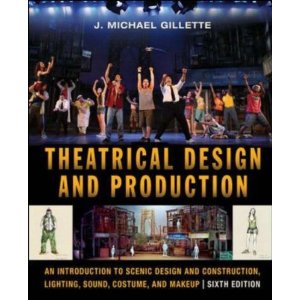
 was published in 2008. Gillette, a retired professor at the University of Arizona, first published this seminal textbook in 1987. Though pricey (it is a textbook, after all), it has not become the go-to text for stagecraft without earning it.
 and Strawn’s Handbook, few books lay out the process in such a clear fashion, and none have the advantage of incorporating the experience of prop directors from many of our major regional theatres.
 , is more descriptive, and its use comes in describing the most commonly-used items, rather that every possible iteration. The section on safety equipment is so brief it feels like an afterthought, and does nothing to address the most common areas of concern for a beginner: the difference between impact and chemical-splash goggles, the various types of respirators, and
  by the tireless Monona Rossol. Learning how to create props without the proper safety precautions is like learning how to drive without learning to use turn signals, checking your mirrors, wearing your seat belt, or reading road signs.